Midwest
SEE IT: Suspected drunken driver’s wrong-way head-on crash caught on deputy’s dashboard camera

NEWYou can now listen to Fox News articles!
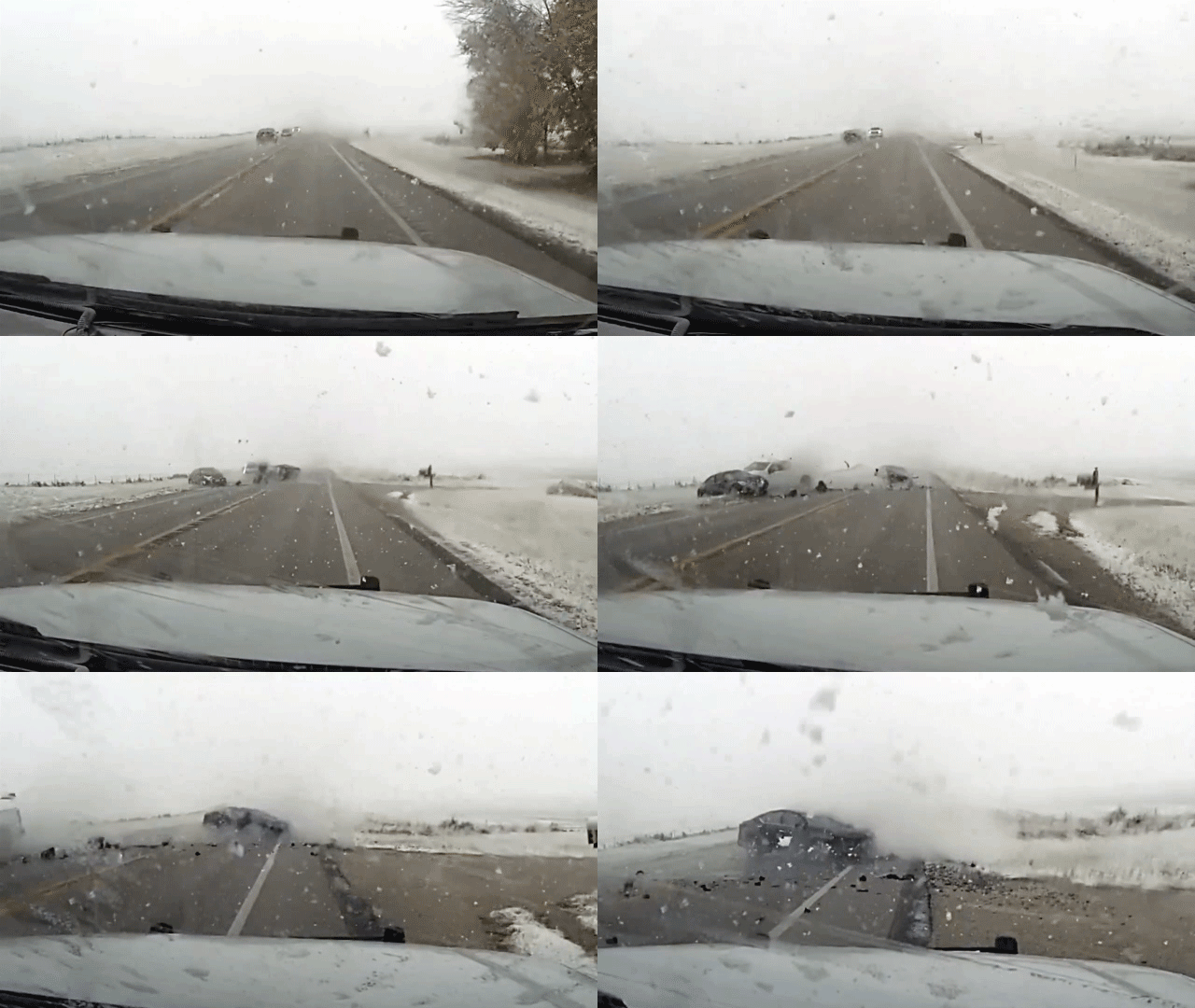
Dramatic dashcam footage shows a suspected drunken driver slam a vehicle head-on into another car on a highway south of Story City, Iowa, after failing to stop for a deputy, leaving three vehicles wrecked but no one seriously hurt.
The Story County Sheriff’s Office said on social media that a deputy patrolling Highway 69 on Nov. 8 spotted a vehicle traveling erratically before it crossed into oncoming traffic.
Dashcam video shows the deputy following the vehicle on the wrong side of the road, sirens blaring as he tried to get the driver to stop. The clip captures the cruiser closing in on the car moments before the collision.
FOUR DEAD, AT LEAST 13 INJURED AFTER SPEEDING CAR CRASHES INTO CROWD OUTSIDE FLORIDA BAR
A sheriff’s deputy’s dashcam captures the suspected drunken driver traveling on the wrong side of Highway 69 moments before a head-on collision near Story City, Iowa, Nov. 8, 2025. No major injuries were reported. (Story County Sheriff’s Office)
About 13 seconds later, the vehicle crashed head-on into a sedan, then hit a pickup truck that was pushed into the first car. The impact scattered debris across the highway and left the roadway littered with glass, twisted metal and personal items.
The sheriff’s office said the deputy immediately stopped to render aid. Body camera footage shows him first approaching the vehicle that caused the crash, opening the rear driver’s-side door where the airbag had filled the back seat. He then checked the other two cars, where some occupants were already outside.
TEEN DRIVER CHARGED WITH KILLING THREE UNIVERSITY OF ARIZONA STUDENTS IN PORSCHE HIT-AND-RUN CROSSWALK CRASH
Body camera footage shows a Story County deputy checking vehicles involved in a three-car crash Nov. 8 south of Story City, Iowa. Officials say the deputy immediately rendered aid after the crash. (Story County Sheriff’s Office)
“Thankfully, no major injuries were reported,” the sheriff’s office wrote, adding that the crash was preventable and urging drivers never to get behind the wheel while impaired.
FLORIDA SERIAL OFFENDER ACCUSED OF DRAGGING BICYCLIST TO DEATH IN HIT-AND-RUN
Body camera footage shows a Story County deputy checking vehicles involved in a three-car crash south of Story City, Iowa. Officials say the deputy immediately rendered aid after the crash. (Story County Sheriff’s Office)
The driver was arrested and charged with first-offense operating while intoxicated, driving on the wrong side of a two-way highway and failing to yield to an emergency vehicle.
CLICK HERE TO DOWNLOAD THE FOX NEWS APP
The sheriff’s office said the crash serves as a reminder of how quickly impaired or distracted driving can turn dangerous. The investigation is ongoing.
Read the full article from Here



Manuel Franco claims his $768 million Powerball jackpot
Manuel Franco, 24, of West Allis was revealed Tuesday as the winner of the $768.4 million Powerball jackpot.
Mark Hoffman, Milwaukee Journal Sentinel
The Wisconsin Lottery offers multiple draw games for those aiming to win big.
Here’s a look at July 15, 2026, results for each game:
Winning Powerball numbers from July 15 drawing
02-07-18-29-38, Powerball: 16, Power Play: 2
Check Powerball payouts and previous drawings here.
Winning Pick 3 numbers from July 15 drawing
Midday: 0-6-9
Evening: 8-6-6
Check Pick 3 payouts and previous drawings here.
Winning Pick 4 numbers from July 15 drawing
Midday: 9-3-8-0
Evening: 4-5-2-7
Check Pick 4 payouts and previous drawings here.
Winning All or Nothing numbers from July 15 drawing
Midday: 01-04-05-07-09-11-12-17-18-21-22
Evening: 05-06-10-11-12-13-14-16-17-19-21
Check All or Nothing payouts and previous drawings here.
Winning Badger 5 numbers from July 15 drawing
05-06-23-28-31
Check Badger 5 payouts and previous drawings here.
Winning SuperCash numbers from July 15 drawing
04-08-15-16-21-33, Doubler: N
Check SuperCash payouts and previous drawings here.
Winning Megabucks numbers from July 15 drawing
10-19-25-31-37-40
Check Megabucks payouts and previous drawings here.
Feeling lucky? Explore the latest lottery news & results
Are you a winner? Here’s how to claim your lottery prize
- Prizes up to $599: Can be claimed at any Wisconsin Lottery retailer.
- Prizes from $600 to $199,999: Can be claimed in person at a Lottery Office. By mail, send the signed ticket and a completed claim form available on the Wisconsin Lottery claim page to: Prizes, PO Box 777 Madison, WI 53774.
- Prizes of $200,000 or more: Must be claimed in person at the Madison Lottery office. Call the Lottery office prior to your visit: 608-261-4916.
Can Wisconsin lottery winners remain anonymous?
No, according to the Wisconsin Lottery. Due to the state’s open records laws, the lottery must, upon request, release the name and city of the winner. Other information about the winner is released only with the winner’s consent.
When are the Wisconsin Lottery drawings held?
- Powerball: 9:59 p.m. CT on Monday, Wednesday, and Saturday.
- Mega Millions: 10:00 p.m. CT on Tuesday and Friday.
- Super Cash: 9:00 p.m. CT daily.
- Pick 3 (Day): 1:30 p.m. CT daily.
- Pick 3 (Evening): 9:00 p.m. CT daily.
- Pick 4 (Day): 1:30 p.m. CT daily.
- Pick 4 (Evening): 9:00 p.m. CT daily.
- All or Nothing (Day): 1:30 p.m. CT daily.
- All or Nothing (Evening): 9 p.m. CT daily.
- Megabucks: 9:00 p.m. CT on Wednesday and Saturday.
- Badger 5: 9:00 p.m. CT daily.
That lucky feeling: Peek at the past week’s winning numbers.
Feeling lucky? WI man wins $768 million Powerball jackpot **
WI Lottery history: Top 10 Powerball and Mega Million jackpots
This results page was generated automatically using information from TinBu and a template written and reviewed by a Wisconsin editor. You can send feedback using this form.

4Warn Weather – The dangerous heat that gripped Metro Detroit Wednesday will ease, but having slightly lower temperatures does not mean that Southeast Michigan is in the clear.
The 4Warn Weather Alert remains in effect Thursday, as a thick plume of wildfire smoke from Canada settles into the region, bringing some of the poorest air quality this season.
While the Heat Advisory was allowed to expire Wednesday evening, the Air Quality Alert continues through Thursday, and for many communities, the smoke will pose the greatest health concern.
Unlike some air quality events driven by ozone or lighter smoke high in the atmosphere, this smoke is expected to settle close to the ground.
The result is unhealthy air pollution for the general population, with some neighborhoods potentially reaching very unhealthy and hazardous levels for a time, especially late Wednesday night through Thursday morning.
A few storms beating the odds Wednesday night
Although most of Southeast Michigan will stay dry Wednesday night, a few isolated thunderstorms developed Wednesday evening along the advancing cold front. Just enough instability developed for a handful of storms to briefly become severe.
The National Weather Service issued Severe Thunderstorm Warnings for portions of Oakland, Genesee and Shiawassee counties, with radar indicating the potential for wind gusts up to 60 mph and hail up to quarter-size.
Quarter-sized hail was reported in Holly at 7:19 p.m.
The Storm Prediction Center noted the overall severe weather threat remained isolated.
Overnight, attention turns back to the arrival of dense Canadian wildfire smoke, which is expected to become the dominant weather story through Thursday.
Smoke thickens late Wednesday night
The cold front opened the door for dense Canadian wildfire smoke to pour into Southeast Michigan on Wednesday.
The thickest smoke is expected overnight into Thursday morning, when cooler temperatures and a stable atmosphere trap the smoke close to the surface.
Visibility may be reduced at times; skies will appear hazy, and many people may notice the smell of smoke even indoors.
Those with asthma, COPD, heart disease, children, older adults, and pregnant women should avoid prolonged outdoor activity.
However, even healthy adults may experience irritated eyes and throats, coughing, headaches, or shortness of breath during periods of heavier smoke.
If possible:
-
Limit strenuous outdoor activity.
-
Keep windows closed.
-
Run your air conditioning on recirculate if available.
-
Change air filters.
-
Consider wearing a properly fitted N95 mask if you must spend extended time outdoors in smoky conditions.
Still hot Thursday
Even though the oppressive humidity backs off behind the front, Thursday will not feel cool.
Afternoon highs climb back into the lower 90s, with “feels like” temperatures generally remaining in the lower 90s as well.
That is noticeably more tolerable than Wednesday’s triple-digit heat indices, but it is still hot enough to require frequent hydration and breaks if you are spending time outside.
The combination of heat and smoky air may make outdoor conditions especially taxing, even if temperatures are not as high.
Rain chances return
Thursday stays dry before moisture begins returning on Friday.
Scattered showers and thunderstorms become possible Friday afternoon and continue at times into Saturday as the next weather system approaches the Great Lakes.
Not everyone will see rain, but several opportunities for showers and thunderstorms develop through the weekend.
By Sunday and early next week, temperatures settle closer to normal with highs generally in the lower to mid-80s, along with periodic chances for additional showers and thunderstorms into Tuesday.
While the cooler weather will be welcome, air quality should also gradually improve as the weather pattern becomes more active and winds help disperse lingering smoke.
The wildfire smoke will lead to more vibrant and redder sunsets and sunrises. Share your weather and nature photos with Local 4 at MIPics.
Copyright 2026 by WDIV ClickOnDetroit – All rights reserved.

MILWAUKEE – The clock is ticking in the fight between ICE and Milwaukee. The federal Department of Justice gave Milwaukee until Friday to respond.
Law enforcement mask ban
The backstory:
In April, Milwaukee passed an ordinance that bans all law enforcement from wearing masks. There are exemptions for health or safety reasons. Those breaking it can face a fine of up to $10,000.
Supporters said it was part of what they called “ICE Out Milwaukee.” It was clear from debate, they were targeting immigration agents.
FREE DOWNLOAD: Get breaking news alerts in the FOX LOCAL Mobile app for iOS or Android
The U.S. DOJ sent the mayor and city attorney a letter on July 10. It says the federal government will not comply. It tells the city to respond by this Friday, July 17, that it will not enforce the ban against federal agents.
One Milwaukee nonprofit leader critical of ICE responded to the situation.
“I look at the federal government’s threats to Milwaukee as analogous to David versus Goliath,” said Emilio De Torre of the Milwaukee Turners at Turner Hall. “David was doing the right thing in the face of of violence and oppression, and Milwaukee’s doing the right thing too. If a person is proud of what they’re doing, if they know that what they’re doing is legal and justified, then they don’t need to be a coward and hide behind a mask.”
U.S. DOJ ultimatum
What we know:
The U.S. Department of Justice letter was signed by an assistant attorney and also Brad Schimel, who leads the U.S. attorney’s office in Eastern Wisconsin.
It says the mask ordinance is unconstitutional by breaking the U.S. Constitution’s supremacy clause.
“This Mask Ban endangers federal officers and undermines federal law enforcement operations,” the letter also states. “The consequences are severe. Protecting the personal identities of federal officers and their families is especially critical in part due to the increasingly common threats of targeted harassment, tracking, interference, and assaults on federal agents for simply doing their jobs.”
SIGN UP TODAY: Get daily headlines, breaking news emails from FOX6 News
Several Milwaukee groups held a vigil and protest against ICE on Wednesday, July 15 in Burnham Park. That included Milwaukee Turners, the Milwaukee teachers’ union and Voces de la Frontera. They are criticizing recent deaths.
Portions of this article were formatted using A.I. FOX6’s Jason Calvi and an editor reviewed it for accuracy and tone prior to publishing.
The Source: Information in this story was gathered from the U.S. Department of Justice, and Emilio De Torre, the Milwaukee Turners, along with Milwaukee’s ordinance on law enforcement masks.
-

 Vermont6 minutes ago
Ben & Jerry’s Foundation says it will shut down amid legal dispute with parent company – VTDigger
-

 Virginia12 minutes ago
Drought emergency declared for parts of Virginia; governor warns of water restrictions
-

 Washington18 minutes ago
Trump fires WA US Attorney within an hour
-

 Wisconsin24 minutes ago
Wisconsin Lottery Powerball, Pick 3 results for July 15, 2026
-

 West Virginia30 minutes ago
Concerned West Virginians speak out against proposed Monongalia County power plant – WV MetroNews
-

 Wyoming36 minutes ago
July 15 recap: Wyoming news you may have missed today
-

 Crypto42 minutes ago
Luno Pushes South Africa to Rewrite Crypto Rules Through Parliament, Not Proclamation
-

 Finance48 minutes ago
SixCap Healthcare Finance Appoints Carroll as Senior Relationship Manager

