Ohio
Ohio GOP infighting stalls marijuana legislation

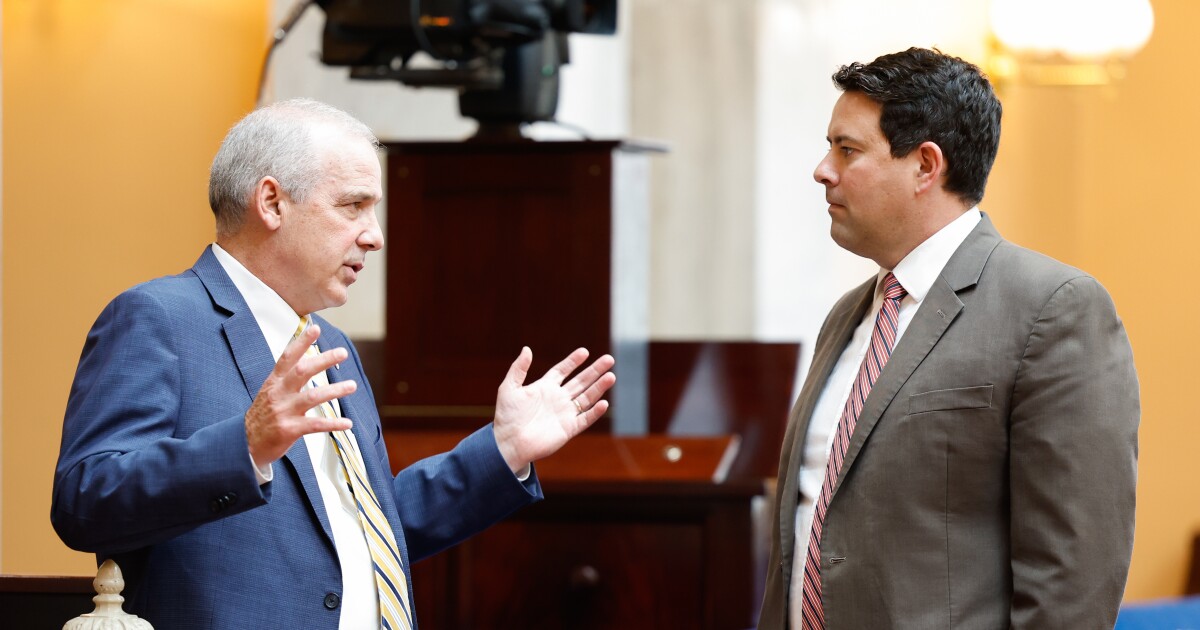
COLUMBUS, Ohio — Ohio House and Senate Republicans had finally agreed on a bill changing the state’s recreational marijuana policy, but hours before the vote was supposed to take place, it was pulled from the schedule.
Voters spoke loud and clear in November of 2023, with 57% of Ohioans voting yes on Issue 2: legalizing recreational marijuana.
“I voted for it,” state Rep. Jamie Callender (R-Concord), the House’s resident cannabis expert.
Callender has been smoking marijuana for decades and has been trying to reduce stigma around the product for just as long.
If you are 21 years old, you can smoke, vape, and ingest marijuana. Individually, you can grow six plants, but you can grow up to 12 plants per household if you live with others.
But since then, other Republican leaders have been trying to change the law.
For the past several months, the House and Senate chambers have been trying to compromise on their separate bills.
I have been covering marijuana policy extensively for years, including a series answering viewer questions about cannabis.
Ohio GOP plans to pass marijuana restrictions by end of June
In short, the Senate’s proposal decreases THC content, reduces home growing from 12 plants to 6, imposes more criminal penalties and takes away tax money from local municipalities that have dispensaries. The House’s latest version had none of those.
Click here for Senate version and here for House version changes.
“The Senate had proposed taking that tax away, and the House has fought really hard to keep that in…” Callender said. “We finally had that negotiated so it would stay in.”
Recently, Callender told me an agreement was reached on following most of the House’s new version, which mainly focused on preventing children from accessing the drug. The bill was set to hit the House floor Wednesday.
But in a turn of events, Republican infighting is preventing the bill from being passed.
“Apparently, the Senate changed their mind,” Callender said.
In a shock to House Speaker Matt Huffman (R-Lima), the Senate pulled out of the compromise.
“I’m pretty disappointed — we’re not going to have it on the floor today,” Huffman said. “To my surprise, there was a whole new set of issues, additional issues, which were raised Monday night by the Senate regarding what we were trying to do.”
It was a Senate push for 16 changes, ones that Huffman didn’t get to even see until the day before the vote was set to take place.
“They wanted to make a mandatory jail sentence for passing a joint between friends,” Callender said, referencing a provision on “sharing.”
The main holdup is the tax money, he added.
The law gives the 10% tax revenue from each marijuana sale to four different venues: 36% to the social equity fund, to help people disproportionately impacted by marijuana-related laws; 36% to host cities — ones that have dispensaries; 25% to the state’s mental health and addiction services department; and 3% to the state’s cannabis control department.
Instead, the Senate wants all the revenue from the tax to be sent to the state’s General Revenue Fund, meaning lawmakers can choose to allocate that money toward whatever they want.
The House, as Callender had mentioned, has a major sticking point with making sure that at least the local municipalities get at least some percentage of the tax revenue.
“What changed in the past 72 hours to pull the Senate out of the marijuana deal?” I asked Senate President Rob McColley (R-Napoleon)
“Well, I wouldn’t say anything has changed; I think the conversations have gone pretty well on it,” McColley responded. “I think, maybe, there was a misunderstanding as to where we might have been on the bill as both chambers.”
The president wants to follow his version of the legislation.
“Our priorities are in the bill that we already passed,” he said.
The teams will work together to actually come to an agreement as soon as possible, he continued.
“I would like to get something done by the end of June; I think [Huffman] would like to get something done by the end of June,” McColley added. “We’ll see if we can get something done in the next week.”
Huffman said he’s “not very optimistic” about that.
“I just told my caucus: ‘We’re not going to just say, “OK,” because we’re so anxious to pass the marijuana bill,’ which I’d like to get it done, but we’re not going to give up house priorities to do that,” the speaker said.
Several hours later, Huffman responded to additional cannabis questions.
“I thought we were on a path, this time last week, to pass it [this week],” the speaker said. “That was the kind of clear indication we had.”
However, when I pointed out to Huffman how McColley denied their agreement, he switched gears.
“There was no agreement to pull out of,” he said.
I asked why he would put a bill on the floor if there wasn’t an agreement.
“We were hoping that there would be, anticipating there would be, sounded like we might have, but it’s not correct to say that there was an agreement that anybody pulled out of,” he said.
However, his cousin and the resident marijuana expert in the opposite chamber, state Sen. Steve Huffman (R-Tipp City), said there was. The senator had been the main negotiating party for that chamber.
“We were in an agreement,” S. Huffman said.
He continued that policy staff and McColley brought “ongoing concerns” to him, but he believes they could be easily fixed. An additional reason why it was pulled is due to drafting issues with the bill language, he added.
“I believe that things are still being worked out, and I have the utmost confidence that we will resolve this by next Wednesday,” the senator said.
Callender isn’t so sure about that.
“Do you believe that the Senate will be going against the will of the voters with all of their requests?” I asked him.
“Yes,” he said.
Callender said that this reminds him of the last General Assembly, when M. Huffman and former Speaker Jason Stephens (R-Kitts Hill) were squabbling constantly about everything, but especially marijuana.
Stephens and Callender prevented then-Senate President Huffman’s legislation from passing. Back in 2023-24, Huffman proposed a bill very similar to the Senate’s current version.
It appears that Huffman, with the House GOP, has shifted away from a more restrictive view to a position similar to the one Stephens held in the past.
Follow WEWS statehouse reporter Morgan Trau on Twitter and Facebook.





It is the season for salamanders!
Nicholas Gaye, a naturalist with Lake Metroparks, said Northeast Ohio is home to about 15 species of salamander, each with their own habitat. But one of these species, the mole salamander, has a habitat unlike the others.
“Most of their time they’re spending is actually underneath the ground,” Gaye said.
Mole salamanders emerge once a year during the transition from winter to spring. This yearly migration was the delight of Lake County nature enthusiasts Saturday at the Penitentiary Glen Reservation, where nationalists shared facts about these elusive amphibians, pointing them out and guiding families along the trail.
Lake Metroparks
During these migrations, the salamanders trek to the surface in search of vernal pools, bodies of water that fill with rain and melted snow but dry in the summer and lack fish, the predators of salamander eggs.
Then, after four to eight weeks of development, the baby salamanders will emerge and spend a year or three in that vernal pool until they can survive on land.
If you missed it, don’t worry, because Gaye said the migration typically lasts for a week or two at the beginning of the season, and he expects further opportunities for viewing depending on the temperature. Mole salamanders require moist conditions to travel, so look for rainy and warm nights.
Additionally, he expects that another species, the marble salamander, will undergo its annual migration in the fall.
If you plan to join the hunt, however, Gaye asks for caution.
“As humans, we are stewards to our environment,” he said. “And it’s really important that, when we get out there to enjoy these amazing opportunities, that we’re being respectful and caring towards the critters that we’re coming across.”
Nicole Chaps Wyman

Salamanders are slow-moving, so Gaye said observers should bring a flashlight to avoid stepping on them. Then, if you intend to touch them, he said to avoid anything on your hands that contains heavy metals, such as scented lotions, sunscreen, bug spray, or other products.
“Salamander skin is semi-permeable, meaning things can get through it easily and, if those heavy metals get through, they can really hurt the salamanders,” Gaye said.
Wet hands are also encouraged, as is limited exposure to what, at the end of the day, is considered a wild animal.
Lake Metroparks also has a salamander migration email list, which you can sign up for on their website.
We Follow Through
Want us to continue to follow through on a story? Let us know.

Is the Christian thing to do to turn a blind eye to this tragedy? Would it be to advocate for more money towards a system that is already flush with cash?

The Center for Christian Virtue, or CCV, is Ohio’s largest Christian public policy group.
The Center for Christian Virtue, or CCV, is Ohio’s largest Christian public policy group.
Aaron Baer is president of the Center for Christian Virtue.
Parents deserve options, competition and constitutional clarity — not fearmongering.
A February Dispatch guest column by teachers’ union gadfly William Phillis criticizing the Center for Christian Virtue is a case study in how teachers’ unions attempt to distract and divert the public’s attention away from the education crisis facing Ohio.
Tracking Phillis’ rants can be difficult. But in his piece, he manages to attack the Center for Christian Virtue for advocating for parental choice, goes on a rambling pseudo-legal argument about the First Amendment, and ends with a complete butchering of Jesus’ words.
What his column never does is address the plight of Ohio’s kids in a failing education system created by the teachers’ unions. Because for Phillis and his friends, this discussion is not about the kids — it’s about protecting their monopoly and the billions of dollars that flow through their system.
The numbers don’t add up
This system needs reform from the ground up. And that’s what Center for Christian Virtues’ work is all about.
At its core, CCV’s education agenda is about expanding opportunity, strengthening parental authority and ensuring more families can access schools that meet their children’s needs.
Through our advocacy for EdChoice and other scholarship pathways, CCV has helped broaden access to nonpublic education for families who previously had few realistic options.
Critics like Phillis describe this as “diverting” public funds. The numbers tell a different story.
The combined cash reserves of Ohio’s school districts now exceed $10.5 billion, nearly triple what they were just 12 years ago. Yet three out of five Ohio fourth graders are not proficient in math and two out of three struggle with reading, according to the National Center for Education Statistics’ latest report.
Columbus City Schools tells the same story.
In fiscal year 2019, the district enrolled 48,927 students, spent $21,336 per pupil, and ended the year with a $229 million cash balance. By 2025, enrollment had dropped nearly 10% to 43,998. Yet per-pupil revenue rose 8% to $23,166, and cash reserves grew 62% to $372 million.
Despite higher funding and larger reserves, academic outcomes remain troubling: Just 25% of Columbus City Schools eighth graders are proficient in reading, and only 23% are proficient in math.
Simply pouring more money into underperforming public schools and into the political priorities of teachers’ unions has not produced the academic gains families were promised.
We must stop blindly throwing money away
That’s why the Center for Christian Virtues advocates for expanding educational options and fostering healthy competition among schools. This isn’t abolishing the public schools, this is challenging the public schools to meet the needs of families today, instead of just blindly throwing money after the problem.
Phillis also falsely raises alarms about the separation of church and state. But the constitutional framework governing school choice is well established.
The U.S. Supreme Court made clear in Zelman v. Simmons-Harris that Ohio’s school voucher program is constitutional and that scholarship programs driven by private parental choice do not violate the First Amendment.
More broadly, Center for Christian Virtues’ education advocacy extends beyond vouchers. Through the Ohio Christian Education Network, we help communities launch new schools where demand is strong and equip educators with operational support to serve families seeking alternatives.
We also protect the religious liberty of Christian schools while expanding access to Gospel-centered education for Ohio families who choose it.
Yet what Phillis gets most wrong is his use of scripture to try to silence Center for Christian Virtues and our Ohio Christian Education Network.
We cannot stay silent
Jesus commands his followers to “love our neighbors as ourselves,” and to care for the “least of these.”
So, as Christians, when we see a generation of American children suffering at the hands of an education establishment that is getting more money than ever and producing worse results, we cannot stay silent.
Research from neuroscientist Jared Cooney Horvath revealed that Generation Z is the first generation in American history to perform worse academically than the previous generation.
Is the Christian thing to do to turn a blind eye to this tragedy? Would it be to advocate for more money towards a system that is already flush with cash?
No. As Christians, we serve a God who cares for the “orphan, the widow, the stranger.” He loves those forgotten about by society. And there are few more overlooked today than the kids in our schools who are being starved of the educational opportunity our state has promised to provide them.
Phillis seems upset that Center for Christian Virtues is growing and having success helping families find better schools. While he continues to call us names and criticize our work, we’ll stay focused on helping kids.
It’s what Jesus would have us do.
Aaron Baer is president of the Center for Christian Virtue.

COLUMBUS, Ohio — Ohio State President Walter “Ted” Carter Jr. resigned on Monday after disclosing “an inappropriate relationship” with a woman seeking public resources for her private business.
Carter, 66, said in a statement that he had resigned voluntarily after informing the university’s board of trustees of his error. He did not elaborate on the nature of the relationship and said he was leaving with his wife, Lynda.
“For personal reasons, I have made the difficult decision to resign from my role as president of The Ohio State University,” he said. “I disclosed to the board of trustees that I made a mistake in allowing inappropriate access to Ohio State leadership.”
SEE ALSO: Sherrone Moore update: Fired Michigan football coach reaches plea deal to resolve home invasion case
Ohio State is the nation’s sixth-largest university, with more than 60,000 students, over 600,000 living alumni and a highly ranked football team and medical center. Carter oversaw a fiscal year 2026 budget totaling $11.5 billion in revenues and $10.9 billion in expenditures.
The university brought Carter on board in 2023 from the University of Nebraska system. He is also a former superintendent of the U.S. Naval Academy and holds the national record for carrier-arrested landings with over 2,000 mishap-free touchdowns.
He filled a vacancy at Ohio State left by the mid-contract resignation of President Kristina Johnson, which went largely unexplained. The engineer and former undersecretary of the U.S. Department of Energy had been chancellor of New York’s public university system before she joined the Buckeyes as president in 2020.
Copyright © 2026 by The Associated Press. All Rights Reserved.

Mississippi First Congressional District Primary 2026: Live Election Results, Buck vs. Johnson

Missouri Supreme Court hears arguments on congressional redistricting map – Missourinet

Montana AG letter alleges Helena violates law banning ‘sanctuary cities’

Shelter in place issued after suspicious object found in mailbox

Visitors flock to Death Valley National Park in California and Nevada for rare superbloom

Florida High School Football Rankings: Top 25 teams – Oct. 21

How old is Bo Nix? What to know about Oregon quarterback ahead of 2024 NFL Draft

Cleary's 21 help Le Moyne down Central Connecticut State 69-64 in OT

99th annual Pony Swim held in Virginia

Indiana Members Credit Union announced as new anchor tenant at Bottleworks District

Map: 2.3-Magnitude Earthquake Reported North of New York City

Trump stirs GOP primary drama with visit to Massie’s Kentucky home turf

Israeli air strike targets building in south Lebanon

Ed Martin, outspoken Justice Department lawyer, is formally accused of ethical violations | CNN Politics

Trump reveals top issues GOP should focus on to secure midterms victory: ‘I’ve never been more confident’
-

 Wisconsin1 week ago
Setting sail on iceboats across a frozen lake in Wisconsin
-

 Massachusetts1 week ago
Massachusetts man awaits word from family in Iran after attacks
-

 Maryland1 week ago
AM showers Sunday in Maryland
-

 Pennsylvania5 days ago
Pa. man found guilty of raping teen girl who he took to Mexico
-

 Florida1 week ago
Florida man rescued after being stuck in shoulder-deep mud for days
-

 Sports6 days ago
Keith Olbermann under fire for calling Lou Holtz a ‘scumbag’ after legendary coach’s death
-

 Detroit, MI4 days ago
U.S. Postal Service could run out of money within a year
-

 Miami, FL6 days ago
City of Miami celebrates reopening of Flagler Street as part of beautification project