Nebraska
Avian flu case found in commerical flock in southeast Nebraska


LINCOLN, Neb. (WOWT) – The Nebraska Department of Agriculture confirmed another HPAI case on Tuesday.
The latest case of highly pathogenic avian influenza, known as HPAI, was found in a a commercial broiler flock in Johnson County, located in southeast Nebraska.
The latest report — the state’s sixth case detected this year — comes almost two weeks after the Nebraska officials reported two cases in backyard flocks. All but one of the Nebraska cases have been reported this month; the first case of the year was reported in Februrary.
Iowa also recently reported an additional case, found in a commercial egg-laying flock in O’Brien County, located in the northwest part of the state, near Sioux Center. The case, reported on Dec. 14, was Iowa’s fourth H5N1 HPAI case detected this month. A total of eight cases have been reported in the state this year.
HPAI symptoms can include birds that aren’t drinking water, are suffering from incoordination, or lacking energy or appetite; decreased egg production or laying eggs that are soft-shelled or misshapen; or birds with nasal discharge, coughing, sneezing, and diarrhea.
Wild birds can also be succeptible to the virus, but Nebraska officials have previously noted that migratory birds can carry the virus without becoming sick at all.
—
Get a first alert to breaking news delivered to your inbox. Sign up for First Alert 6 email alerts.
Copyright 2024 WOWT. All rights reserved.



OKLAHOMA CITY, Okla. (KOKH) — Former Oklahoma State and Nebraska Cornhuskers wrestler Albert “AJ” Ferrari was arrested in Nebraska after leading officers on a police pursuit on Friday night.
According to a report from the Nebraska State Patrol, a trooper attempted a traffic stop after noticing a driver speeding on Interstate 80 near North Platte at mile marker 176, later identified as Ferrari.
The NPS trooper followed Ferrari as he exited at mile marker 179 heading northbound on Highway 30.
The trooper clocked Ferrari’s vehicle, a Chevrolet Corvette, traveling over 110 miles per hour in a 55 miles per hour zone.
During an attempted traffic stop, Ferrari refused to stop and fled westbound, leading to a pursuit. After several miles, Ferrari stopped his car and fled on foot.
Officers found identifying information in the vehicle. Ferrari was found the next morning by authorities.
Ferrari was booked into Lincoln County Jail for flight to avoid arrest, willful reckless driving, and obstruction.
In 2022, Ferrari left the Oklahoma State Wrestling program following an investigation by the Stillwater Police after a woman accused Ferrari of sexual assault.
Charges against Ferrari were later dismissed by the Payne County District Court.
BE THE FIRST TO COMMENT
For more local news delivered straight to your inbox, sign up for our daily newsletter by clicking here.

One of the nation’s top forwards is giving Nebraska another look.
First reported by Robin Washut of HuskerOnline, the Big Red have secured an official visit from the No. 13 overall prospect in the 2027 recruiting class. Dawson Battie of St. Mark’s High School in Dallas, Texas, will visit Lincoln for the third time overall during the weekend of Oct. 9.
Battie, a five-star recruit according to the 247Sports Composite rankings, first traveled to campus in August of 2025 before returning to watch the Huskers take on then-No. 9 Illinois in February. Despite Nebraska’s nine-point loss, the visit left a lasting impression, and the Huskers have remained among his top schools. They’ll now get another opportunity to strengthen their position this fall.
Here’s the latest on Battie’s recruitment, including where Nebraska stands and why the Huskers feel confident about their chances leading down the final stretch until the early signing period in November.
Battie’s Other Top Schools
The composite five-star has no shortage of Division I offers. Battie holds 23 in total, with Nebraska, SMU, Texas, Kentucky, and Kansas appearing to be among the top on his list.
The Huskers were one of the first Power Conference programs to offer the Dallas native, extending one in October of 2024. Since then, Battie’s recruitment has taken off, but Nebraska has remained within striking distance.
To date, Battie has visited SMU three times, Nebraska twice, and both Texas and Kentucky once. He also has official visits scheduled this fall to Texas A&M, Houston, SMU, and Virginia before announcing his college decision.
100% Committed #GBR #God✝️ #Committed pic.twitter.com/Etd7xtmIgC
— Ty Schlagel (@TySchlagel) October 20, 2025
NU’s 2027 Recruiting Class to Date
Nebraska currently has one commitment in its 2027 recruiting class: Ty Schlagel. The 6-foot-5 rising senior from Cretin-Derham Hall in St. Paul, Minnesota, is ranked No. 107 nationally in the 247Sports Composite.
The four-star recruit committed to the Huskers last October over fellow Big Ten programs such as Minnesota, Iowa, and Wisconsin. He quickly developed a strong relationship with Fred Hoiberg’s staff and has remained committed ever since.
NU is expected to add at least one or two more high school prospects to the class, making Battie one of the program’s biggest remaining targets left on the board.
Other 2027 Prospects Who Have Visited Lincoln in 2026:
- Mathias Alessanco- Forward (★★★★)
- Ryan Hampton- Shooting Guard (★★★★★)
- Chase Richardson- Point Guard (★★★★)
All 2027 Prospects Nebraska Has Offered
Nebraska has extended offers to 13 prospects in the 2027 class, with most of them being forwards. Battie is one of the two five-stars on this list.
Dooney Johnson (Gonzaga), Jack Kohnen (Iowa State), London Dada (Creighton), Donovan Davis (Iowa State), Chase Richardson (Texas A&M), Jalen Brown (Wisconsin), Ryan Hampton (Kentucky), and Mathias Alessanco (South Carolina) are committed to other schools.
Remaining uncommitted targets include Battie, Eden Vinyard, Isaiah Mack-Russel, and Cherif Millogo. They could also work to flip targets closer to signing day, though with the 5-for-5 eligibility rules passing earlier this week, the Huskers have several players on their current roster who have gained an additional year.
- Mathias Alessanco- Forward (★★★★)
- Dawson Battie- Forward (★★★★★)
- Eden Vinyard- Forward (★★★★)
- Ty Schlagel- Forward (★★★★)
- Donovan Davis- Forward (★★★★)
- Jack Kohnen- Forward (★★★★)
- London Dada- Forward (★★★)
- Isaiah Mack-Russel- Forward (★★★)
- Chase Richardson- Point Guard (★★★★)
- Dooney Johnson- Point Guard (★★★★)
- Jalen Brown- Shooting Guard (★★★★)
- Ryan Hampton- Shooting Guard (★★★★★)
- Cherif Millogo- Center (★★★★)
What Happens Next?
Nebraska’s staff has plenty of reason to feel optimistic. Not only have the Huskers remained contenders throughout Battie’s recruitment, but they’ll also get another opportunity to host him before the early signing period in November.
Several high-profile programs remain near the top, but a strong start to the 2026-27 season against Providence and Boise State could further strengthen NU’s pitch. While NIL will undoubtedly play a role, Battie’s recruitment appears to be centered on relationships, player development, and overall fit.
If the Huskers can check those boxes, they’ll have a real shot. Battie has the talent to start as a true freshman, and wherever he signs, he’ll likely have an opportunity to contribute right away. Landing him would give Nebraska the highest-ranked recruit in program history, making it easy to understand why Hoiberg and his staff aren’t backing down from the fight.
Follow
-
 Sports13 minutes ago
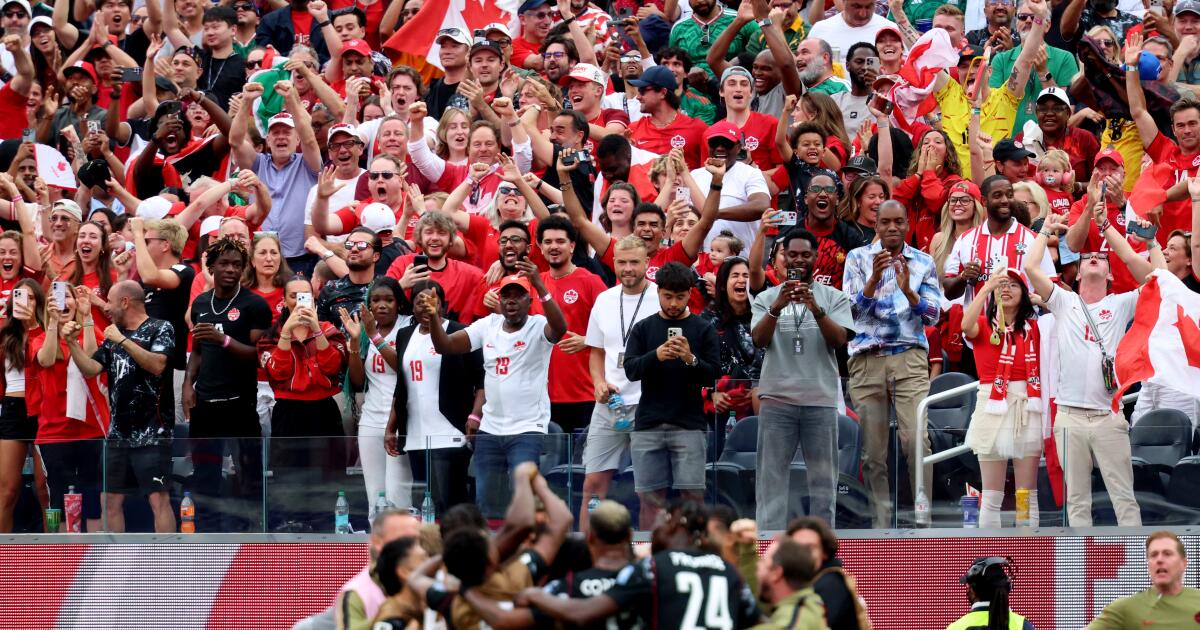
Commentary: World Cup shows MLS still needs to achieve major goals to grow the game
-

 World21 minutes ago
‘A concession to Zelenskyy’s ultimatum’: Ukraine’s triumph over Belarus
-
 News43 minutes ago
Native Americans celebrate victory at the Battle of Little Bighorn, 150 years later
-

 New York2 hours ago
How a Global Researcher Lives on $110,000 in Long Island City
-

 Los Angeles, Ca2 hours ago
Mass shooting at L.A. street takeover leaves 1 dead, 6 injured
-

 Detroit, MI2 hours ago
On the front lines of chronic absenteeism: What Detroit’s Health Hubs do to get kids to school
-

 San Francisco, CA3 hours ago
S.F. police arrest 20 at 300-person SoMa block party during Pride
-
Dallas, TX3 hours ago
CJ Goodwin announces retirement after 8 seasons with Cowboys


