In the months before the Planned Parenthood clinic in Columbia was forced to stop providing abortions in 2018, Emily Wales spent long nights calling patients to make back-up plans.
The clinic’s license was in jeopardy as it faced a court battle over hospital admitting privileges. Wales was among the staff calling women across Missouri as their fate was left in limbo.
“The state is interfering in your care and we want to make a back-up plan,” Wales remembers telling patients. “We want to have you at the ready to get to Kansas or Illinois, because we may not be able to see you tomorrow or on Monday.”
Wales is now CEO and president of Planned Parenthood Great Plains. And after years of Missouri law clamping down on access to abortion, culminating in a near-total ban in 2022, she and other advocates see a proposed initiative petition as a ray of hope.
Advertisement
If the coalition called Missourians for Constitutional Freedom is successful in gathering the more than 171,000 signatures necessary to land on the ballot later this year, and if voters approve it, abortion in Missouri would be legal up to the point of fetal viability.
“We think every single day about the damage being done to Missourians because we see it in our Kansas clinics,” Wales said. “And we hear the stories of how hard it is, how long they have to wait to get in, what they’re doing with their families and children back home trying to figure out work.”
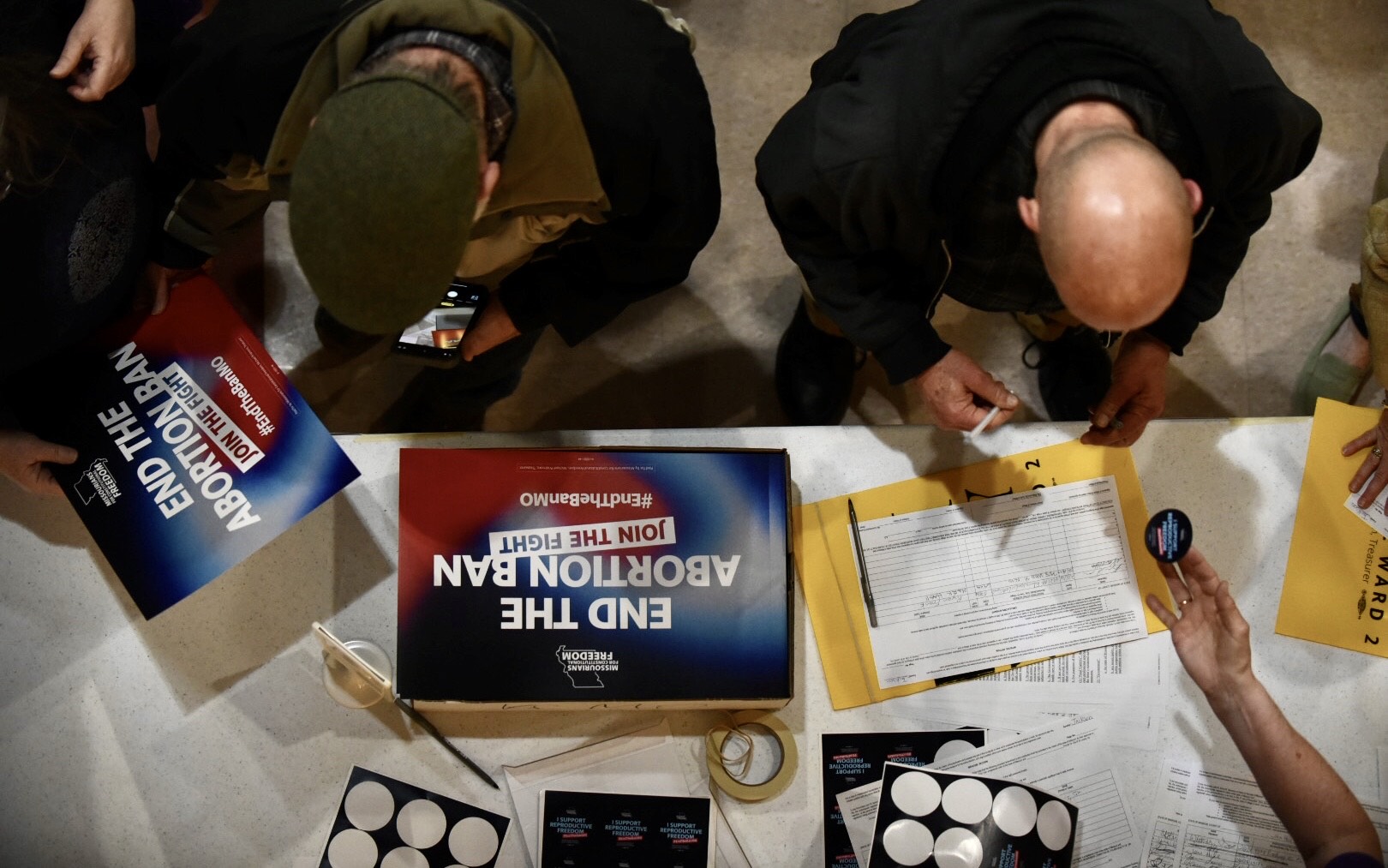
Winning voter approval and enshrining abortion-rights into Missouri’s Constitution, however, wouldn’t restore access overnight. Meladee Patterson, a volunteer with Missourians for Constitutional Freedom, joins a signature-gathering event on Feb. 6, 2024, in Kansas City (Anna Spoerre/Missouri Independent).
Decades of so-called TRAP laws, or “targeted regulation of abortion providers,” whittled down abortion access across the state and shuttered all but one abortion clinic in Missouri by 2019.
Those laws would still be on the books even if the amendment passes.
Advertisement
But constitutional law experts who reviewed the initiative petition language told The Independent the amendment would pave the way to tearing down the state’s TRAP laws. Anti-abortion advocates agree, arguing the proposal would undo years of legislative work that drove the number of abortions in Missouri down from 6,000 in 2010 to only 150 in 2021.
Physicians should legally be allowed to render services again immediately after the amendment goes into effect, said Richard Friedman, a law professor at the University of Michigan.
But for clinics to open up again, Friedman said each of Missouri’s TRAP laws would have to be challenged in court to see if they can stay in place when abortion is a constitutional right.
Wales acknowledged winning on the 2024 ballot is only the first step to restoring access.
“We’re trying to be really thoughtful about what the steps would be to restore access to care,” Wales said. “And there’s some really clear burdens that were so problematic by the end of any access in Missouri.”
Advertisement
A path to overturning Missouri’s TRAP laws
Missouri recorded its most abortions in 1984, with more than 20,000 performed across 26 clinics, according to the St. Louis Post-Dispatch.
By 1999, only five facilities continued offering abortion, according to the Missouri Department of Health and Senior Services.
By the time a trigger law went into effect in 2022 making nearly all abortions illegal in Missouri, there was only one: the Planned Parenthood in St. Louis.
Advertisement
Up until abortion was outlawed, Missouri required doctors performing the procedure to have admitting privileges at hospitals no more than 15 minutes away. The state also required that abortion clinics meet the standards of ambulatory surgical centers.
Women had to wait 72 hours between seeing their physician and undergoing their abortion, and doctors were required to perform pelvic exams even for medical abortions.
Living in a world of uncertainty was difficult on providers and “totally nonsensical” to patients, Wales said.
In 2018, Wales said, the web of restrictions resulted in Planned Parenthood clinics in Columbia and Kansas City losing their license to perform abortions.
Need to get in touch?
Have a news tip?
Advertisement
The next year, the St. Louis clinic nearly shut down operations after refusing to comply with state regulation that women undergo two pelvic exams before getting an abortion.
“Missourians just to some extent got used to seeing restriction after restriction,” Wales said.
The key passage in the proposed constitutional amendment that could undermine Missouri TRAP laws, according to legal experts interviewed by The Independent, declares that “the right to reproductive freedom shall not be denied, interfered with, delayed or otherwise restricted unless the government demonstrates that such action is justified by a compelling governmental interest achieved by the least restrictive means.”
The amendment goes on to say that government interest only has a leg to stand on if its goal is helping the health of the person seeking an abortion and does not infringe on their personal decision-making.
Advertisement
“It’s not just that the government has to have a compelling interest, but that the law is achieved by the least restrictive means,” said Nicole Huberfeld, a law professor and co-director of the Boston University Program on Reproductive Justice.
Huberfeld also said the measure would establish strict scrutiny, the highest judicial standard of review.
“The way this is written, it is meant to try to make it much harder to have the kinds of laws that erode access to abortion and other kinds of reproductive care,” Huberfeld said, adding that the language “appears to be attempting to take Missouri to a place that it maybe never has been.”
Republicans block attempt to add rape, incest exemptions to Missouri’s abortion ban
Mary Ziegler, a law professor at the University of California-Davis, said it’s hard to predict what will happen next because courts can be unpredictable.
Advertisement
But what she does know is that if the amendment is added to the state constitution, the shadows of the TRAP laws will create gray areas for abortion providers.
“Physicians may not want to jump the gun,” Ziegler said. “They may continue applying those old rules because they’re unsure how a judge would practice. But I think most providers will assume that they’ll be safe in providing abortion access much later into pregnancy than they would’ve absent the ballot initiative. And then I think we’d expect to see some kind of uncertainty and wrangling about the details after the ballot initiative is in place.”
The writers of the ballot initiative, Ziegler said, seem to have thought ahead to address some of the issues cropping up in Ohio, where lawmakers are trying to argue that fetal personhood overcomes the ballot initiative. Missouri’s language attempts to forestall that anti-abortion tactic, she said, by leaving viability decisions up to health care professionals.
Though she said this doesn’t guarantee lawmakers won’t try to define viability down to a certain number of weeks.
Wales said Planned Parenthood’s Columbia clinic is ready to begin performing abortions again.
Advertisement
“The obligation to re-establish care as quickly as possible and to make it local and accessible is not lost on us and we will work really hard to reestablish care,” Wales said. “At the same time, we are realistic that there are a lot of steps to get to before we’re making those decisions.”
Challenges to reopening abortion clinics
Jessie Hill, a law professor at Case Western University in Ohio who also worked on that state’s ballot initiative, said Missouri and Ohio are similar in that both are red states where legislators have enacted wide-ranging anti-aboriton laws.
But unlike Missouri, Ohio never had to shut down all of its abortion clinics.
Advertisement
“Once there’s a ban in place, it’s not so easy for providers to just open back up and come back,” Hill said, noting that often the buildings get sold or providers change careers or leave the state.
What can also make reopening challenging is that while the constitutional amendment would limit government interference, it would not require access.
But while it would be arduous, she believes reopening would be possible, especially for Planned Parenthood, which already has a statewide clinic network.
Missouri Republicans push bill to defund Planned Parenthood after years of legal fights
The biggest hurdle will be undoing the TRAP laws. In Ohio, Republican lawmakers are fighting to uphold the TRAP laws on the books.
Advertisement
While she’s not aware of any new abortion clinics opening in Ohio since the amendment was passed, Hill has heard talk of some providers hoping to open new locations.
“It’s still gonna be a challenge to sort of staff up and get healthcare providers to move into states like Missouri and Ohio that are still pretty hostile climates for abortion, even though we now have a constitutional right here,” Hill said.
She said some providers might be left asking, “Why go to Missouri if you can go to Illinois?”
Yamelsie Rodriguez, president and CEO of Planned Parenthood of the St. Louis Region and Southwest Missouri, said if the ban is overturned, her organization will work “swiftly” to provide abortions again in Missouri.
Advertisement
‘Extreme language’ would undo years of laws
The initiative petition effort has received staunch opposition from anti-abortion lawmakers and organizations in Missouri. A political action committee called Missouri Stands with Women, whose president is veteran anti-abortion activist Sam Lee, was formed last month to fight any abortion initiative petitions that make it to the ballot.
“For years, Missouri voters have voted for pro-life legislators,” said Stephanie Bell, a spokeswoman and attorney with Missouri Stands with Women. “Those legislators have enacted a whole host of statutory provisions that protect the safety of women that protect parental rights. And those are essentially all under this proposed measure presumed invalid.”
Jason Lewis, general counsel for the Missouri Attorney General’s Office, argued before a Cole County court last fall that any of the 11 versions of the initiative petition put forth by Missourians for Constitutional Freedom would loosen state abortion law beyond what it was pre-Dobbs. An anti-abortion protester holds a sign that reads “pray to end abortion” (Getty Images).
“Missouri prohibits abortion on the basis of sex, race or Down’s Syndrome. It prohibits abortion for unborn children that can feel pain. It has gestation-age requirements. It has fetal heartbeat law and certainly has informed consent law, those are just some of the measures,” Lewis said last year. “And Missouri law makes it clear that life begins at conception. Are these interferences, are they delays, are they restrictions or are there no restrictions?”
Bell said she expects the “extreme language” to invalidate years of anti-abortion legislation if it is approved by voters. One of her biggest concerns, she said, is that she believes the proposal could do away with a requirement that both parents sign off on an abortion for a minor.
Advertisement
“The measure completely strips parents of their rights currently to help their kids through some really difficult decisions,” Bell said. “I have lots of rights as a mother in Missouri about notification and consent on a whole host of other items that are much less serious than this type of decision.”
While Bell anticipates the measure will be tied up in court for years if it passes, her organization is doing what it can to dissuade Missourians from putting it on the ballot in the first place.
As of Friday, Missouri Stands with Women has reported raising $55,000, including from statewide Republican groups and Catholic dioceses.
Missouri Right to Life has also launched a “decline to sign” campaign, encouraging those who visit their website to “report pro-abortion signature gatherers” to a hotline and refrain from signing the “deceptive and extreme anti-life measure.”
Advertisement
Ballot initiatives are not ‘miracles’
While the Missouri proposal is similar to what has been approved in other states, some aspects of the initiative petition are unique.
Huberfeld, at Boston University, said the anti-criminalization language is particularly significant given the recent arrest of Brittany Watts, an Ohio woman who was charged with abuse of a corpse after she miscarried into a toilet and then flushed and plunged the fetus’s remains. A grand jury later decided not to file charges.
Missouri’s initiative petition states that no one can be penalized or prosecuted for their birth outcomes, nor can anyone who assists them.
The Missouri measure also carves out a right to “respectful birthing conditions.”
Advertisement
Huberfeld said this language is typically part of a larger movement to take the spotlight off abortion and focus more attention on the country’s maternal mortality crisis.
“It’s a recognition that the person who’s giving birth should be heard, should be giving informed consent to everything that happens, should be able to birth under the conditions that are safe and meaningful to them,” Huberfeld said.
Pamela Merritt, executive director of Medical Students for Choice, points to a lawsuit in Michigan challenging a 24-hour waiting period to receive an abortion. The legal challenge follows a successful abortion-rights ballot measure. Supporters sign an initiative petition in support of a ballot measure that would legalize abortion up to the point of fetal viability in Missouri. during an event on Feb. 6, 2024, in Kansas City hosted by Missourians for Constitutional Freedom (Anna Spoerre/Missouri Independent).
Michigan, she said, is a good roadmap for how difficult it is to recreate protections and strike down TRAP laws. But she agreed with others that Missouri could prove even more complicated since abortion has been banned for two years.
“One of the hardest things to do in the state of Missouri is to actually get a license and maintain a license for an abortion provider,” Merritt said. “We don’t know, to my knowledge, whether reinstating the right to abortion means you have to re-apply for that license. This is uncharted territory.”
Merritt said while abortion-rights organizers should be proud of the strides they’ve made, voters should not expect clinics to begin opening up in 2025 if the initiative passes.
Advertisement
“At best, it is a step in the right direction,” Merritt said of the ballot measure. “But they are not magical miracles in and of themselves.”
The Missouri Lottery offers several draw games for those aiming to win big.
Here’s a look at July 9, 2026, results for each game:
Winning Pick 3 numbers from July 9 drawing
Midday: 3-9-1
Midday Wild: 4
Advertisement
Evening: 7-7-1
Evening Wild: 1
Check Pick 3 payouts and previous drawings here.
Winning Pick 4 numbers from July 9 drawing
Midday: 0-5-3-2
Midday Wild: 8
Advertisement
Evening: 4-9-6-9
Evening Wild: 7
Check Pick 4 payouts and previous drawings here.
Winning Cash Pop numbers from July 9 drawing
Early Bird: 11
Morning: 13
Advertisement
Matinee: 08
Prime Time: 05
Night Owl: 10
Check Cash Pop payouts and previous drawings here.
Winning Show Me Cash numbers from July 9 drawing
08-09-20-23-32
Advertisement
Check Show Me Cash payouts and previous drawings here.
Feeling lucky? Explore the latest lottery news & results
Are you a winner? Here’s how to claim your lottery prize
All Missouri Lottery retailers can redeem prizes up to $600. For prizes over $600, winners have the option to submit their claim by mail or in person at one of Missouri Lottery’s regional offices, by appointment only.
To claim by mail, complete a Missouri Lottery winner claim form, sign your winning ticket, and include a copy of your government-issued photo ID along with a completed IRS Form W-9. Ensure your name, address, telephone number and signature are on the back of your ticket. Claims should be mailed to:
Ticket Redemption
Advertisement
Missouri Lottery
P.O. Box 7777
Jefferson City, MO 65102-7777
For in-person claims, visit the Missouri Lottery Headquarters in Jefferson City or one of the regional offices in Kansas City, Springfield or St. Louis. Be sure to call ahead to verify hours and check if an appointment is required.
For additional instructions or to download the claim form, visit the Missouri Lottery prize claim page.
Advertisement
When are the Missouri Lottery drawings held?
Powerball: 9:59 p.m. Monday, Wednesday and Saturday.
Mega Millions: 10 p.m. Tuesday and Friday.
Pick 3: 12:45 p.m. (Midday) and 8:59 p.m. (Evening) daily.
Pick 4: 12:45 p.m. (Midday) and 8:59 p.m. (Evening) daily.
Powerball Double Play: 9:59 p.m. Monday, Wednesday and Saturday.
This results page was generated automatically using information from TinBu and a template written and reviewed by a Missouri editor. You can send feedback using this form.
COLUMBIA — Hundreds of Missouri realtors were in Columbia Thursday to show their opposition to a couple of proposals on the August 4th ballot. The Missouri Association of Realtors hosted a statewide rally against Amendments 4 & 5. Realtors distributed tens of thousands of yard signs, bumper stickers, buttons, and literature.
More than 26,000 Missouri realtors want Missourians to vote no on Amendments 4 & 5. They said the proposals ignore tax restrictions that Missouri voters put into the Missouri Constitution. Amendment 4 would modify the current requirements for a simple statewide majority vote. Amendment 5 would require the phase out of the individual state income tax. Matthew Becker is the Treasurer-Elect for the Missouri Board of Realtors and said Amendment 5 would give too much power to state government.
Becker said, “Amendment 5 is nothing more than a bait and switch. Amendment 5 literally wants to go out and give our legislature a blank checkbook for the next 5 years.”
Jefferson City Realtor Logan Gratz said Amendment 4 favors politicians and destroys majority rule for Missourians.
Advertisement
Gratz said, “Realtors have always been major advocates of property owners, of property rights, good business, and good tax policy.”
Springfield area State Representative Bishop Davidson said Missouri realtors were wrong when they opposed Amendments 4 & 5. Davidson said Amendment 5 would improve Missouri’s tax system.
Davidson said, “Right now, the way our tax structure works is old and archaic. It discourages economic growth. When it comes to Amendment 4, what I would say is protecting our Missouri Constitution is important.”
Governor Mike Kehoe’s communication director sent KRCG a statement that said, “Governor Kehoe supports Amendment 5 because it is a revenue-triggered, constitutionally protected path to eliminating Missouri’s individual income tax, allowing workers to keep more of every paycheck.”
Missouri Farm Bureau’s 2026 Agritourism Conference will be held Sunday through Tuesday in Hermann, bringing together agritourism stakeholders to explore opportunities in Missouri’s growing agritourism sector.
The conference usually draws 60-70 attendees annually, said Janet Adkison, director of public affairs and advocacy with Missouri Farm Bureau. This includes farmers, agribusiness leaders, tourism professionals and local economic development partners.
At the conference, participants will see firsthand how farms, wineries, orchards and other value-added agriculture business and rural destinations are connecting tourists and consumers with the state’s agriculture scene, while diversifying revenue streams for farm families and rural communities.
“Whenever folks think of agritourism, they think of a pumpkin patch or a flower farm,” Adkison said. “But agritourism is really anything that gets folks to connect with the agriculture industry. So from your Airbnbs that are out in rural Missouri to the wineries that you see across the countryside, to even a tree farm or just a simple orchard, those are all part of Missouri’s agritourism industry.”
Advertisement
The conference kicks off Sunday with welcome remarks by Missouri Farm Bureau president Garrett Hawkins and a dinner at Hermann Farm Store Barn. Participants will spend the nights at The Inn at Hermannhof.
Monday will include an agritourism bus tour, with stops at Thierbach Orchard, Heritage Valley Tree Farm, White Mule Winery & BNB and Cool Cow Cheese, where participants have the opportunity to speak to business owners.
It will be followed by a farm-to-table, wine-pairing dinner at Hermannhof Winery Court with the Missouri Wine & Grape Board.
“If you are somebody who’s interested in agritourism, you get to hear from somebody who’s been there and done that, and some of the hurdles that they may have experienced along the way,” Adkison said. “You’ll have that exposure both on the tour and also during the programs that they’ll provide on Tuesday.”
On the final day of the conference, participants will attend educational workshops and network with other vendors at Hermannhof Festhalle. Topics discussed in the workshops include marketing, risk management, USDA Rural Development resources for agricultural businesses.
Advertisement
“You’ll hear from some folks as far as the missteps or wins that they had while trying to market and get those crowds to come to the farm, and sometimes something might work, (or) something surprises you and it doesn’t work,” Adkison said.
The conference location rotates around the state each year — past stops have included northeast and west central Missouri, which Adkison said gives the conference a chance to showcase how agritourism looks based on the terrain and agricultural strength of each region.
Find out more about the event or register for it at mofb.org/event/2026-agritourism.