The author of a new book about women on the Santa Fe Trail, which starts in Kansas City and is considered America’s first great international commercial highway, is well aware of how people often think of women who made the journey: fearful, sun-bonneted white women in wagon trains, reluctantly leaving behind their comfortable lives on the East Coast.
But in her new book, “Crossings: Women on the Santa Fe Trail,” St. Louis-based author Frances Levine tells the stories of women of many backgrounds, each with her own reason for traveling the trail between New Mexico and Missouri.
Just like women today, some appeared to be fully in charge of their lives, and others had very little control.
“If we look at sort of a wide-angle lens on Western history,” she says, “we’ll see that … oftentimes, women had to move their families looking for new opportunities, and so they were the primary decision makers, in some cases, of moving their families west.”
Advertisement
At the opposite end, the most fearful women on the trail were likely not white, high-society ladies torn from posh parlors, as sometimes portrayed in fiction.
“I didn’t expect to find so much about Native enslavement and the trafficking in women and children,” Levine says.
She writes that Native peoples and Europeans trafficked humans in a variety of settings, enslaving them, trading them in hostage exchanges, taking them as sexual partners or exploiting their skills as laborers and translators.
Though the trail legally opened in 1821, when Mexico won independence from Spain, Levine’s work excavated stories going back to 1760.
Advertisement
gift of J. Lionberger Davis, St. Louis Art Museum
Albert Bierstadt, Surveyor’s Wagon in the Rockies, c. 1859. Women had many different reasons for making the long, difficult journey from Missouri to New Mexico, but their stories are often left out of historical records — particularly women who were enslaved. Oil on paper mounted on masonite.
That was the year a group of Comanches kidnapped María Rosa Villalpando Salé dit Lajoie and 55 other women and children from their compound in Ranchos de Taos, New Mexico.
Her name itself is a trail, Levine suggests.
Villalpando Salé dit Lajoie started out as a member of the Hispanic community in northern New Mexico, then became a Comanche captive, a Pawnee captive, and later a member of a French Creole community where she gained social standing and owned real estate, firearms, furs, a store and slaves. She died in St. Louis at more than 100 years old.
Advertisement
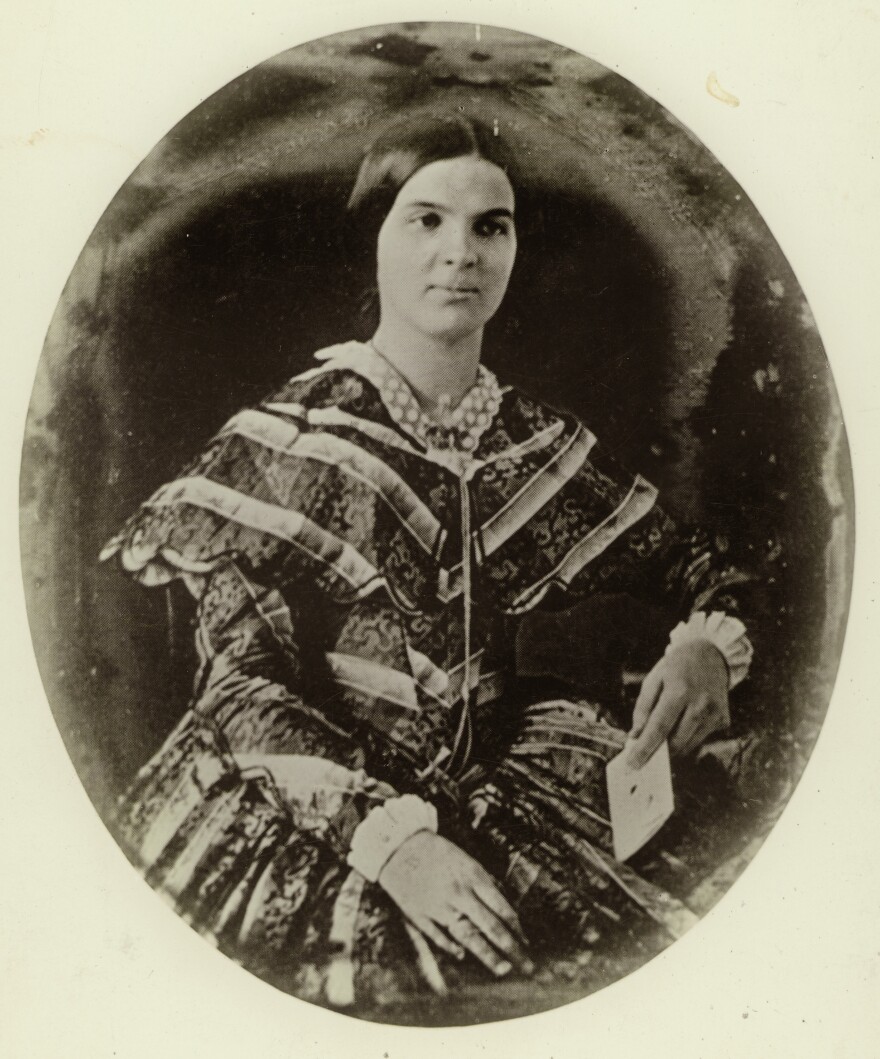
Missouri Historical Society, St. Louis
Portrait of Marie Hèléne Salé dit Lajoie Leroux (1773-1859), daughter of María Rosa, whose story features experiences common to women making that journey. Wash drawing based on 1859 daguerreotype by Emile Herzinger, 1863.
Levine, who earned a Ph.D. in anthropology from Southern Methodist University, first ran across Villalpando Salé dit Lajoie in another book. In it, Villalpando Salé dit Lajoie was a mere footnote and blamed for her own capture.
Levine writes that the book embellished and romanticized the story of the raid, “claiming it was in retaliation for her refusal to marry a Comanche chief, a union supposedly arranged by her father when she was a child.”
The more Levine searched, the more she saw that Villalpando Salé dit Lajoie’s story encapsulated much of what women of the era experienced.
Levine found her story so illuminating that she has more entries in the book’s index than anyone else and jokes that “Maria Rosa Villalpando is very disappointed that this whole book is not about her.”
Advertisement
Levine now makes her home in St. Louis, where traveler and merchant supplies were aggregated and shipped west along the trail. She is the past president of the Missouri Historical Society. Before moving to this end of the trail, she helped preserve history at the other end: She was the former director of the New Mexico History Museum and Palace of the Governors, in Santa Fe.
She writes that making the move from one end to the other allowed her to “explore the complexity and depth of the links between the Southwest and the American heartland” and the “evolution of women’s roles in interregional travel and intercultural exchanges.”
Her office at the Missouri Historical Society occupied the same space as did the society’s head librarian from 1913 to 1943, who edited one of the trail’s most significant woman-authored journals.
Hall
Advertisement
/
Missouri Historical Society, St. Louis
Portrait of Susan Shelby Magoffin (1827-1855), taken in St. Louis circa 1852-1855. Magoffin’s published journal is one of the seminal records of women’s experiences on the trail.
The librarian, Stella Drumm, had corresponded with journal writer Susan Shelby Magoffin’s daughter. Levine found a box with those and other papers, which appeared not to have been disturbed since the 1940s.
The information in Magoffin’s “Down the Santa Fé Trail and Into Mexico,” still in print, was plentiful, but other evidence of the female experience on the trail took a great deal of digging to find.
“I had to look for women in other contexts,” Levine explains. “I had to look for them in store records, census records, property maps, wills and lawsuits.”
Advertisement
She struggled especially to find particulars about enslaved women — Levine says she didn’t think she’d find anything at all. Once she did, it took the form of diary entries written by other people — an enslaved woman’s existence reduced to what captured someone else’s attention on any given day, she says.
Magoffen’s diary includes entries about the woman she enslaved, named Jane.
She “writes about Jane’s misbehaving at the same time that she’s writing about her own fears about being on the trail, but she’s not recognizing that Jane may have had her own set of fears,” Levine explains.
Missouri Historical Society, St. Louis
Advertisement
Aunt Sukey, circa 1860, identified as the eldest enslaved woman owned by the family of Robert B. Smith, in Lafayette County, Missouri. There are very few records of the enslaved women who journeyed on the trail.
Levine says that examining women’s parts in this history can also reveal a failure to recognize families, very often multiracial or multicultural.
But it was the family-making and everything else that the women carried that shaped American culture, particularly through the middle of the nation.
“What we need to do,” Levine says, “is to teach history in a slightly different way, from a different perspective, sometimes taking a more community perspective. … look at the way in which people moved with their cultures, the way in which they brought their own cultural practices, their own food ways, their own heritage with them along the trails.”
This story was produced in partnership with the Kansas City Public Library.
Frances Levine will discuss “Crossings: Women on the Santa Fe Trail” at 6 p.m. on Tuesday, March 4, at the Kansas City Public Library’s Plaza branch, 4801 Main St., Kansas City, Missouri 64112. The event is free with RSVP. More information at KCLibrary.org.
The Missouri Supreme Court heard arguments Tuesday on whether the so-called “Missouri First” map is unconstitutional.
The map, passed by Republican lawmakers in September and signed by Gov. Mike Kehoe, stretches the boundaries of the 5th Congressional District, a Democratic stronghold, eastward into heavily Republican regions of the state. It also moves part of the current 5th District into the 4th and 6th districts, currently represented by Republican congressmen Mark Alford and Sam Graves. Incumbent Democrat Emanuel Cleaver is running for reelection in the 5th District.
Opponents of the Missouri First map’s main argument focused on the map being passed by lawmakers without any new data from the U.S. Census Bureau. The congressional boundaries tossed out by the Missouri First map were based on the 2020 U.S. Census.
Advertisement
Attorney Chuck Hatfield represents those challenging the new map passed by Republican lawmakers last fall.
“The whole idea is tethered to the census data. You must do it at the census, and you only do it at the census,” Hatfield told the High Court. “The court’s precedents also support this.”
Solicitor General Louis Capozzi, representing the Missouri Sec. of State’s office, disagreed, saying the Missouri Constitution is silent on mid-decade redistricting.
“Mid-decade redistricting had happened in Missouri in the 1870s, and mid-decade redistricting was common around the country in the first half of the 20th century,” he argued. “Article III, Section 45 of the Missouri Constitution sets out only three requirements for the redistricting of seats in Missouri, ‘The district shall be composed of contiguous territory, as compact, and as nearly equal in population as may be.’ And as long as the General Assembly complies with those three rules, this court said that Missouri courts, ‘shall respect the political determinations of the General Assembly.’”
Meanwhile, roughly a hundred demonstrators held signs across the street from the Missouri Supreme Court building, condemning the Missouri First map and calling for the Missouri Supreme Court to strike it down.
Advertisement
“Voters should choose our politicians,” said Missouri League of Women Voters Director Kay Park. “The League (of Women Voters) believes redistricting should keep communities of similar culture and race together to strengthen their vote and promote partisan fairness.”
The Missouri Supreme Court will rule on the congressional district map later.
Missouri senior forward Mark Mitchell was recognized Monday with a second-team selection to the All-Southeastern Conference teams.
Mitchell has led the Tigers all season long and tops the team in scoring (17.9 points per game), rebounding (5.2) and assists (3.6). He would be the just the second player in program to lead all the categories in one season, joining Albert White from the 1998-99 season.
Mitchell is also on pace to become the first player in program history to average at least 17 points, five rebounds and three assists since Anthony Peeler in 1992, the year he took home the Big 8 Conference Player of the Year award.
Mitchell was the only Missouri player to be recognized in SEC postseason awards.
Advertisement
Five players were named to each of the three All-SEC teams.
Darius Acuff Jr. (Arkansas), Ja’Kobi Gillespie (Tennessee), Thomas Haugh (Florida), Labaron Philon Jr. (Alabama) and Tyler Tanner (Vanderbilt) made the first team.
Acuff was named the conference’s player of the year and freshman of the year.
Joining Mitchell on the second team were Nate Ament (Tennessee), Rueben Chinyelu (Florida), Otega Oweh (Kentucky) and Dailyn Swain (Texas), while Rashaun Agee (Texas A&M), Alex Condon (Florida), Keyshawn Hall (Auburn), Aden Holloway (Alabama) and Josh Hubbard (Mississippi State) were named to the third team.
The All-SEC defensive team consisted of Chinyelu, Somto Cyril (Georgia), Felix Okpara (Tennessee), Billy Richmond III (Arkansas) and Tanner. Chinyelu was selected as the defensive player of the year.
Advertisement
Appearing on the all-freshman team were Acuff, Amari Allen (Alabama), Ament, Malachi Moreno (Kentucky) and Meleek Thomas (Arkansas).
Swain was selected as the newcomer of the year, while Urban Klavzar of Florida was named the sixth man of the year.
The 2026 Missouri high school basketball state championship brackets continue on Monday, March 9, with eight games in the sectional and quarterfinal round of the higher classifications.
High School On SI has brackets for every classification in the Missouri high school basketball playoffs. The championship games will begin on March 19.
Missouri High School Girls Basketball 2026 Playoff Brackets, Schedule (MSHSAA) – March 9, 2026
Advertisement
Sectionals
Doniphan vs. Potosi – 03/09, 6:00 PM CT
Advertisement
St. James vs. St. Francis Borgia – 03/09, 6:00 PM CT
Notre Dame de Sion vs. Oak Grove – 03/09, 6:00 PM CT
Smithville vs. Benton – 03/09, 6:00 PM CT
Cardinal Ritter College Prep vs. Clayton – 03/09, 6:00 PM CT
Advertisement
Orchard Farm vs. Kirksville – 03/09, 6:00 PM CT
Advertisement
Boonville vs. Strafford – 03/09, 6:00 PM CT
Reeds Spring vs. Nevada – 03/09, 6:00 PM CT
Advertisement
Quarterfinals
Festus vs. Lift for Life Academy – 03/13, 6:00 PM CT
Grandview vs. Kearney – 03/13, 6:00 PM CT
MICDS vs. St. Dominic – 03/13, 6:00 PM CT
Advertisement
Helias vs. Marshfield – 03/13, 6:00 PM CT
Advertisement
Quarterfinals
Jackson vs. Marquette – 03/13, 6:00 PM CT
Advertisement
Rock Bridge vs. Staley – 03/13, 6:00 PM CT
Incarnate Word Academy vs. Troy-Buchanan – 03/13, 6:00 PM CT
Kickapoo vs. Lee’s Summit West – 03/13, 6:00 PM CT