Milwaukee, WI
Here’s a guide to Milwaukee’s Layton Park neighborhood


Located on the city’s south side, Layton Park is one of more than 75 distinct neighborhoods in Milwaukee.
Working-class Poles and Germans arrived in the late 19th century, but now, the largely residential neighborhood is about three-quarters Latino. Home to just over 8,200 residents, Layton Park is one of Milwaukee’s most populated neighborhoods.
The neighborhood and its surrounding area are known for their vibrant Latin American and Caribbean influences, ample outdoor recreation opportunities and beloved, hidden-gem restaurants.
Here’s what to know about and check out in Milwaukee’s Layton Park neighborhood.
More: Here’s a guide to Milwaukee’s Tippecanoe and Town of Lake neighborhoods
More: What to know about Milwaukee’s Brewers Hill neighborhood
More: Here’s a guide to Milwaukee’s lower east side neighborhood
Where is Milwaukee’s Layton Park neighborhood?
Neighborhood boundaries in Milwaukee are not completely set in stone and may differ depending on who you ask.
However, most sources define Layton Park’s boundaries as W. Becher Street at the north and W. Cleveland Ave. or W. Kinnickinnic River Parkway at the south, and S. 35th Street at the west and W. Forest Home Avenue and S. 27th Street at the east.
An earlier definition in the 1970 “Metropolitan Milwaukee Fact Book” defined the neighborhood’s boundaries as “Lincoln Ave. from 16th St. to 24th St., Becher St. from 24th St. to 35th St., and Howard Ave. from 16th St. to 35th St.,” according to UW-Milwaukee’s Encyclopedia of Milwaukee. Today, this area includes Layton Park, Forest Home Hills, Southgate, Southpoint and parts of the Jackson Park, Morgandale, and Polonia neighborhoods.
Layton Park was a Polish neighborhood in the 1800s
In 1849, Englishman John Layton purchased land now bounded by Lincoln Avenue, Forest Home Avenue, and 31st Street, wrote Jim Nelsen, Golda Meir School social studies department chair, for the Encyclopedia of Milwaukee. When Layton arrived, the area was home to white farmers and Native Americans. Layton and his son Frederick are the neighborhood’s namesake and shaped much of it, building a farm, residence and inn.
In 1885, the Laytons sold their land, and it was subdivided for houses, Nelsen wrote. Working-class Polish residents, as well as some Germans and other northern Europeans, made up the majority of the neighborhood’s residents by the turn of the century.
The neighborhood’s Polish roots are still evident in a lot of nearby places: Pulaski High School, Pulaski Park and Pulaski Indoor Pool, just to name a few. Many things in the area are named “Pulaski” after General Casimir Pulaski, a Polish hero of the American Revolution, Nelsen explained.
“He actually didn’t speak more than probably a few words of English, but he was an officer during the time of the American Revolution and fought on the American side,” Nelsen said. “So, for a lot of Polish residents here back like 100, 150 years ago, there was this big concern of, ‘We want to be American right away, but we also want to be Polish. So, what can we do to be proud Polish-American? Oh man, there’s this American-Polish patriot!’”
Layton Park has been home to Maynard Steel Casting since World War I. From 1951 to 1999, the neighborhood was also the site of Southgate Shopping Center, Milwaukee’s first shopping mall. Leon’s Frozen Custard, currently Milwaukee’s second-oldest custard stand, popped up on 27th Street in 1942.
Latino immigrants, mainly from Mexico, began settling in Layton Park and much of the rest of Milwaukee’s south side in large numbers in the mid-to-late 20th century.
“Latinos were able to settle successfully alongside the Poles because they shared so many traits in common,” wrote anthropologists at Urban Anthropology Inc. in their “190 Milwaukee Neighborhoods” project entry on Layton Park. “These included the Catholic faith, the focus on the Madonna figure, polka music traditions, similarities in childrearing and eldercare practices, and an entrepreneurial spirit.”
Today, Layton Park is home to a vibrant, majority-Latino community
Today’s Layton Park neighborhood is largely residential. Nelsen said its reasonably priced homes attract first-time homeowners and immigrants. As of 2020, Layton Park is about 75% Latino.
The main commercial corridors in the neighborhood are along Lincoln Avenue and W. Forest Home Avenue. Many restaurants and small auto repair businesses line these streets. Nelsen said Layton Park attracts job-seekers with lots of opportunities in retail, restaurants and at Aurora St. Luke’s Medical Center, one of the neighborhood’s biggest employers.
Kevin Solis is the senior outreach and engagement manager for VIA Community Development Corporation. He works with residents of Layton Park ― and the nearby Burnham Park and Silver City neighborhoods ― on civic engagement: voting, providing public comment at the mayor’s budget hearing and organizing neighborhood projects.
Solis said Layton Park’s Latino culture is on display in the neighborhood’s food offerings.
“We can see it, not only in the restaurants that are available, but there are grocery stores that cater a lot to our community,” he said. “This makes the community feel more like home.”
Solis cited El Rey Foodmart on Burnham Street and Cermak Fresh Market on Miller Parkway, both just north of Layton Park’s official boundaries, as examples. El Rey is a Milwaukee-based Central and South American specialty food store chain, while Cermak specializes in a variety of cultural foods from across the globe, including Latin American cuisine.
Layton Park’s Latino culture is also evident in the nearby churches, such as Our Lady Queen of Peace Parish, which offers Mass in Spanish multiple times a week as well as other Latino Catholic traditions like Quinceañeras and Spanish-speaking faith groups.
What to eat, see and do in and around Milwaukee’s Layton Park neighborhood
Nelsen recommends Mazos Hamburgers, 3146 S. 27th St. The small diner has been around since 1934.
“Most people drive past and don’t realize it’s there,” he said. “But, if you’re just looking for a hole-in-the-wall type place with home-cooked food with reasonable prices, it’s not a bad place at all to get a burger.”
One neighborhood favorite is Tu Casa Mexican Restaurant and Bar, 3710 W. Lincoln Ave. The restaurant promises “The tastes of Mexico, the feelings of home” on its website, and the menu features Mexican favorites well-known in the U.S., like tacos and enchiladas, as well as authentic dishes and seafood that some Milwaukeeans may be less familiar with.
Another spot to check out is Neveria Las Maravillas, 2908 W. Lincoln Ave. The shop serves traditional Mexican ice cream in a wide variety of flavors, as well as elotes, fruit and drinks.
Layton Park and the surrounding area are also a hub for food trucks.
“If you walk around, you’ll for sure bump into a food truck,” Solis said. “And I will guarantee that it will have something delicious for you.”
One truck he recommends is Mexicano Express, 3301 W. Burnham St. A Puerto Rican food truck, Sabor Divino, just opened a brick-and-mortar location at 3300 W. Lincoln Ave.
Just east of Layton Park’s official boundary is the Forest Home Cemetery and Arboretum. The 200-acre cemetery was established in 1850 and is the burial site of many “beer barons, industrialists, mayors, governors, senators and families who have made significant contributions to, and helped to build, Milwaukee,” the cemetery says on its website. A list of notable people buried at Forest Home can be found on its website.
The cemetery offers self-guided and public summer tours. It also hosts a Día de los Muertos festival and 5K, as well as a Halloween event called “Spirits of the Silent City,” where professional actors portray famous Milwaukeeans buried in the cemetery and guide visitors on an educational, after-dark tour. The cemetery is also an arboretum, where people can enjoy walking and cycling trails, birdwatching and 2,600 trees of over 100 labeled species.
The Kinnickinnic Sports Center, 3070 S. 20th St., is also nearby. It features an archery range, basketball court, baseball and softball diamonds, trails and a playground.
Solis also recommends the recently renovated Burnham Playfield, 1755 S. 32nd St., which now has a splash pad, playground, soccer fields and basketball courts.
New to the neighborhood? Here’s how to access Milwaukee services
Tell us about your Milwaukee neighborhood. We want to hear from you!
What makes your Milwaukee neighborhood special to you? Do you have any photos in the neighborhood you’d like to share? Share more at bit.ly/MKE_Neighborhoods.



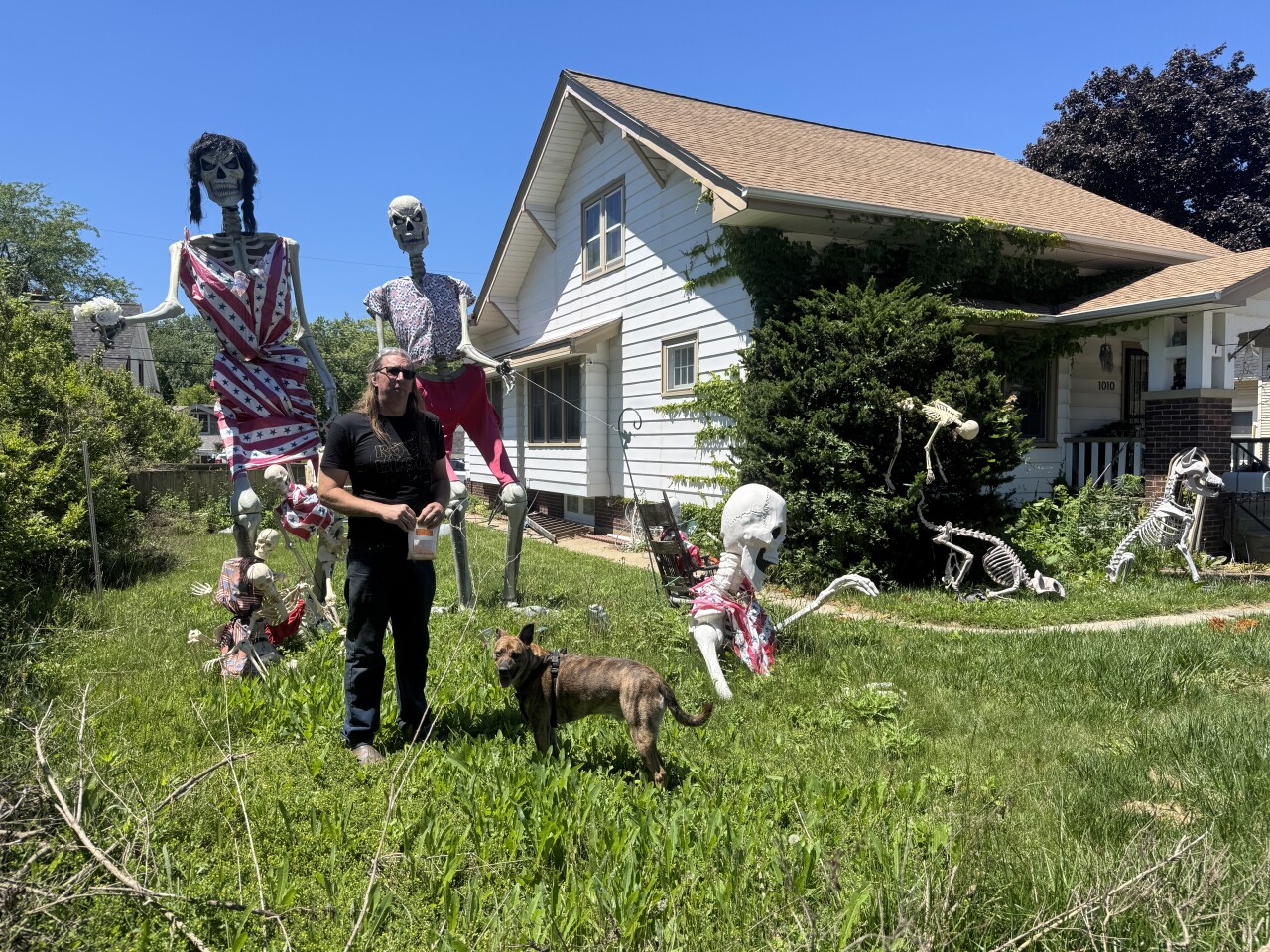
SOUTH MILWAUKEE, Wis. — A South Milwaukee homeowner is pushing back after the city ordered him to take down his year-round skeleton display, calling it a violation of property maintenance codes.
Sean Oster and his wife have maintained the display — featuring skeletons named Hector and Henrietta along with other decorations— for nearly two years, dressing them up for holidays, sports events, and other occasions.
Mike Beiermeister
The display has drawn attention from neighbors and passersby, with some saying it has become part of the neighborhood’s character.
Watch: South Milwaukee homeowner fights city order to remove year-round skeleton display
South Milwaukee homeowner fights city order to remove year-round skeleton display
“It’s like an expression of the owner’s passion… and I think it’s cool they can use their lawn that way,” neighbor Jeremy Payment said.

Mike Beiermeister
Last month, Oster received a letter from the city of South Milwaukee describing the skeletons as Halloween decorations being displayed outside the appropriate time of year and ordering him to remove them by July 7.
Under the city’s property maintenance code, yards must be kept free of anything considered an “unreasonable blighting influence,” which the city says can include displays left up out of season. The notice also flagged an inoperable vehicle on the property. Each violation could result in fines of up to $500 per day if not corrected by the deadline.
Oster says he understands part of the city’s concern.
“They have a few points… I’ve got a couple collector cars… I understand those shouldn’t be out,” Oster said.
Mike Beiermeister
He plans to move the cars into the garage and clean up the yard, but says the skeletons are staying.
“I don’t think it’s hurting anybody. It’s literally a victimless crime,” Oster said.
Oster also had a message for whoever filed the complaint.
“Live with it… more people like it than hate it. And if we’re enforcing this, then we should go around and take down Christmas lights that are up year-round,” Oster said.
The city administrator did not respond to a request for comment.
This story was reported on-air by a journalist and has been converted to this platform with the assistance of AI. Our editorial team verifies all reporting on all platforms for fairness and accuracy.
Let’s talk:
Hey there! At TMJ4 News, we’re all about listening to our audience and tackling the stuff that really matters to you. Got a story idea, tip, or just want to chat about this piece? Hit us up using the form below. For more ways to get in touch, head over to tmj4.com/tips.
It’s about time to watch on your time. Stream local news and weather 24/7 by searching for “TMJ4” on your device.
Available for download on Roku, Apple TV, Amazon Fire TV, and more.
Report a typo or error // Submit a news tip

The Milwaukee Bucks’ impending trading of Giannis Antetokounmpo to a new team has been the buzziest NBA story since the New York Knicks won the title. But what if it never happens?
The stars are aligning for the Bucks to pitch a narrative to Giannis that for the second straight transaction cycle they’ve dangled him to the rest of the Association and gotten a tepid response.
A few teams, like the Miami Heat, have been clearly interested. Many others, like the Boston Celtics, seem much more cautious and coy about their pursuit of the Greek Freak. Juggernauts like the Oklahoma City Thunder and San Antonio Spurs are less than a Giannis away from winning the championship, and neither team even seems willing to bid.
Even Miami’s dogged pursuit may not include exhausting every possible means to add Giannis. After all, he’s into his 30s now, with a lot of basketball miles between NBA and international competition, and his representatives want a seat at the table, plus the injury history is getting extensive…
The important distinction, as @Anthony_Chiang and I, and @EthanJSkolnick have noted, is while only Bam is off limits, the Heat cannot in good conscience offer every single good young player and every single available first and every pick swap. Most, sure. But offer everything…
— Barry Jackson (@flasportsbuzz) June 18, 2026
And then there’s the Bucks, an organization so committed to winning with Giannis they waived and stretched Damian Lillard last summer because they thought adding Myles Turner would lead to the next great Milwaukee frontcourt following Brook Lopez’s decline. There’s a pitch to be made right now from Jon Horst and the Bucks’ leadership that there’s no other NBA team out there who wants to win with Giannis as badly as they do.
Outside from the human element of feeling wanted, there are more tangible elements in play. Giannis can’t sign his next massive extension until October 1 with Milwaukee, or six months following a trade if he is dealt. If his next team is hesitant to give up players or picks to trade for Giannis, is there really any guarantee that a max extension is on the table in 2027?
The collective bargaining agreement’s extension rules offer somewhat of a double-edged sword in this case. It hurts the Bucks’ ability to keep Giannis that he can’t formally extend until the draft and free agency are over, but also the prospect of being able to sign before suiting up in 2026-27 is more appealing to Giannis than having to wait until January or February. Especially given the series of injuries that have plagued him.
All of this sentiment and security still isn’t enough in itself for Milwaukee. The Bucks would require a plan to improve quickly to get Antetokounmpo bought in again to avoid ending up back here, but in an even more desperate spot, come February. Upgrading from Doc Rivers to Taylor Jenkins is a great start, but executing trades and smart free agent signings will be crucial.
Is it serendipitous timing that the Bucks biggest position of need is wing players and the New Orleans Pelicans reportedly want to get into the range of the 2026 NBA Draft where Milwaukee is slated to pick, with rival teams eyeing young wings Trey Murphy and Herb Jones? Notably, those same Pelicans infamously overpaid to “get their guy” last Draft.
This is more than likely some combination of pipe dream and fairy tale, given most of the reporting around Giannis continues to conclude he’ll be departing Milwaukee in the coming weeks. But even that is strangely optimistic for the Bucks, as they’ve reportedly quietly walked back ownership’s stated timeline of having a decision made by the draft.
All of that said, it still feels more likely that Giannis is traded than not. But this saga has had its share of twists and turns so far and throughout all the noise Giannis has re-signed with the Bucks. Who’s to say that couldn’t happen one more time?
Follow

MILWAUKEE — An Oak Creek couple’s stolen car has been found after a viewer who saw a report on the theft spotted it near a south side Milwaukee apartment complex.
Melinna Posey said the ordeal began when her car was stolen and she turned to social media for help. A person who responded claimed to have the vehicle and demanded money for its return. The person messaging even taunted her, discarding some of the items inside the car.
Personal items were inside the vehicle, including the family’s car seat, stroller, cameras and photos.
“It’s been very stressful, especially for him. It’s his vehicle, it’s in his name,” Posey said.
Watch: Stolen Oak Creek couple’s car found by viewer dumped near Milwaukee apartment complex
Stolen Oak Creek couple’s car found by viewer dumped near Milwaukee apartment complex
I spoke to Posey on Tuesday. Since then, she and Tyler Dusenberry had been searching for the car. On Thursday, the couple received a message from someone who saw the story on TMJ4. That person found the car at a south side Milwaukee apartment complex and shared pictures of the red Dodge Durango SRT between trees and a building, covered in tarps.
“I didn’t believe the text message at first today, and then he sent pictures of the car, and I was like, thank the lord, I was like thank you so much,” Posey said.
“It’s a roller coaster that’s what it’s been,” Dusenberry said.
Brendyn Jones/TMJ4
Oak Creek Police picked up the car and are processing it for evidence. The family has not yet been able to see the inside of the vehicle or what, if anything, was left behind.
The family said they are grateful to everyone who helped them this week, but said the entire experience will be tough to get over.
“It’s just unfortunate that this all happened, and we had a lot of memories and trips within that vehicle so it’s just a little life-changing to be honest,” Dusenberry said.
This story was reported on-air by a journalist and has been converted to this platform with the assistance of AI. Our editorial team verifies all reporting on all platforms for fairness and accuracy.
Let’s talk:
Hey there! At TMJ4 News, we’re all about listening to our audience and tackling the stuff that really matters to you. Got a story idea, tip, or just want to chat about this piece? Hit us up using the form below. For more ways to get in touch, head over to tmj4.com/tips.
It’s about time to watch on your time. Stream local news and weather 24/7 by searching for “TMJ4” on your device.
Available for download on Roku, Apple TV, Amazon Fire TV, and more.
Report a typo or error // Submit a news tip
-

 Cleveland, OH10 minutes ago
Cleveland police arrest suspect in involuntary manslaughter investigation, find fentanyl and PCP
-

 Austin, TX13 minutes ago
Austin community celebrates ‘Black Artists Matter’ mural before removal
-

 Alabama18 minutes ago
Two Alabama bridges rank among longest in U.S. Have you crossed them?
-

 Alaska25 minutes ago
Pilot dies in small plane crash southeast of Cordova
-

 Arizona28 minutes ago
Arizona’s Rugged Wilderness Area Has Gorgeous Mountain Trails And Scenic Camping Spots – Islands
-

 Arkansas33 minutes ago
Tulsa downs Northwest Arkansas | Northwest Arkansas Democrat-Gazette
-

 California40 minutes ago
California man arrested for alleged lewd acts, exploitation involving juveniles
-

 Colorado43 minutes ago
Colorado neighbors lament likely closure of Roxborough library; $22 million regional library breaks ground nearby

