Michigan
The largely invisible presidential campaign on the ground in rural Michigan

Brandy Jones and Justin Patterson were hoping to find a restaurant with prime rib on the menu as they walked along the main street in this small Central Michigan town of about 1,750.
Justin Patterson and Brandy Jones in downtown Evart, Mich.
(Connor Sheets / Los Angeles Times)
The pair said they have seen little evidence of the presidential election this year in their hometown outside Lansing, on the nearly two-hour drive to the Evart area, where they were vacationing, or even on social media. That’s a major shift from past campaign seasons, according to Jones.
“I’m actually seeing a lot less campaign signs and advertisements,” she said Monday afternoon. “Usually this time during an election year, we’re being bombarded with it and I’d be over it and irritated. This year it’s just nothing.”
While the relative prevalence of campaign signs is hardly a scientific indicator of voter enthusiasm, election day is just three months away and you wouldn’t know it by visiting or driving through many rural stretches of Michigan.
A Times reporter who drove hundreds of miles across a broad swath of the state last week, mostly on rural main streets, country roads, gravel lanes and highways, spotted only 16 presidential campaign signs and flags and a single billboard, all in support of former President Trump.
Several Michigan political experts agreed that it’s far different from the nearly ubiquitous pro-Trump yard signs and flags that characterized even the early lead-ups to the last two presidential elections.
“I am beginning to see just a few here and there in the last couple weeks, but it has been noticeably different than 2016 or 2020,” said Thomas Ivacko, the recently retired executive director of the University of Michigan’s Center for Local, State, and Urban Policy, who travels frequently to largely rural Benzie County in the state’s northwest.
In more than two dozen interviews last week, rural Michiganders chalked that gap up to a weariness of what they describe as a broken political system, fear of repercussions for sharing their views, and a lack of passion for the politicians at the top of both parties’ tickets.
The result? In rural Michigan, the 2024 presidential election is all but invisible.
‘Just not as big this time around’
Along a 42-mile stretch of hilly backroads in Ingham and Livingston counties, east of Lansing, dozens of signs advertised a local “U-Pick Festival,” equestrian summer camps and down-ballot politicians, but only one flag and one sign for Trump was visible — and none for President Biden or presumptive Democratic nominee Vice President Kamala Harris.
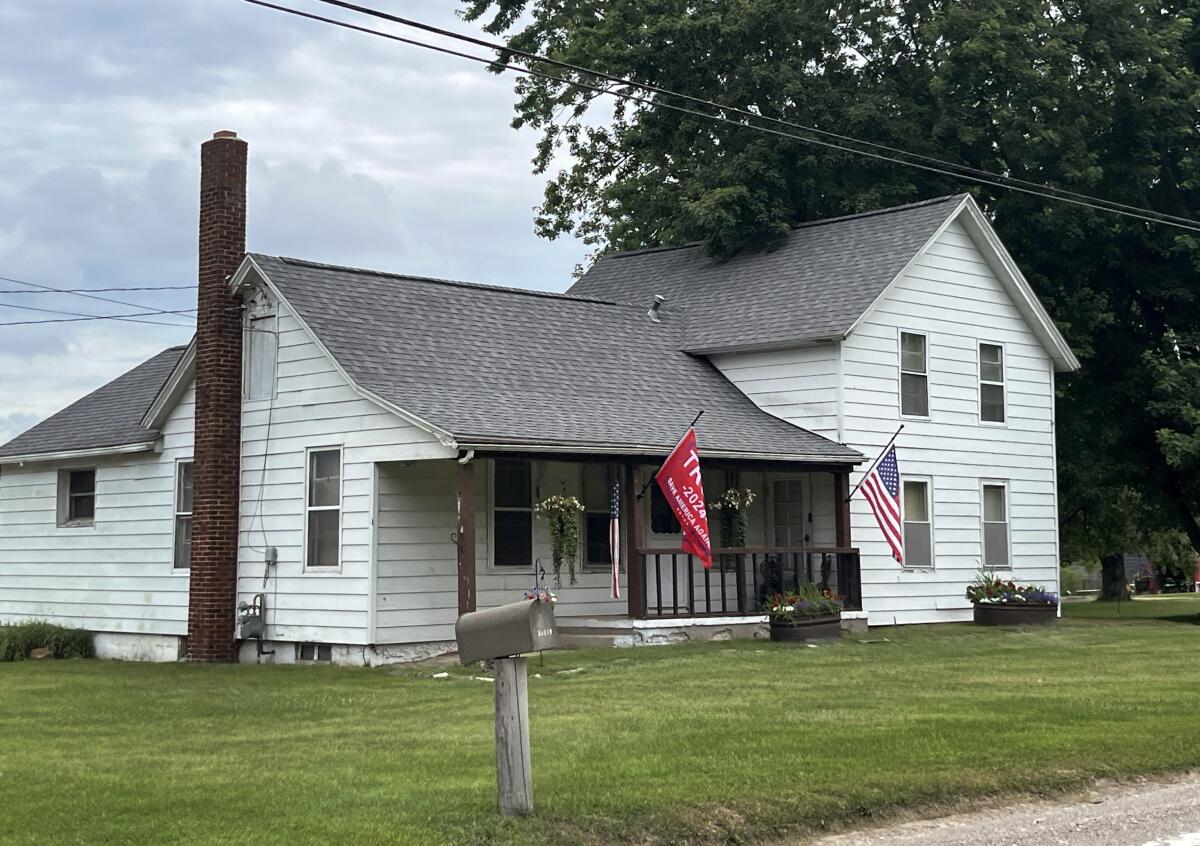
A Trump flag flies outside a home on a country road in Macomb County, Mich.
(Connor Sheets / Los Angeles Times)
As Joan Saunders headed into Christians Greenhouse in rural Williamstown to shop for plants, she said she’s “for Trump,” but doesn’t have a sign or flag supporting his candidacy outside her home.
The election is “just not as big this time around,” said Saunders, who lives in an unincorporated community in Ingham County. She said she, too, has seen far less visible support for the presidential candidates this election cycle. “People know who they’re voting for, and they are sick of the games.”
Nicholas Valentino, a political science professor at the University of Michigan, cautioned that it’s still too early to draw broad conclusions from the dearth of signs and flags.
He said much of the political emphasis in Michigan is focused on the Tuesday primary, which will help determine who will fill the state’s open U.S. Senate seat, all of its 13 seats in the House of Representatives, and a number of state and local positions. There will likely be “a pretty dramatic change” after the primary, he said, with both political parties pouring money and energy into the presidential election.
“Salience and energy in the race is very important, and it’s going to tell the tale when we find out who wins in November,” Valentino said. “The outcome of the election will pivot not so much on how each campaign is able to persuade voters, it will be a matter of mobilization.”
Michigan is one of a handful of battleground states — one with a recent history of hotly contested elections whose winner also claimed the White House. In 2016, Trump beat Hillary Clinton in Michigan by only about 11,000 votes; four years later, Biden won the state by more than 150,000 votes.
For months before Biden dropped out of the presidential race on July 21, polling consistently showed Trump beating the president in Michigan, typically by fairly slim margins. But a poll conducted by Bloomberg News/Morning Consult between July 24 and 28 showed Harris with an 11-point lead over Trump in the state.
Multiple Michigan political experts described the poll as an outlier, and said the race will be far tighter come November. While most Michigan voters live in big cities and suburbs, the rural vote could play a key role in an exceedingly close election.
Some experts expect high voting rates in the state again this year. Corwin D. Smidt, an associate professor of political science at Michigan State University, said via email that he “will know a lot more after Tuesday’s primary,” but “right now my models expect turnout will be very close to 2020.”
‘Some people are tired of his antics’
As the county seat of Macomb County, northeast of Detroit, Mount Clemens is home to more than 15,000 people — more a sleepy outlying suburb of the Motor City than a true rural small town like Evart. Trump carried Macomb County by just 8 percentage points in 2020, a far smaller margin than in rural counties such as Osceola, where Trump commanded more than 72% of votes, and Gratiot, where the former president defeated Biden by more than 28 percentage points.
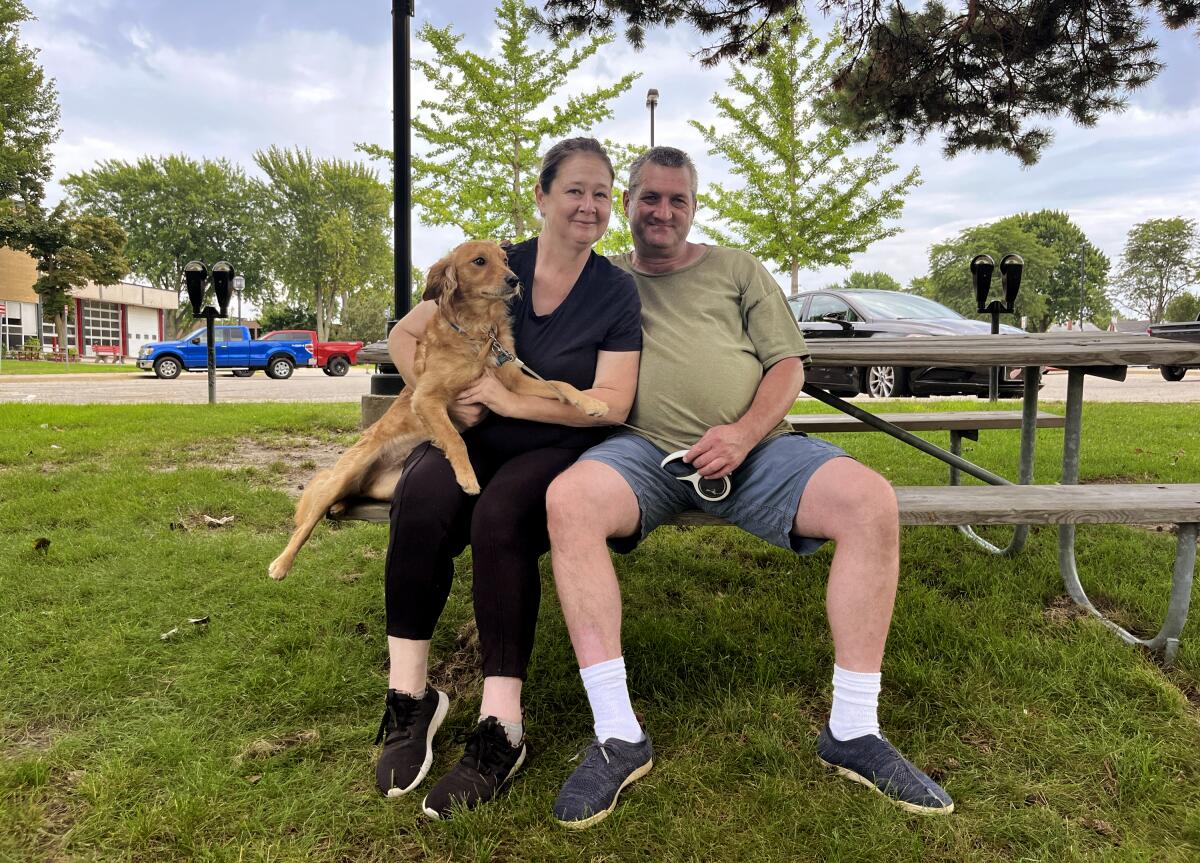
Mickey Kraft, right, and Kristy Kitchen sit in a Mount Clemens, Mich., park with Kraft’s dog.
(Connor Sheets / Los Angeles Times)
In conversations with several people who were enjoying a greenspace in the shadow of Mount Clemens’ City Hall on Monday, the overriding sentiment, as in many more rural areas, was that the 2024 presidential campaign season is uninspiring and passing by without much fanfare.
Mickey Kraft and Kristy Kitchen, both Trump supporters, said they believe many people’s enthusiasm for the former president has flagged.
“People love Trump and everything, but some people are tired of his antics,” said Kraft, 52.
Kitchen, 47, added that she’s “not afraid to put a Trump sign in my yard” in nearby Roseville, but she thinks many people will opt out of that ritual this year.
“People don’t care who the president is,” she said. “They care who gives them money. They care about gas prices, how much groceries cost.”
Some rural and suburban Michiganders also reported a general sense of unease and even fear, particularly those who say they were spooked by the attempted assassination of Trump at a rally in Pennsylvania last month. Kitchen said she “kind of shut down” her previously active Facebook account after the attack, because the political rhetoric got too heated.
Raffy Castro, 22, was fishing for bass from a dock over the Clinton River on Monday afternoon. Though this will be the first election the Sterling Heights resident has voted in, he recalled much higher enthusiasm in the lead-up to the 2020 election.
“I haven’t heard people talking about it,” he said. “I think people are scared, especially with the shooting. I guess people don’t want to portray who they support.”
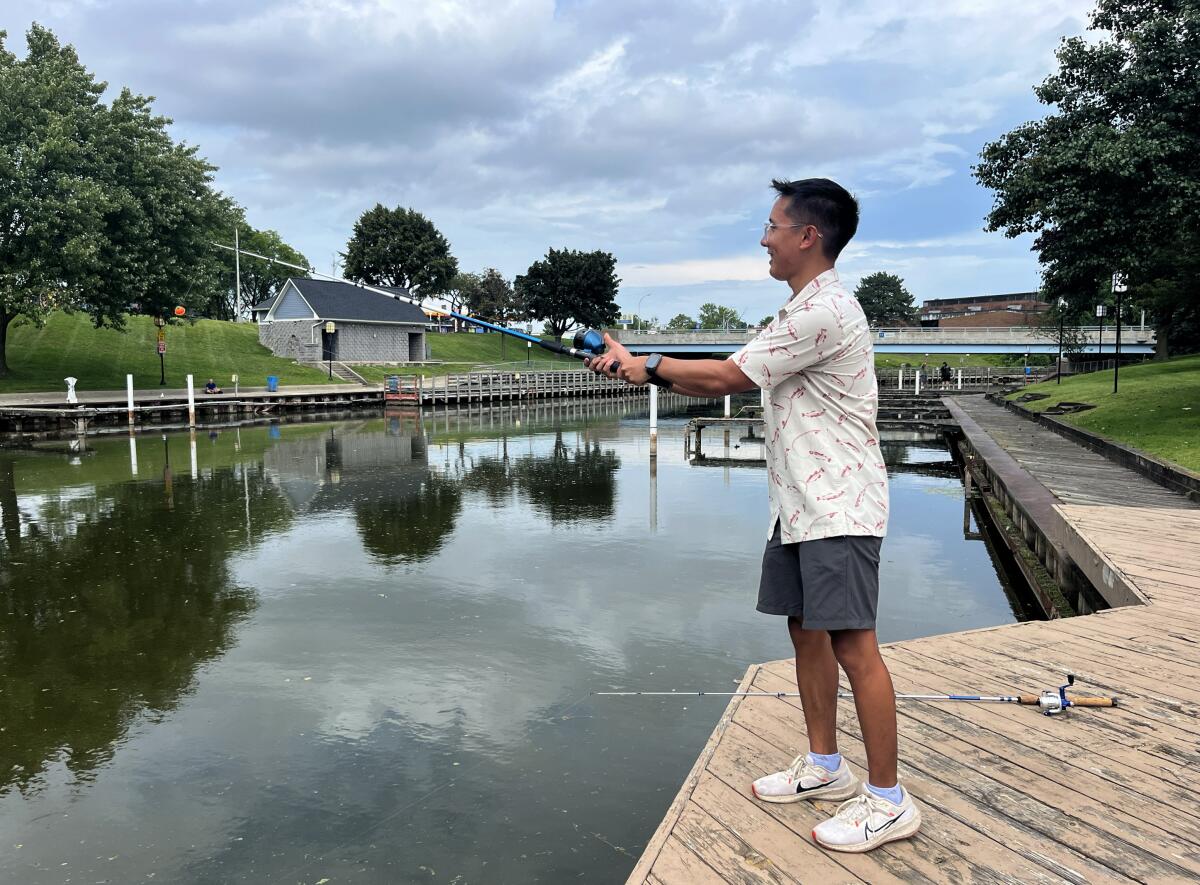
Raffy Castro fishes in the Clinton River at a park in Mount Clemens, Mich.
(Connor Sheets / Los Angeles Times)
In Clare, a rural town about 150 miles northwest of Mount Clemens, Gene and Cindy Gibson chalked up the lack of excitement to a broader malaise.
“I think a lot of people are voting for the lesser of two evils,” Gene Gibson said of Trump and Harris. “And people don’t want to vote for either of them. They’re tired of all the fighting.”
Whatever the reason, Matthew Grossmann, director of the Institute for Public Policy and Social Research at Michigan State University, said this year’s level of public-facing political expression has a different feel.
“In 2016 and 2020, people didn’t wait for the signs to be produced,” he said. “They were making their own and painting the sides of barns, and we’re seeing a lot less of that.”

Michigan
Michigan basketball champ Yaxel Lendeborg joins Warriors, gets chance to learn from Curry, Draymond Green

NEW YORK – Michigan Wolverines national champion Yaxel Lendeborg grew up rooting against Stephen Curry and Draymond Green; now he’ll be learning from them.
The Golden State Warriors selected him with the No. 11 overall pick in the 2026 NBA draft on Tuesday night, adding a versatile, defense-first playmaker from a national championship team to a franchise built on championship standards.
“It’s a full-circle moment for me,” Lendeborg said after being drafted.“I’ve been saying this every time I get asked this question, but in 2016, I’m a big Kyrie guy, so I used to hate Steph Curry. So now that I’m actually gonna be on the same team with him, play and actually learn so much from him, it means a lot.”
Lendeborg said Curry’s reputation extends beyond the court.
“I met him a couple of times. He’s a very great guy, genuine person, and it’s gonna be an honor to be able to watch him do what he does in person,” Lendeborg said.
Lendeborg is coming off a breakout season at Michigan, where he helped former coach Dusty May’s Wolverines win a national championship.
He became one of college basketball’s top defenders, earning a spot on the Big Ten All-Defensive Team while developing into a versatile forward who could impact the game on both ends.
“I feel like what will translate quickly for me would be just my defense, my versatility,” Lendeborg said. “Just the IQ of the game, making the right reads, making the play at the right time.”
In Golden State, Lendeborg will also have a chance to learn from veteran Draymond Green, the longtime Warriors leader and Michigan State Spartans legend, known for defense, playmaking, and voice in the locker room.
One immediate adjustment will be a new jersey number.
Lendeborg wore No. 23 at Michigan, but Green wears it for the Warriors.
Lendeborg joked that his backup choice, No. 3, is also unavailable.
“I think now that I’m stepping into the NBA, I’m going to step in with another number and start a new legacy,” Lendeborg said.
He also carried his Michigan rivalry energy with him on draft night. Asked if he would wear Michigan State gear to convince Green to give up No. 23, Lendeborg quickly said no.
“Nah, I’m not doing that, man,” Lendeborg said. “I hate those guys. I only been there for one year, but I definitely hate those guys.”
Lendeborg pointed to Michigan’s success against the Spartans during its title run.
“They can’t really say much because I went 2-0 against them this year,” Lendeborg said. “They’re gonna be little brother for me forever.”
Lendeborg also said his decision to return to college for another season helped him develop before making the jump to the NBA.
“When I was getting recruited by Dusty, he said he was going to make me a lottery pick,” Lendeborg said. “Evidently, he made me a lottery pick.”
“I went back because I didn’t feel like I was ready yet,” Lendeborg added. “I wanted to become a better person, better player. I wanted to develop pro habits.”
Michigan’s championship group shared draft night moments as several Wolverines were selected in the first round.
Lendeborg said the players stayed connected throughout the process.
“We were all super excited, super nervous,” Lendeborg said. “We were just talking about who we think is going to go first, who’s going where.”
He also joked that Dusty May would leave Michigan for the Dallas Mavericks after the title, then select teammate Morez Johnson Jr. No. 9 overall.
“I’m definitely mad at Dusty right now because we know who his favorite is now,” Lendeborg said.
Despite the banter, he said he was happy for his former teammate.
“I’m super happy for Morez. He definitely deserves it, and he’s going to be a great pro for sure,” he said.
Now Lendeborg heads to Golden State with the confidence of a champion and the chance to learn from champions.
“I’m super excited,” Lendeborg said. “I’m excited to be there and play
Copyright 2026 by WDIV ClickOnDetroit – All rights reserved.


Amazon Prime Day 2026 will span four days next week. Here’s when
Amazon Prime Day 2026 begins next week and will last for four days. Only Prime members benefit from Amazon’s biggest annual sales event.
Prime Day is in full swing, and as Michigan residents scroll though deals, there are Michigan-themed coffee/tea mugs to consider, perhaps for a gift or to spice up your morning sip.
Amazon Prime Day — the 4-day event of discounted items for Prime members — begins at 3:01 a.m. ET on Tuesday, June 23, and ends at 2:59 ET, on Friday, June 26.
Here are five fun Michigan-themed mugs to consider as you shop for deals this week:
Michigan coffee mug by Primitives by Kathy
The 18-fluid-ounce Michigan-inspired stoneware mug is designed to represent the state with its scattered wraparound design. It includes a large outline of the state and a deer, surrounded with key words such as “yoopers,” “fudge,” “Big Mac,” “dunes,” “Great Lakes,” “we’re smitten in the mitten,” and others.
It is priced at $11.48 on Amazon Prime. Primitives By Kathy is the name of the company.
Sip and admire a detailed map of Michigan by Xplorer Maps
The founder and owner of the company, Xplorer Maps, illustrates maps by hand on everyday items such as a mug. On Amazon, there is a 16-fluid-ounce mug available that features a map of Michigan on one side with landmarks, and other illustrations of what Michigan is known for on the other side.
It is priced at $19.99 on Amazon Prime.
Represent Michigan with a Detroit Lions coffee mug
There are several Detroit Lions-themed coffee mugs available on Amazon Prime. One design by Rico Industries is a 12-ounce campfire mug fully coated in the iconic honolulu blue shade with a speckled print and the team’s logo.
It is priced at $16.52 on Amazon Prime.
On-the-go Michigan-inspired travel mug
In another busy Michigan design, Swig Life’s 22-ounce insulated travel mug is scattered with the state’s landmarks and key illustrations. The travel mug is cup holder friendly and is stainless steel with a handle.
It is priced at $30.07 on Amazon Prime.
Simple Michigan coffee mug deal on Prime Day
For those who are looking for a more straight-forward design, the coffee mug by Andaz Press via Amazon is perhaps an option. The 11-ounce mug includes a simple print of Michigan’s silhouette with the word “home” beside it.
It is priced at $14.21 on Amazon Prime.
Contact Sarah Moore @ smoore@lsj.com

Lansing — Michigan residents will be able to begin voting this week in the state’s Aug. 4 primary election with nominations for governor, the U.S. Senate, the U.S. House and the Legislature hanging in the balance.
Under the Michigan Constitution, by Thursday — 40 days before Election Day — clerks have to ensure that absentee ballots are available for voters and that ballot dropboxes, through which the ballots can be returned, are accessible.
Michael Siegrist, the clerk in Canton Township, said this week marks the start of the election.
“Most of the voters in Michigan are going to have a ballot in their hand within the next week or two,” Siegrist said.
Siegrist, a Democrat and the president of the Michigan Association of Municipal Clerks, was referring to the fact that most of the vote in the primary election is expected to come through absentee ballots.
In the August 2024 primary election, as an example, about 65% of the vote in Michigan’s largest county, Wayne County, came via absentee ballots.
Adrian Hemond, a Michigan political consultant and CEO of the firm Grassroots Midwest, said it will be difficult this year for candidates who go into Election Day behind their opponents on absentee ballots to catch up.
“It’s basically the election,” Hemond said of the absentee ballot window.
A larger portion of the vote in primaries comes through absentee ballots than in general elections because there’s usually a smaller pool of voters in primaries and primary participants tend to be more educated about their ballot options.
Before 2018, Michigan voters generally had to have an explanation to cast an absentee ballot, like they planned to be out of state on the date of the election. But in 2018, they approved a ballot proposal that allowed for no-reason absentee voting, broadly providing the option to submit an absentee ballot through the mail, a dropbox or by turning it in at the clerk’s office.
Local clerks can’t begin processing and tabulating the absentee ballots until July 27, at the earliest.
Also, in July, Michiganians can begin voting early in person into a tabulator. The exact date of the early voting window opening depends on decisions made by local clerks, but it has to start statewide by July 25.
In Michigan’s last primary election in a year when the governor’s office was on the ballot, about 2.17 million voters participated, according to the Secretary of State’s tracking.
Both Republican and Democratic primary ballots have contested races for their gubernatorial nominations this year.
On the Democratic side, voters will pick between Secretary of State Jocelyn Benson of Detroit and Genesee County Sheriff Chris Swanson. On the GOP side, there are four candidates on the ballot: former Attorney General Mike Cox of Livonia, U.S. Rep. John James of Shelby Township, businessman Perry Johnson of Bloomfield Hills and state Senate Minority Leader Aric Nesbitt of Porter Township.
Early polling has indicated that Republican gubernatorial race and the Democratic campaign for U.S. Senate might be close. The Democratic U.S. Senate contest has three contenders: former public health official Abdul El-Sayed of Ann Arbor, state Sen. Mallory McMorrow of Royal Oak and U.S. Rep. Haley Stevens of Birmingham.
Former U.S. Rep. Mike Rogers is the lone Republican candidate for U.S. Senate.
Tony Forlini, the clerk in Macomb County, said he expects voters who are on the permanent absentee ballot list to begin getting the ballots in the coming days. Some of them will turn their filled-out ballots in as soon as they have the chance, Forlini said.
“We’re ready for it,” said Forlini, a Republican who’s running for secretary of state this fall
In Michigan’s largest city, Detroit, election officials are sending out 99,000 absentee ballots for the primary, said Matt Friedman, spokesman for Detroit Votes, the nonpartisan voter information campaign that partners with Detroit’s elections department.
“Voters are starting to receive absentee ballots this week for the primary election, as they have for the third consecutive year in Detroit, under Michigan’s absentee and early voting laws that took effect in 2024 as part of Michigan’s Constitution,” Friedman said.
In the August 2024 primary, about 63% of Detroit’s 84,994 ballots cast were absentee, about 3% were early votes and about 34% were in-person Election Day votes.
cmauger@detroitnews.com,
-
 Lifestyle7 minutes ago
4 ways to design a dreamy summer, according to a happiness expert
-

 Education12 minutes ago
Video: School Year Cut Short and Aid Delivery Slowed Amid Fuel Crisis in Cuba
-

 Technology19 minutes ago
Our favorite Prime Day deals you can shop on day two
-

 World22 minutes ago
Kim Jong Un calls for North Korea to build 2 large warships per year in major naval expansion push: report
-

 Politics27 minutes ago
Trump to kick off Great American State Fair as 250th anniversary celebrations take over National Mall
-

 Health34 minutes ago
One common type of fat may increase diabetes risk, while another helps fight it
-

 Sports37 minutes ago
ESPN’s Jay Williams faces awkward ribbing from colleagues during NBA Draft
-

 Technology42 minutes ago
Helmet-style cockpit vision system aims to change how pilots see in low visibility

