Brandy Jones and Justin Patterson were hoping to find a restaurant with prime rib on the menu as they walked along the main street in this small Central Michigan town of about 1,750.
Justin Patterson and Brandy Jones in downtown Evart, Mich.
(Connor Sheets / Los Angeles Times)
Advertisement
The pair said they have seen little evidence of the presidential election this year in their hometown outside Lansing, on the nearly two-hour drive to the Evart area, where they were vacationing, or even on social media. That’s a major shift from past campaign seasons, according to Jones.
“I’m actually seeing a lot less campaign signs and advertisements,” she said Monday afternoon. “Usually this time during an election year, we’re being bombarded with it and I’d be over it and irritated. This year it’s just nothing.”
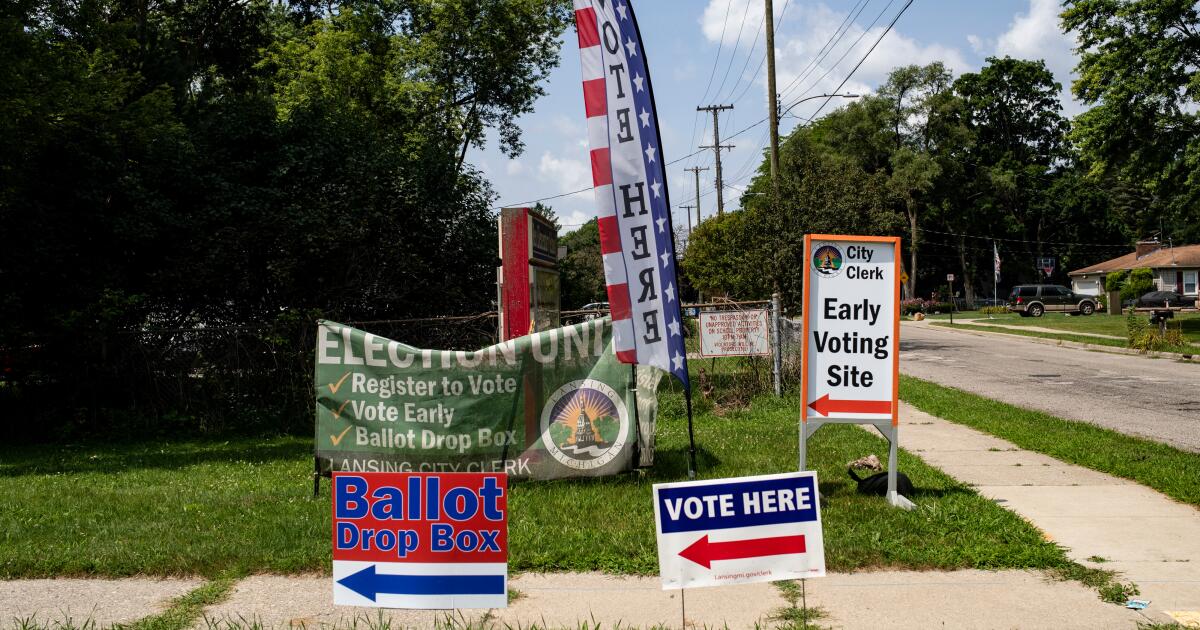
While the relative prevalence of campaign signs is hardly a scientific indicator of voter enthusiasm, election day is just three months away and you wouldn’t know it by visiting or driving through many rural stretches of Michigan.
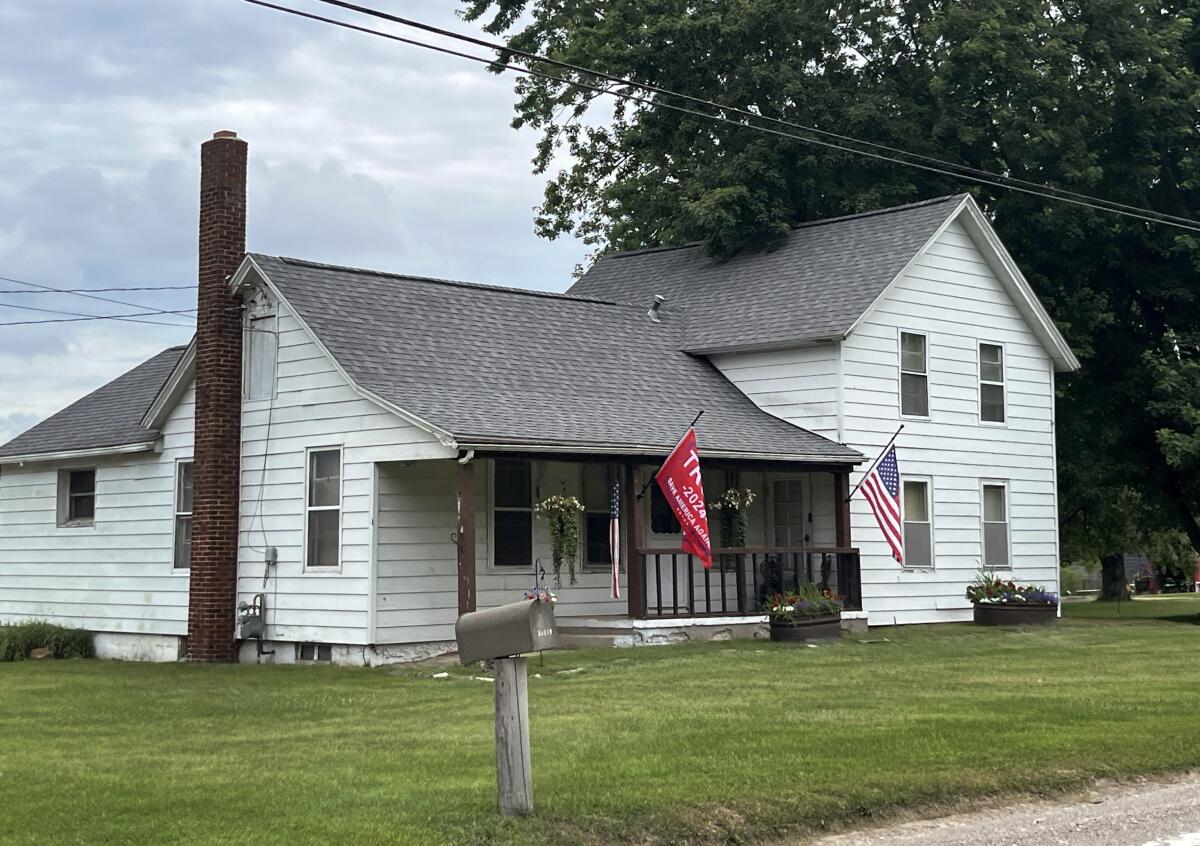
A Times reporter who drove hundreds of miles across a broad swath of the state last week, mostly on rural main streets, country roads, gravel lanes and highways, spotted only 16 presidential campaign signs and flags and a single billboard, all in support of former President Trump.
Advertisement
Several Michigan political experts agreed that it’s far different from the nearly ubiquitous pro-Trump yard signs and flags that characterized even the early lead-ups to the last two presidential elections.
“I am beginning to see just a few here and there in the last couple weeks, but it has been noticeably different than 2016 or 2020,” said Thomas Ivacko, the recently retired executive director of the University of Michigan’s Center for Local, State, and Urban Policy, who travels frequently to largely rural Benzie County in the state’s northwest.
In more than two dozen interviews last week, rural Michiganders chalked that gap up to a weariness of what they describe as a broken political system, fear of repercussions for sharing their views, and a lack of passion for the politicians at the top of both parties’ tickets.
The result? In rural Michigan, the 2024 presidential election is all but invisible.
‘Just not as big this time around’
Along a 42-mile stretch of hilly backroads in Ingham and Livingston counties, east of Lansing, dozens of signs advertised a local “U-Pick Festival,” equestrian summer camps and down-ballot politicians, but only one flag and one sign for Trump was visible — and none for President Biden or presumptive Democratic nominee Vice President Kamala Harris.
Advertisement
A Trump flag flies outside a home on a country road in Macomb County, Mich.
(Connor Sheets / Los Angeles Times)
As Joan Saunders headed into Christians Greenhouse in rural Williamstown to shop for plants, she said she’s “for Trump,” but doesn’t have a sign or flag supporting his candidacy outside her home.
The election is “just not as big this time around,” said Saunders, who lives in an unincorporated community in Ingham County. She said she, too, has seen far less visible support for the presidential candidates this election cycle. “People know who they’re voting for, and they are sick of the games.”
Nicholas Valentino, a political science professor at the University of Michigan, cautioned that it’s still too early to draw broad conclusions from the dearth of signs and flags.
Advertisement
He said much of the political emphasis in Michigan is focused on the Tuesday primary, which will help determine who will fill the state’s open U.S. Senate seat, all of its 13 seats in the House of Representatives, and a number of state and local positions. There will likely be “a pretty dramatic change” after the primary, he said, with both political parties pouring money and energy into the presidential election.
“Salience and energy in the race is very important, and it’s going to tell the tale when we find out who wins in November,” Valentino said. “The outcome of the election will pivot not so much on how each campaign is able to persuade voters, it will be a matter of mobilization.”
Michigan is one of a handful of battleground states — one with a recent history of hotly contested elections whose winner also claimed the White House. In 2016, Trump beat Hillary Clinton in Michigan by only about 11,000 votes; four years later, Biden won the state by more than 150,000 votes.
For months before Biden dropped out of the presidential race on July 21, polling consistently showed Trump beating the president in Michigan, typically by fairly slim margins. But a poll conducted by Bloomberg News/Morning Consult between July 24 and 28 showed Harris with an 11-point lead over Trump in the state.
Multiple Michigan political experts described the poll as an outlier, and said the race will be far tighter come November. While most Michigan voters live in big cities and suburbs, the rural vote could play a key role in an exceedingly close election.
Advertisement
Some experts expect high voting rates in the state again this year. Corwin D. Smidt, an associate professor of political science at Michigan State University, said via email that he “will know a lot more after Tuesday’s primary,” but “right now my models expect turnout will be very close to 2020.”
‘Some people are tired of his antics’
As the county seat of Macomb County, northeast of Detroit, Mount Clemens is home to more than 15,000 people — more a sleepy outlying suburb of the Motor City than a true rural small town like Evart. Trump carried Macomb County by just 8 percentage points in 2020, a far smaller margin than in rural counties such as Osceola, where Trump commanded more than 72% of votes, and Gratiot, where the former president defeated Biden by more than 28 percentage points.
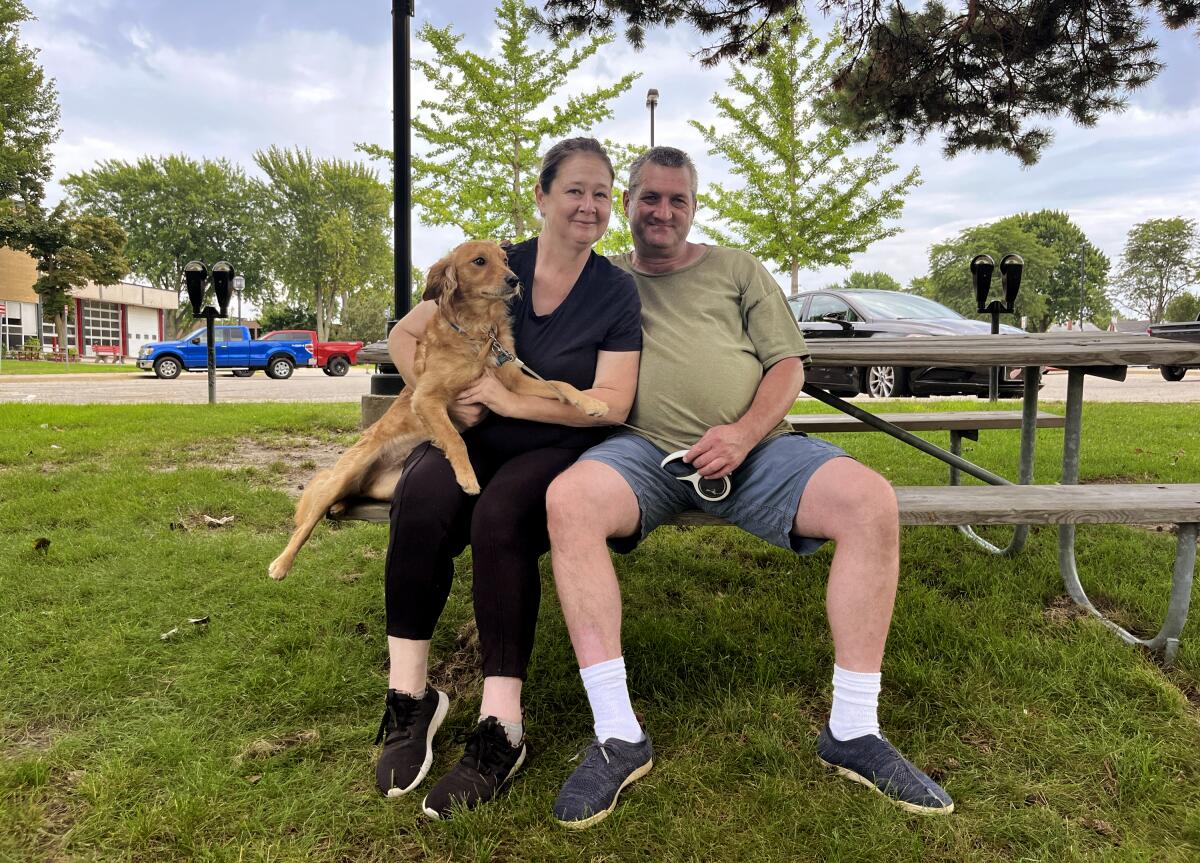
Mickey Kraft, right, and Kristy Kitchen sit in a Mount Clemens, Mich., park with Kraft’s dog.
(Connor Sheets / Los Angeles Times)
In conversations with several people who were enjoying a greenspace in the shadow of Mount Clemens’ City Hall on Monday, the overriding sentiment, as in many more rural areas, was that the 2024 presidential campaign season is uninspiring and passing by without much fanfare.
Advertisement
Mickey Kraft and Kristy Kitchen, both Trump supporters, said they believe many people’s enthusiasm for the former president has flagged.
“People love Trump and everything, but some people are tired of his antics,” said Kraft, 52.
Kitchen, 47, added that she’s “not afraid to put a Trump sign in my yard” in nearby Roseville, but she thinks many people will opt out of that ritual this year.
“People don’t care who the president is,” she said. “They care who gives them money. They care about gas prices, how much groceries cost.”
Some rural and suburban Michiganders also reported a general sense of unease and even fear, particularly those who say they were spooked by the attempted assassination of Trump at a rally in Pennsylvania last month. Kitchen said she “kind of shut down” her previously active Facebook account after the attack, because the political rhetoric got too heated.
Advertisement
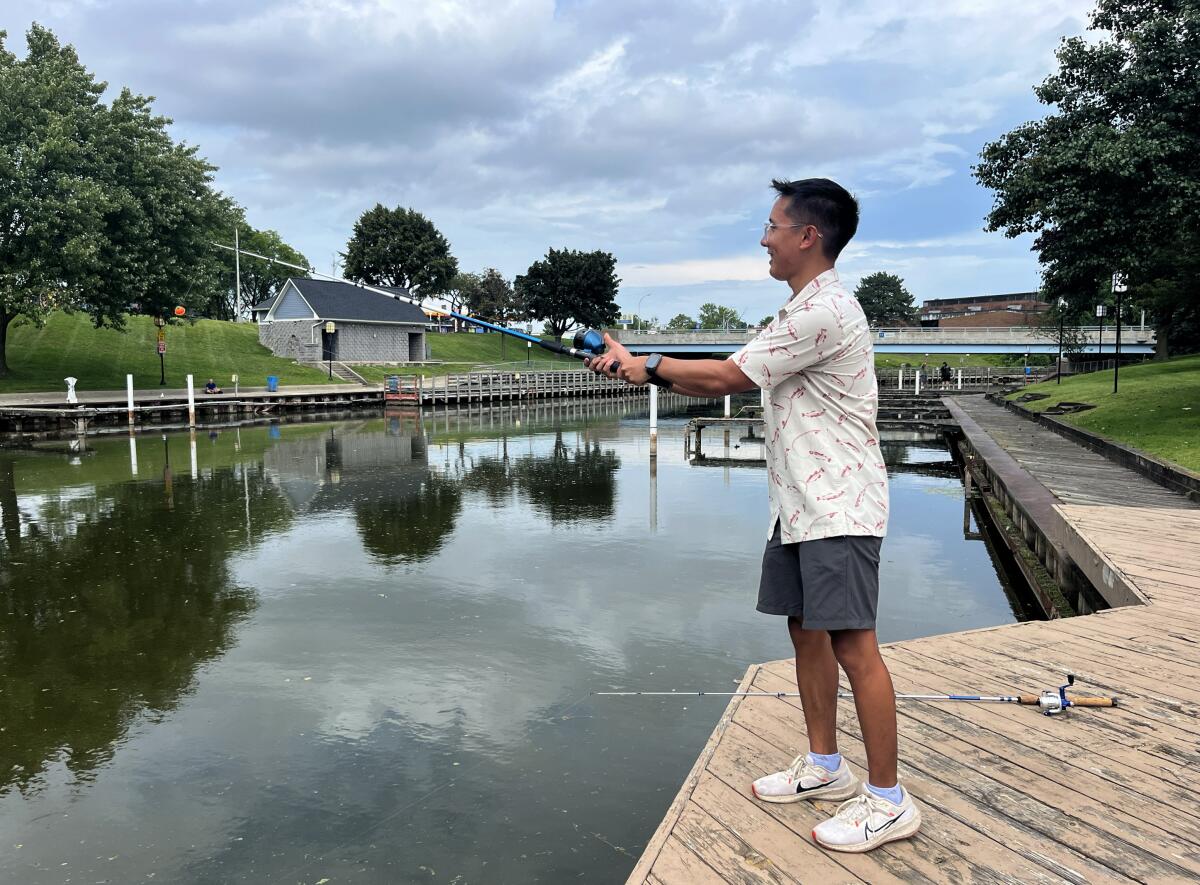
Raffy Castro, 22, was fishing for bass from a dock over the Clinton River on Monday afternoon. Though this will be the first election the Sterling Heights resident has voted in, he recalled much higher enthusiasm in the lead-up to the 2020 election.
“I haven’t heard people talking about it,” he said. “I think people are scared, especially with the shooting. I guess people don’t want to portray who they support.”
Raffy Castro fishes in the Clinton River at a park in Mount Clemens, Mich.
(Connor Sheets / Los Angeles Times)
In Clare, a rural town about 150 miles northwest of Mount Clemens, Gene and Cindy Gibson chalked up the lack of excitement to a broader malaise.
Advertisement
“I think a lot of people are voting for the lesser of two evils,” Gene Gibson said of Trump and Harris. “And people don’t want to vote for either of them. They’re tired of all the fighting.”
Whatever the reason, Matthew Grossmann, director of the Institute for Public Policy and Social Research at Michigan State University, said this year’s level of public-facing political expression has a different feel.
“In 2016 and 2020, people didn’t wait for the signs to be produced,” he said. “They were making their own and painting the sides of barns, and we’re seeing a lot less of that.”
Vytas Reid joins the CBS Detroit team as a meteorologist, having previously worked in West Palm Beach, Florida, as well as Baltimore and Flint.
Read Full Bio
Advertisement
Paula Wethington
Web Producer
Paula Wethington is a digital producer at CBS Detroit. She previously held digital content roles at NEWSnet, Gannett/USA Today network and The Monroe News in Michigan. She is a graduate of the University of South Carolina.
Read Full Bio
Advertisement
/ CBS Detroit
Advertisement
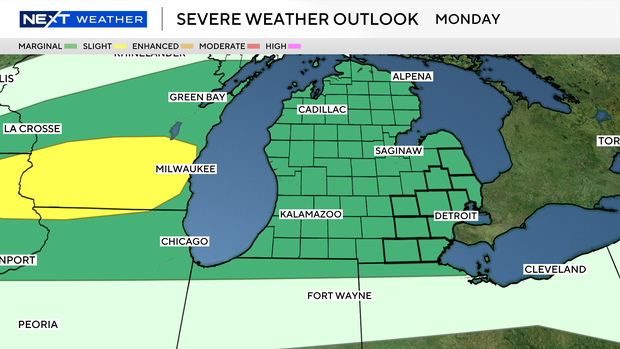
Southeast Michigan will see an increasingly severe weather threat from Monday night into Tuesday, starting with warming temperatures in the 60s and 70s across the area.
The National Weather Service Storm Prediction Center outlook for March 30, 2026.
CBS News Detroit
Monday’s weather
A marginal risk (level 1/5) is in place for Monday night, meaning only isolated severe storms are expected, mainly after 7 p.m. through midnight. The primary threats will be hail around 1 inch and a few localized damaging wind gusts, with storms moving quickly west to east, with storm coverage remaining limited.
Advertisement
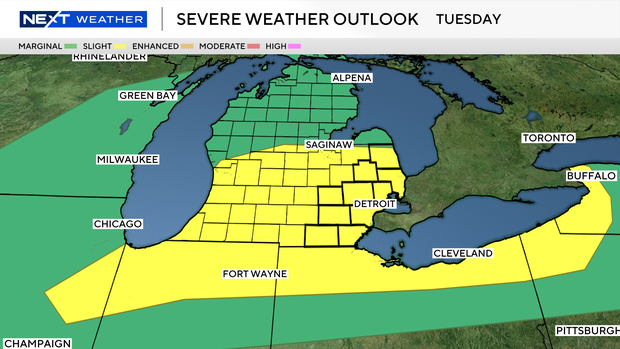
The Storm Prediction Center outlook for March 31, 2026.
CBS News Detroit
Tuesday’s weather
By contrast, Tuesday brings a Weather Alert Day with a slight risk (level 2/5), indicating a higher chance of more organized and scattered severe storms through the day as a cold front moves through.
On Tuesday, all severe weather hazards are possible, including damaging winds (potentially 60+ mph), large hail, heavy rainfall, and even a low risk of tornadoes, with damaging winds expected to be the main concern.
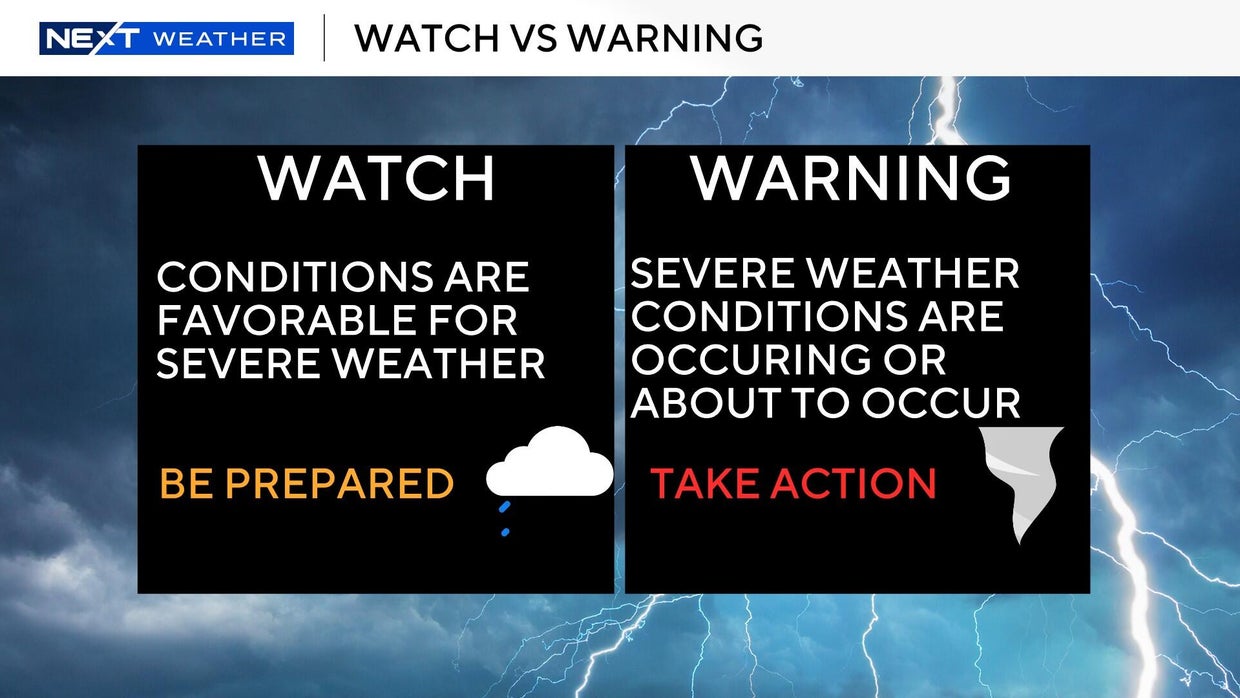
Explanation of a severe weather watch and a severe weather warning when issued by the National Weather Service.
Advertisement
CBS News Detroit
Watch vs. warning
The National Weather Service says a severe weather watch means “be prepared.” It is possible that the weather will reach severe levels during the time frame specified.
A severe weather warning means “take action,” that severe weather conditions have been reported by spotters or can be detected on radar. People are asked to take shelter indoors, away from windows.
It is possible for a tornado warning to be issued without a tornado watch already in effect. This is the scenario that happened in Southwest Michigan on March 6, 2026.
Jim Harding has landed his first commitment on the recruiting trail as offensive line coach in Ann Arbor, as 2027 four-star Sidney Rouleau announced on Sunday night that he will be playing college football for at Michigan.
Rouleau — a native of Canada but now playing high school football at The Brook Hill School in Bullard, Texas — is coming off an unofficial visit to Michigan this weekend. That was his third time in Ann Arbor, as he also visited for the Purdue game last fall and another time a couple summers ago.
Understandably so, Rouleau had great things to say after his most recent trip.
“My visit to Michigan was awesome,” Rouleau told Rivals’ Steve Wiltfong ($). “The energy around the program is contagious, and I really connected with the coaches and players. What excites me most about playing for coach (Kyle) Whittingham and the Wolverines is the chance to be part of building something special. Their vision for the future, combined with the tradition and passion of the fanbase, makes it an opportunity I couldn’t pass up. I’m excited to contribute to their success and also being able to play for coach Harding!”
Advertisement
Rouleau is listed at 6-foot-5 and 240 pounds, per Rivals, but 247Sports has him listed at 6-foot-7 and 269 pounds, so he may be a bit bigger than Rivals’ last update on him. Regardless, the expectation is that he will eventually play one of the tackle positions at Michigan.
Other than the Wolverines, Rouleau also earned offers from Ohio State, Clemson, Penn State, Oregon, Georgia, USC, Wisconsin, Texas, Alabama, Oklahoma Miami, Washington, Florida, Florida State and many others.
Michigan is now up to six total commitments in the 2027 recruiting class, and three of them are offensive linemen — Rouleau, and three-stars Louis Esposito and Tristan Dare. Rouleau also joins four-star edge rusher Recarder Kitchen, four-star safety Darrell Mattison and three-star safety Maxwell Miles in the class.
Rouleau is ranked No. 300 overall on the Rivals Industry Ranking. Check out some of his junior year highlights down below.
The remainder of the bracket is going to be tough for the Michigan Wolverines, including Sunday’s tilt against the Tennessee Volunteers, but of the two options for the Elite Eight, this was the preferrable opponent. Analytics believe this squad is underseeded (No. 11 overall per Kenpom), but compared to the swarming defense of Iowa State, the Wolverines have to feel great about their chances of advancing to the Final Four.
The Vols lost four of their last six games heading into the NCAA Tournament, though were impressive against Miami (OH), Virginia, and Iowa State. Their defense is solid (11th) while the offense is productive (31st), perhaps making their No. 6 seed a little misleading. Still, Michigan is the better overall team here, and unfortunately the odds of a third straight year of losing to a No. 1 seed in the Elite Eight are quite high for Rick Barnes and company.
Date & Time: Sunday, March 29, 2:15 p.m. ET Location: United Center, Chicago, IL TV/Streaming: CBS
Advertisement
Oddly, this is the fourth Tournament meeting between these schools since 2010-11, with the prior three favoring the maize and blue. That first contest was a 30-point First Round blowout, followed by a narrow Michigan win in the 2013-14 Sweet Sixteen. The most recent edition was also a close one, with Hunter Dickinson and Eli Brooks each topping 20 points as the No. 11 Wolverines upset No. 3 Tennessee in the Second Round in 2021-22.
Tennessee 2PT Defense: 49.0% (63rd)
The most obvious path to victory for Michigan over Alabama was using its huge size advantage in the paint, yet both Aday Mara and Morez Johnson had games to forget. The bigs will get their chance for redemption on Sunday against a Tennessee defense that is much better than its SEC rival’s, yet is beatable down low. Weak hands and poor finishing will not work against this frontcourt, but the Wolverines have proven they can win physical battles all year.
As fun as March Roddy (Gayle) is, or the rapid emergence of Trey McKenney, Michigan will not win a national championship if it does not get substantial production from the Mara-Johnson duo. Enough others contributed against the Tide to still claim the win, and perhaps that could be possible again in the Elite Eight, but it would give a lot more confidence heading into the final weekend if these two could bounce back in a big way. The Vols have had issues fouling too, so being aggressive at the rim is a must.
Tennessee Offensive Rebounding: 45.1% (1st)
Advertisement
Yes, that is correct — Tennessee grabs nearly half of its own misses. With an effective field goal rate around 140th, this is less extreme than the Texas A&M gameplan last year, but surely no one will be caught sleeping after witnessing the Vols collect 53.3% (!!) of their opportunities against the Cyclones on Friday. Without basically any outside shooting, second-chance points are the only way this offense scores enough to keep it close.
However, since the Duke and Illinois games, the Wolverines have been pretty solid on the defensive glass and should feel capable of at least reducing the impact of Tennessee’s rebounding. The Michigan frontcourt can match up body-to-body, and this is another way Mara and Johnson can make huge contributions. Like Saint Louis and Alabama hitting threes, there will be frustrating stretches of elongated possessions, but the key is just getting enough rebounds to stop any torrent.
Tennessee Defensive 3PT Rate: 44.7% (33oth)
Few teams see more opposing three-point attempts than the Vols do, yet this rarely seems to burn them, as opponents connect on just 30.3% of their shots, which is 11th-best nationally. This resilience is going to be really tested by a Michigan offense that is making 47.3% of its threes in the Tournament thus far after a cold Big Ten Tournament. The touch could certainly cool off on Sunday, but is that a bet Tennessee really wants to take?
If the Wolverines can stay disciplined and keep taking the high-percentage looks, this should be a huge factor on Sunday. While I still would like to see the offense attack the paint, there are too many good shooters on the roster to not take advantage when the defense is passive. Should Barnes choose to start closing out on shooters, there will be paths open to the hoop. Though the metrics consider this a strong defense, it feels like there is an easy way Michigan blows this game open.
Advertisement
Tennessee Adj. Offense: 31st
As a whole, the Tennessee offense appears fine, but the analytics are actually kind of sour on most of the parts. Bad free throw shooting (286th) on modest attempts (103rd), too many turnovers (233rd), limited three-point attempts (329th), and a slow tempo (290th) make me wonder how anything actually happens aside from getting good second-chance looks on offensive rebounds.
Clearly that strategy has worked this year — and over the past two weekends — but the 24-point loss to Florida (with a 17.1% OReb rate) might tell the story of what happens against defenses with size. The best actual shooter is Ja’Kobi Gillespie, who has improved since his combined 6-for-22 effort in two games against Michigan last season, but aside from him and Nate Ament, there is little outside threat.
I do think there will be enough offensive rebounds and tough makes to avoid an instant blowout (though not off the table for the final score), and maybe the Vols’ three-point defense is real, but the ways Michigan can win are so much more numerous than the ways it can lose. Trust the better team to take care of business and move on to Indianapolis next weekend.










 Sports1 week ago
 Miami, FL4 days ago
 South-Carolina2 days ago
 New Mexico1 week ago
 Politics1 week ago
 Tennessee1 week ago
 Minneapolis, MN4 days ago
 Science1 week ago