Michigan
Michigan baby had measles vaccine 1 day before trip to airport with contagious traveler


Measles cases surge to six-year high with over 700 confirmed in 24 states
There are now over 700 cases of measles across 24 U.S. states, according to CDC data, marking the highest number of cases in six years. (Scripps News)
Scripps News
An Ingham County baby who is now infected with measles had one dose of a measles, mumps rubella (MMR) vaccine the day before she traveled through a Michigan airport where another person was contagious, said Dr. Nike Shoyinka, the county’s medical health officer, during an afternoon news conference April 15.
The 12-month-old girl, who has the first documented measles case in Ingham County since 1994, traveled out of state with her family, but there wasn’t enough time between her immunization and her exposure to the virus for the vaccine to fully trigger her immune system and protect her from getting sick, Shoyinka said.
“Usually, what we expect is that our body’s immune system … would have developed full immunity at about a two-week mark” after vaccination, Shoyinka said. “Even though this child was vaccinated, she was still relatively susceptible given the short period of time. However, I will say that this child’s symptoms were very mild … presumably because she had received at least one dose.
“We have been in close contact with the family, who, by the way, have been excellent in providing the information we need about potential exposures, about where they’ve been,” Shoyinka said. “I want to also emphasize that they did exactly what they were supposed to do in terms of making sure that their child was protected as they took her out of state (for) travel.
“This individual is doing well currently and is isolating at home with family.”
The girl visited one of the two Michigan airports where a Kent County traveler exposed potentially hundreds of others to measles in late March — Detroit Metropolitan Airport in Romulus and the Gerald R. Ford International Airport in Grand Rapids, Shoyinka said, though she did not specify which airport the child visited or exactly when.
“It’s unclear at what point the exposure happened during that trip,” she said, noting that health officials are still investigating whether the cases are epidemiologically linked. “We are looking at specimen samples and we have sent them all the way to the CDC (U.S. Centers for Disease Control and Prevention) in order to identify matches to figure out where the exposure happened.”
The tricky thing about measles is that a person can be infectious and spreading the disease for as many as four days before they develop the telltale rash, and for four days after the rash begins, according to the CDC. And the virus is so contagious that even after a person infected with measles leaves the room, up to two hours later, 90% of people without immunity to the virus will get sick if they enter the room.
The Ingham County Health Department issued a news release April 10 detailing multiple exposure sites in Lansing, East Lansing and Okemos from April 4-8 where the girl went with loved ones while potentially infectious. But the health department did not disclose that the child also attended a Lansing day care/preschool over the course of several days in early April, exposing about 50 other children, along with staff members and other visitors.
“We are matching records with every single child and every single family in there to make sure that we can communicate with them (about) what they need to do” to protect themselves and their children, Shoyinka said of the health department’s contact tracing efforts. “If a child was unvaccinated, then we would monitor them for 21 days following the last date of exposure.”
The school’s name was not publicly disclosed, Shoyinka said, because “we are working closely with the school. … They have been very cooperative in terms of giving us a list of the students in the school, the staff, the people who have been there. And so the information that we need in order to communicate with the people who are exposed and provide them with the adequate information is available.
“The other places that are listed are places where it is difficult for us to determine exactly who was there during those time frames.”
Those other known exposure sites, dates and times are:
Friday, April 4: 6 p.m.-8:30 p.m. at the Tractor Supply Co., 5241 W. Grand River Ave., Lansing.
Saturday, April 5:
- 1:30 p.m.-4:30 p.m. at the Farmers Market inside Meridian Mall, 1982 W. Grand River Ave., Okemos.
- 2:30 p.m.-6 p.m. at Aldi, 5165 Marsh Road, Okemos.
Sunday, April 6:
- 10:30 a.m.-2 p.m. at Towar Hart Baptist Church, 6157 Towar Ave., East Lansing. The child spent time in the infant room during the service.
- 5:30 p.m.-9 p.m. at Toscana Restaurant, 3170 E. Michigan Ave., Lansing.
Tuesday, April 8:
- 6 p.m.-10:30 p.m. in the emergency department of the University of Michigan Health-Sparrow, 1215 E. Michigan Ave., Lansing.
- 5:30 p.m.-7:35 p.m. at the MSU Community Music School, 4930 Hagadorn Road, East Lansing. The child was in a bathroom at the school.
Health leaders urge anyone who may have been exposed to measles to monitor for symptoms for 21 days after the date of potential exposure. If symptoms develop, call ahead before visiting a doctor, urgent care center, or hospital emergency department to ensure precautions can be taken to avoid exposing others.
5 Michigan measles cases so far in 2025
The Ingham County child is the fifth person in Michigan to contract the measles this year, the state health department reported, and it comes amid an exploding number of cases in the U.S.
As of April 10, there were 712 confirmed measles cases in the U.S. this year in 24 states — more than double the number of cases nationally in all of 2024, when there were 285, according to the CDC.
Of the cases so far this year, about 70% were among children and teenagers, and 97% were among people who were either unvaccinated or whose vaccination status was unknown.
The other Michigan cases involved include:
- An adult from Oakland County who traveled internationally with an unknown vaccination history and was the state’s first measles case of 2025. The person exposed others March 8-10 at a restaurant in Rochester and at Henry Ford Rochester Hospital.
- A traveler from Kent County who potentially exposed hundreds of other people to measles March 24-28 when visiting Detroit Metropolitan Airport in Romulus and the Gerald R. Ford International Airport in Grand Rapids, along with a restaurant in Kentwood and a Corewell Health facility in East Grand Rapids.
- An adult from Macomb County who traveled to the Windsor-Essex County area of Ontario, Canada. The case was announced April 4, and the person is not believed to have gone out in public while infectious, so there are no known exposure sites.
- A Montcalm County resident whose measles case was announced April 9 by the Mid-Michigan District Health Department. The person recently traveled out of the state, but no details were released about possible exposure sites.
How can I protect myself from measles?
“Our recommendation is for everyone to be vaccinated,” Shoyinka said.
One dose of the MMR vaccine provides about 93% protection against the virus, and two doses offer about 97% coverage, the CDC says. It recommends the following for MMR vaccines:
- A first dose for children at 12 months-15 months old, with a booster dose administered between ages 4 and 6.
- Anyone born during or after 1957 without evidence of immunity against measles or documentation of having been vaccinated with two doses of MMR vaccine should get vaccinated. The second dose should be given no sooner than 28 days after the first.
- People exposed to measles who cannot document immunity against the virus should get post-exposure prophylaxis — a dose of the vaccine to potentially provide protection within 72 hours of initial exposure, or immunoglobulin within six days of exposure.
- The CDC changed its recommendations in 1989 from one dose of the MMR vaccine to two doses, which provides longer-lasting and more robust protection. People born between 1957 and 1989 who have had just a single dose of the vaccine may be at a higher risk of contracting the virus in an outbreak setting.
“We’re really encouraging everyone to contact their primary care provider if they’re not sure about their vaccination status,” Shoyinka said. “If they have received one dose in the past, then we’re asking them to get another one. If they have not received any, then they need to start their vaccinations as soon as possible.”
As of February, about 83.3% of Ingham County children ages 19 to 35 months had gotten the MMR vaccine, the health department said. That’s slightly higher than the statewide average of 80%, but it’s still well below the 95% threshold required to protect the most vulnerable people in society from becoming infected with measles through herd immunity, Shoyinka said.
Herd immunity occurs when almost an entire community is immune to an infectious disease, which reduces the risk of spreading the illness to those who are not vaccinated because the virus cannot maintain sustained spread within the population.
“When our numbers are less than that expected herd immunity number, we create a lot of immunity holes, so to speak, where a lot of people are unprotected,” Shoyinka said. “And the more unprotected people we have, the higher the chance we have of outbreaks.”
What are the symptoms of measles?
According to the CDC, measles symptoms typically start within seven-14 days of exposure, but also have been known to appear as long as 21 days after initial exposure and can include:
- Fever, which may rise above 104 degrees.
- Respiratory symptoms such as runny nose, cough.
- Red, watery eyes that can develop into pink eye or conjunctivitis.
- Two to three days after symptoms begin, tiny white spots, known as Koplik spots, may develop on the inner cheeks, gums and roof of the mouth.
- Three to five days after symptoms begin, a rash that is red, raised and blotchy appears. It usually begins on the face and spreads to the trunk, arms and legs.
How serious is a measles infection?
Measles can cause serious illness, long-term disability and death in people of all ages.
So far this year, 79 people in the U.S. with confirmed measles cases have been hospitalized for treatment — that’s about 11% of the 712 confirmed infections nationally. The vast majority — 65 of the 79 who were hospitalized — were younger than the age of 20, according to the CDC.
About 1 in 20 children with measles develops pneumonia. Roughly 1 out of every 1,000 children with measles infections will also have encephalitis. Brain swelling from encephalitis can lead to convulsions, permanent hearing loss, intellectual disability and death, according to the CDC.
Anywhere from 1 to 3 of every 1,000 children with measles dies from respiratory or neurologic complications from the virus.
People who contract measles during pregnancy also are more likely to develop pneumonia and be hospitalized. The virus can cause miscarriage and stillbirth as well as trigger preterm birth and lead to lower birth weights, according to the CDC.
The CDC has confirmed two deaths from measles in the U.S. this year. A third death remains under investigation.
Where can I get a measles vaccine?
Ingham County residents can get an MMR vaccine at the health department’s immunization clinic, 303 S. Cedar St., Lansing. (Use entrance No. 3 when entering the building and go to the second floor.) Walk in hours are:
- 9:30 a.m.-4 p.m. Mondays, Tuesdays and Fridays.
- 9:30 a.m.-5:30 p.m. Wednesdays.
- 1-4 p.m. Thursdays.
Call the health department at 517-887-4316 or email Immunization@ingham.org to make an appointment.
MMR vaccines also are available through primary care providers and pharmacies.
Medicaid and most private insurance plans cover the MMR vaccine at no cost. Low- to no-cost vaccines also are available at local public health department offices.
Children eligible for the Vaccines for Children program also may receive the vaccine from a provider enrolled in that program at no cost. To learn more, go to: Vaccines for Children (VFC): Information for Parents | CDC.
The Oakland County Health Division offices in Southfield and Pontiac also have MMR vaccines available 8:30 a.m.-5 p.m. Mondays, Wednesdays and Fridays; 9:30 a.m.-6 p.m. Tuesdays, and 7:30 a.m.-5 p.m. Thursdays at:
- North Oakland Health Center, 1200 N. Telegraph Road, Building 34 East, Pontiac.
- South Oakland Health Center, 27725 Greenfield Road, Southfield.
In Macomb County, call 586-469-5372 or go to the Immunization Clinics webpage to learn more about vaccination services available.
Contact Kristen Shamus: kshamus@freepress.com.
Subscribe to the Free Press.



Michigan must shut down Pohlkamp’s offensive blue line presence, Lorenz’s momentum-building play, and Hicks’ rookie goaltending to advance.
Video Transcript
Give me, yeah, give me like 30 seconds to a minute.
Give me, yeah, give me like 30 seconds to a minute.
obviously their overall record, Michigan, let’s see here.
obviously their overall record, Michigan, let’s see here.
They’re running right now at 22 and 4, I think.
They’re running right now at 22 and 4, I think.
They’re 10 and 2 at home.
They’re 10 and 2 at home.
They’re on a six-game win streak.
They’re on a six-game win streak.
and in conference right now they’re 13 and 3.
and in conference right now they’re 13 and 3.
So they did play Michigan State twice already.
So they did play Michigan State twice already.
they split the series.
they split the series.
I think, the first game it was in Ann Arbor or whatever.
I think, the first game it was in Ann Arbor or whatever.
They won the, against, in the opposite place, right?
They won the, against, in the opposite place, right?
Yeah, yeah, yeah.
Yeah, yeah, yeah.
And they split the series, so- Each home, each home team won a game, right?
And they split the series, so- Each home, each home team won a game, right?
That’s it, right.
That’s it, right.
Yeah, exactly.
Yeah, exactly.
and so I was looking this up earlier ’cause I was looking up probably the most interesting stat ear- when I first, you know, the season started, Michigan was oh, way in ahead with the most goals overall for Division I hockey.
and so I was looking this up earlier ’cause I was looking up probably the most interesting stat ear- when I first, you know, the season started, Michigan was oh, way in ahead with the most goals overall for Division I hockey.
and I looked up again and I refreshed that and they’re still 26 games played, 125 goals scored, 56 goals scored against them.
and I looked up again and I refreshed that and they’re still 26 games played, 125 goals scored, 56 goals scored against them.
That’s- I mean, that’s- Whoa.
That’s- I mean, that’s- Whoa.
That’s, that’s amazing.
That’s, that’s amazing.
That’s Yeah.
That’s Yeah.
The next, the next best team is Quinnipiac, and they’ve played two more games and they have 115 goals and 62 goals scored against them.
The next, the next best team is Quinnipiac, and they’ve played two more games and they have 115 goals and 62 goals scored against them.
So- Wow I think, I think you got the top five teams are all in the Big 10 right now.
So- Wow I think, I think you got the top five teams are all in the Big 10 right now.
You got Michigan, Michigan State, Western Wisconsin, and I think Penn State was up there, but I know they just lost two games to Michigan State, and then Gavin McKenna might be going to prison, so.
You got Michigan, Michigan State, Western Wisconsin, and I think Penn State was up there, but I know they just lost two games to Michigan State, and then Gavin McKenna might be going to prison, so.
Yeah, I saw that.
Yeah, I saw that.
That’s kinda crazy.
That’s kinda crazy.
Yeah.
Yeah.
Anyways, but the thing about it is some of the players like Michigan has right now, Will Horkoff, he has Let’s see.
Anyways, but the thing about it is some of the players like Michigan has right now, Will Horkoff, he has Let’s see.
He has the most goals.
He has the most goals.
He has 20 goals right now.
He has 20 goals right now.
TJ Hughes, he’s right behind him with 13.
TJ Hughes, he’s right behind him with 13.
Michael Hage, another great player.
Michael Hage, another great player.
You’re gonna, guys You guys are obviously are, is familiar, so those are probably three of the names you’re gonna hear.
You’re gonna, guys You guys are obviously are, is familiar, so those are probably three of the names you’re gonna hear.
Jayden Perron, one of the best defensemen.
Jayden Perron, one of the best defensemen.
His name’s Dakota, so you’ll probably hear him too.
His name’s Dakota, so you’ll probably hear him too.
but the way they play- Gotta sneak that in, huh?
but the way they play- Gotta sneak that in, huh?
Yeah.
Yeah.
The, the way they play, their coach, Brandon Yarioto, he’s, he’s, he played at Michigan.
The, the way they play, their coach, Brandon Yarioto, he’s, he’s, he played at Michigan.
He’s a great coach.
He’s a great coach.
They extended his contract.
They extended his contract.
Yeah.
Yeah.
So you just kinda see the success just getting more and more.
So you just kinda see the success just getting more and more.
Their, their goaltender went down a few games ago, and he was phenomenal.
Their, their goaltender went down a few games ago, and he was phenomenal.

LANSING, Mich. — Convenience stores, smoke shops and even drug stores across Michigan often offer a wall of tobacco products behind the counter. Michigan is one of only eight states where retailers aren’t required to obtain a license to sell the items, and now lawmakers want to change that.
A package of House bills making its way through committee would strengthen regulations, seeking to protect minors.
“We know how potentially dangerous tobacco usage is, and that we need to prevent teens from starting in the first place, helping them to avoid a lifelong health challenges that are caused by smoking and vaping,” Rep. Bradley Slagh (R-Zeeland) said.
The package, a version of which already passed the state Senate, would require retailers to obtain a license to sell tobacco or nicotine products.
It would also penalize those who sell to minors, from the cashier to the store’s owner.
“We license people that might give me a bad haircut, but we’re not going to license people selling tobacco, and increasingly more to our youth,” Jeff Griffith, of The Youth Connection, said.
The bills would further remove penalties for minors that obtain or attempt to buy tobacco products.
“There is no evidence demonstrating that these laws are effective in reducing youth initiation, use of or addiction to tobacco products,” Rep. Helena Scott (D-Detroit) said. “Research shows that African American and Hispanic youth were more likely to receive these citations. We do not want to increase interactions between young people of color and law enforcement.”
The 2023 Michigan Youth Tobacco survey found 29% of minors got their products through retailers.
Only 9% of respondents reported that retailers refused to sell cigarettes to them because of age, and only 5% said the same for vapes.
According to Food and Drug Administration (FDA) data, within just the past five years, more than 3,100 enforcement actions have been taken against retailers for selling to minors.
Among them, five violations since 2022 at just one store, Deering’s Market in Traverse City. Last year, the FDA even sought a 30-day ban on tobacco sales at the store.
Under the bills, Deering’s would have been fined $10,000 and their license would have been revoked.
Two other stores, one in Ann Arbor and the other in Detroit, also received those orders.
“They continue to operate and profit in the State of Michigan, while, as it was pointed out, the kids pay the price for the laws that criminalize them,” Jodi Radke, regional director for Campaign for Tobacco-Free Kids, said. “Today, Michigan kids are counting on you to place accountability where it belongs.”
Critics note mistakes are made and welcome regulation, but call the effort as a cash grab, with its $500 license fee.
They also point out the bills fail to address the 64% of minors who got their tobacco elsewhere, citing the 2023 survey.
“Quite frankly, we have little faith that based on our past experience with regulation enforcement and all these investigations we’ve seen that this is going to solve the problem of mom and dad and aunt and uncle giving smokes to kids,” Mark Griffin, president of the Michigan Association of Convenience Stores, said.
Supporters acknowledge the bills won’t completely solve the issue, but believe it shows Michigan is serious on the matter.

Paula Wethington is a digital producer at CBS Detroit. She previously held digital content roles at NEWSnet, Gannett/USA Today network and The Monroe News in Michigan. She is a graduate of the University of South Carolina.
Read Full Bio
Southeast Michigan will see an increasingly severe weather threat from Monday night into Tuesday, starting with warming temperatures in the 60s and 70s across the area.
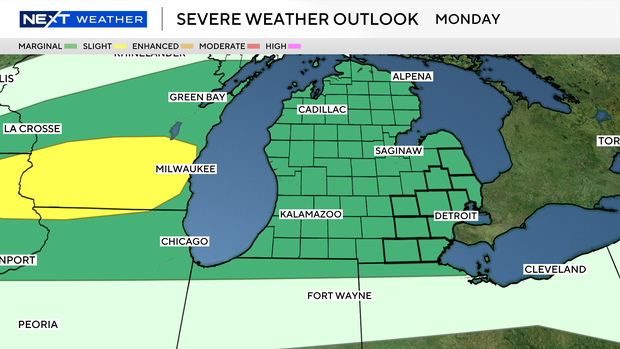
Monday’s weather
A marginal risk (level 1/5) is in place for Monday night, meaning only isolated severe storms are expected, mainly after 7 p.m. through midnight. The primary threats will be hail around 1 inch and a few localized damaging wind gusts, with storms moving quickly west to east, with storm coverage remaining limited.
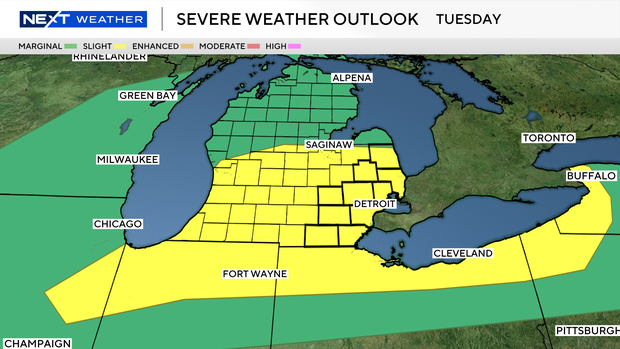
Tuesday’s weather
By contrast, Tuesday brings a Weather Alert Day with a slight risk (level 2/5), indicating a higher chance of more organized and scattered severe storms through the day as a cold front moves through.
On Tuesday, all severe weather hazards are possible, including damaging winds (potentially 60+ mph), large hail, heavy rainfall, and even a low risk of tornadoes, with damaging winds expected to be the main concern.
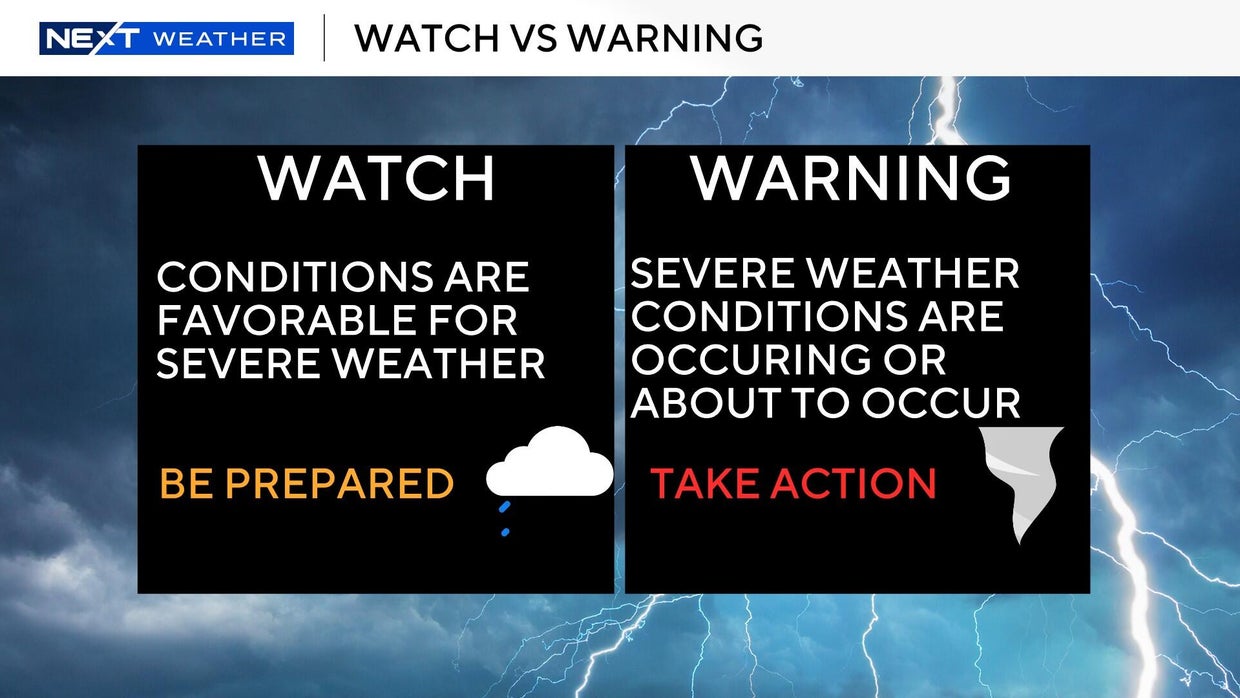
Watch vs. warning
The National Weather Service says a severe weather watch means “be prepared.” It is possible that the weather will reach severe levels during the time frame specified.
A severe weather warning means “take action,” that severe weather conditions have been reported by spotters or can be detected on radar. People are asked to take shelter indoors, away from windows.
It is possible for a tornado warning to be issued without a tornado watch already in effect. This is the scenario that happened in Southwest Michigan on March 6, 2026.

AISD to Close Blackshear Elementary Amid Budget Challenges

Which Players are Standing Out this Spring on Alabama’s Defensive Front

Alaska bike journey rolls along

Vote. Republic’s 2025-26 All-Arizona boys HS wrestling team, coach

Gov. Sanders to make announcement & recognize grant recipients

Florida High School Football Rankings: Top 25 teams – Oct. 21

How old is Bo Nix? What to know about Oregon quarterback ahead of 2024 NFL Draft

Cleary's 21 help Le Moyne down Central Connecticut State 69-64 in OT

99th annual Pony Swim held in Virginia

Indiana Members Credit Union announced as new anchor tenant at Bottleworks District
Latino Republicans in South Texas Turn on Trump Over Birthright Citizenship

Fugitive illegal alien convict on the run after attempting to strike ICE officer with vehicle: DHS

EU to urge Israel to scrap death penalty bill as ‘grave regression’

Army reviewing after helicopters hovered alongside Kid Rock’s swimming pool as he saluted

Emanuel pushes back on ‘straight White man’ question, says ideas matter most in 2028
-

 Sports1 week ago
IOC addresses execution of 19-year-old Iranian wrestler Saleh Mohammadi
-

 Miami, FL5 days ago
Jannik Sinner’s Girlfriend Laila Hasanovic Stuns in Ab-Revealing Post Amid Miami Open
-

 South-Carolina2 days ago
South Carolina vs TCU predictions for Elite Eight game in March Madness
-

 New Mexico1 week ago
Clovis shooting leaves one dead, four injured
-

 Politics1 week ago
Schumer gambit fails as DHS shutdown hits 36 days and airport lines grow
-

 Science1 week ago
Record Heat Meets a Major Snow Drought Across the West
-

 Minneapolis, MN5 days ago
Boy who shielded classmate during school shooting receives Medal of Honor
-

 Tennessee1 week ago
Tennessee Police Investigating Alleged Assault Involving ‘Reacher’ Star Alan Ritchson