Michigan
Michigan attorney general, state lawmakers push to combat antisemitism


In the days following last week’s attack on Temple Israel in West Bloomfield, Michigan Attorney General Dana Nessel and state lawmakers are speaking out against antisemitism.
“Hate has no place here in Michigan,” said Nessel.
This is the message heard loud and clear on Monday by Dana Nessel and state lawmakers after last week’s attack on Temple Israel.
“This is not just a Jewish problem. This is a problem for all of us as Americans,” state Sen. Jeremy Moss said.
“It felt like an attack on every Jewish person in Michigan. This is intolerable, and people need to stand up and say enough is enough,” said Oakland County Treasurer Robert Wittenberg.
According to Nessel, antisemitism and hate crimes against the Jewish population in Michigan are on the rise, making it even more crucial to have preventative tools in place.
“Prevention begins by better understanding the problem we face. This is a wakeup call,” said state Rep. Noah Arbit.
In Michigan, a law targeting hate crimes is already in effect. State leaders are also working to lock down funds to allow security training at other houses of worship, like the staff at Temple Israel received weeks before the attack.
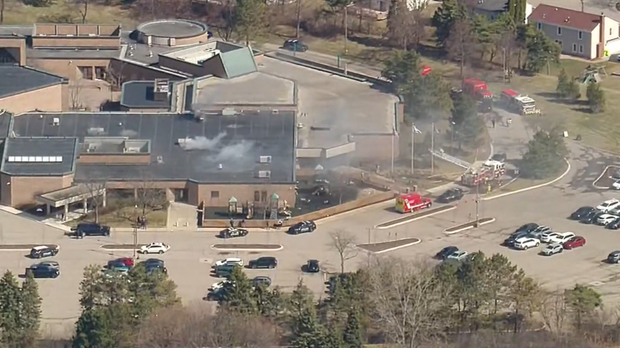
“These investments matter. The training the teachers and staff received was implemented, security protocols were followed, and emergency responders were able to coordinate quickly,” said state Rep. Samantha Steckloff. “Over the past several years, the Michigan legislature has appropriated about $19 million in security funding, and I want you all to know that I have already begun those conversations in finding out where appropriations can lead in this year’s budget.”
These lawmakers say now is the time to stand up and speak out against hate.
“What we can do is train parents, teachers, coaches and peers to recognize the signs of radicalization and intervene before it becomes violence. What we can do is fund programs that deter hate and target violence in the first place,” Arbit said.
Nessel is also encouraging houses of worship to work with law enforcement to update their safety plans.
“I implore every single house of worship, every religious school, organization that represents a minority community to please contact their local or sheriff’s department to begin or to update your safety plan. Not just for the worst-case scenario as we’ve seen in far too many places of worship, but for all emergencies,” said Nessel.



Michigan
3 dead after vehicle collides with semitruck on Interstate 94 in Wayne County, Michigan State Police say

Three people are dead after a vehicle hit the back of a semitruck on Interstate 94 in Southeast Michigan late Friday, state officials said.
The Michigan State Police responded to the crash on eastbound I-94 near Michigan Avenue in Wayne County around 11:44 p.m. Investigators said the semitruck was stopped in traffic due to flooding when it was struck by the vehicle.
Three passengers in the vehicle that crashed into the semi died at the scene, according to the state law enforcement agency, and the driver was taken into custody.
The ages of the individuals involved in the collision have not yet been disclosed by officials.
As of Saturday afternoon, the investigation into the incident is ongoing.
Michigan
What to know about cyclosporiasis as Michigan health officials investigate 300+ cases in outbreak

Over 300 cases of cyclosporiasis have been reported within a week in Southeast Michigan, and Michigan health officials are investigating.
The Michigan Department of Health and Human Services (MDHHS) and Michigan Department of Agriculture and Rural Development (MDARD) are actively investigating the potential source of the “large and growing outbreak” of cases confirmed in Monroe, Lenawee, Washtenaw, Wayne, Shiawassee, Jackson and Livingston counties.
Health officials also reported 24 cases across 11 other Michigan counties, including in the city of Detroit. Typically, Michigan only gets around 50 cases per year.
On July 1, MDHHS reported there were at least 170 cases. On Thursday, the number of cases jumped to at least 300.
Read more –> Michigan health officials warn of ‘large and growing outbreak’ of cyclosporiasis
The age range of individuals who were diagnosed with the illness ranges from 8 years old to 84 years old, with a median age of 41, according to MDHHS.
Health officials are working to determine the common exposure of the outbreak in Michigan.
Here’s what to know about cyclosporiasis:
What is cyclosporiasis?
Cyclosporiasis is an intestinal illness caused by a parasite and infects the small intestine.
Healthcare providers can diagnose the illness by testing a stool sample.
Signs and symptoms
If infected with cyclosporiasis, people may experience watery diarrhea with frequent and sometimes explosive bowel movements.
The illness can last from a few days to over a month if the illness is not treated. Symptoms could relapse.
The timeframe from becoming infected to becoming sick usually takes about one week but can range from two days to two weeks or more.
In the US, outbreaks of cyclosporiasis have been linked to various types of fresh produce. People can get infected with Cyclospora more than once.
Anyone who experiences symptoms of cyclosporiasis should see their healthcare provider.
How it spreads
The illness can spread when people eat food or drink water that was contaminated with feces.
The CDC said it can take at least one or two weeks outside the body for Cyclospora to become infectious after passing in a bowel movement, making direct person-to-person transmission unlikely.
How to prevent cyclosporiasis
According to the CDC, people can prevent infection by avoiding food or water that may contain feces and by following food safety recommendations for safe preparation and storage.
The CDC recommends washing hands with soap and water before and after handling or preparing raw fruits and vegetables.
Wash all fruits and vegetables thoroughly under running water before eating, cutting or cooking. Cut away any damaged or bruised areas on fruits and vegetables before preparing and eating.
Read more on prevention here.
Copyright 2026 by WDIV ClickOnDetroit – All rights reserved.

A shooting altercation between two groups of young people at a shopping mall in Dearborn, Michigan, left two people dead and a third injured over what is typically the most violent weekend of the year in the US, police said.
The shooting occurred as the US began celebrating the Fourth of July, historically a holiday weekend that sees higher rates of gun violence across the country. In 2024, the Gun Violence Archive reported more than 500 shootings over Independence Day weekend.
The shooting at Fairlane Town Center on Friday sent mall patrons scrambling, including a person who was hit by a vehicle outside the mall while attempting to flee, said Issa Shahin, the Dearborn police chief.
People believed to be linked to the fight were being questioned at the police station, but no one was immediately taken into custody, he said.
Shahin said the altercation was not a random act: the two groups knew each other and after they came into contact at the mall a fight started that escalated into gunfire. Members of both groups had handguns, he said.
One of the victims died inside Fairlane Town Center and the other died at a nearby hospital. Details on the third person who was shot were not released.
The mall was evacuated after the shooting and police planned to keep it closed while they investigated.
A video posted to social media appeared to show people running from the shopping center after gunshots could be heard.
Fairlane Town Center has more than 125 stores and restaurants, according to its website.
Dearborn is a suburb of Detroit with a population of more than 100,000 people about nine miles west of Detroit.
Tyhrann Howard, Michigan state police specialist lieutenant, said the agency was assisting with the investigation and referred questions to the Dearborn police.
A person who answered the phone at the telephone number for mall security declined comment.
Associated Press contributed reporting
-

 World6 minutes ago
80 vials of fentanyl stolen from Rome hospital
-

 News36 minutes ago
Crowds ordered to evacuate National Mall area as stormy weather slams DC
-

 Los Angeles, Ca2 hours ago
Motorcyclist struck, killed by driver making U-turn in L.A. neighborhood
-

 Detroit, MI2 hours ago
GameThread: Detroit Tigers vs. Texas Rangers, 4:05 p.m.
-

 San Francisco, CA2 hours ago
Why Vogue World Should Definitely Head to San Francisco Next
-

 Dallas, TX2 hours ago
Mistake avoided? Cowboys FA signing could’ve been drafted… but fate
-

 Miami, FL3 hours ago
No Room For LB Ronnie Harrison In Miami?
-

 Boston, MA3 hours ago
Celtics’ Jaylen Brown trade leaves Boston fans, community feeling bankrupt: ‘A huge void’

