Midwest
Jury convicts North Dakota lawmaker of misdemeanor speculation

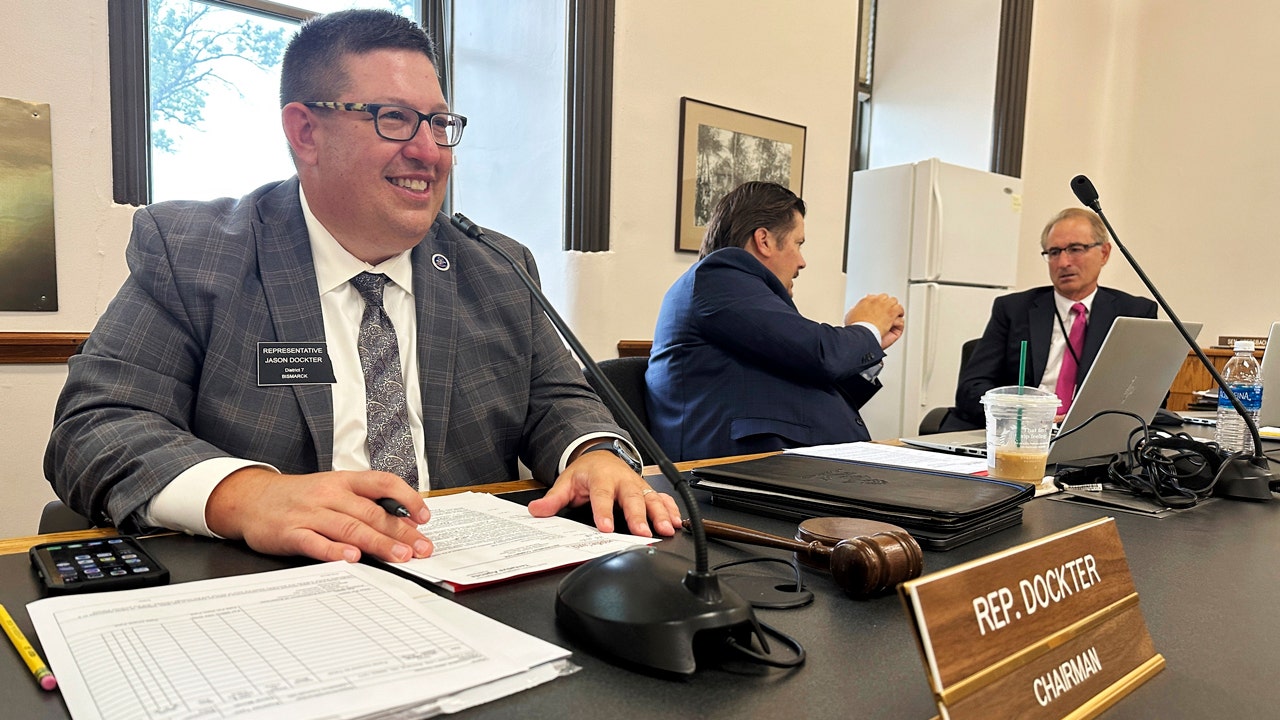
A jury in North Dakota on Friday convicted a state lawmaker of a misdemeanor in connection with a state-leased building he has ownership ties to. A legislative leader said he disagrees with the verdict and plans to review the statute and rules involved.
Republican Rep. Jason Dockter, of Bismarck, was charged in December 2023 with speculating or wagering on official action. He pleaded not guilty. The charge has a maximum penalty of 360 days in jail and/or a $3,000 fine. Dockter declined to comment on the verdict but said he will consider an appeal. His sentencing has yet to be scheduled.
A criminal complaint alleged that, as a member of the North Dakota House of Representatives, Dockter voted “on legislative bills appropriating money to pay for property he had acquired a pecuniary interest in,” against the law and legislative rules. The charge arose from complaints to the state Ethics Commission.
NORTH DAKOTA LAWMAKER HIT WITH MISDEMEANOR CHARGE IN SPECULATION CASE
Republican House Majority Leader Mike Lefor said the case is concerning because “legislators aren’t going to feel comfortable knowing what a conflict of interest is.”
“I’m thinking that we need to visit legislative rules, look at state statutes and have a thoughtful conversation with the Ethics Commission so that we can make absolutely sure that legislators are not looking over their shoulder worrying about does it rise to the level of a conflict of interest or not?” Lefor said.
He called it a “slippery slope” for scenarios of a legislator who is a teacher voting on an education bill or a farmer voting on agricultural issues.
Prosecutor Ladd Erickson declined to comment on the verdict.
Republican North Dakota state Rep. Jason Dockter chairs a legislative meeting on Tuesday, Aug. 22, 2023. (AP Photo/Jack Dura, File)
Dockter’s charge is part of a nearly two-year-old controversy involving the building, leased by the late Attorney General Wayne Stenehjem for consolidating divisions of his office, that under Stenehjem incurred a cost overrun of over $1 million that hasn’t been fully reconciled.
Stenehjem’s successor, Attorney General Drew Wrigley, disclosed the overrun and that Stenehjem’s state email account was deleted days after his death in January 2022 at the direction of his executive assistant, Liz Brocker, who later resigned. A prosecutor declined to bring charges for the deleted emails.
Dockter is a co-owner of companies that own and worked on the building. He was friends with Stenehjem, but has denied any wrongdoing in the lease arrangement. Dockter was first elected in 2012. He was reelected in 2022 without opposition.
Democratic House Minority Leader Zac Ista called on Dockter to resign after the verdict. Dockter said he has no immediate plans to do so. Lefor said he doesn’t expect the Republican-majority House to take any immediate steps against Dockter.
The Legislature is not in session, and isn’t scheduled to convene until January 2025, after a December organizational session.
The cost overrun and deleted emails shocked state lawmakers, who raised concerns about trust and transparency. Earlier this year, Wrigley’s office recovered thousands of Stenehjem’s emails through a cellphone backup and released them in response to records requests. Stenehjem’s phone data became part of an investigation into former state senator Ray Holmberg, who is accused of traveling to Europe with the intent of paying for sex with a minor. Holmberg’s trial is set for September.
Read the full article from Here



Drone view shows Milwaukee’s County Courthouse
Built in 1931, Milwaukee’s historic County Courthouse is in dire need of repair and upgrades. Here’s a recent drone view of the MacArthur Square building.
The Milwaukee County Sheriff’s Office will not move forward on a potential deal to use facial recognition technology, Sheriff Denita Ball announced Friday.
In a statement on Feb. 27, Ball said after “thoughtful evaluation” and “meaningful dialogue” with community stakeholders and leaders, she decided to stop pursuing a contract with Biometrica, a Las Vegas-based company whose technology allows authorities to compare photos to a large database of photos for matches.
“While we recognize the potential of this software as an investigative tool, we also recognize that trust between the MCSO and the people we serve is important,” she said.
“My discussions with local advocates highlighted valid concerns regarding how such data could be accessed or perceived in the current national climate. This decision is not a retreat from innovation but rather an understanding that timing matters, too,” Ball said.
The Milwaukee Journal Sentinel reported on Feb. 17 that the Sheriff’s Office was on the verge of signing off on the use of facial recognition technology after news broke at a community advisory board meeting held by the office.
The update on the office’s sign-off on an intent to enter into a contract with Biometrica blindsided local officials and advocates because it contradicted earlier claims that the office had not moved forward with a controversial contract.
At the time, supervisors on the county’s judiciary and legislation committee called for more information from the Sheriff’s Office about the nature of the then-potential contract.
Supervisor Justin Bielinski, who chairs the committee, said Ball’s decision to step away from the deal was good news, but said he was still feeling wary.
“I would like to see more I guess,” he said of the two paragraph statement from Ball. “At what point would she reconsider, right?”
County Executive David Crowley, who is running for governor as a Democrat, had also voiced concerns about a possible contract when news came to light earlier this month.
After learning of Ball’s decision to not move forward with Biometrica, Crowley thanked community members who voiced concerns about facial recognition technology, saying he will “continue doing everything in my authority to ensure our residents’ First Amendment rights, civil liberties, and personal data are protected.”
In recent months, Milwaukee politicians and residents rebuffed local law enforcement’s efforts to pursue the use of such technology at both the city and county levels, with many citing concerns over racial bias and unjust surveillance of residents.
The Milwaukee County Board of Supervisors voted last summer to recommend the development of a policy framework for the use of facial recognition technology as worries about its use by local law enforcement grew in the community.
The policy emphasized that the use of such technology doesn’t “suppress First Amendment-related activities, violate privacy, or otherwise adversely impact individuals’ civil rights and liberties,” and called for a pause on acquiring new facial recognition technology until regulatory policies were in place to monitor any existing and new surveillance technology.
In early February, the Milwaukee Police Department paused its pursuit of facial recognition technology after almost a year of pushback from activists and some public officials at public meetings. The department also noted that community feedback was a part of its final decision as well as a volatile political climate amid the federal government’s immigration crackdown.
(This story was updated to add new information.)

MINNEAPOLIS (FOX 9) – The story behind Anthony Edwards wearing a bright orange bracelet since last season has received a positive development, after Timberwolves fans learned Luca Wright has beaten leukemia.
Anthony Edwards, Luca Wright connection
What we know:
Last January, the 6-year-old Minnesotan met “Ant” for the first time following a game against the Detroit Pistons, proclaiming him to be his favorite player, and asking him to wear a bracelet that symbolizes leukemia awareness, resilience and support for those affected. During the interaction, the fan had created a sign with a to-do list: “1. Beat Cancer. 2. Be The Next MJ.”
Leukemia is a type of cancer that spreads throughout the bloodstream, infecting bone marrow and a person’s lymphatic system by rapid production of abnormal white blood cells that can’t fight infection.
Since then, the Wolves’ MVP has worn a bracelet that proclaims, “Love Like Luca” on it for every game he has played, vowing to wear it “until he hangs up his sneakers.”
Ant has gone on to explain how the gesture connected with him given that he lost both his mother, Yvette, and grandmother, Shirley, to cancer when he was 14 years old. The No. 5 jersey he wears currently is a tribute to them both.
Luca bracelet latest
Dig deeper:
More than a year later, Wolves fans have received the update they hoped for – now 7-year-old Luca has beaten his cancer.
What’s next:
Ant has since responded to the news with his own social media video, calling it “God’s gift” and saying, “Let’s do this Luca.”
No word yet on whether he intends to keep wearing the bracelet, though he’s previously said he has a stash of replacements near the team bench should one ever be broken.
The Source: Information provided by the Minnesota Timberwolves public relations department.

FISHERS, Ind. (WISH) — The Nickel Plate Trail pedestrian bridge over 96th Street is officially open.
It was being touted Friday as a major milestone for central Indiana’s growing trail system. The street is the Fishers-Indianapolis border.
Leaders called the project a critical connection point for the Nickel Plate Trail. The new bridge helps move the nearly 17-mile trail closer to its goal of connecting multiple counties through one continuous path.
The bridge also came with a 1.3-mile trail extension. A $4.5 million grant from the Indiana Department of Natural Resources made the bridge possible.
Dale Brier, deputy director of Indiana Department of Natural Resources, talked about the state’s Next Level Trails grant program. “Currently, we have 89 trail projects that that were funded with that money. Fifty-nine of those are complete. We’ve got 12 under construction. As of this opening, we have 167 miles of trail that have now been opened with that grant money.”
People who frequently take the trail for their daily exercises say they’re excited the bridge is finally open.
Alan Errichiello of the Fishers Running Club said, “Extending this down south into Indianapolis is a big game changer for us. It’ll add a lot of miles that we can easily get into.”
Resident Tracy Mundell said, “Trying to get to the other side was nearly impossible, so I think most people didn’t even attempt it. It’s going to be great, we can get over to the other side, and I’m anxious to see what’s over there.”
The final portion of the project, called the Clear Path project, remains under construction.
Fishers Mayor Scott Fadness, a Republican, said, “We need to double-down on that investment, and we know time and time again here in the city of Fishers that trail systems, the ability to get up and get out and get active, is such an important part in our culture of health, that an investment like this is critical.”
Once complete, local leaders say the goal is to provide a more safe and connected routes between Noblesville, Fishers, Indianapolis and other surrounding cities.
Resident Steve Mundell said, “It’s lovely. It’ll be real convenient to get across too.”

San Diego State moves back into NCAA Tournament field in latest ESPN Bracketology

Sheriff’s Office backpedals on controversial facial recognition deal

Soccer Frenzy: Cities, Fans, and What to Know | Futbol HQ

Fan behind Anthony Edwards’ orange bracelet has beaten cancer

New bridge over 96th Street adds to Nickel Plate Trail connections

Florida High School Football Rankings: Top 25 teams – Oct. 21

Cleary's 21 help Le Moyne down Central Connecticut State 69-64 in OT

How old is Bo Nix? What to know about Oregon quarterback ahead of 2024 NFL Draft

99th annual Pony Swim held in Virginia

Indiana Members Credit Union announced as new anchor tenant at Bottleworks District

Where Iran’s ballistic missiles can reach — and how close they are to the US

Has India’s influence in Afghanistan grown under the Taliban?

Bill Clinton to testify before House committee investigating Epstein links

Read Judge Schiltz’s Order

Vulnerable House Dem lashes out at Trump’s ‘racist’ SOTU challenge: ‘That was uncomfortable’
-

 World2 days ago
Exclusive: DeepSeek withholds latest AI model from US chipmakers including Nvidia, sources say
-

 Massachusetts2 days ago
Mother and daughter injured in Taunton house explosion
-

 Montana1 week ago
2026 MHSA Montana Wrestling State Championship Brackets And Results – FloWrestling
-

 Oklahoma1 week ago
Wildfires rage in Oklahoma as thousands urged to evacuate a small city
-

 Louisiana5 days ago
Wildfire near Gum Swamp Road in Livingston Parish now under control; more than 200 acres burned
-

 Denver, CO2 days ago
10 acres charred, 5 injured in Thornton grass fire, evacuation orders lifted
-

 Technology6 days ago
YouTube TV billing scam emails are hitting inboxes
-

 Technology6 days ago
Stellantis is in a crisis of its own making