Cougars on the air
No. 23 BYU (21-8, 12-6) at No. 10 Iowa State (22-7, 12-6)
- Tuesday, 7 p.m. MST
- Ames, Iowa
- TV: ESPN2
- Radio: 107.9 FM/BYURadio.org/BYU Radio app
For most of the Big 12 basketball season, Iowa State has dealt with one injury after another, while BYU has been relatively healthy and at full strength.
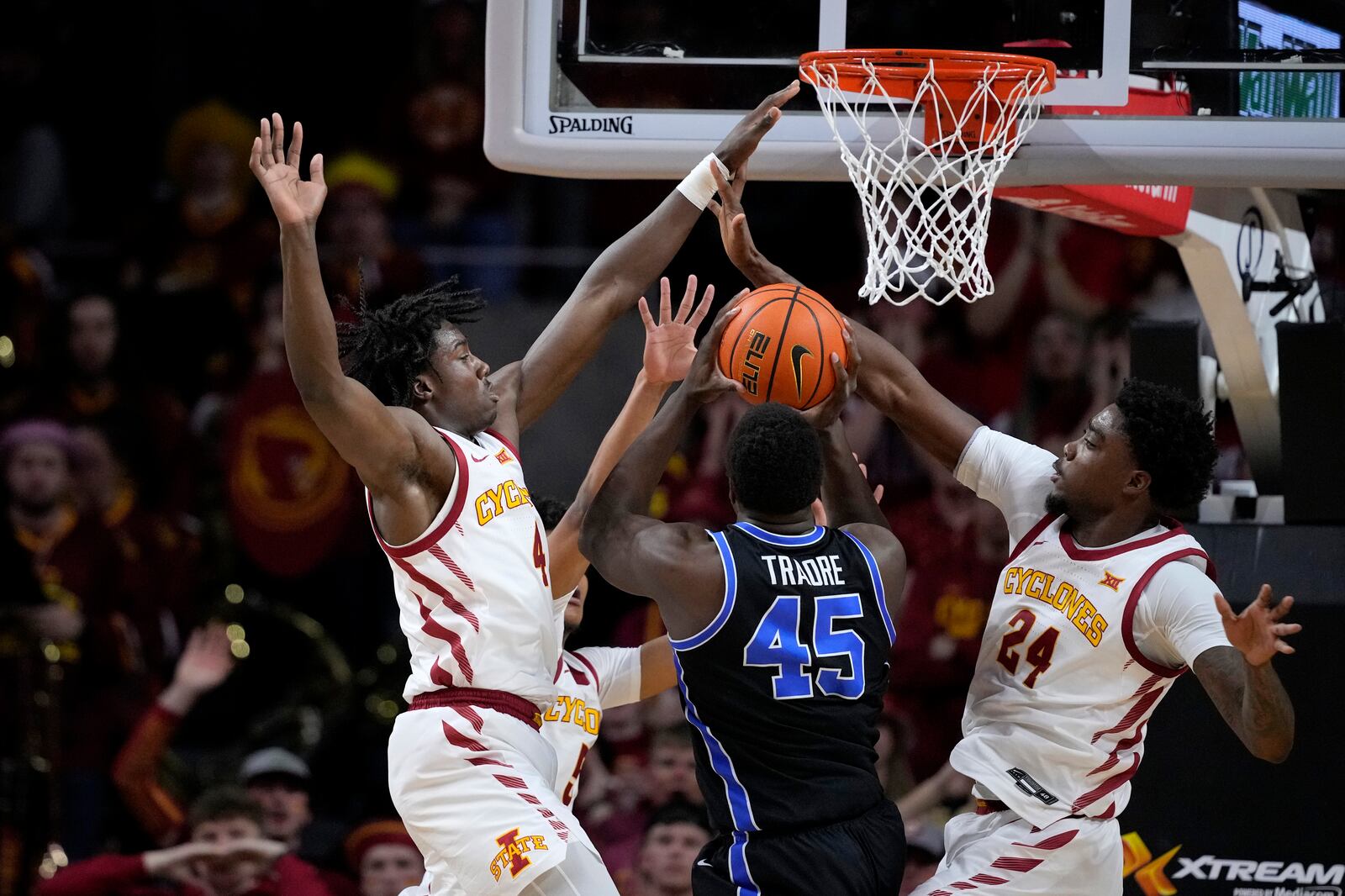
But that could change Tuesday night (7 p.m. MST, ESPN2) when the No. 10 Cyclones host the No. 23 Cougars in one of the most important contests of the year, as far as seeding for the conference tournament is concerned.
In his weekly press briefing on Monday, BYU coach Kevin Young said that 6-foot-9 freshman Kanon Catchings could miss the showdown between teams tied for fourth place in the Big 12 standings after he sustained a left knee injury while contesting a dunk midway through the first half of BYU’s 77-56 win over West Virginia.
Special Collector’s Issue: “1984: The Year BYU was Second to None”
Get an inclusive look inside BYU Football’s 1984 National Championship season.
“It wasn’t as bad as it looked, which is great,” Young said. “He is kind of day to day, and that is how we are approaching it.”
Although BYU (21-8, 12-6) is as deep as any team in the league, Catchings’ absence could hurt because he is averaging 7.6 points and 2.3 rebounds a game and had big games in two of BYU’s most impressive wins. The Indiana native had 23 points in BYU’s overtime win over Baylor and 14 points in BYU’s 96-95 upset of No. 19 Arizona.
For the second-straight year, the BYU-Iowa State clash will feature two ranked teams — and have heavy implications for the postseason. The four top seeds earn two byes in the conference tournament and don’t have to play until the quarterfinals next Thursday in Kansas City.
Young said his team and coaching staff are aware of the big-picture importance of the matchup, noting that assistant coach Chris Burgess stays “pretty dialed in with that stuff” and passes it along, but reiterated that the Cougars generally do better when they take it day by day.
“Some teams are better when they just focus on what is right in front of them. That seems to be the case with this group. So that is kinda how we handle the players,” Young said. “As it relates to the staff, I am pretty singular focused. But I try to have an understanding of what is going on big picture as well.”
Regardless of what happens Tuesday night, or Saturday when BYU hosts Utah on Senior Night, BYU can do no worse than a No. 5 seed at T-Mobile Center. That’s an overachievement, considering BYU has a new coach, was picked to finish ninth in the league, and lost four of its first six conference games.
How has it come together so quickly for the Cougars?
“I think there is a lot that goes into that. If I had to narrow it down to a couple of things I just think belief, execution, togetherness,” Young said. “That’s where we have been able to move the needle.
“I think patience, as I’ve learned how to operate in this space (has also been important). … So all that stuff has been the recipe, I would say, to why we are where we are right now.”
This is the most significant and challenging game of the Kevin Young era, as Iowa State is 15-1 at 14,356-seat Hilton Coliseum in Ames, Iowa, and enjoys one of the best home-court advantages in all of college basketball.
Last year, in front of 14,267, BYU jumped out to a 38-27 halftime lead but was outscored 41-25 in the second half and wilted to ISU’s pressure defense late to give away a game it probably should have won.
BYU finished with 17 turnovers in the 68-63 loss, including a late blunder by point guard Dallin Hall, while ISU had only six giveaways.
“That’s one of the best atmospheres I have played in,” Hall said Saturday after scoring eight points and notching six assists against West Virginia.
Iowa State coach TJ Otzelberger also met with reporters Monday, and said the Cougars’ maturity and size in the back court, with 6-9 freshman Egor Demin running the point, along with Hall, sets them apart.
“Number one, Demin with the basketball … as a playmaker, facilitator, that’s a unique endeavor, for sure,” he said, then noted that reigning two-time Big 12 Player of the Week Richie Saunders and graduate Trevin Knell are two of the top 3-point shooters in the league.
“I think that’s one thing with them that you have to factor into the equation, is how well they shoot the basketball,” Otzelberger said. “They’ve got older guys. They’ve got experienced, veteran guys that know how to find ways to win. You don’t win six in a row in this league without having that type of experience.
“Saunders is playing at about as high a level as anybody is in the conference right now in terms of shooting the ball, making big plays for them late, just competing,” the coach continued.
Iowa State forces 15.2 turnovers per game, which ranks 17th nationally. The Cyclones use those turnovers to get out in transition and fuel their offense. They average 80.2 points per game, which is No. 42 in the country.
BYU averages 81.0 points, 32nd in the country.
“I think we have to go in there with the mindset that no matter what they do, we are going to be under control offensively,” Young said. “… Their defense is different than West Virginia’s. But at the same time, I am big on proof of concepts. We have proven that we can (score) against good defensive teams, particularly one whose M.O. is to turn you over.”
Young said turnovers were “a weakness of ours” earlier in the season, “but we are starting to use people’s aggression against them. I think that is the ultimate key to the game.”

See how Iowa schools are bring language teachers from Spain
see how Iowa schools are filling world language teacher positions and enriching classrooms through an exchange program with Spain.
The sounds of Dallas Center-Grimes High School Spanish students singing “¿Por Que Te Vas?” by Jeanette with varying levels of gusto and prodding by teacher Antton Zuazu Hernández may seem like an unusual way to learn.
But the sing-along is how Zuazu Hernández, a native of Spain, helps engage his students and share his culture as part of a teacher-exchange program.
“I feel I’m a messenger in a way, and this is part of the program,” he said. “We’re expected to both bring our culture here and bring your culture back to Spain.”
Zuazu Hernández — who taught English in Spain — is among 26 bilingual teachers in Iowa as part of an exchange program between the Iowa Department of Education and Spain’s Ministry of Education and Culture.
“(The program) was created to address the shortage of qualified Spanish teachers in the state and helps expose students to different world cultures,” said Heather Doe, the department’s spokesperson. “… The Exchange Visiting Teachers from Spain program has been very successful in helping schools, especially in rural communities, hire highly qualified Spanish teachers.”
Iowa has nearly 1,200 world language teachers in kindergarten through college, according to the Iowa World Language Association website.
Some foreign language teachers in Iowa moved to the U.S. and later obtained teaching credentials. Others were recruited to work in Iowa schools.
Iowa schools, including Waukee Community School District, even offer financial incentives as a recruitment tool for hard to fill positions.
“Many of them, like me, will arrive with teaching experience from our home countries, but in the process of validating the credentials in the U.S. we find obstacles,” said Elizabeth Bulthuis, a Waukee High School world languages teacher who immigrated from Ecuador in 2003, “and the validating of credentials also can be lengthy and costly, because of all the educational systems and how they are structured differently.”
The Spain exchange program — which brings hundreds of teachers to schools across the U.S. — comes with several requirements.
The Spanish teachers must be certified in the language with at least two years of experience, Doe said. Additionally, candidates go through a vetting process at the federal, state and local levels. Teachers also attend a three-day state orientation.
Schools and districts participating in the program pay an $895 fee to offset licensing and orientation costs, Doe said.
The program is a blessing for rural areas struggling to fill positions teaching foreign language, special education, math and science.
“It’s very difficult to even get an applicant,” said Deron Stender, the superintendent at the rural Creston Community School District, “… When I say it’s difficult to even find (the candidates) they don’t exist. And if they do, they’re probably going to be in a larger metro, urban, suburban areas where there’s just more opportunities.”
St. Anthony’s conducts bilingual class for its students
St. Anthony’s Catholic school brings Spanish speaking teachers to the U.S. to teach students the language.
Zuazu Hernández taught Spanish and drove a bus at Creston during the 2024-25 school year. But falling enrollment and budget cuts resulted in his position being eliminated.
A program drawback is teachers only have three-year visas, he said.
“When you have a very good individual that comes to your district from a foreign country after the third year, you still have that need again,” Stender said. “So, we just open it back up to the same program, but you’re doing another refresh of the process, and while that’s a challenge, it’s still better than not having a teacher in the classroom.”
Another issue schools have faced is filling teaching positions for immersion programs.
In the early 2000s, St. Anthony’s started a Spanish-immersion program after several families with children of Honduras and Guatemala descent wanted their kids to have a Catholic school education and maintain their connection to the Spanish language.
“A lot of teachers go to school to teach Spanish, but they go to school to teach it as a standalone Spanish class,” principal Jennifer Raes said. “… We were really searching for teachers that could come here and teach in any subject, just a regular teacher, but also has the skills of teaching in Spanish and English.”
Marisol Guerra, a Honduras native, came to the U.S. in 2010 to help start St. Anthony’s program. Guerra manage to come to the U.S. as part of that year’s Spain exchange program cohort.
More than a decade later, the school offers classes in English and an immersive track where 85% of the students’ day is spent learning in Spanish. While families were hesitant in the beginning to take part in the immersion program, there is now a waitlist of almost a dozen families.
“There was uncertainty, (but) they wanted their children to learn a second language,” Guerra said, “and they wanted without knowing, I think, they also were exposing them to other cultures and opening their minds to other things.”
The over the years, St. Anthony’s has employed teachers who moved to America from Spain, Mexico and other Latin American countries.
The over representation of teachers from Spain likely is due to other countries not offering similar exchange programs, said Bulthuis, a member of the Iowa World Language Association.
It took several years for the veteran teacher — who came to Iowa in 2005 — to become credentialed to teach in the U.S. because she was not part of an exchange program.
“I think that world language teachers can be difficult to recruit because the pool of candidates is relatively small, so teachers need a strong language proficiency, cultural knowledge and all the teaching certifications,” said Bulthuis, who left Ecuador in 2003 because of the country’s financial crisis, “(but) many people who speak another language also have opportunity in other careers.”
Bulthuis does not recommend loosening the criteria to teach in Iowa but suggests improving or streamlining the process for an international teacher to obtain a state teaching license.
“… Not every Spanish speaking country is going to have (an exchange) program like that in place to help their community,” Bulthuis said,
Educators say employing international teachers goes beyond language skills.
“International educators can bring tremendous cultural and linguistic expertise to the classroom, which is an incredible skill and very valuable for students,” Bulthuis said.
That cultural exchange can carry over into a school’s lesson plans.
Zuazu Hernández often lets his American students’ interests drive what he teaches them about Spanish culture. These questions have ranged from wanting more insight into bullfighting, the Spanish school system, stereotypes and politics.
“Sometimes, they are more interested in me as a person, or the things I can tell them about Spain than the actual Spanish language,” he said, “but they have that curiosity that I think all teachers, we have to take advantage of.”
While reading “¡Viva el toro!” by Lisa Ray Turner and Blaine Ray, a novel about bullfighting, Zuazu Hernández talked to students about his family’s love of the cultural spectacle and how it is losing popularity in Spain because of how the bulls are treated.
Zuazu Hernández is open about his perspective on the practice to his students.
“To me, bullfighting is not worth sustaining just because it’s a tradition — traditions are not always good or acceptable — but rather because it’s an art, and it expands the depth of human understanding of the most intense truths in life, with death as the scariest of all,” he told the Des Moines Register in an email.
His students appreciate his candidness and the chance to learn from teachers with different lived experiences.
“I like having different teachers because they have different experiences, and I think it adds to the overall class,” said Grace Heston, an 11th grader Dallas Center-Grimes High School. “When you’re learning about Spanish, you’re not just learning about a language, you’re learning about the culture associated with it.”
Samantha Hernandez covers education for the Register. Reach her at (515) 851-0982 or svhernandez@gannett.com.
Iowa wrestling’s Tom Brands discusses Big Ten Championships results
VIDEO: Iowa wrestling’s Tom Brands talks Big Ten Championships results
Iowa Athletics
The 330 wrestlers competing in Cleveland at the NCAA Championships are now set.
After the conference tournaments established the lion’s share of wrestlers, the NCAA announced the at-large bids on Tuesday, March 10, completing the rest of the field.
Brackets and seeds will be announced on March 10, but here’s a look at the contingents each state of Iowa program will be sending after the at-large bids were announced.
For the third year in a row, Iowa wrestling will be sending nine to the NCAA Championships. Victor Voinovich did not earn an at-large bid at 157 pounds after finishing ninth at the Big Ten Championships, one place outside of NCAA automatic qualification. He concludes his season with a 12-6 record.
Voinovich narrowly earned the starting job over Jordan Williams at 157, with Iowa coach Tom Brands saying it was very close, but Voinovich had shown a little more “fight” this year. Now that Voinovich hasn’t qualified for NCAAs, it’s a decision that will go further under the microscope.
What’s done is done, however, for Iowa. They’ll take Dean Peterson (125), Drake Ayala (133), Nasir Bailey (141), Ryder Block (149), Michael Caliendo (165), Patrick Kennedy (174), Angelo Ferrari (184), Gabe Arnold (197) and Ben Kueter (285) to Cleveland in hopes of salvaging what has been a tough season.
For the first time since 2010, Iowa State will send all 10 wrestlers to the NCAA Championships. Vinny Zerban earned an at-large bid at 157 pounds despite falling short of the automatic qualifying threshold at the Big 12 Championships. Zerban suffered a concussion and medically forfeited out of the tournament after his first match in Tulsa. His health status will be worth monitoring NCAAs inch closer, from March 19-22.
The Cyclones look poised for one of their best postseasons in recent memory with their 10 qualifiers ―Stevo Poulin (125), Garrett Grice (133), Anthony Echemendia (141), Jacob Frost (149), Zerban, Connor Euton (165), MJ Gaitan (174), Isaac Dean (184), Rocky Elam (197) and Yonger Bastida (285). The loss of Evan Frost hurts the Cyclones, considering his pedigree and season as a whole, but Grice’s has earned several ranked wins since entering the lineup in February and could still add some much-needed team points as the team chases a team trophy.
Behind title contenders Elam and Bastida, proven podium threats in Poulin, Echemnedia, Jacob Frost and Zerban (if healthy), Iowa State will be in the mix for a top-four finish in Cleveland.
Northern Iowa will send five to the NCAA Championships. Automatic qualifiers Julian Farber (133), Caleb Rathjen (149) and Ryder Downey (165) will be joined by Jared Simma (174) and Nick Fox (184), who each earned at-large bids. The number of qualifiers could extend to six, with Trever Anderson (125) being the alternate at 125 pounds for NCAAs. However, he had to medically forfeit out of the Big 12 Championships, so his health status would be in question if he got called up.
With that, Max Brady (141), Cael Rahnavardi (157), John Gunderson (197) and Adam Ahrendsen (285) will have their seasons come to an end. Brady, a true freshman, will still have three NCAA chances in his career after showing promising moments in relief of Cory Land’s season-ending injury. Gunderson, a U23 World team member, will return for next season as well. Rahnavardi and Ahrendsen were both in their final seasons of eligibility.
Following injuries to Land and Wyatt Voelker, it’s been a hard year for the Panthers. This is half the number of NCAA qualifiers that UNI had last season when they qualified 10 for the first time since 1986. The last time UNI had five or fewer qualifiers was 2016.
However, all five of their wrestlers have each shown moments of brilliance, either this season or in prior NCAA Championships. They may be a smaller crew than normal, but Downey, Rathjen, Farber, Simma and Fox are all ones to watch in Cleveland.
Eli McKown covers high school sports and wrestling for the Des Moines Register. Contact him at Emckown@gannett.com. Follow him on Twitter at @EMcKown23.
ISU’s Kevin Dresser on gambling probe: ‘I knew this thing was a mess’
Iowa State’s Kevin Dresser on the gambling probe: “I hope all these athletes at Iowa and Iowa State take the state of Iowa to the cleaners.”
A longtime investigator for the Iowa Division of Criminal Investigation says he was forced out of the agency because he voiced reservations about a high-profile investigation into gambling in college athletics.
Mark Ludwick was hired by Iowa’s top investigative agency in 1997 and was terminated in November 2024, according to a lawsuit filed Feb. 20 in Polk County. According to his complaint, Ludwick was fired after two “frivolous” investigations, one claiming he’d exceeded the speed limit driving to a murder scene, and the other for assistance he provided to a domestic abuse victim.
The real reason, Ludwick alleges, is that officials were embarrassed after Ludwick testified under oath about what he regarded as weaknesses in their sports wagering investigation, which resulted in dozens of Iowa State University and University of Iowa student-athletes facing suspensions, 25 being criminally charged and 19 pleading guilty to underage gambling.
Ludwick testified in early 2024 he believed investigators had conducted illegal searches to identify the online gamblers and that he and other agents had been directed to lie to students about whether they were subjects of the investigation. He also alleged that stress about the case contributed to another agent’s fatal heart attack, although the agent’s relatives disputed the connection.
Now Ludwick is accusing the state of violating Iowa’s whistleblower protection statute. He declined through his attorney to comment. The Iowa Attorney General’s Office also declined to comment, and the Iowa Department of Public Safety, which includes the DCI, did not respond to an inquiry about the case.
In the gambling investigation, DCI investigators used software tools provided by GeoComply, a Canadian company that contracts with online sportsbooks like FanDuel and DraftKings, to look for evidence of illegal gambling activity. Using a GeoComply system, the investigators created a so-called “geofence” around college athletic facilities that allowed them to detect student athletes using wagering accounts registered to parents and friends to place bets ― sometimes on their own games.
Although the investigation resulted in numerous arrests and suspensions, it also drew controversy, in particular for agents’ failure to obtain warrants before conducting their location searches. GeoComply, which had encouraged Iowa to use its service, responded by cancelling the state’s access.
A large group of current and former students sued the state, accusing investigators of violating their constitutional rights. In November 2025, a federal judge ruled that the state’s investigation “does not comport with the Fourth Amendment,” which provides protection from illegal searches.
Nonetheless, the court dismissed the lawsuit, finding the officers involved were entitled to immunity. An appeal is pending.
Ludwick was an experienced investigator for the DCI, working on high-profile cases including the 2015 murder of Shirley Carter, whose son was tried and acquitted, and the 2017 deaths of two girls in a fire started by a relative.
While not the lead agent on the 2023 gambling investigation, Ludwick was tapped to assist by interviewing some of the student athletes. He later testified he grew concerned that the state’s geofence searches amounted to illegal, warrantless searches, and declined to participate in the case any further. He alleges that other DCI agents shared his concerns and also maneuvered to avoid being involved in the case.
Ludwick says he reported his concerns to his superiors. In January 2024, he was deposed by defense attorneys for four of the students, and “testified truthfully during his deposition that he believed an illegal search had been conducted.” Defense attorneys cited Ludwick’s remarks within days in filings covered by numerous media outlets, including the Des Moines Register, which “caused embarrassment and increased scrutiny for the Iowa Department of Public Safety, Commissioner Bayens, and other employees,” Ludwick’s suit states.
According to the complaint, officials launched an investigation into Ludwick for speeding on March 5, weeks after the embarrassing testimony was reported. On Aug. 8, officials initiated a second investigation after, Ludwick says, “he attempted to help a victim of domestic abuse flee her abuser.” He denies his actions violated Iowa law or department policy.
William Morris covers courts for the Des Moines Register. He can be contacted at wrmorris2@registermedia.com or 715-573-8166.
Setting sail on iceboats across a frozen lake in Wisconsin
Massachusetts man awaits word from family in Iran after attacks
Pa. man found guilty of raping teen girl who he took to Mexico
U.S. Postal Service could run out of money within a year
City of Miami celebrates reopening of Flagler Street as part of beautification project
Keith Olbermann under fire for calling Lou Holtz a ‘scumbag’ after legendary coach’s death
Giants will hold 2026 training camp in West Virginia
Try This Quiz on the Real Locations in These Magical and Mysterious Novels
