Midwest
In Indiana, competition for GOP gubernatorial primary ramps up

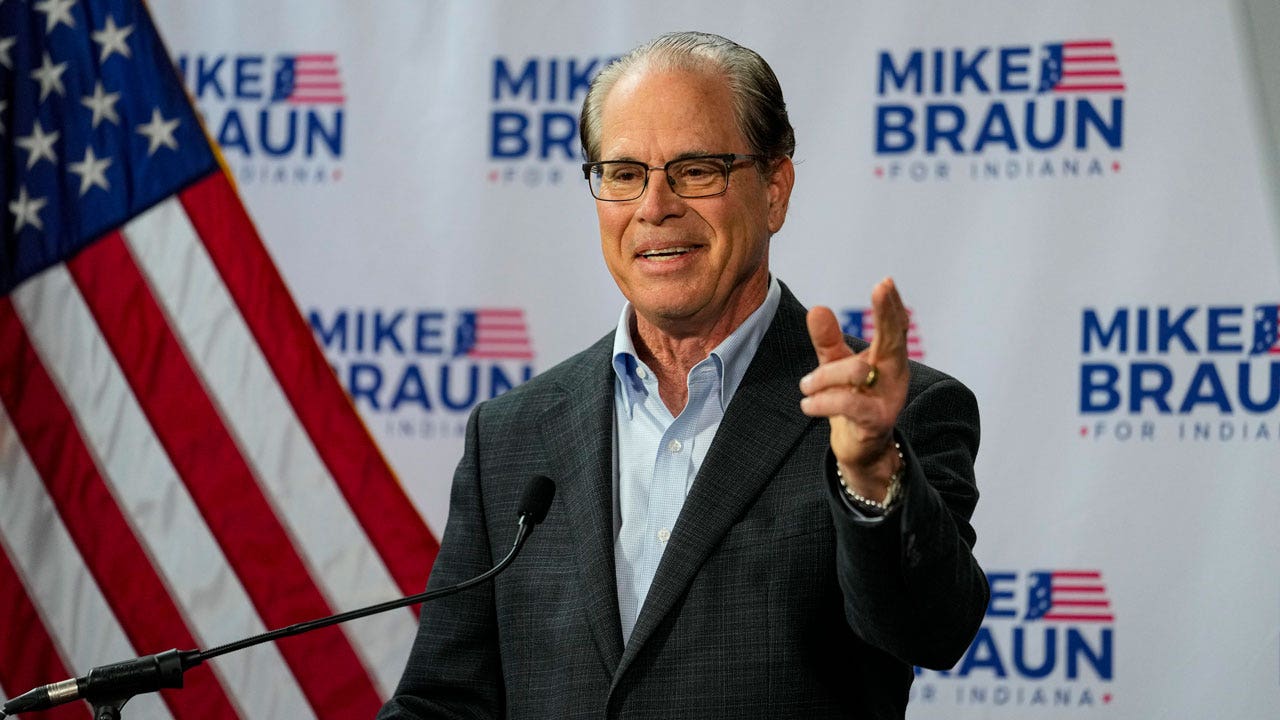
In a state as solidly Republican as Indiana, the May primary is the real competition.
Four months out, five candidates are still jockeying for the GOP gubernatorial nomination in an unusually crowded field. Annual campaign finance reports filed Wednesday reflect a multimillion-dollar race that has become a competition of who can out-conservative the others for primary votes in a state with historically low turnout.
Two-term Gov. Eric Holcomb, a Republican, cannot run again because of term limits. Indiana’s primary is May 7.
INDIANA HOUSE UNANIMOUSLY PASSES BILL DEFINING ANTI-SEMITISM IN EDUCATION CODE
“In Indiana, we are not used to seeing competitive primaries,” said Gregory Shufeldt, a professor of political science at the University of Indianapolis.
Shufeldt said the crowded field could be a result of interest in state government roles, rather than a career in a Congress bogged with gridlock in the recent years. First-term U.S. Sen. Mike Braun’s decision to join the gubernatorial race opened up his seat, and many expect U.S. Rep Jim Banks, a Republican, to easily fill it.
Braun’s close allegiance to former President Donald Trump helped propel his Senate win in 2018 and has given him statewide name recognition. Braun ended 2023 with a healthy $4 million in the bank, according to finance reports, and has Trump’s endorsement again this year.
On Dec. 12, 2022 in Indianapolis, Republican Sen. Braun announced that he will run for Indiana governor in 2024. (AP Photo/Michael Conroy, File)
Touting similar name recognition is Lt. Gov. Suzanne Crouch, whose ambitious plan to eliminate the state income tax is one of the most divisive subjects in the race so far. “Axe the Tax” has been decried by the other candidates to some degree as unrealistic and untimely.
Holcomb has not endorsed a successor, including Crouch. And Crouch has rarely evoked Holcomb, whose popularity took a hit over some COVID-19 restrictions such as a statewide mask mandate. Crouch has, rather, relied on her record of statewide and county service and pitched a focus on mental health and addiction services.
Her campaign reported ending 2023 with $3.7 million in the bank.
Shufeldt called Crouch’s politics “pragmatic” conservatism, similar to Indiana’s past two governors.
“It’s a contest between conservative, very conservative and extremely conservative,” he said of the race.
SUPREME COURT DECLINES INDIANA SCHOOL’S APPEAL ON TRANSGENDER BATHROOM ORDER
Curtis Hill, the embattled former attorney general, has appealed to the Trump conservative base with his campaign rhetoric.
Hill lost the Republican nomination for reelection in 2020 following allegations that he drunkenly groped four women during a party. He denied the accusations, but the Indiana Supreme Court temporarily suspended his license after finding “by clear and convincing evidence that (Hill) committed the criminal act of battery” against three female legislative staffers and a state lawmaker.
He and Braun have been the most vocal on topics pertaining to issues contested in national elections, such as immigration and border security.
Shufeldt said Holcomb and former Gov. Mitchell Daniels, who served two terms before former Vice President Mike Pence, generally avoided stepping into “cultural issues” and focused more on school vouchers and economic development.
“I think a Braun or Hill governorship probably puts cultural issues more front and center,” he said.
However, Hill ended the year millions of dollars behind the competition, reporting about $123,000 in cash on hand.
The other Republican candidates, Brad Chambers and Eric Doden, have similar resumes. Both have led the Indiana Economic Development Corporation, a quasi-governmental agency, and have focused their campaigning on Indiana’s economic future.
Doden’s “Main Street Initiative” — focused on reviving and retaining the economy of Indiana’s small towns — is the backbone of his campaign. Chambers has repeatedly touted Indiana’s economic growth during his recent time as secretary of commerce. Both have directed messaging toward supporting law enforcement.
Chambers, who entered the race last of the bunch in August, raised over $8.5 million in 2023 and contributed $5 million himself. He ended the year with $2.91 million in the bank, according to records.
Doden threw his name in the ring as early as 2021 and reported over $1 million in cash on hand at the end of 2023. His campaign said he has raised $5 million to date.
While the race is expected to be the most expensive in Indiana history for the office, its unlikely to boost turnout, said Laura Wilson, professor of political science at the University of Indianapolis. Indiana historically has low voter turnout; 24% of those registered voted in the 2020 primary. Fundraising might matter the most to Doden and Chambers, who lack the name recognition of the other candidates.
On the Democratic side of the ballot, former Indiana schools Superintendent Jennifer McCormick is running a longshot bid to flip the state’s top office. McCormick split from the GOP over education policy and later changed her party affiliation after her term ended in early 2021. Libertarian Donald Rainwater and Republican Jamie Reitenour are also campaigning for the office.
Wilson expected the race to soon turn to more political topics including abortion and support for Trump.
“For some voters, I think, this race unfortunately is going to be somewhat of an afterthought because the focus nationally is going to be so heavy on the presidential,” Wilson said.
Read the full article from Here


The Michigan Wolverines are the last Michigan team standing in college hockey as both Western Michigan and Michigan State lost in the round of eight.
Michigan will face Denver, while Wisconsin and North Dakota face off in the other semi-final game this week.
Milwaukee, WI
[*LIVE*] Los Angeles Lakers vs Milwaukee Bucks Live Free Streams On Sport’sTvl 30 March 2026
![[*LIVE*] Los Angeles Lakers vs Milwaukee Bucks Live Free Streams On Sport’sTvl 30 March 2026](https://i2.wp.com/encrypted-tbn0.gstatic.com/images?q=tbn%3AANd9GcReQZPBURuIIuh0fPF6YTAqOY-y1_BeWJWzPA&s&ssl=1 "[*LIVE*] Los Angeles Lakers vs Milwaukee Bucks Live Free Streams On Sport’sTvl 30 March 2026")
Los Angeles Lakers vs Milwaukee Bucks
Los Angeles Lakers vs Milwaukee Bucks in a highly anticipated clash of the 2026.These rule changes are seen as part of Live NBA ongoing efforts to evolve the game and maintain competitive integrity across formats.Pluto TV and All Men’s Sports Network Forge Global Partnership to Launch a New FAST Channel and Media.

WASHINGTON, DC (FOX 9) – The Republic of Somaliland is calling for Minnesota Congresswoman Ilhan Omar to be extradited after Vice President JD Vance accused her of committing immigration fraud.
Vance accuses Ilhan Omar of immigration fraud
The backstory:
Vance appeared on conservative Benny Johnson’s podcast over the weekend, where he accused the Minnesota lawmaker of fraud.
“Ilhan Omar definitely committed immigration fraud against the United States of America. She has been at the center of a lot of the worst fraudsters at the center of the Somali community,” Vance told Johnson.
Omar has been at odds with the Trump Administration and the White House multiple times over accusations that she married her brother to obtain U.S. citizenship. FOX 9 looked into those allegations, and found no evidence that can corroborate that.

Omar calls allegations ‘a ridiculous lie’
The other side:
Omar responded to Vance’s allegations on Sunday, via FOX News.
“This is rich coming from someone who literally said they were willing to ‘create stories’ to redirect the media,” the statement said. “This is a ridiculous lie and desperate attempt to distract from the pedophile protection party’s unpopular war of choice, increasing gas prices, and rapidly dropping polling numbers.”
Omar sprayed at town hall
Local perspective:
In late January, Omar held a town hall where after calling for then DHS Sec. Kristi Noem to resign over Operation Metro Surge in the Twin Cities, an attendee stood up and sprayed Omar with a liquid.
The man, later identified as Anthony Kazmierczak, was charged with threats of violence and assault for the attack. The Hennepin County complaint alleges that Kazmierczak told Omar that “you should f–king die” during the attack.
Trump on Omar: ‘Throw her the hell out’
Why you should care:
President Trump made an appearance in Pennsylvania last December, where he highlighted Minnesota’s ongoing issues with fraud.
President Trump blasts Ilhan Omar, Gov. Walz at Pennsylvania rally
President Donald Trump on Tuesday blasted Minnesota lawmaker llhan Omar and Gov. Tim Walz over the fraud taking place in the state as federal agents are in the Twin Cities area targeting the Somali population. Trump made the remarks while speaking about the economy at Mount Airy Casino Resort in Mt. Pocono, Pennsylvania.
Trump said in the appearance she married her brother, and “she should get the hell out.”
“You know, that’s called the Great Big Minnesota scam with one of the dumbest governors ever in history. I love this Ilhan Omar, whatever the hell her name is, a little turban. I love her, she comes in, does nothing but bitch. She’s always complaining. She comes from a country where, I mean, it’s considered about the worst country in the world, right?” Trump said. “They have nothing. She comes to our country and she’s always complaining about the constitution allows me to do this. We ought to get her the hell out, she married her brother in order to get in. Can you imagine if Donald Trump married his sister, if I married my sister to get my citizenship? Do you think I would last about two hours, or would it be less? She married her brother to get in, therefore she’s here illegally. She should get the hell out, throw her the hell out.”
ICE officers could remain at airports after TSA workers are paid

Wolverines make Frozen Four

Bay Area residents hold rally in SF as war with Iran enters 2nd month

Dallas Jenkins says he is the ‘evangelical mascot of the LDS church’ and talks Easter celebrations

New video shows aftermath of police shooting in Downtown Miami

Florida High School Football Rankings: Top 25 teams – Oct. 21

How old is Bo Nix? What to know about Oregon quarterback ahead of 2024 NFL Draft

Cleary's 21 help Le Moyne down Central Connecticut State 69-64 in OT

99th annual Pony Swim held in Virginia

Indiana Members Credit Union announced as new anchor tenant at Bottleworks District
ICE officers could remain at airports after TSA workers are paid

Scathing report claims nation’s oldest labor union ‘betrayed’ MAGA members through ‘shocking’ spending

Republican US lawmaker demands Congress vote on any Iran troop deployment

So you went to a No Kings protest. Now what?

JD Vance says he was ‘obsessed’ with UFOs, believes aliens are actually ‘demons’
-

 Sports1 week ago
IOC addresses execution of 19-year-old Iranian wrestler Saleh Mohammadi
-

 New Mexico1 week ago
Clovis shooting leaves one dead, four injured
-

 Miami, FL4 days ago
Jannik Sinner’s Girlfriend Laila Hasanovic Stuns in Ab-Revealing Post Amid Miami Open
-

 Tennessee6 days ago
Tennessee Police Investigating Alleged Assault Involving ‘Reacher’ Star Alan Ritchson
-

 Minneapolis, MN4 days ago
Boy who shielded classmate during school shooting receives Medal of Honor
-

 Politics1 week ago
Schumer gambit fails as DHS shutdown hits 36 days and airport lines grow
-

 Science1 week ago
Record Heat Meets a Major Snow Drought Across the West
-

 Technology1 week ago
YouTube job scam text: How to spot it fast