Illinois
UNI softball splits games against Northern Illinois, Omaha – UNI Athletics


CEDAR FALLS, Iowa — UNI softball split a pair of games on Saturday evening as the annual Doc Halverson UNI-Dome classic rolled along. The Panthers started Saturday with a 7-3 victory over Northern Illinois before dropping a 6-2 game against Omaha to wrap up action on day two of the event.
UNI was able to record its first 3-0 start to a season since 2018 after an impressive offensive showing powered the Panthers to a four-run victory against Northern Illinois. Taylor Hogan led the way with a team-high four RBIs, and Alexis Pupillo and Madison Parks hit back-to-back home runs in the sixth inning to secure the win.
The Panthers were unfortunately unable to carry that momentum over into their game against Omaha. UNI now sits at 3-1 ahead of the final day of the event on Sunday, where the Panthers wrap up the weekend with another game against Western Illinois.
Game 1 | UNI 7 – NIU 3
The Panthers started quickly for the second consecutive contest, jumping on NIU starting pitcher Madison Carlson for a pair of first-inning runs. Carlson walked the bases loaded in the home half of the opening frame, which set the table for Hogan to poke a two-out, two-run single into center field to open the scoring.
Samantha Heyer, who got the start for the Panthers after a complete game shutout against Butler on Friday night, powered through two innings before running into some trouble in the third.
NIU’s Ellis Erickson hit a solo home run with one out to kickstart the rally. Erickson’s home run snapped a 16-inning shutout streak for the Panther pitching staff, the longest such streak to start a UNI softball season since 2002.
A double and a hit batter put runners at second and third, and the Huskies took the lead with two outs in the inning. Katy Ramage fizzed a sharply-hit ground ball to Kylee Sanders, whose throw to first base from the back of the infield took an errant hop and allowed both runners to score.
Heyer closed out the inning in what would ultimately be her last action of the day. Anna Wischnowski, who featured in the Panthers’ game Friday against Western Illinois, pitched the final four innings of the contest.
In the bottom of the third, Hogan again came up clutch with a two-out RBI. With two outs, Kate Lappe roped a double down the left field line to set up Hogan, who drove Lappe home with a double of her own. Wischnowski then cruised through two efficient innings before the Panthers threatened once again in the bottom of the fifth.
UNI loaded the bases with no outs, which brought Hogan to the plate. She delivered what would ultimately be the game-winning RBI, poking a run-scoring double through the left side of the NIU infield.
The Panthers broke the game open in the bottom of the sixth inning after another quick inning from Wischnowski. Sanders kicked things off with a deep double that hit the left field fence on the fly, then Pupillo drove her home with a towering home run into the right field bleachers.
Parks, the next batter, followed suit with a blast to right field. The consecutive home runs blew the game open for the Panthers, and Wischnowski closed out an impressive relief outing with a 1-2-3 inning to secure the 7-3 win.
Wischnowski allowed just two hits in four innings of work. The Trevor, Wisconsin native picked up her second victory of the 2024 campaign in the process.
Game 2 | Omaha 6 – UNI 2
The Panthers unfortunately picked up their first loss of the season in their second and final game of the night, which took place 30 minutes after defeating Northern Illinois. The Mavericks jumped out to an early lead that proved too significant for the Panthers to overcome, and Omaha pitcher Kamryn Meyer spun a complete game while largely keeping UNI’s bats at bay.
Maddy McDermott received her first collegiate start for the Panthers in Saturday night’s contest, and the Mavericks greeted her with a pair of early runs. Omaha loaded the bases with no outs before McDermott settled in, forcing a fielder’s choice and a sacrifice fly before ending the inning one batter later. The Mavericks did turn the fielder’s choice and sacrifice fly into runs, though, and held a 2-0 advantage after the top of the first inning.
Meyer held the Panthers hitless through the first two innings before the Mavericks extended their lead in the top of the third. Omaha started the inning with back-to-back singles then, after a fielder’s choice, Sydney Ross belted a three-run home run to put the Mavericks up 5-0.
McDermott ultimately went four innings in her collegiate debut, allowing five hits and five earned runs. She earned the first strikeout of her collegiate career in the top of the third inning. Kara Maiers went the rest of the way for the Panthers in relief.
In the bottom of the fourth inning, Pupillo belted her second home run in as many games with a sharp drive to right field. UNI’s second run came in the bottom of the sixth inning, as Addison McElrath recorded her first RBI of the season with a sacrifice fly that scored Lappe from third base.
Omaha added an insurance run in the top of the seventh inning with a solo home run to extend its lead to 6-2.
Savanna Jemilo recorded her first collegiate hit in the bottom of the seventh inning. Meyer then retired the Panthers in order to hand UNI its first loss of the season.
ADDITIONAL NOTES
- Prior to Saturday, the Panthers had not started a season 3-0 since 2018. UNI’s 16-inning scoreless streak to start the season was its longest to begin a campaign since 2002.
- Parks hit her 15th career home run to cap an explosive sixth inning against Northern Illinois. Prior to Saturday, Parks had not hit a home run since April 14, 2023.
- Saturday’s win against Northern Illinois marked the third four-RBI game of Hogan’s career. Her career high for runs batted in came on March 18, 2023 with a six-RBI performance against Murray State.
- Not only did Pupillo pick up her first two home runs of the 2024 season on Saturday, she also made a bit of personal history. In 2023, Pupillo started all 51 of UNI’s games behind the plate. Pupillo started in right field for the first time in her collegiate career against Omaha, recording three putouts in the contest.
- Ellie Owen made her season debut against the Huskies.
- Wischnowski made her second career plate appearance in the bottom of the sixth inning against Northern Illinois. She drew a walk.
- Ava Smithson made her first appearance as a Panther on Saturday against the Mavericks. She did not record a hit in her lone plate appearance. Smithson started the game against Omaha.
- Maiers, a Kirkwood Community College transfer, pitched the final three innings against the Mavericks. She allowed three hits and a run while striking out two batters in relief.
- Jemilo, who earned her first collegiate at-bat on Friday night against Western Illinois, knocked an opposite-field double for her first collegiate hit against the Mavericks.
UP NEXT
The Panthers return to action on Sunday to wrap up the third and final day of the Doc Halverson UNI-Dome Classic. UNI faces Western Illinois, who the Panthers beat 6-0 on Friday night, at 4:30 p.m. on Sunday. The game will be broadcast on ESPN+.


The Illinois Republican Party filed its quarterly campaign finance report on the July 15 deadline. The party reported having just $223K in the bank. The next day, the party sent a letter to the Illinois State Board of Elections saying they were “reconciling” their records after a leadership change, and then noted that their actual end balance was $101K higher than it had reported the day before.
But that bit of found money was basically the end of the “good news” for the GOP last week.
Republicans no longer have a pet billionaire. Bruce Rauner and Ken Griffin have fled the state. The legions of wealthy business titans who once contributed and raised money have either retired to sunnier climes or passed away. Several prominent party members have publicly shunned labor unions and their hefty political war chests, although the state GOP legislative leaders have at least tried to rebuild ties to trade unions and even the Illinois Education Association. But the heavily gerrymandered legislative map combined with the current political climate means they’ll mostly receive scraps.
And, yes, the House Democrats are struggling this month with scandals, including a state representative who resigned under pressure and another who was indicted. I’m not trying to downplay that at all. But Democrats have the national political environment, the local infrastructure and tons of cash behind them. The Republicans have little to none of that.
The GOP’s gubernatorial candidate, Darren Bailey, raised $1.3 million in the second quarter, which ended June 30. That sounds like a lot, but he spent almost all of that on direct mail fundraising costs. The huge expenditures do give him a prospect list for future fundraising, but he ended the quarter with a mere $128K in the bank. That was still a whole lot more than the rest of the statewide ticket.
Attorney General nominee Bob Fioretti, a perennial candidate, raised $31K, spent $39K and had $28K on hand at the end of the quarter along with almost $15K in recent debt. Secretary of State candidate Diane Harris raised $6K, spent a bit over $4K and had a paltry $1,816.42 in the bank. Treasurer candidate Max Solomon, who ran as a write-in during the primary because the party failed to recruit anyone, raised less than $3K, reported no spending and ended the quarter with less than $8K. Comptroller candidate Bryan Drew raised $30K and received $47K in in-kind contributions from a company owned, ironically, by independent gubernatorial candidate Collin Corbett, spent less than $3K, ended with $54K and had $25K in debt from earlier this year.
Man, that’s just downright pathetic.
But I suppose it doesn’t really matter anyway unless we see a massive sea-change in national opinion in the coming months or the federal government finds a way to not certify certain election results. Regardless of where individual candidates are at this moment, they’ll have the money to compete. Unlike the Republicans, the Dems do have a pet billionaire (JB Pritzker) and, I assume eventually for most of them, organized labor.
The Republican legislative leaders have tried to scrape and claw as much as they can, but they’re vastly outgunned. Senate Republican Leader John Curran raised just $75K in the second quarter. He spent $71K and reported having a bit more than $3 million in the bank. His caucus committee reported having $160K in the bank.
Leader Curran has three Republican-held districts to defend in the Chicago media market that have all trended Democratic in the last three cycles. Depending how bad things get, he could be defending a couple, two or three more.
The Senate Democrats have a ton of money to do whatever they want. Senate President Don Harmon has about $20 million in his personal campaign account and $1.7 million in his caucus account.
Over in the House, Republican Leader Tony McCombie has at least four Democratic-trending or swingy districts to defend and just $1.3 million in her personal campaign account and another $363K in her caucus account so far.
In contrast, House Speaker Chris Welch had $11.4 million in his personal account and $1.2 million in his caucus account. Like Senate President Harmon, he has more than enough money already, but more is never enough when there’s so much out there, so those numbers will likely rise by November.
Rich Miller also publishes Capitol Fax, a daily political newsletter, and CapitolFax.com.

BLOOMINGTON — Springfield’s Alex Eickhoff nearly had a magical Thursday as he tied for second place in the 95th annual Illinois State Amateur Championship at Crestwicke Country Club.
Eickhoff, a 2020 Hillsboro High School graduate and former standout on the Southern Illinois University Edwardsville’s men’s golf team, shot a 4-under-par 68 in Thursday’s third round and followed that with an even-par 71 to finish the three-day, four-round event 1-over 285. He tied for second with Bloomington’s Logan Stauffer.
Eickhoff briefly took the lead through nine holes of his fourth round when he sat at 1-under par. Chicago’s Charlie Kulwin finished both of Thursday’s rounds under par and finished 2-under 282. He was the lone golfer to finish under par for the tournament.
Eickhoff was The State Journal-Register’s Small School Boys Golfer of the year twice in his high school career: once as a freshman in 2016-17 and again as a senior in 2019-20. After high school, he golfed for the University of Minnesota for two years before transferring to SIUE.
He began the tournament with a 3-over 74 on Tuesday and shaved off a stroke Wednesday with a 2-over 73. He closed out the event with an even-par 71 in Thursday’s final round.
Other area golfers who made the cut were Springfield’s Charles Hoogland (7-over 291, tied for 20th) and Jacksonville’s Brady Kaufmann (8-over 292, 25th).
The last golfer from The State Journal-Register’s coverage area to win the Illinois State Amateur was Jay Davis. Davis, a Jacksonville Routt graduate, won the 1991 and ‘92 tournaments.
Contact Ryan Mahan: 788-1546, ryan.mahan@sj-r.com, Twitter.com/RyanMahanSJR.
Illinois
Illinois awards AD Josh Whitman a new contract worth more than $31 million over the next 10 years

CHAMPAIGN, Ill. — Illinois has extended athletic director Josh Whitman’s contract through 2036, committing more than $31 million over the next 10 years on the heels of a series of standout seasons for the department and its teams.
The university’s board of trustees approved the new deal for Whitman at its regular meeting on Thursday. The fifth-longest tenured AD among the four power conferences will make $2.15 million during the 2026-27 school year, a salary increase of more than 40%.
Whitman is scheduled to receive $100,000 raises annually before a $200,000 bump to $3.15 million in the final year of the agreement and a $500,000 retention bonus each June 30 that he remains on the job at Illinois.
The contract also includes additional incentives of up to $500,000 annually related to performance goals set by the university chancellor and three automatic one-year extensions through 2039 if certain Illini football and men’s basketball performance measures are met.
Whitman, a former Illinois football player, was hired in 2016. This was the fifth time his contract has been amended. The men’s basketball team reached the NCAA Final Four in April for the first time in 21 years. The football team won 19 games over the last two seasons, a program record for that span. Illini athletics also set a revenue record for a fourth consecutive year and topped $200 million for the first time in 2025-26, according to the board of trustees meeting memo.
-

 Technology9 minutes ago
Taylor Farms pulls iceberg lettuce from the US market after cyclosporiasis outbreak
-

 World15 minutes ago
Who is Andy Burnham? The Trump critic set to become the UK’s next prime minister
-

 Politics21 minutes ago
Major appeals court declares New Jersey AR-15 ban unconstitutional in landmark Second Amendment ruling
-

 Health27 minutes ago
First death reported in Upper East Side Legionnaires’ disease outbreak as cases rise to 67
-

 Sports33 minutes ago
Raising Cane’s owner Todd Graves on how viral Tom Brady-Rob Gronkowski dunk tank came to be at Fanatics Fest
-

 Technology39 minutes ago
Fox News AI Newsletter: IBM’s AI warning sends ‘shockwave’
-
 Business45 minutes ago
Netflix is the king of streaming. So why is its stock down this year?
-
 Entertainment51 minutes ago
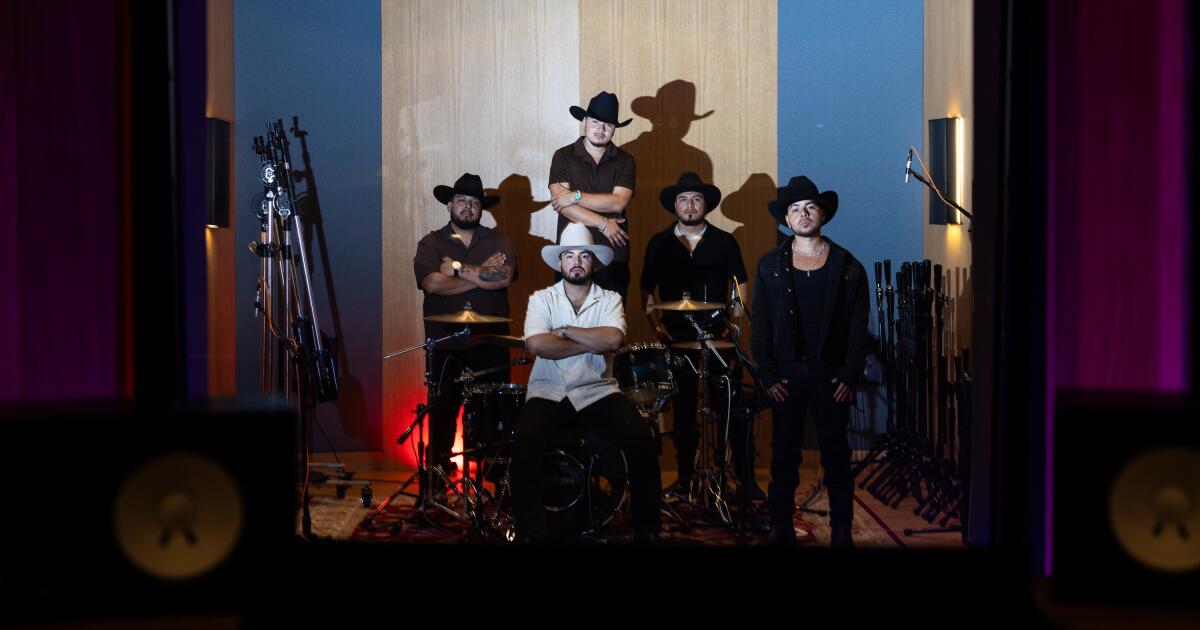
For Los Primos del Este, writing new album ‘Dulce Amargo’ felt like therapy

