Illinois
Illinois authorities divided on TRUST Act forbidding federal immigration enforcement collaboration


CHICAGO (WLS) — As the threat of ICE enforcement actions looms, local leaders are aligning themselves in word and action with the state’s Illinois TRUST Act.
It’s a law that only specifically forbids law enforcement from collaborating with federal authorities on immigration enforcement without a warrant.
ABC7 Chicago is now streaming 24/7. Click here to watch
Local law enforcement, elected officials and immigrant advocates said the debate rages on between how local and federal laws are enforced.
As President Donald Trump’s hardline stance on immigration continues in its first week, with the first-ever military planes used to repatriate undocumented immigrants taking off, the debate between federal enforcement and local laws and policies is hitting a boiling point.
That conversation, especially over the Illinois TRUST Act that bars local law enforcement assistance in ICE operations without a warrant, has now rekindled.
SEE ALSO | US Secret Service approached South Side school, not ICE agents: officials
“Those that are charged with or convicted of serious, heinous crimes they don’t want them on the street,” Kankakee County Sheriff Mike Downey said. “We don’t want them on the street if they’re U.S. citizens, why would we want them on our streets if they’re here illegally?”
In an exclusive interview, the sheriff allowed I-Team cameras into the Kankakee County jail. That facility, until the past few years, was contracted to hold up to 200 ICE detainees.
“We want to be there as just backup. We’re not looking to detain or arrest anybody. We’re there to support another law enforcement agency and that’s where the frustration comes in,” Downey said. “It’s a public safety issue. Get these bad people off our streets and out of our country. That’s what law enforcement is asking.”
The bipartisan TRUST Act was signed into law by Governor Bruce Rauner and implemented in 2017, with additional amendments in more recent years keeping law enforcement from assisting ICE agents.
“The bottom line is public safety right?” said Nina Sedeño, a Senior Immigration Policy Analyst with the Latino Policy Forum. “If individuals feel comfortable and safe communicating and cooperating with local law enforcement, then it helps local law enforcement, do their jobs more safely and efficiently when investigating crimes.”
Sedeño said with the TRUST Act, witnesses and victims from any community are more likely to come forward to law enforcement when they know their immigration status isn’t a factor.
“It creates what we call this this chilling effect right, this climate of fear, where, if an individual say without status witnessed a crime in the community, or something of that nature, but they’re fearful for to come forward with law enforcement, then that just creates an unsafe situation for everyone,” Sedeño said.
SEE ALSO Governor Pritzker suggests President Trump’s planned mass deportations could be political payback
However, Republican west suburban state Representative Dan Ugaste said the entire act should be repealed.
“Rather than putting them back out on the streets making ice go find them in the neighborhoods. We then will have a safe transfer of someone who’s going to be removed from the country,” Ugaste said.
Currently, the closest local ICE detention center is in Wisconsin, where republican lawmakers are working to establish new rules for all local law enforcement to collaborate and assist with ICE.
Copyright © 2025 WLS-TV. All Rights Reserved.


A major overhaul to the Illinois justice system could be officially underway.
House Bill 3363 lays the foundation for a brand new agency, the state public defender office.
The goal is to bring more consistent legal representation for Illinois residents who can’t afford an attorney.
Joining us now to discuss the rolled-out timeline is the bill’s sponsor, State representative Dave Vella, who actually started his legal career as a public defender, before heading to Springfield.
Illinois
Illinois Democrats face backlash after blaming Trump in Chicago cross-burning case | Fox News Video

‘Outnumbered’ reacts to Illinois Gov. JB Pritzker and Chicago Mayor Brandon Johnson blaming President Donald Trump for a cross-burning incident in Grant Park.
Illinois Democratic leaders Governor JB Pritzker and Chicago Mayor Brandon Johnson are slammed for weaponizing a Chicago cross burning incident by blaming former President Trump. Despite the suspect, Murlin Lue, admitting his motive was to protest Trump, not racism, Pritzker and Johnson doubled down. Critics, including Illinois GOP State Rep. Chris Miller, accuse them of playing politics and fostering division rather than seeking truth.

ROCKFORD, Ill. (WIFR) – November ballots will feature a repeat of top billing in the race for governor. Illinoisans can once again choose between Governor JB Pritzker or Darren Bailey to lead the Land of Lincoln.
But beside their spots, new names will appear for voters.
The Democratic and Republican candidates for governor picked new running mates for their rematch. With Lieutenant Governor Julianna Stratton running for U.S. Senate, Pritzker picked Christian Mitchell to join his ticket. On the Republican side, Aaron Del Mar joins Bailey, who previously ran with Stephanie Trussell in 2022.
Mitchell and Del Mar spoke Thursday with WIFR on what inspires them to run, their campaign priorities and ideas to improve the Rockford region.
Backgrounds
Starting with the Democratic ticket, Mitchell joins the race as a former state representative from Chicago as well as a deputy governor with the Pritzker administration.
“Before anything else, I’m Debbie’s son, and I’m James’s grandson,” Mitchell introduced. “They’re the ones who really instilled in me the value of hard work and made sure that I was going to have a very bright future.”
Mitchell sees the role of lieutenant governor as a partner to the state’s executive.
“I’m really lucky to be running with somebody who I respect, and who I think is the best governor in the nation… Governor JB Pritzker,” he said.. “My first thing is going to be supporting his agenda, which right now is all about lowering costs and raising wages.”
On the Republican side, Del Mar hails from suburban Chicago and considers his first priority to be raising his family.
“I wanted nothing to do with politics, did not want to be involved — wanted just to raise my kids and work my job,“ said Del Mar. He described his start in public service as something he ”kind of got pulled into.”
The Republican worked his way from a city council member in Palatine, at 29-years-old, to co-chair of the Illinois GOP. Although he says he “wanted nothing to do with being on” Bailey’s campaign, Del Mar sees strength in unity — offering a Chicago area perspective alongside Bailey’s southern Illinois roots.
“How about everybody in the state of Illinois, regardless of where you come from, has a seat at the table. If you’re from a southeast farming community, or you’re from the city of Chicago, where I grew up, everybody has a stake in the game.”
Priorities
Mitchell points to economic development as his focus for the gubernatorial campaign.
“I see vacancies on State Street in Chicago. I see vacancies on Main Street in Belleville and Alton and in Carbondale,” he recounted. “I want to make sure that we’ve got the kind of amenities and economic development, that kind of affordability, that allow us to make sure that folks want to stay in the towns that they’re born in if they want to.”
The Democratic candidate also eyes long-term planning for the state, including an “Illinois 2050 Plan.”
“How do we have the kind of educational undergirding that means that no matter where you’re from, you have a chance to have one of those jobs, whether it’s in new agriculture technology and new farming techniques or biotech, quantum.”
When asked how to achieve these priorities, Mitchell turned to investing in public education, retaining residents with better wages and improving health care.
“Making sure that we are able to protect our health care system, so that folks aren’t going broke when they get sick, that’s another big way that we can make an impact.”
Del Mar outlined a cost-of-living focus as central to his campaign.
“You wanna succeed, you do the basics really well, and the basics are affordability,” he contended.
The Republican repeatedly highlighted the state’s property taxes — reportedly the highest in the nation — as an issue to tackle. He suggested redirecting Illinois’s budget as one measure to ease the burden on homeowners.
“Number one is fully funding the state’s portion of local taxes, because that will offer people property tax relief.” Del Mar clarified this wouldn’t mean redirecting funds for public education.
“We’re looking at how we fund schools, how we make sure to empower teachers to have the best educational outcomes that we can have here in Illinois, regardless of what your zip code is, regardless of what your parents do for a living or how much money they make,” added Del Mar.
Reflecting on Rockford
Each candidate provided their vision for boosting the Rockford region.
For Mitchell, improvements continue with infrastructure funding, building on the state’s roughly $500 million investment in the area.
“The things that we have already worked on, through the capital plan that I helped lead as deputy governor, that the governor signed and is implementing, are already having benefits that the people of Rockford can see.”
The Democrat also pointed to the Chicago Rockford International Airport as an opportunity.
“Investing in that regional airport where we’ve already helped with a matching grant to get additional funds, that helps build out the economy,” said Mitchell. “There’s so much that’s happening there that it is really good for the economy and bringing more people back to Rockford.”
Del Mar shared his local priority as supporting unionization in the area.
“Union families deserve to be able to have a livable wage, and that’s something that’s important to Darren and I,” said Del Mar. He mentioned pensions were another item that a Republican executive wouldn’t touch for the public and private sector unions.
“I know that area up there has strong union backbone,” described Del Mar. “We want to make sure they know that they’re not going to have a bigger supporter in the governor’s mansion than Darren and I.”
Election Day
When asked for thoughts on their opponent, Mitchell criticized the Bailey campaign as a “repacking” of his 2022 run.
“The only record that they have to run on is extremism,” he exclaimed.
The Republican candidate also reflected on records, pointing to Pritzker’s years in office.
“Why are we underfunding education? Why are property taxes at all-time high? Why are businesses leaving?” asked Del Mar.
Voters can decide on who will lead Illinois November 3. Early voting starts September 24, with applications for voting by mail opening August 5.
Extended Interviews
Copyright 2026 WIFR. All rights reserved.
-

 Sports6 minutes ago
2026 World Cup Group Scenarios: What Remaining Teams Need To Advance To Round of 32
-

 Technology13 minutes ago
Ohio robot cop retires after zero arrests
-
 Business16 minutes ago
Commentary: Puncturing the myth of Alan Greenspan, whose policies gave us the Great Recession
-
 Entertainment21 minutes ago
On 10th anniversary, Boleros de Noche’s legacy is celebrated by L.A. City Hall
-
 Lifestyle28 minutes ago
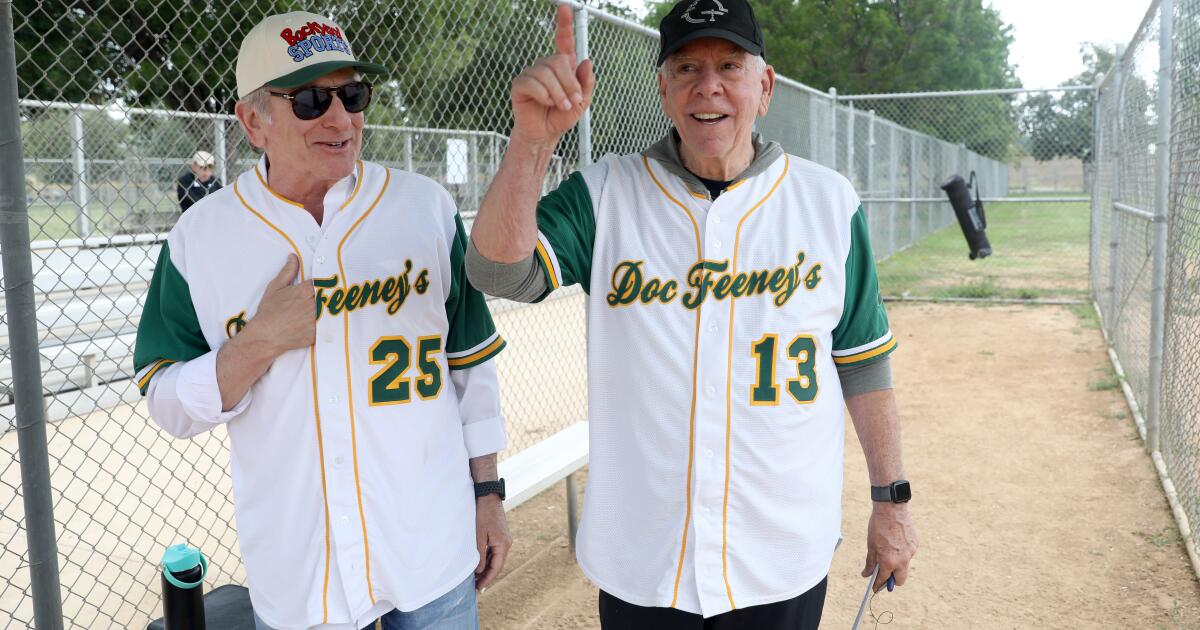
They started playing L.A. Municipal softball 50 years ago. They’re still at it
-
 Politics31 minutes ago
Newsom, California Legislature reach $351.7-billion budget deal
-
 Sports43 minutes ago
Roki Sasaki struggles with command early, Dodgers fall to Padres
-

 World51 minutes ago
Trump threatens 100% tariffs over EU digital tax

