Midwest
Expert reveals key factor that led to massive Minnesota fraud scheme

NEWYou can now listen to Fox News articles!
An ongoing decline in American assimilation and a deep fear of being accused of racism were key factors in the massive fraud scheme in Minnesota that is now coming to light, according to an expert.
Minnesota is facing one of the largest social-services fraud scandals in U.S. history after federal prosecutors uncovered what they describe as “schemes stacked upon schemes” by Somali-run non-profits that siphoned hundreds of millions of taxpayer dollars from child-nutrition and Medicaid housing programs.
Prosecutors have since charged more than 70 defendants, a large percentage of whom are members of Minnesota’s Somali community, securing dozens of convictions as new waves of indictments continue. The scandal has triggered state and federal investigations, congressional scrutiny, and calls for accountability over why warnings were missed and how the fraud was allowed to reach this scale.
Simon Hankinson, a senior research fellow at the Heritage Foundation’s Border Security and Immigration Center, said that the decline in immigrant assimilation in America was key during an interview with Fox News Digital.
INSIDE ‘LITTLE MOGADISHU’: MINNESOTA’S BELEAGUERED SOMALI COMMUNITY UNDER A CLOUD OF FRAUD AND TRUMP ATTACKS
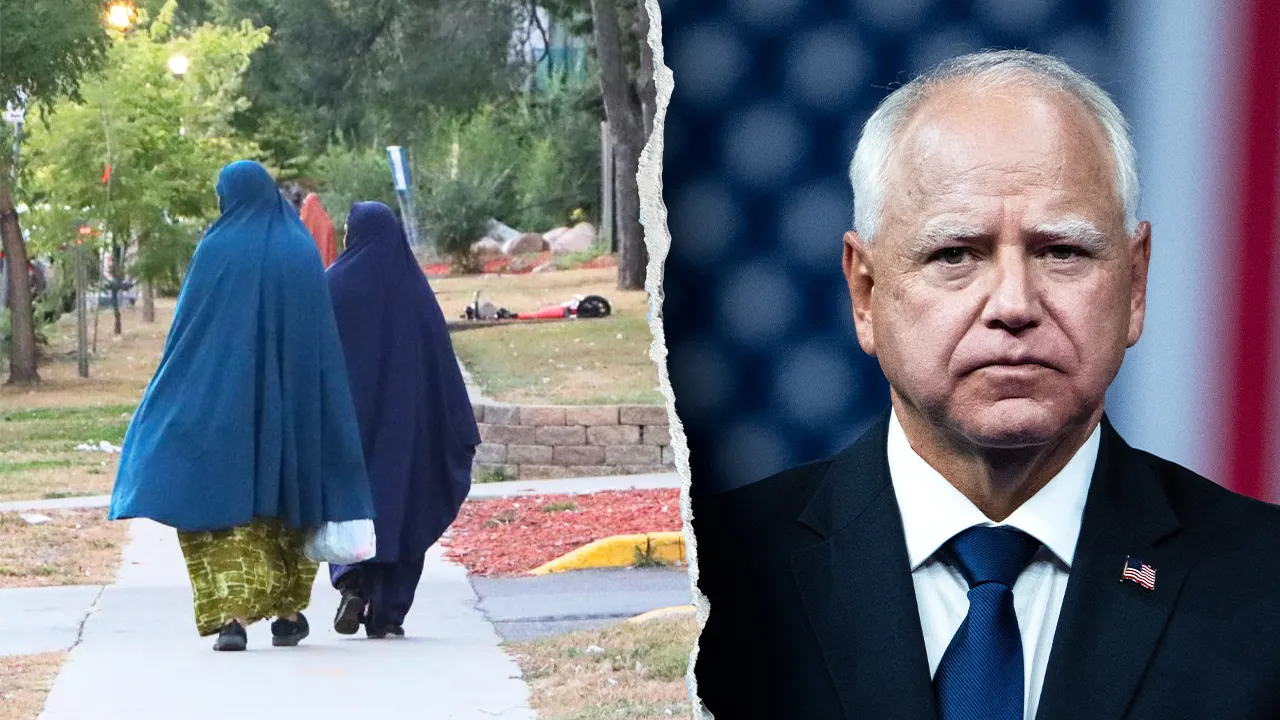
Two Somali women walk through a Minneapolis neighborhood as Minnesota Gov. Tim Walz appears in a split image. Lawmakers say the state’s oversight failures and political sensitivity around Somali-run nonprofits helped fuel the $1 billion welfare fraud scandal now under federal investigation. (Williams/CQ-Roll Call, Inc via Getty Images; Michael Dorgan/Fox News Digital)
“Assimilation is a two-sided coin. The pressure comes from inside, from you wanting to assimilate so you can make it in the new society, but it also comes from outside, where the society says, ‘Hey, we expect you to do this. We expect you, if you want a driver’s license, to be able to speak and read English at a basic level.’ We don’t do that anymore in America. We don’t we don’t really expect anything of our immigrants,” explained Hankinson.
“There are a lot of people who are American-born,” he went on, “who really don’t like this country and what it stands for. And so, they don’t think anyone else ought to accept it and adapt to it either.”
Hankinson noted that in no way can the fraud scheme be blamed writ large on the Minnesota-Somali community, which is estimated to have around 80,000 people. He said that those involved in the scam are a minority. However, the fact that the tight-knit community has by and large not assimilated into the broader American society and customs meant that many of the factors that could have exposed the scheme earlier were not there, according to Hankinson.
“When you come from a culture that provides you with nothing from the center, everything is family, everything is clan, everything is local, then it’s almost impossible for you to understand how a federal system would work. And if your neighbor came to you and said, ‘Hey, we got this cool thing going, if you just say your kid’s autistic, I’ll give you a thousand dollars a month.’ I mean, that’s a no-brainer for an awful lot of people,” he explained.
“Even if they thought that maybe it was wrong on some level, they might think, ‘Well, hang on, in my new country, maybe that’s frowned upon,’ they’re not going to rat out the clan member, the family member,” he added.
TIM WALZ CALLED OUT BY WASHINGTON POST FOR REFUSING TO TAKE RESPONSIBILITY FOR MINNESOTA FRAUD SCANDAL
Men take part in a weekly Friday Jum’ah prayer session at Abubakar As-Saddique Islamic Center amid a reported ongoing federal immigration operation targeting the Somali community in Minneapolis, Minnesota, U.S. Dec. 5, 2025. (Tim Evans/Reuters)
That, combined with the existence of generous taxpayer-funded welfare programs and Minnesota being what Hankinson called a “high trust state,” made the state “ill-equipped to handle fraud.”
“In Minnesota, these programs were low-hanging fruit. They were so easy to fleece, it’s almost farcical,” said Hankinson. “So, the carrot is there to commit fraud, and there’s no stick.”
He pointed to one aspect of the scheme in which prosecutors say Minnesota’s Medicaid autism program was exploited by companies recruiting families, securing fraudulent diagnoses, and billing for therapy that never happened, draining millions from the program.
“That is outrageous. Somebody should have noticed at some point that, ‘Hang on a minute, why have the autism rates in Somali kids gone from one in a hundred to like one in three or whatever it was?’” he said. “There should have been some oversight, and there again you get into the whole American racial guilt, which is a particular issue that we have, where if you’re an unscrupulous scammer, you can always play the race card, and that will often get you away with it because people are terrified.”
“Nobody likes to be called a racist. It’s about one of the worst things you could be called,” he went on. “But I do think liberal Americans, in particular white liberal Americans, are more afraid of that label than anything else. So, some of these scammers, they threatened to make a fuss about being targeted on account of race or immigrant status or religion. And that probably contributed to state authorities being a little slower.”
ILHAN OMAR SAYS SHE’S FRUSTRATED SINCE SOMALIS ARE ALSO VICTIMS IN ‘FEEDING OUR FUTURE’ SCAM
Somali illegal alien Abdul Dahir Ibrahim, who was convicted of fraud, has been photographed with Rep. Ilhan Omar, D-Minn., (left) and Democratic Minnesota Gov. Tim Walz (right). (ICE)
This dynamic has also played out on the national level. Following the Trump administration’s announcement of its crackdown on illegal immigrant Somalis in Minnesota, Democratic Gov. Tim Walz has accused it of “demonizing an entire group of people just by their race and their ethnicity.”
“I can’t take Tim Walz seriously, honestly, because he was the governor who was in charge while all this was happening. Where was he?” said Hankinson. “He was asleep at the switch.”
CLICK HERE TO DOWNLOAD THE FOX NEWS APP
“It’s not a question of scapegoating,” he said. “It’s a good thing to send a message, not to the Somali community per se, but to all of Minnesota and the rest of the 49 states that this is America, we have laws, we have rules. When you break those rules, you are going to get punished.”
Hankinson added that ultimately, he hopes to see many Somalis joining in the effort to crack down on the minority involved in fraud so that they can “give their community the reputation that it deserves.”
Read the full article from Here



Tears, prayers, songs and memories filled the Lancaster Elementary School parking lot June 2 as family, friends and fellow members of S.I.G. Youth Fraternity, Inc. gathered at a Blackout Community memorial to honor Pepe Sikisi-Belle Jr.
Sikisi-Belle, 22, was killed May 30 during a birthday party for his son at Center Street Park in Milwaukee. During the private memorial, loved ones shared stories of the Milwaukee man, who was known within the fraternity as “House Party.”
‘He was the life of the party’
The memorial was emceed by fellow S.I.G. Youth Fraternity member Juanie Johnson, who said he had known Sikisi-Belle, a father of three, since he was a freshman.
“I actually pledged him into [S.I.G. Youth Fraternity], so I’ve had the opportunity to work with Pepe since he was in ninth grade,” Johnson said. “Like we said, we’re here to celebrate his life. This is what we do when one of our members passes. Just remember that although he’s gone, he will forever live in our hearts.”
Several fraternity brothers remembered Sikisi-Belle as the ‘life of the party’ who regularly checked on friends and family.
Speakers said Sikisi-Belle’s fraternity name, “House Party,” reflected not only his outgoing personality but also the comfort he provided to others. One fraternity member described him as a sincere soul who was always there for those around him, while others recalled his playful side and said he was known for teasing and trolling his friends.
One of Sikisi-Belle’s fraternity line brothers was too emotional to speak during the memorial, so Johnson spoke on his behalf.
“They were like two peas in a pod. They gave me a headache,” Johnson said. “They used to always get in trouble together, but to know Pepe is to love Pepe. He was always the life of the party, the spirit of the party, and he used to call me every morning just to be like, ‘You good, bro?’”
Sikisi-Belle’s parents also attended the memorial and shared remarks about their son.
“I miss my son,” said Marissa Bopilo, Sikisi-Belle’s mother. “I know that he loves y’all very, very much, and he’ll live on with us for the rest of our lives.”
Bopilo said she hopes those responsible for her son’s death are brought to justice.
“He was the life of the party, and he was definitely loved by many,” Bopilo said after the memorial. “I’m hoping things move forward with the situation. I’m hoping that we get justice.”
Members of the organization blew out candles one by one in honor of Sikisi-Belle before closing the memorial with a song.
Sikisi-Belle died from multiple gunshot wounds
At 6:47 p.m. May 30, Milwaukee County Sheriff’s Office deputies responded to Center Street Park, 420 W. Clarke St., for reports of a shooting.
When authorities arrived, they found Sikisi-Belle dead from at least two gunshot wounds to his upper torso, according to the Milwaukee County Sheriff’s Office.
A 25-year-old Milwaukee woman was arrested at the scene in connection with the shooting. MCSO said the woman knew Sikisi-Belle and was found with two firearms in her possession.
As of June 3, no criminal charges had been filed in the case.
Adrienne Davis is a south suburban reporter for the Milwaukee Journal Sentinel. Got any tips or stories to share? Contact Adrienne at amdavis@gannett.com. Follow her on X at @AdriReportss.

Minneapolis leaders are divided over whether to keep paying for ShotSpotter as the city weighs a new contract for the gunfire detection system.
A public hearing at City Hall focused on the technology as Minneapolis negotiates a new contract with SoundThinking, the company that provides ShotSpotter. Deputy Chief of Investigations Travis Riddle told the council the system supports gun violence strategies and can alert police no later than 60 seconds after shots are fired.
Critics at the hearing said the technology is not proven enough and argued the money could be spent in other ways. The proposed deal would cost $3.7 million through 2029 and would expand ShotSpotter into new areas of Minneapolis.
“We have actually had a contract with SoundThinking for their ShotSpotter services since 2014, and even with this technology for over 12 years now, MPD’s solve rates for homicides and non-fatal shootings were some of the worst in the country,” Council member Robin Wonsley said.
Council members pushed back on the long-term proposal and said they want a one-year deal instead. Council Member LaTrisha Vetaw disagreed with concerns raised by her colleague during the debate.
“In my opinion, and in folks I’ve heard from the North Side who have shown up here time and time again to say that we want this technology, we believe that ShotSpotter is a tool that the police use to save lives,” LaTrisha Vetaw said
City Council is set to take up the issue again on June 17. Minneapolis police are expected to return with a one-year contract instead of the three-year contract brought forward at the hearing.

by:
Gregg Montgomery and Kelsie Gibbs
Posted: / Updated:
INDIANAPOLIS (WISH) — Indy Parks on Saturday will unveil the restoration of longstanding fountains, a project almost two years in the making.
The fountains were already shooting water among newly landscaped walking paths on Wednesday afternoon at the Garfield Park Sunken Garden.
City planner and landscape architect George Kessler designed the Sunken Garden and the adjacent Garfield Park Conservatory, which was built in 1916 at 2505 Conservatory Drive.
Funds for the $3 million restoration project were part of an $80 million Lilly Endowment grant issued to Indy Parks in late 2022 for projects at 42 Indianapolis parks.
The Friends of Garfield Park, a group devoted to the south-side park, oversaw the project to restore the concrete walls and plumbing, and add color-changing lights to enhance the look of the fountains.
The group hopes to raise an additional $1 million for the upkeep of the fountains.
A news release issued Wednesday said a recognition event and a ribbon-cutting, free and open to the public, were scheduled for 4 p.m. Saturday. Due to storms in the forecast, the event could be delayed or canceled.
-

 San Diego, CA2 minutes ago
Automated license plate readers and public surveillance cameras are coming to Imperial Beach
-

 Milwaukee, WI7 minutes ago
Friends, family gather to remember gunshot victim Pepe Sikisi-Belle Jr.
-

 Atlanta, GA14 minutes ago
As FIFA World Cup nears, some MARTA riders raise safety concerns after recent attacks on transit system
-

 Minneapolis, MN17 minutes ago
Minneapolis leaders split over ShotSpotter contract
-

 Indianapolis, IN22 minutes ago
Work completed on $3 million restoration of fountains at Garfield Park
-

 Pittsburg, PA29 minutes ago
Pittsburgh Regional Transit starting to install new ReadyFare machines
-

 Augusta, GA32 minutes ago
Five Augusta Women’s Tennis Players Honored on PBC All-Academic Team – Augusta University
-

 Washington, D.C44 minutes ago
Washington archbishop removes priest as exorcist after comments on UFOs and demons

