Midwest
DOGE co-leader Ramaswamy planning 2026 run for governor in Ohio: sources

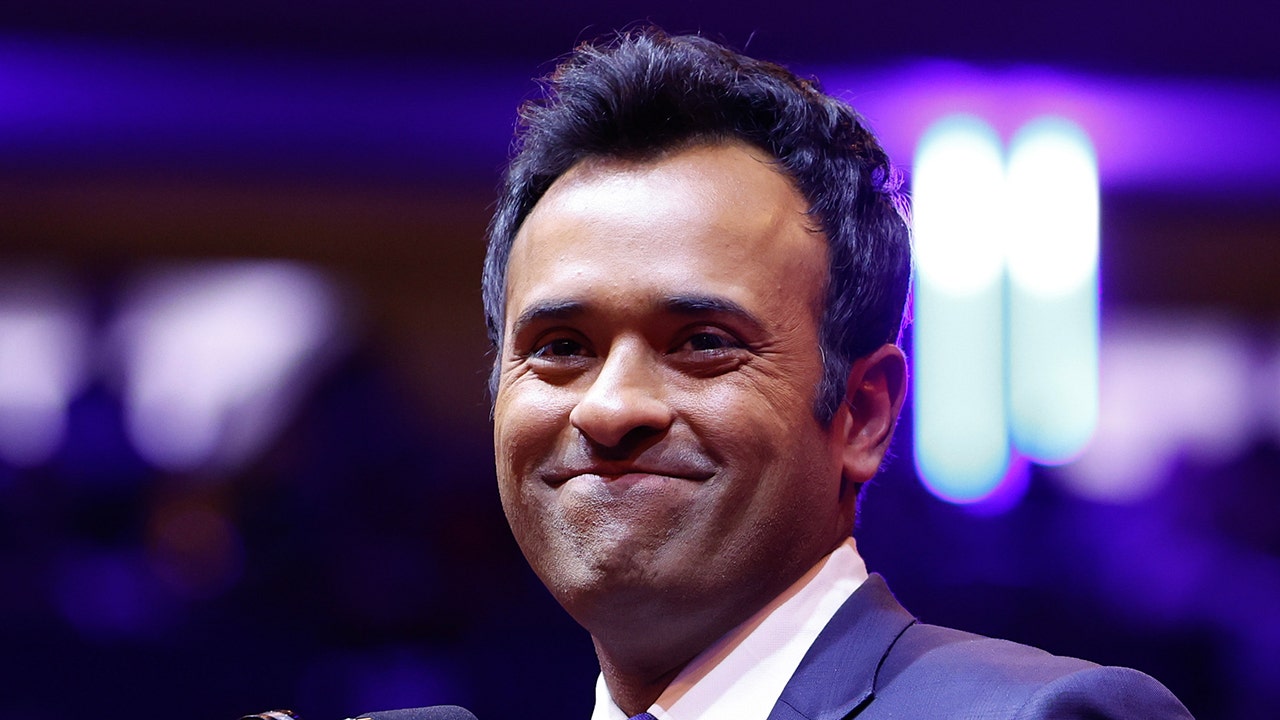
Vivek Ramaswamy, the multi-millionaire biotech entrepreneur and former Republican presidential candidate, plans to launch a bid for Ohio governor, multiple sources confirm to Fox News Digital.
The sources add that Ramaswamy, who along with Elon Musk is co-leader of President-elect Donald Trump’s Department of Government Efficiency (DOGE) initiative, is expected to make an announcement on a gubernatorial run “shortly.”
“Vivek’s base plan remains [the] same: to get accomplishments at DOGE and then announce a run for governor shortly,” said an Ohio operative familiar with Ramaswamy’s thinking who asked to remain anonymous to speak more freely, told Fox News on Friday.
TRUMP ALLY WHATLEY VOWS RNC TO BE ‘TIP OF THE SPEAR’
Vivek Ramaswamy speaks before former President Donald Trump takes the stage at the campaign rally at Madison Square Garden on Oct. 27, 2024 in New York City. (Anna Moneymaker/Getty Images)
Current Ohio Republican Gov. Mike DeWine is term-limited and cannot seek re-election in 2026.
DeWine on Friday announced that Lt. Gov. Jon Husted would fill the U.S. Senate seat held by former Sen. JD Vance until earlier this month, when the vice president-elect stepped down ahead of Monday’s inauguration.
MUSK AND RAMASWAMY IGNITE MAGA WAR OVER SKILLED WORKER IMIMGRATION
Before the Senate announcement, Husted had long planned to run for governor in 2026 to succeed DeWine.
Gov. Mike DeWine announced that Lt. Gov. Jon Husted will fill the vacant U.S. Senate seat, held until earlier this month by Vice President-elect JD Vance, on Friday, Jan. 17, 2024. (Reuters)
The now-39-year-old Ramaswamy, who launched his presidential campaign in February 2023, saw his stock rise as he went from a long-shot to a contender for the Republican nomination.
CLICK HERE FOR THE LATEST FOX NEWS REPORTING ON VIVEK RAMASWAMY
Ramaswamy campaigned on what he called an “America First 2.0” agenda and was one of Trump’s biggest supporters in the field of rivals, calling Trump the “most successful president in our century.”
Vivek Ramaswamy, right, endorses former President Donald Trump during a campaign event at the Atkinson Resort and Country Club in Atkinson, New Hampshire, on Jan. 16, 2024. (TIMOTHY A. CLARY/AFP via Getty Images)
He dropped his White House bid a year ago after a distant finish in the Iowa caucuses. Ramaswamy quickly endorsed Trump and became a top surrogate on the campaign trail.
Ramaswamy, an Ohio native, was named along with Musk, the world’s richest person, to lead DOGE, in an announcement in November by Trump.
Ohio, which was once a top general election battleground, has shifted red over the past decade as Republicans have dominated statewide elections.
Read the full article from Here



(WLUK) — Applications for Wisconsin’s 2026 elk season open next week.
The DNR says the application period begins Sunday, Mar 1 and will close on Sunday, May 31.
Selected applicants will be notified in early June.
For the third year in a row, there will be increased opportunity to pursue elk within the Central Elk Management Zone (formerly Black River Elk Range), as additional bull elk and antlerless harvest authorizations will be available through the state licensing system. The 2026 elk quota for the Central Elk Management Zone is six bull elk and six antlerless elk, up from a quota of four bull and five antlerless in 2025.
The Northern Elk Management Zone (formerly Clam Lake Elk Range) quota will be eight bull elk, subject to a 50% declaration by Ojibwe tribes.
During the open application period, applicants will have the choice to submit one bull elk license application and/or one antlerless elk license application, separately. Applicants can apply to any unit grouping with an associated quota for that authorization type (bull or antlerless). The order of drawing will be bull licenses first, followed by antlerless licenses. As a reminder, only one resident elk hunting license can be issued or transferred to a person in their lifetime, regardless of authorization type.
In 2026, there will be one continuous hunting season, opening Saturday, Oct. 17, and continuing through Sunday, Dec. 13, eliminating the split-season structure that was in effect from 2018-2025. This offers elk hunters more opportunities and flexibility to pursue elk in Wisconsin.
Wisconsin residents can submit elk license applications online through the Go Wild license portal or in person at a license sales agent. The application fee is $10 for each of the bull elk and antlerless elk drawings and is limited to one application per person, per authorization type. The DNR recommends that all applicants check and update their contact information to ensure contact with successful applicants.
For each application fee, $7 goes directly to elk management, monitoring and research. These funds also enhance elk habitat, which benefits elk and many other wildlife. If selected in the drawing, an elk hunting license costs $49.
Before obtaining an elk hunting license, all selected hunters must participate in a Wisconsin elk hunter education course. The class covers Wisconsin elk history, hunting regulations, biology, behavior and scouting/hunting techniques.
NEWYou can now listen to Fox News articles!
Kansas has officially invalidated driver’s licenses and birth certificates for transgender residents who changed their sex designation on government documents under a law that took effect Thursday.
Roughly 1,700 individuals in Kansas will be required to obtain a new standard driver’s license at a cost of $26, according to the House Substitute for Senate Bill 244.
The state’s vehicle division informed residents that no grace period will be offered for those who need to update their IDs, according to The Kansas City Star.
“Please note that the Legislature did not include a grace period for updating credentials. That means that once the law is officially enacted, your current credentials will be invalid immediately, and you may be subject to additional penalties if you are operating a vehicle without a valid credential,” the Kansas Department of Revenue’s vehicle division said.
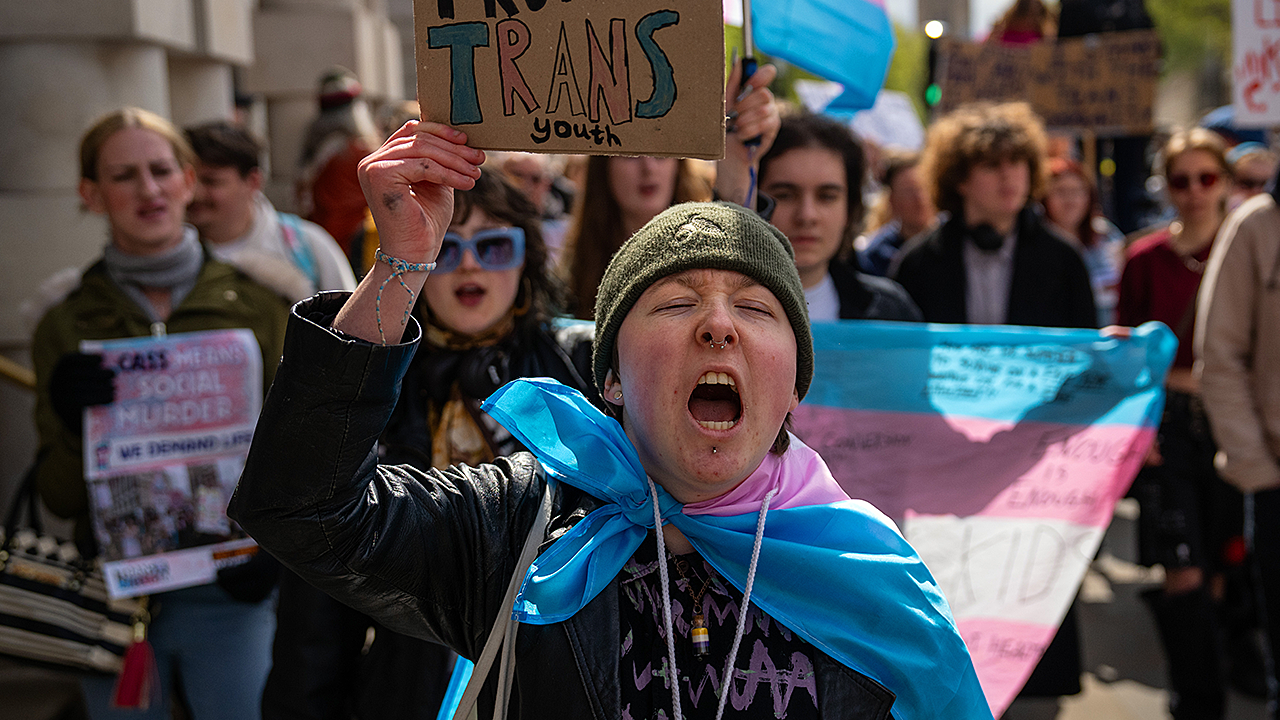
Trans rights activists take part in a protest April 20, 2024. (Carl Court/Getty Images)
The law also establishes clear rules for shared private spaces in government buildings, restricting their use to a single sex. This applies to facilities such as restrooms, locker rooms, changing rooms and shower rooms where individuals may be partially or fully undressed.
The bill further reinforced a strict definition of sex and gender as an “individual’s biological sex, either male or female, at birth.”
Consequently, individuals or entities who violate the space restrictions may face significant civil penalties or potential criminal charges.
KANSAS JUDGE SAYS TRANSGENDER RIGHTS NOT VIOLATED BY STATE’S REFUSAL TO CHANGE SEX ON DRIVER’S LICENSES
A drone aerial view of downtown Wichita (Joe Sohm/Visions of America/Universal Images Group via Getty Images)
Individuals are also given the right to take legal action if someone of the opposite biological sex violates their privacy in these spaces.
Democratic Gov. Laura Kelly, whose veto of the bill was ultimately overridden by the Republican-led Kansas Legislature Feb. 18, had previously called it a “poorly drafted bill with significant, far-reaching consequences.”
“It is nothing short of ridiculous that the Legislature is forcing the entire state, every city and town, every school district, every public university to spend taxpayer money on a manufactured problem,” she said. “Kansans elected them to focus on education, job creation, housing and grocery costs.”
SUPREME COURT CONSERVATIVES SIGNAL SUPPORT FOR STATE TRANSGENDER SPORTS BANS DURING ORAL ARGUMENTS
Kansas Gov. Laura Kelly previously tried to veto a bill that ultimately went into effect Feb. 26, 2026, restricting identification preferences for transgender state residents. (Rich Sugg/Kansas City Star/Tribune News Service via Getty Images)
Under the bill, entering a multiple-occupancy space designated for the opposite sex constitutes a violation. After a first warning, a second offense could result in a $1,000 civil penalty and a third or subsequent violation is treated as a class B misdemeanor.
Anyone who believes their privacy has been violated in such a setting may bring a civil lawsuit against the violator and seek $1,000 in liquidated damages, according to the bill.
CLICK HERE TO DOWNLOAD THE FOX NEWS APP
Government entities, such as state agencies or local districts, that fail to align with the new regulations are subject to steep fines. Entities face a $25,000 civil penalty for a first violation and $125,000 for each subsequent violation.
The law provides specific exceptions for entering spaces designated for the opposite sex, including custodial or maintenance work, medical or emergency aid, law enforcement duties, assisting someone who needs help or children under 9 accompanied by a caregiver.
Related Article

Read the full article from Here

Feeding South Dakota

Trump touted gas prices under $2.30. Tennessee gas prices say otherwise

North Texas middle school closes after a norovirus outbreak

Utah man dies of injuries sustained in avalanche in Big Cottonwood Canyon

Here are five places to ice skate in Vermont this winter

Florida High School Football Rankings: Top 25 teams – Oct. 21

Cleary's 21 help Le Moyne down Central Connecticut State 69-64 in OT

How old is Bo Nix? What to know about Oregon quarterback ahead of 2024 NFL Draft

99th annual Pony Swim held in Virginia

Indiana Members Credit Union announced as new anchor tenant at Bottleworks District

Where Iran’s ballistic missiles can reach — and how close they are to the US

Has India’s influence in Afghanistan grown under the Taliban?

Bill Clinton to testify before House committee investigating Epstein links

Read Judge Schiltz’s Order

Vulnerable House Dem lashes out at Trump’s ‘racist’ SOTU challenge: ‘That was uncomfortable’
-

 World2 days ago
Exclusive: DeepSeek withholds latest AI model from US chipmakers including Nvidia, sources say
-

 Massachusetts2 days ago
Mother and daughter injured in Taunton house explosion
-

 Montana1 week ago
2026 MHSA Montana Wrestling State Championship Brackets And Results – FloWrestling
-

 Oklahoma1 week ago
Wildfires rage in Oklahoma as thousands urged to evacuate a small city
-

 Louisiana4 days ago
Wildfire near Gum Swamp Road in Livingston Parish now under control; more than 200 acres burned
-

 Technology6 days ago
YouTube TV billing scam emails are hitting inboxes
-

 Denver, CO2 days ago
10 acres charred, 5 injured in Thornton grass fire, evacuation orders lifted
-

 Technology6 days ago
Stellantis is in a crisis of its own making