Detroit, MI
Alex Lange emotional ahead of surgery to end his Detroit Tigers season


Detroit Tigers right-handed reliever Alex Lange wiped tears from his eyes in the clubhouse Friday, just four days before Tuesday’s season-ending surgery in New York to repair an avulsion in his right lat (a tear in the large muscle covering the back) with Yankees head team physician Dr. Christopher Ahmad.
Lange won’t pitch again until the 2025 season, but will miss his teammates more than anything.
“I’m looking forward to watching ball this summer,” Lange, 28, said at Comerica Park. “I watch every game. When you’re away from the boys, it’s tough. You become such like a family. It’s tough. I want to get back and get healthy and help. It’s been pretty cool to be a part of this family. I’m going to miss it.”
And his teammates will miss him.
“He’s a huge part of our bullpen, and he’s a nasty pitcher,” catcher Jake Rogers said. “He’s got literally the best pitch in baseball. It’s a tough loss for us. I’m praying for him. I know he’ll be back even better than before, which I’m excited to see.”
COMEBACK SOON: Tigers’ Kerry Carpenter cleared for baseball activities, wishes he could help offense
Lange, diagnosed with a right lat strain, suffered the injury while pitching June 14 with Triple-A Toledo. He was trying to work his way back to the Tigers after getting sent down May 23 because of continued problems with his command and his curveball.
Lange lost his job as the closer with a 4.34 ERA, 17 walks and 21 strikeouts across 18⅔ innings in 21 relief appearances with the Tigers this season. (He notched 26 saves in 32 opportunities in 2023.)
“When you pitch as poorly as I was, you gotta accept your option, go down there and work on some stuff,” Lange said. “We had stuff to clean up. I was giving it up pretty good and costing the boys. To go down there and get right, I felt like I was ready, and then obviously unfortunate events happened.”
Lange took the mound June 14 for the Mud Hens in the seventh inning. He felt pain upon throwing a 96.5 mph sinker — his second-to-last pitch of the season — to the second batter he faced in his ninth outing with Toledo. Lange then struck out John Rave, a 26-year-old in the Kansas City Royals’ organization, with a curveball, but after throwing that pitch, immediately signaled to the dugout for medical attention.
“The heater, I felt it snap off the bone,” Lange said. “The tendon just pulled off the bone. I was like, ‘Uh oh, that’s not good.’ With the time of the pitch clock and everything, I wanted to test it to see what happens. I threw a breaking ball, swing and miss, and knew something was wrong, so I called the trainers out.”
The swing-and-miss curveball for a strikeout of Rave marked the final pitch of Lange’s season.
“The tendon pulled off the bone and retracted five and a half centimeters down the lat,” Lange said. “Go in there, sew it back on, a little duct tape, a little glue.”
[ MUST LISTEN: Make “Days of Roar” your go-to Detroit Tigers podcast, available anywhere you listen to podcasts (Apple, Spotify) ]
Dating back to June 4, 2023, Lange posted a 4.92 ERA with 51 walks (18% walk rate) and 66 strikeouts (23.3% strikeout rate) across 60⅓ innings in 64 games.
At the time of this year’s May 23 demotion, Lange’s 18% walk rate since last June 4 ranked 46th among 46 relief pitchers with at least 60 innings during that span, while his ERA ranked 44th. He struggled to throw strikes for far too long.
“I feel for him,” manager A.J. Hinch said. “He was working on the things that we asked him to work on, which is finding his breaking ball and throw more strikes. The curveball was hit or miss. He was throwing a few more strikes. When he got hurt, it was a punch in the gut for him and for us.”
J-HEN: In return to Atlanta, Tigers’ Justyn-Henry Malloy reflects on career-changing move
His curveball has the potential to be one of the best breaking balls in baseball because of the swing-and-miss profile, but his curveball hasn’t fooled opponents as often recently because it doesn’t fall off the table like it used to.
Simply put, his curveball lacks downward movement.
It averaged minus-0.1 inches of induced vertical break in MLB and plus-1.7 inches of IVB at the Triple-A level this season. Three years ago, it averaged minus-7.4 inches of IVB in MLB.
Fixing the curveball will have to wait.
“All we can really focus on is getting him healthy and getting him back and having him factor in whenever that is,” Hinch said. “But it was good to see him and see his determination to tackle this part of his career with the intensity that all of us would expect of him.”
Lange will rehab from season-ending lat surgery in Houston — which is where he lives in the offseason — as he aims to report healthy to spring training in 2025.
He sounds confident about his chances of bouncing back.
“It’s a pretty big muscle,” Lange said. “We’ll start with reattaching it to where it’s supposed to be and getting that tendon strong back to that bone. As far as the plan, we’re just going to execute. We’ll deal with those obstacles as they come. I’ll be all right. I’m not too worried.”
Contact Evan Petzold at epetzold@freepress.com or follow him @EvanPetzold.
Listen to our weekly Tigers show “Days of Roar” every Monday afternoon on demand at freep.com, Apple, Spotify or wherever you listen to podcasts. And catch all of our podcasts and daily voice briefing at freep.com/podcasts.



Detroit, MI
Detroit crime hits decades-low as Michigan governor candidates debate how to keep progress going

DETROIT – Violent crime has been trending downward in Detroit and across Michigan, but the five major candidates running for governor disagree on what it will take to sustain that progress.
Detroit recorded 165 homicides in 2025, the city’s fewest since the mid-1960s.
Non-fatal shootings fell 26%, carjackings dropped 46%, and robberies declined 21% compared with the previous year.
In one-on-one interviews with Local 4, the candidates agreed that public safety remains foundational to Michigan’s future, arguing that residents and businesses are less likely to invest in communities they do not believe are safe.
However, they offered sharply different approaches to reducing crime, strengthening law enforcement, and preventing future violence.
Mike Cox emphasizes tougher enforcement and parole supervision
Former Michigan Attorney General Mike Cox said his experience as a Wayne County prosecutor and the state’s top law enforcement official has shaped his approach to public safety.
Asked about Michigan’s biggest public safety challenge, Cox acknowledged recent progress but said more work remains.
“Crime has gone down in Detroit, Saginaw, and Flint, but we have to do better,” said Cox. “200 murders is unacceptable in the city of Detroit. Any murder is unacceptable. So I worked with the Detroit police back when I was AG, and of course, when I spent 13 years as a Wayne County prosecutor.”
Cox said he would revive the “Joshua Project,” a program that conducted nighttime compliance checks on probationers and parolees through the Michigan Department of Corrections.
“Which had Department of Corrections folks going out at night, checking on probationers and parolees,” said Cox. “That worked then; it would work now. Politics got in the way then; it won’t this time.”
He also called for changes to Michigan’s criminal justice system.
“I push the legislature to get rid of cashless bail to change sentencing guidelines and, importantly, appoint the right sort of judges who understand that there’s a difference between being a victim and a defendant,” said Cox.
John James says restoring confidence in the justice system is critical
Republican Congressman John James argued the state’s biggest public safety issue is declining public confidence in law enforcement and the courts.
“I believe the number one public safety concern is that people frankly don’t trust that the judicial system, that the law enforcement system works for them,” said James. “They see people getting out back on the streets after committing violent crimes before a lot of these cops are out done with their shifts. We need to enforce the law, and we need to make sure that there are consequences and common sense in the state of Michigan again.”
James said his administration would prioritize victims and seek tougher consequences for repeat violent offenders.
“People don’t feel safe in their neighborhoods anymore,” said James. “I’m going to enforce the law. I’m going to make sure that violent repeat offenders go to jail and stay there. And any activists, judges, DAs, and prosecutors who care more about criminals’ feelings than victims’ rights are going to have to account to the governor and to the agency.”
Perry Johnson says policy should begin with data
Republican businessman Perry Johnson said public safety strategies should be tailored to regional needs rather than applied uniformly across the state.
“Safety depends on regions,” said Johnson. “Some areas of our state are extremely safe. Other areas are not.”
Johnson said the government should first identify weaknesses before implementing new policies.
“So those are the areas that must be looked at,” said Johnson. “So even when you look at safety, doing a basic audit of seeing where the weaknesses are, where the strengths are, where you need to improve. Has to be done instead of just randomly have something go across the board in the entire state.”
Johnson also argued that decision-making should be driven by measurable data.
“I think making a decision blind is like shooting at a dart board, covering your eyes, and hoping you hit the bullseye,” said Johnson. “That is not my way to run any organization, any business, or any government.”
Chris Swanson focuses on prevention and trafficking
Genesee County Sheriff Chris Swanson, a Democratic candidate with three decades in law enforcement, identified drug trafficking and human trafficking as Michigan’s most pressing public safety threats.
“Drug trafficking is the number one industry,” said Swanson. “Human trafficking is fastest growing in the world, and they’re interdependent. Those are the top two.”
Swanson said preventing crime before it occurs should be a central responsibility of government.
“The best way to treat crime is preventative,” said Swanson. “Stop it before it starts. It’s called problem-solving policing. And if you just treat the symptom, then you’re not solving the problem.”
Jocelyn Benson centers plan on reducing gun violence and increasing transparency
Secretary of State Jocelyn Benson said reducing gun violence would be a top priority if elected governor.
“We need to protect our communities against gun violence, whether it’s here in an education institution, at a place of worship, or in any community,” said Benson. “As a resident of Detroit, I see how important it is that we prioritize reducing gun violence and ensuring our law enforcement and other community partners are equipped with the tools they need.”
Benson also argued that transparency in state government strengthens public trust.
“Transparency in how our executive offices work,” said Benson. “Is going to be really important for me as governor because it helps engage citizens in seeing the process and getting information about how your government’s actually working.”
Different approaches to a shared goal
The Republican candidates generally emphasized tougher enforcement, judicial accountability, and data-driven resource deployment.
The Democratic candidates focused more heavily on prevention, gun violence reduction, combating trafficking, and strengthening trust between government, law enforcement, and the public.
Whoever succeeds Gov. Gretchen Whitmer will inherit a state where several public safety indicators continue to improve.
According to the Michigan Department of Corrections, the state’s recidivism rate fell to a record low of 21% last year, meaning nearly four out of five people released from prison did not return within three years.
Copyright 2026 by WDIV ClickOnDetroit – All rights reserved.

Wildfire smoke drifted across Southeast Michigan Wednesday night and a smoky, hazy sky resulting from fine particulate pollution was clearly visible by daybreak on Thursday.
All of Michigan is under an air quality alert through Friday.
The air was so bad early Thursday in Southeast Michigan that Detroit was listed as having the worst air quality in the world in the IQAir database, well into the “hazardous” range, topping even Toronto, Canada, and Minneapolis, Minnesota.
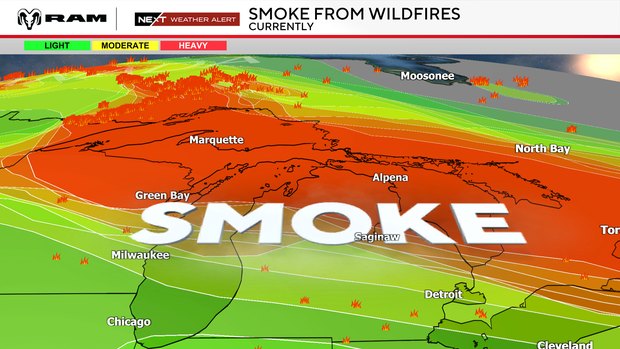
The smoke plume from hundreds of wildfires in Canada and Minnesota began crossing into Northern Michigan during the day on Wednesday. By midnight Wednesday, the MiAir database showed significantly deteriorating air quality in Southeast Michigan.
The CBS News Detroit weather team has declared Thursday and Friday to be NEXT Weather Alert Days, stepping up forecasts and announcements as needed.
How bad is the air?
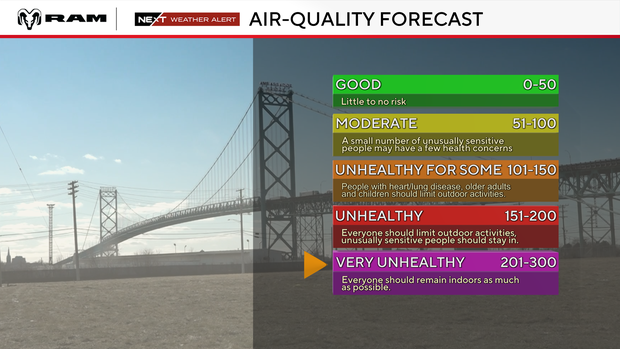
The MiAir database run by the Michigan Department of Environment, Great Lakes and Energy showed air quality numbers well over the “very unhealthy” range in multiple locations in Metro Detroit early Thursday. EGLE says that the readings on Thursday morning were the highest seen for Detroit since at least 2023, during a scenario when wildfire smoke drifted over Michigan.
Other communities in Michigan, including Lansing, Flint and Grand Rapids saw readings at or above the very unhealthy range early Thursday.

How can this affect your health?
Dr. Herb Aronow, the chair of heart and vascular health at Henry Ford Health, says unhealthy air affects everyone with heart and vascular diseases, even those who haven’t been diagnosed yet.
Even healthy people may notice eye irritation or difficulty breathing during prolonged outdoor activity.
How widespread is the smoke?
It’s not just Michigan facing air quality issues. Several states are or will be in the path of the wildfire smoke plume.
Some of the wildfires feeding the smoke plume are in Minnesota, where much of the state is under an air quality alert.
An air quality alert called for the Chicago area was aggravated by wildfire smoke drifting into the region.
Pennsylvania will be under a code red air quality alert on Thursday, the state’s Department of Environmental Protection says.
And the entire state of Ohio was placed under an air quality alert for Thursday as air quality readings may reach the unhealthy stage, the Ohio Environmental Protection Agency said.
What does this mean for summer events and programs?
The combination of poor air quality rising on the heels of a heat wave in Metro Detroit resulted in several summer school and community program closures for Thursday.
When will Detroit get a break from the smoke?
A cold front will move through Southeast Michigan Thursday night into Friday, bringing cooler temperatures, lower humidity, and a shift in winds that should gradually push the wildfire smoke out of the region and improve air quality heading into the weekend.
The above video originally aired on July 15, 2026.

4Warn Weather – The dangerous heat that gripped Metro Detroit Wednesday will ease, but having slightly lower temperatures does not mean that Southeast Michigan is in the clear.
The 4Warn Weather Alert remains in effect Thursday, as a thick plume of wildfire smoke from Canada settles into the region, bringing some of the poorest air quality this season.
While the Heat Advisory was allowed to expire Wednesday evening, the Air Quality Alert continues through Thursday, and for many communities, the smoke will pose the greatest health concern.
Unlike some air quality events driven by ozone or lighter smoke high in the atmosphere, this smoke is expected to settle close to the ground.
The result is unhealthy air pollution for the general population, with some neighborhoods potentially reaching very unhealthy and hazardous levels for a time, especially late Wednesday night through Thursday morning.
A few storms beating the odds Wednesday night
Although most of Southeast Michigan will stay dry Wednesday night, a few isolated thunderstorms developed Wednesday evening along the advancing cold front. Just enough instability developed for a handful of storms to briefly become severe.
The National Weather Service issued Severe Thunderstorm Warnings for portions of Oakland, Genesee and Shiawassee counties, with radar indicating the potential for wind gusts up to 60 mph and hail up to quarter-size.
Quarter-sized hail was reported in Holly at 7:19 p.m.
The Storm Prediction Center noted the overall severe weather threat remained isolated.
Overnight, attention turns back to the arrival of dense Canadian wildfire smoke, which is expected to become the dominant weather story through Thursday.
Smoke thickens late Wednesday night
The cold front opened the door for dense Canadian wildfire smoke to pour into Southeast Michigan on Wednesday.
The thickest smoke is expected overnight into Thursday morning, when cooler temperatures and a stable atmosphere trap the smoke close to the surface.
Visibility may be reduced at times; skies will appear hazy, and many people may notice the smell of smoke even indoors.
Those with asthma, COPD, heart disease, children, older adults, and pregnant women should avoid prolonged outdoor activity.
However, even healthy adults may experience irritated eyes and throats, coughing, headaches, or shortness of breath during periods of heavier smoke.
If possible:
-
Limit strenuous outdoor activity.
-
Keep windows closed.
-
Run your air conditioning on recirculate if available.
-
Change air filters.
-
Consider wearing a properly fitted N95 mask if you must spend extended time outdoors in smoky conditions.
Still hot Thursday
Even though the oppressive humidity backs off behind the front, Thursday will not feel cool.
Afternoon highs climb back into the lower 90s, with “feels like” temperatures generally remaining in the lower 90s as well.
That is noticeably more tolerable than Wednesday’s triple-digit heat indices, but it is still hot enough to require frequent hydration and breaks if you are spending time outside.
The combination of heat and smoky air may make outdoor conditions especially taxing, even if temperatures are not as high.
Rain chances return
Thursday stays dry before moisture begins returning on Friday.
Scattered showers and thunderstorms become possible Friday afternoon and continue at times into Saturday as the next weather system approaches the Great Lakes.
Not everyone will see rain, but several opportunities for showers and thunderstorms develop through the weekend.
By Sunday and early next week, temperatures settle closer to normal with highs generally in the lower to mid-80s, along with periodic chances for additional showers and thunderstorms into Tuesday.
While the cooler weather will be welcome, air quality should also gradually improve as the weather pattern becomes more active and winds help disperse lingering smoke.
The wildfire smoke will lead to more vibrant and redder sunsets and sunrises. Share your weather and nature photos with Local 4 at MIPics.
Copyright 2026 by WDIV ClickOnDetroit – All rights reserved.
-
 San Francisco, CA7 minutes ago
A sculpture of a giant naked woman goes on sale in San Francisco. Bring a crane
-

 Dallas, TX13 minutes ago
No ‘straight answer’: Why Pioneer Cemetery is the latest battleground at City Hall
-

 Miami, FL19 minutes ago
TSA hosts news conference ahead of World Cup third place match at Miami Stadium
-

 Boston, MA25 minutes ago
ICE Boston arrests Barbados national during targeted operations in Attleboro
-

 Denver, CO31 minutes ago
Denver Broncos training camp is 2 weeks away
-

 San Diego, CA43 minutes ago
Daily Business Report: July 17, 2026, San Diego Metro Magazine
-
 Milwaukee, WI49 minutes ago
‘You can see God’s hand in it’: How Milwaukee women are building a double Dutch community through sisterhood and fitness
-

 Atlanta, GA55 minutes ago
One Of Atlanta, Georgia’s Safest Suburbs Is An Irish-Inspired Town With Tasty Restaurants And Golf Greens – Islands

