Cleveland, OH
Free clinic appreciation month

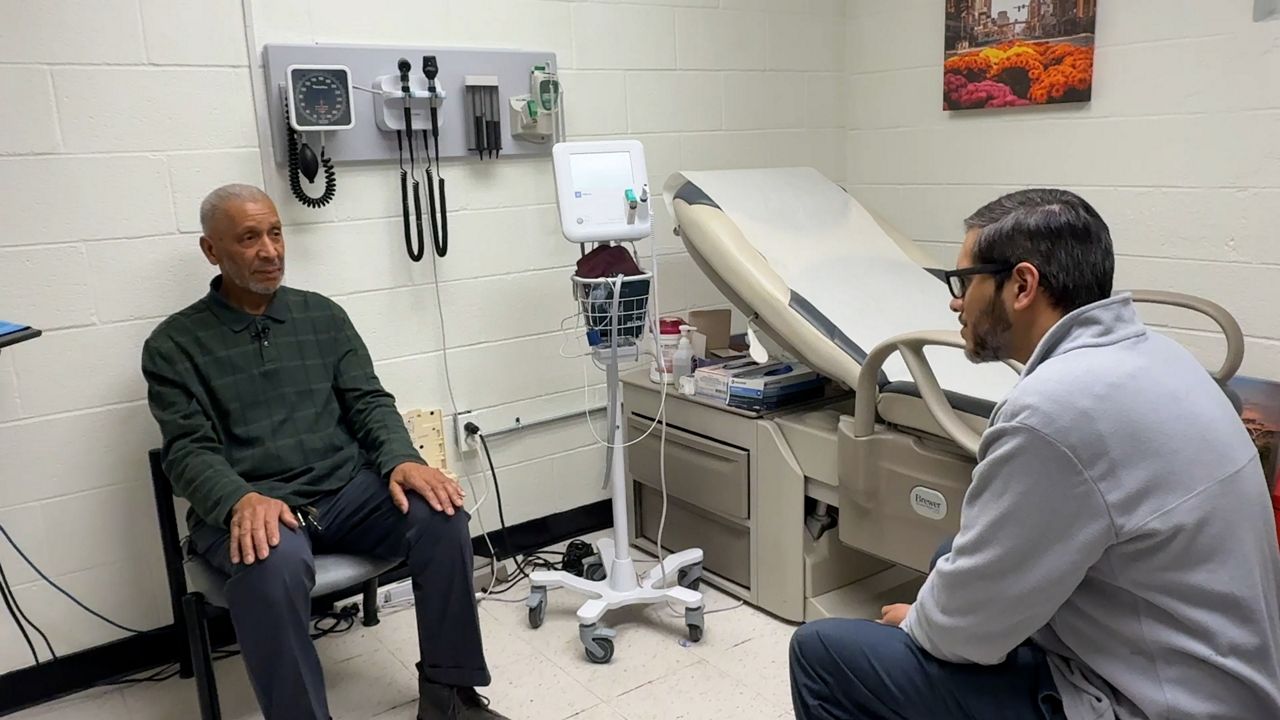
CLEVELAND — There are more than half a million people in Ohio who do not have health insurance.
Ohio has 59 free and charitable clinics and pharmacies that provide essential care for the uninsured. They’re supported by the Charitable Healthcare Network, and this month, CHN is celebrating the care they provide to patients in 86 of the state’s 88 counties.
Salaam Clinic is one of several clinics in Cleveland. They see hundreds of patients a year. Shafeeq Sabir is one of those patients.
“The opportunity is there for me to see a doctor, a physician, without having to worry about a cost factor,” said Sabir.
Sabir has insurance but said he has a copay, and he’s on a fixed income. Salaam Clinic takes in uninsured, underinsured and those who cannot afford care.
“Sometimes I can’t afford the copay, so I would prefer to come here for an exam before I go and see my primary physician,” said Sabir.
Salaam Clinic is part of the Charitable Healthcare Network. The network is celebrating Free Clinic Appreciation Month this December.
The network is Ohio’s statewide system that supports free and charitable clinics. Jason Koma is CHN’s Executive Director. He said the network’s 59 clinics provide high-quality health care to those who need it.
“We are the backbone of the safety net of health care in the state of Ohio,” said Koma.
More than 60,000 patients were seen at one of the network’s facilities from Jan. to Sept. 2025. In 2024, the clinics saw nearly 80,000 patients.
The network’s clinics offer a wide range of services including primary care, specialty, dental, vision, behavioral health, social services, pharmacy, education, prescriptions, tests and insurance enrollment. In 2024, CHN’s clinics provided $224 million worth of services to patients all over the state. The network is supported by funds from the Ohio Department of Health and the state budget.
The Ohio Department of Health said this in a statement.
“Free clinics are an integral part of the healthcare system in Ohio, which is why the Ohio Department of Health (ODH) financially supports healthcare services to patients who lack the funds or insurance coverage to pay for vital health services.
ODH support comes through the Uninsured Care Fund, a general revenue fund line item used to support free and charitable clinics providing medical and dental care at free or reduced costs to uninsured and underinsured Ohioans. These funds pay for primary healthcare services to any uninsured person who gets healthcare services at a free clinic in Ohio.”
Every fiscal year, CHN gets $1.75 million to support the individual clinics around the state.
Salaam Clinic receives funding from several sources, including CHN. Dr. Syed Shoaib Shah is the CEO of the Salaam Clinic.
“Year over year it takes about $230,000 to run the clinic,” said Shah. “We have a part time nurse practitioner on staff as well as an administrative assistant and then includes all the supplies, all that lets us run all the mobile clinics, all the pop-up clinics that we do around the city.”
However, the clinic doesn’t always get the full amount, and the clinic is looking at other options, including private donations.
“Without the Charitable Healthcare Network in our clinics, these folks would have nowhere else to go,” said Koma. “Probably ending up in the emergency room and getting sicker and sicker and sicker.”
According to UnitedHealthcare, the average emergency room visit costs $1700, but the cost depends on the services and care provided. Shah said clinics can be the first stop to getting healthy.
“We make sure every patient leaves with a roadmap and they know where they’re going, what they’re doing, and they have the referrals and check,” said Shah.
Shah said clinics like his are saving lives. He said that even though they are seeing more patients and expect to see even more patients; he wants the community to know the clinic is here for them.
“Hospitals are closing their outpatient centers because they can’t afford the care that they’re giving to the uninsured population,” said Shah.
In 2024, Salaam Clinic saw around 700 patients. This year, the number doubled to nearly 1400 patients seen. With rising healthcare costs, Shah said the number will continue to rise, but they are happy to serve the community.
“We expect to see more patients that are underinsured and uninsured, but they cannot afford care,” said Shah.
Sabir said he’s grateful for Salaam Clinic and he tells everyone he knows about the clinic.
“An opportunity of this service and that really has just gives me a better feeling consciously in my thinking and in my health, and I just feel much, much better about my life,” said Sabir.
To become a patient of Salaam Clinic, first call them at (216) 243-7924. From there, the staff will recommend next steps and provide resources. If you would like to visit the clinic, appointments are preferred, but walk-ins are welcome.
Saleem Clinic in Midtown, at 7401 Euclid Ave, Cleveland, OH 44103, is open on Sundays from 1 p.m. – 5 p.m. Their Solon location at Chagrin Valley Islamic Center at 6909 Liberty Rd. is open every last Friday of the month, 2 p.m. – 5 p.m. They also do pop-up and mobile clinics.
Salaam Clinic has a multilingual staff who speak French, Arabic, Swahili, South Asian languages, Urdu, Hindi, Punjabi.
Salaam Clinic, along with the other clinics in the network, are nonprofit clinics with paid and volunteer employees.
The clinics accept monetary donations, and for every dollar donated to the Charitable Healthcare Network, it provides $13 worth of healthcare.




CLEVELAND — Federal prosecutors in Ohio have unsealed a broad cybercrime indictment against two Russian companies and three people accused of operating a Russia-based online service that investigators say enabled hackers around the world to perform ransomware, malware and other damaging cyberattacks.
The case is being prosecuted in Ohio because of the large number of victims in the state, authorities said.
U.S. Attorney for the Northern District of Ohio David Toepfer said the alleged crimes affected victims in 21 states and in countries around the world, causing more than $62 million in losses.
The indictment charges two companies — Media Land and ML.Cloud — along with three individuals based in St. Petersburg, Russia. Investigators allege that the defendants operated infrastructure that allowed cybercriminals to launch attacks against hospitals, schools, civic organizations and businesses.
“Cybercrimes like this are a matter of national security,” Toepfer said.
According to prosecutors, the companies provided so-called “bulletproof hosting” services, which shield criminal activity from law enforcement and allow cybercriminal operations to remain online. Authorities said the network fueled ransomware, malware and brute-force attacks worldwide.
“Media Land through the darknet was a borderless powerhouse of criminal activity that not only fueled the rise and persistence in ransomware, malware and brute force attacks worldwide, but also a multitude of illegal acts with the capacity to inflict reputational damage and economic harm,” Joshua Del Manzo, the special agent in charge with FBI Cleveland said.
Victims in Ohio were identified in Akron, Brookfield, Canton, Cleveland, Elyria, Findlay, Medina and Valley View.
Federal investigators said the case grew out of a Cleveland FBI investigation that began seven years ago.
“Because of the investigative team’s tireless efforts, the cyber infrastructure supporting American hospitals, schools, civic organizations and companies are safer,” Toepfer said.
Authorities said they have shut down the ability of Media Land and ML.Cloud to provide hosting services to cybercriminals, calling it a major disruption to a significant part of the global cybercrime ecosystem.
“We have effectively shut down Media Land and ML Cloud’s ability to provide hosting services to cybercriminals wherever they operate,” Toepfer said. “This approach identified and exposed the largest bulletproof hosting service in the world, and struck a serious blow to malicious ransomware and malware actors everywhere.”
Prosecutors acknowledged that the suspects Aleksandr Volosovik, Yulia Pankova and Kirill Zatolokin remain in Russia, but said dismantling the companies’ infrastructure is still a significant victory in the fight against global cybercrime.
The U.S. State Department is offering a reward of up to $10 million, and possible relocation, for information about government-linked associates of the Russian individuals and companies charged in the case.

The NBA world is waiting in anticipation to see what 41-year-old LeBron James will do next with his career, and the story just got more interesting.
Over the weekend, Cleveland Cavaliers head coach Kenny Atkinson had a quote that turned heads. “You guys know there’s a little free agency thing going on right now. That could be our real jump, and you know what I’m talking about. That’s exciting too.”
“We’re in the mix for the greatest player of all time”
Cavs Head Coach Kenny Atkinson discusses with @WorldWideWob, @DarthAmin, and Ryan McDonough what it would be like to have LeBron return to Cleveland
Hear our Summer League coverage! ⬇️https://t.co/jnEcXNELrs pic.twitter.com/RLf47TlpM5 — SiriusXM NBA Radio (@SiriusXMNBA) July 12, 2026
The Cavaliers coach also went on to say, “Listen, this is an exciting time for us, right? Like we’re in the mix for, you know, the greatest player of all time… I think you’re nervous, but we understand how it is. He’s obviously earned that right to take his time.”
Major Interest
The Cavaliers knew roster changes needed to happen following their exit from the playoffs in the Eastern Conference Finals. While making the conference finals was an achievement, getting swept embarrassingly by the eventual champion New York Knicks showed one thing: this team still had a clear gap to close if they were to win a championship.
A quote like this from an NBA coach is not typical in the slightest. Atkinson is making his interest in LeBron clear on a national stage, and rightfully so. LeBron brings a skill set the Cavaliers have been missing since his departure: a lengthy forward who can help with spacing while also adding playmaking, postseason experience, and late-game control.
A New Mentality
Aside from roster fit, LeBron can bring something this team has needed for quite some time: a new mentality. The Cavaliers have been labeled as soft, stemming from a quote such as “the lights were brighter than expected” by Jarrett Allen after a series loss to the Knicks in 2023.
“Even for me, the lights were brighter than expected.”
– Jarrett Allen on his playoff struggles
(Via @SpinDavies ) pic.twitter.com/f9ax5rUXkJ
— NBACentral (@TheDunkCentral) April 27, 2023
LeBron, despite his age, still has his championship mentality. This is evident from his playoff series against the Rockets while he was still with the Lakers this past May. LeBron led the Lakers past a younger, arguably more talented team in the Rockets to advance to the second round.
The hope is that this championship mentality can rub off on the Cavs’ younger talent while LeBron wraps up his career in the wine and gold.
It looks like everyone is waiting on what “The King” does next, including his next potential head coach. This is for good reason, as LeBron could be the missing piece needed to take the Cavaliers to the next level, not only because he remains one of the greatest players of all time, but because he could bring a championship mentality to a core that desperately needs it.
Follow

CLEVELAND, Ohio (WOIO) – A massive water main break and a possible sinkhole was reported in Cleveland Monday afternoon.
A 19 News crew is on scene at the intersection of E 130th Street and Buckeye Road for the possible reported sinkhole and a water main break.
According to the Cleveland Division of Water, the break on Buckeye Road is a 10-inch water main and a repair crew is on the way.
The water has been shut off, but the area remains closed due to the debris and for cleanup.
19 News has made call outs to officials for more information.
This is a developing story. Return to 19 News for updates.
Copyright 2026 WOIO. All rights reserved.
-

 Movie Reviews10 minutes ago
Saari Review: Memory, Betrayal and Identity Converge at River Valley Film Festival – Hollywood Times
-
Science46 minutes ago
New Winged Robot Can Fly and Swim Like a Puffin
-
 Lifestyle1 hour ago
‘The Trojan Teddy Bear’: The promise and peril of childhood in the age of AI
-

 Technology1 hour ago
Google and Epic give up fighting — third-party Android app stores are coming next week
-

 World1 hour ago
FBI snares an American heir indicted for allegedly bankrolling anti-cop, pro-Hamas communist revolution
-

 Politics2 hours ago
Biden special counsel’s ‘runaway train’ scooped up sensitive lawmaker info: ‘Abuse of power’
-

 Health2 hours ago
‘Miracle on the Hudson’ hero Captain ‘Sully’ Sullenberger reveals Alzheimer’s diagnosis
-

 Sports2 hours ago
American League stars outshine National League in 96th MLB All-Star game

