Lifestyle
With Video Mapping, Destination Weddings Can Happen Anywhere


When Jonathan Dubin, 34, and Madison Bigos Dubin, 30, hosted their wedding reception last October, they transported their guests to Upper Antelope Canyon in Arizona.
Only the reception was held at Cipriani 25 Broadway in downtown New York.
The couple accomplished this sleight of hand through video mapping, or video projections that effectively paint large surfaces like walls and ceilings.
“I had to remind myself that I was in a ballroom because the atmosphere was so immersive,” said Hutton Cooney, a guest who flew in from Chicago.
Mr. Dubin said the images of Upper Antelope Canyon were intended to evoke the feeling of celebrating inside the canyon, which is near the resort where the couple would be honeymooning in Utah.
Panoramas of the New York City skyline followed. The finale was aerial views of the Empire State Building as the D.J. and a saxophonist played a rendition of Jay-Z’s “Empire State of Mind,” while many of their 250 guests sang and danced.
Mr. and Ms. Dubin, both real estate entrepreneurs in New York, said that video mapping appealed to them because it immersed their guests in places they love. For Ms. Dubin, who is from Minnesota, it was an opportunity to give family and friends from home “a quintessential New York experience.”
With couples increasingly integrating technological innovations into their weddings, video mapping is gaining popularity at ceremonies and receptions, according to event planners and other wedding experts.
Julie Novack, a founder and chief executive of PartySlate, an event planning platform, said that video mapping has its roots in the corporate and nonprofit world. (It has also long been used in contemporary art.) “It was first widely adopted by companies around a decade ago for product launches and to project their logos,” she said. “It’s now finding its way into social events like weddings. ”
Victoria Dubin, Mr. Dubin’s mother and an event planner in New York, said such projections are increasingly an element of the weddings she plans (including her son’s). One couple she worked with in May 2022 chose one that evoked an Italian Renaissance garden with mossed walls, fountains, statues and frescoes on the walls. “The bride and groom thought about getting married in Europe but chose to bring their vision of Europe to New York,” she said.
Video mapping can come at a high cost, with pricing falling within a broad range. Patrick Theriot, a projection designer and the founder of See-Hear Productions, based in Covington, La., who has designed projections for Victoria Dubin said, “Projecting on the side of a forty-story building may require $100,000 or more in just hardware rental, but projecting on a wedding cake may require an equipment rental of less than $5,000.”
According to data from the wedding platform Joy, video mapping was a $3.9 billion market globally in 2023 and is projected to surpass $4.8 billion this year. The company’s chief executive, Vishal Joshi, estimates that wedding video mapping is currently a $100 million industry in the United States, with couples projecting onto cakes, dance floors or entire venues.
The Temple House in Miami has an in-house production team that creates content. Couples can choose from their extensive projection library, which includes a starry night, fireworks, sparkling rain, disco balls and the Italian Riviera. They can also request custom projects.
Omar Lopez, director of events at Candela La Brea, a venue set in a 1920s building in Los Angeles’s Miracle Mile, said, “We host around eight weddings a year that use video mapping, and that number is growing steadily.”
Henry Rodriguez, 46, who works for an education nonprofit, and Suriel Castro, 35, an office manager who lives in Long Beach, hosted their ceremony and reception there last August, which was attended by 225 guests.
Both events included backdrops of cherry blossom trees. When it was time to dance, the room alternated between rotating disco balls and flashing lights. “We wanted to create a nightclub ambience,” Mr. Rodriguez said. He said they spent more than $3,000 to include the projections, and “the expense was well worth it.”
Video mapping isn’t limited to indoor areas.
Alyssa Carrai, 27, a photographer, and Daniel Carrai, 26, a creative director and founder of the production studio Sever, who live in Charlotte, N.C., included it in their wedding reception last April. The celebration, which 75 guests attended, was at the Andrews Farm, in Midland, N.C, in an outdoor area with a swimming pool and white house.
Mr. Carrai, who has used video mapping in his work with music artists, designed an abstract chrome silver projection that was displayed on the home’s exterior and resembled moving water.
“It felt like you were moving through water when you walked by,” he said. “Our guests told us the projection was unlike anything they had ever seen.”



The scoreboard shows the results of the women’s singles final match between Iga Swiatek of Poland and Amanda Anisimova of the U.S. at the Wimbledon Tennis Championships in London, Saturday, July 12, 2025.
Kirsty Wigglesworth/AP
hide caption
toggle caption
Kirsty Wigglesworth/AP
Fifteen points in tennis? Nice. Thirty, 40 — even better. Advantage — that sounds good. “Love” — that also must be great, right? Well, not quite.
As the French Open rolls on and Serena Williams has announced her return to the sport, maybe you’ve been paying a little more attention to tennis. The sport’s scoring system is notably distinct, and can sometimes be hard to grasp for newcomers. But even tennis aficionados might not know why, or how, “love” became the unmistakable callout for zero points. For this installment of NPR’s Word of the Week, we’re exploring how a word that signifies trailing behind got such a sweet name.
“Love” comes from the heart — or an egg?
It’s hard to pinpoint when the first tennis ball went over the net. Tennis is a derivative of lots of other sports, such as “jeu de paume,” a handball game played in France, said JT Buzanga, the collections manager at the International Tennis Hall of Fame museum.

But tennis became a patented, official sport in 1874, said Steve Flink, a journalist whose tennis coverage got him inducted into the International Tennis Hall of Fame. It has retained its unique, mysterious scoring system ever since.
“By and large, the original system has held up almost entirely,” Flink said.
The use of “love” goes back to the late 18th century, said Jesse Sheidlower, a lexicographer. But it was used earlier than that in card games such as whist and bridge. Before the term made its way to tennis, the sport favored plain old “nothing,” or “nil,” he said.
Why love in the first place, though? Historians don’t really know for sure, but there are a few theories.
The French could have something to do with it. Some historians believe “love” derives from “l’oeuf,” which means “the egg” in French. Because eggs are shaped like zeros, terms such as “goose egg” and “duck’s egg” have been used in other contexts to mean zero, Sheidlower said.
It’s also possible English speakers mispronounced l’oeuf as “love.” But Sheidlower isn’t convinced that’s the answer.
“It’s the French equivalent of an English expression. But since that expression doesn’t appear in French, the French word wouldn’t have been used,” he said.
To be sure, France has had a lot of influence on tennis culture, Buzanga said. For example, “deuce” or a game tied at 40 points, comes from the French word for “two”: “deux.” But he prefers another prominent theory: that “love” comes from the idiom “for the love of the game.” Even if a player hasn’t scored, it doesn’t matter, because their heart is in it. It’s the theory Sheidlower said is the most plausible, because the idiom was used by the English before tennis was popularized.

Another variation of the “love of the game” theory is that the word could have come from the Dutch “lof,” or “honor” — or the Latin “amare,” meaning “to love,” Flink said.
But if tennis’ “love” doesn’t come from a French word, the theory at least has a French sensibility.
“I think the ‘for the love of the game’ is kind of romantic,” Buzanga said.
“Love” probably isn’t going anywhere
Tennis used to be a sport of leisure. The style of play has changed a lot over the years; players are more athletic and competitive, for instance, Flink said. But the rules of the sport are more steadfast, he said.
“There’s this incredible, enduring respect for tradition in tennis,” he said. “Changes are not made easily.”
There has been one major change in modern history: the tie-break. Matches can go on and on because players have to score two consecutive points to break a deuce, or by two games to break a tied set. But the onset of television meant matches would have to get shorter if the sport wanted to capture a larger audience, Flink said.

Change even came for “love.” An alternative sprouted up in the 1970s, and is still used today: “bagel,” named for its zero shape, Sheidlower said. Novices may say “zero,” and insiders will understand what they mean, but they “will needle them about it,” Flink said.
But “love” still prevails.
“People kind of like it,” Flink said. “It’s different. Why say zero when you can say love?”

On a 75-mile cliff-hugging stretch of highway in California, traffic is way up, despite soaring gas prices. And locals expect the busiest summer in years.
The road is Highway 1 in Big Sur, which reopened in January after three years of repair and reconstruction following a pair of landslides. Drivers can once again embark on the state’s most famous road trip, covering the 100 miles between Cambria to the south and Carmel to the north without leaving the two-lane coastal highway. And they’re heading out in big numbers.
Caltrans estimates that as of May, Big Sur restaurant and retailer guest counts are up 40% from last year, and that northbound traffic at Ragged Point, the southern gateway to Big Sur, has risen 900% year-over-year.
People pose for photos near Bixby Bridge. Monterey County’s Board of Supervisors voted to explore a 12-month ban on parking around the bridge.

Safety cones prevent parking along Coast Road near the Bixby Bridge.
“Take your time,” said Kirk Gafill, co-owner of the popular Nepenthe restaurant and president of the Big Sur Chamber of Commerce, offering advice to travelers. “You’re going to be sharing the road with a number of people.”
As travelers rediscover the road, the cost of driving has been shooting skyward. California’s average gas price ($6.11 per gallon as of May 26) is up 26% from the year before. In early April, rates hit $9.99 at the isolated gas station in the Big Sur community of Gorda.
For spring and summer travelers, these numbers would seem to pose a stark question: Stay home and save money, or head for the coast because the road is finally open and it’s still cheaper than flying?
So far, the latter answer is winning big.

Fog lingers off the coast of Highway 1.
“We are definitely seeing a huge uptick in our reservations,” said Megan Handy, assistant general manager at the upscale Treebones resort. She estimated that bookings are 30% or more ahead of last year, and rates are unchanged since then. But “it’s still not feeling super crowded, which is nice. Everything still feels kind of calm.”
But added traffic has raised some anxiety. On May 19, Monterey County’s Board of Supervisors voted to explore a 12-month ban on parking at Bixby Bridge, one of the region’s top photo spots.
Over the years, the number of cars parking near the bridge — often illegally, sometimes impeding emergency vehicles — has risen. The proposed parking moratorium won’t take effect until the supervisors discuss it further.

-
Share via
Busy as things are, several business owners pointed out that many international travelers have not yet returned — perhaps because most make their plans more than six months ahead, perhaps because of global politics, perhaps a little of each.
The biggest challenge for businesses during this resurgence? “Restaffing and retaining,” said Handy at Treetops.
At Nepenthe, Gafill said his business has seen a 45% boost in guest volume since the road’s reopening. Gafill said he would have expected a 35% pickup, “simply by virtue of reopening the highway.” The additional 10%, he said, might be “all that pent-up demand,” aided by “a very beautiful and very dry winter,” followed by a mild spring.

A lunch crowd dines at popular restaurant Nepenthe.
Another possible factor: Nobody can be sure how long the road will remain open.
To cope with the influx of people, Gafill said, “everybody is trying to recruit and retain their existing staff.”
At the Ragged Point Inn, where rates dropped as low as $149 nightly last fall, rates are back over $200 and staffers are suggesting that customers book at least six months ahead. The inn has reopened its snack bar for the first time since early 2023, and management is investing in capital upgrades and staging live music on weekends throughout the summer.
Business “is up over 100%,” said Diane Ramey, whose family owns the inn. “I know not all of our neighbors are having the same lift, but everybody is doing better.”
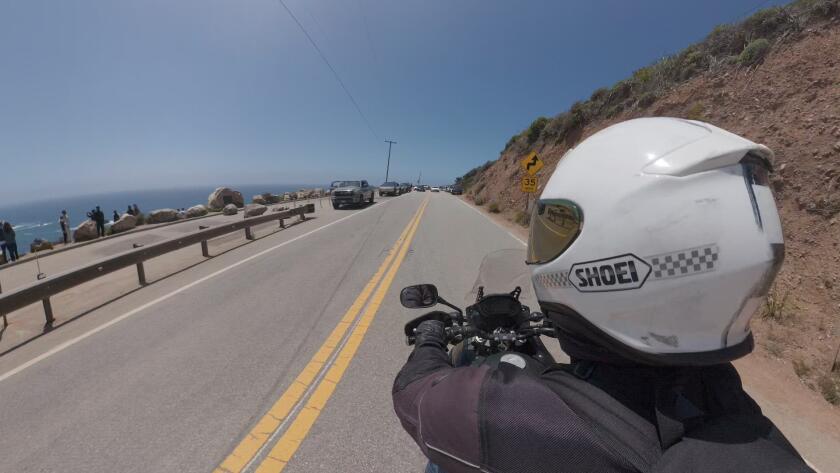
Traffic approaching Bixby Bridge.

A visitor poses in an oversized chair at Big Sur River Inn.
Even at the New Camaldoli Hermitage, a Benedictine monastery above Lucia, the road’s reopening and coming summer season have made a difference. Bookings are up an estimated 30% at the hermitage, which rent rooms and cottages (for two nights or more) to visitors who agree to its requirement of silence.
Big Sur business owners advise visitors to travel on weekdays for less traffic and the best hotel rates, and to get on the road as early as possible.
Since its opening in 1937, the highway has been vulnerable to landslides and shifting ground, operating on a longstanding cycle of landslide, closure, repair, reopening and then another landslide, or sometimes a fire. The U.S. Geological Survey has identified the Big Sur coastline as one of the most landslide-prone areas in the western United States. The 2023-2026 closure was the longest in the highway’s history.
Over time, road crews have used increasingly sophisticated strategies. In the most recent efforts, Caltrans said, it used drones to help survey the slopes and remotely operated bulldozers and excavators to reduce risks to workers.
During the closure, no traffic was allowed on 6.8-mile span from just north of Lucia until about a mile south of the Esalen Institute. Drivers detoured inland by way of U.S. 101.
-

 Politics4 minutes ago
Democrats split over Tlaib’s Lebanon measure as Republicans seize on Hezbollah omission
-

 Health11 minutes ago
Popular weight-loss diet shows surprising impact on serious mental health condition
-

 Sports14 minutes ago
NBA bans two fans for life after court invasion during Knicks-Spurs Game 1
-

 Technology19 minutes ago
Charter breach warning: What customers should know
-
 Business26 minutes ago
Trump announces new coal export terminal in Oakland
-
 Entertainment29 minutes ago
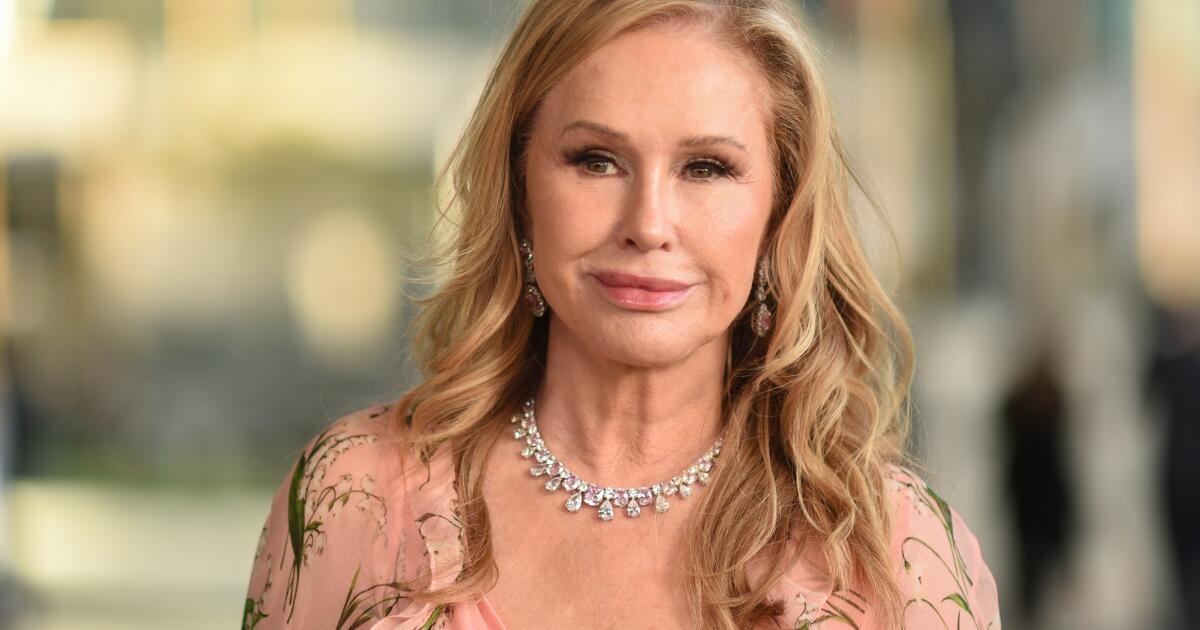
Kathy Hilton won’t be WeHo Pride’s grand marshal after backlash from community
-

 Lifestyle34 minutes ago
OTB Takes Full Control of Viktor & Rolf
-
 Politics41 minutes ago
Senate rejects an initial attempt to ban Trump’s $1.8-billion ‘anti-weaponization’ fund

