Lifestyle
Why Cameron Crowe wears ‘uncool’ as a badge of honor


Cameron Crowe, left, speaks with Gregg Allman in 1973.
Neal Preston/Simon & Schuster
hide caption
toggle caption
Neal Preston/Simon & Schuster
If filmmaker Cameron Crowe’s career arc sounds like a Hollywood story, that’s because it is one. Crowe’s 2000 Oscar-winning film Almost Famous is based on his own teen years; he was 15 years old in 1973 when he became a music journalist, landing a backstage interview Gregg Allman. By age 16, he had written his first cover story for Rolling Stone. He’d go on to write about David Bowie, Jimmy Page and other rock stars.
Crowe credits much of his early success with his hometown of San Diego, which tended to come at the end of a band’s tour. By that time, he says, musicians were open to talking.
“Here’s a kid that comes to the door with a notebook full of questions based on the music that nobody was really asking them about,” Crowe says. “They’re like, ‘Get that kid in here. Come on, we’re bored. Let him ask us those questions.’”
In his new memoir, The Uncool, Crowe reflects on his adventures and misadventures as a teenage journalist. He also writes about what life was like in his family, and how he convinced his parents to allow him to go on the road before he’d even graduated high school.
The book is based in part on Crowe’s old interview tapes, which he saved. Listening back now, he says, those conversations informed his work as a Hollywood writer and director, whose credits include Fast Times at Ridgemont High, Say Anything … and Jerry Maguire.
“I transcribed all my interviews myself, so I knew that people don’t talk elegantly, but they can pour their heart out in half sentences,” he says. “So it was really one big magic carpet ride of learning about people. And it started early. I’m a lucky guy.”
Interview highlights

On interviewing musicians who were only a few years older than he was
I thought they were seasoned adults at the time. … They were 22, for example. And being 15, the distance between 15 and 22 is enormous. It’s like a generation. But really, we were all kind of young together, and rock was young. There wasn’t video assists and all the bells and whistles and dancers and stuff. It was really just a naked stage and people playing songs. And the power of the songs was the power of the concert. … But as a young guy, you’re kind of in this position where this person is allowing me to ask them whatever I want to about music that I love. And it was a blissful time and I still love writing about it.
On his mom’s reluctance to let him tour with rock bands
As a teacher and a counselor who had many great counselees who loved her so much, she always respected intellectualism. So if I could somehow pin it to intellectual success I had a way in. So to go on the road with Led Zeppelin at 15, I had to really sell Led Zeppelin to her as like music that’s based on Tolkien. And this is, like, lofty material that’s good for the soul. And ultimately, I think she said: Because we love the interviewer Dick Cavett in our family, go and take this journey, put on your magic shoes, call me every night, and don’t take drugs.” And that was my ticket out.
On being offered drugs
I learned early on, Terry, that like the best response is no. Because the person offering you the drugs generally then says, “Smart kid, more for me.” And that made me, I don’t know, it made people know that I wasn’t there to join the band, party with the band. I was there with a notebook full of questions based on loving music. And that really swung the door open in many ways.
On interviewing David Bowie in 1976

I asked him at one point, because his real name was David Jones, right? So I asked them at one point, “Am I meeting David Jones or am I meet David Bowie, the creation?” And he said, “You’re meeting David Jones who’s aggressively throwing David Bowie at you.” I asked at one time, I was like, “How do you think you’re gonna die? Do you think you’ll die on stage?” Because Ziggy Stardust, one of his characters, I think was based on somebody who had died on stage. And he said, “No, no no, I don’t think that’s going to happen to me.” I’m paraphrasing a little bit — but he said, “I think my death will be an event, something that I manage and produce and make my own statement.”

Crowe’s new memoir is based on interview tapes from the 1970s, which he saved.
Cameron Crowe/Simon & Schuster
hide caption
toggle caption
Cameron Crowe/Simon & Schuster
And that is exactly what happened. … He died of cancer at a young age and he knew he was dying. And what he did was didn’t tell anybody except a small group of collaborators. And he did this album, Black Star, which is his statement about the death that was coming. And it’s profound and it’s managed. And it is an opportunity that he did not throw away. He made a statement about his death.
On how the groupies would confide in him
All of the so-called “groupies,” or people that were hanging around the bands, women in particular, would, because I was so young, would confide in me. So I had no romantic potential or any of that. So they would actually be like magpies with me and just telling me all their stories and like, “I was really upset when he treated me like this” and “blah, blah, but you know what, you move on, you do this.” And I just I was like, wow. Nobody in high school ever talked to me like this. This is a glimpse of romantic bliss, minefields and all kinds of stuff.
On what he learned from Rolling Stone journalist Lester Bangs about being “uncool” — which was portrayed in a scene from Crowe’s semi-autobiographical film, Almost Famous

I was always trying to figure out what cool was, because my mom skipped me too many grades. I got my high school diploma in the mail, because I graduated as a junior. And the attempt to be cool … was never gonna pay off if you’re younger than everybody else. But what Lester was saying was … when you’re posturing, you’re never there. He said that they had done that to music. They had made music a lifestyle posture, not the thing that’s ripped from the soul. …
YouTube
And I thought, wow, so many of the musicians and the writers and the people that I came to love were not cool. … It was like a lost pursuit, but they found each other through music. They found each through this thing that gave you that feeling of being understood. So I called the book The Uncool because it was the badge of honor that Lester put on me, you know? Don’t try and do it. Be whatever is real to you. And that might be cool.
Sam Briger and Anna Bauman produced and edited this interview for broadcast. Bridget Bentz, Molly Seavy-Nesper and Beth Novey adapted it for the web.

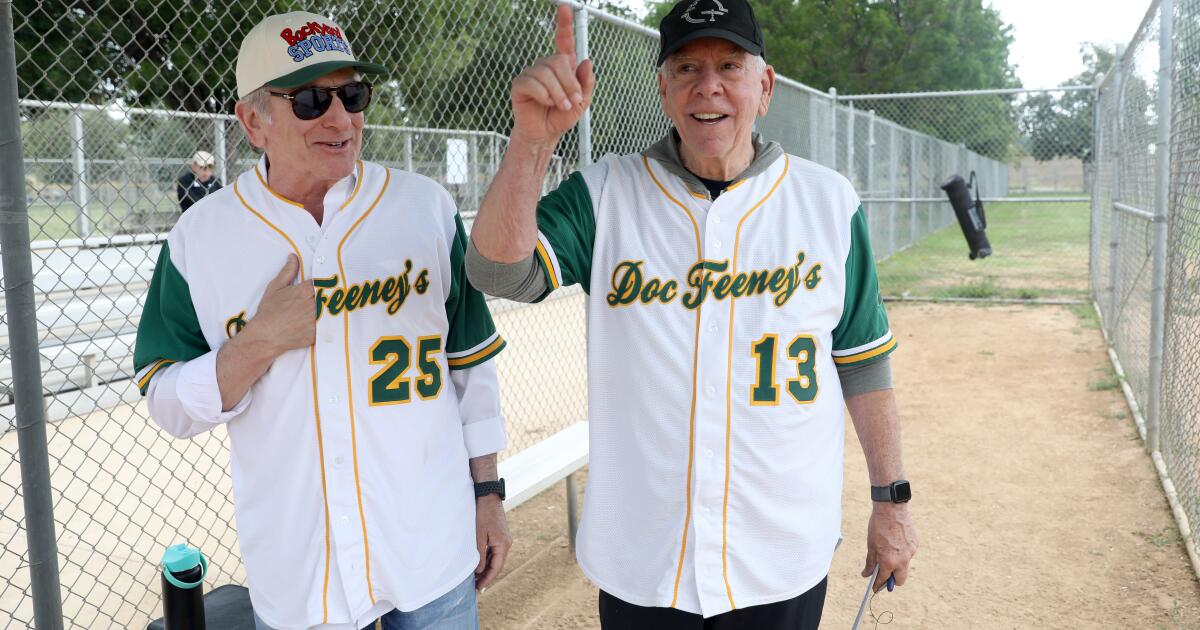
As Al Michel and Mike Sugerman tell it, the first rendition of their L.A. softball team was overflowing with “geeks,” “nerds” and “goofs.”
So they took a name straight out of National Lampoon, a humor magazine that featured “Doc Feeney’s Scrapbook of Sports Oddities,” showing outfielders making catches 40 feet in the air and providing tips to swimmers on proper drowning maneuvers.
“I’m thinking, we’re not a bunch of athletes — we’re a bunch of geeks,” said Michel, the team’s co-founder, current coach and catcher, reflecting on the loose band of UCLA law students, aspiring actors, accountants and other semi-athletic misfits. “Sports oddities? I thought, well, that’s not going to work… Let’s go with ‘All Stars.’”
And thus, in the spring of 1976, Doc Feeney’s All Stars was born. Fifty years and thousands of runs later, six of the original players still take to the diamond nearly every Sunday, swinging for the fences. And if out-of-towners are visiting, the ranks of the older timers swells a few more.
On a recent humid Sunday afternoon, the score was 16-16 going into the final inning. A booming home run at the bottom of the sixth by Aaron Krug — at 36, a youngster by Doc Feeney standards — had tied the game against the Six Pack at the Sepulveda Basin Sports Complex in Encino, one of the many fields across L.A. the Feeneys have graced in the last half-century. The cohort of mostly 70-something players in the dugout rejoiced, waving their caps and hollering.
This wasn’t any old Sunday matchup in the L.A. Municipal Softball League: The Feeneys’ jerseys featured black patches embroidered with “JBK” for Jamie Bailey Krug, the first of the original founders to make it back to home base in the sky.
This game was a memorial dedicated to Krug, the patch a reminder that being a Feeney has never really been about sport anyway.
“Jamie taught me what a best friend was,” said second baseman Richie Greenberg, another Feeney progenitor. “I never knew a best friend was someone you’d never get tired of, or never stopped missing.”
Jeff Koppelman, 72, 48 years on the team, delivers a pitch during a slowpitch softball game against Six Pack at the Sepulveda Basin Sports Complex in Encino.
(Gary Coronado / For The Times)
Jamie’s son, Aaron, belongs to a new generation of All Stars — some of whom grew up watching their fathers’ games from kiddie strollers or their mothers’ arms.
“Every city in this country has a group of morons who get together every Sunday and who have done it for a lifetime, who love each other and love each other’s kids, and who, for some miraculous reason, believe that this will continue with the next generation,” Greenberg said. “We are bound to this thing… It sustains us.”
Feeney history, as told by the founders
The first season of Feeney ball was a resounding success, despite all the strikeouts and bobbled catches in between. The championship game was a struggle of lawfare: Michel, then an attorney in training, noticed that one of the opposing team’s hitters was using a baseball bat instead of the regulation softball bat with a smaller barrel. He kept this fact close to his chest, until the other team went up in the seventh, the last inning.
“The other team is celebrating, thinking they won the championship, high-fives all around,” Michel said. “We call a time out, point out the bat, and the ump comes over and says, ‘Oh yeah, that’s illegal’… It counts as an out and we win the game.”
“The only way to win like a Feeney,” Sugerman added.

Doc Feeney’s All Stars pose for a team photo, circa late 1970s.
(From Doc Feeney’s All-Stars )
Another season, outfielder Craig Simon, knowing he was weak at the plate, intentionally struck out so he could avoid an impending double play, much to the dismay of the opposing team.
“Another Feeney classic,” Greenberg said.
Nobody expected that the Feeneys would go on for half a century, but every winter and spring that passed, the team would be back on the diamond, albeit with a rotating cast.
Krug, Michel and Greenberg were near Sunday constants; Sugerman moved to San Francisco to become an award-winning correspondent on Bay Area radio, but always got a spot when he visited; Howard Lesner and Matt Kaplan became regulars in the 1980s; and other Feeneys faded to time, stuck as a memory of whichever decade they called it quits.
In L.A. Municipal Softball, there is a grading system to facilitate fair competition. The Feeneys oscillated between C and B over the years, a plus or minus coming depending on how much time had passed since the founding. A decade or so back, the team was blown out by a B-minus team in their first game after being upgraded, realizing that the elder’s eyes could no longer keep up with the heat coming off the B-minus bats.
“Couldn’t even see it coming,” Michel said.

Doc Feeney’s All Stars players, from left, Jonny Ehrich, 36, Richie Greenberg, 72, Joel Gerson, 37, and Aaron Krug, 36, warm up before a slowpitch softball game. Greenberg has been a mainstay on the team for 49 years.
(Gary Coronado / For The Times)
Because the team has survived so long, every Feeney has had their day: double plays, home runs and batting averages — think .450 — that would make Shohei Ohtani look like a Triple-A backup. But that’s not what kept players coming back.
“I’ve had a great life and an enjoyable life, but no sense of bond and family,” Kaplan said between innings as dust from home plate lingered about, tears welling up from who-knows-what. “This became my family… This gave me what I was missing.”
The legends surrounding the team can, at times, become muddled. On a recent day outside of the Apple Pan burger joint — a Krug favorite — Michel, Greenberg and Sugerman, all nearly halfway into their 70s, litigated Feeney history:
“Who was it that got kicked off the team for being too competitive?”
“Did he marry the girl in this picture?”
“He never hit a home run in his life.”
“That guy was kind of a jerk.”
“You think so? I thought he was nice.”
But all of these questions led to the same, inevitable conclusion.
“Who cares, he was a Feeney.”
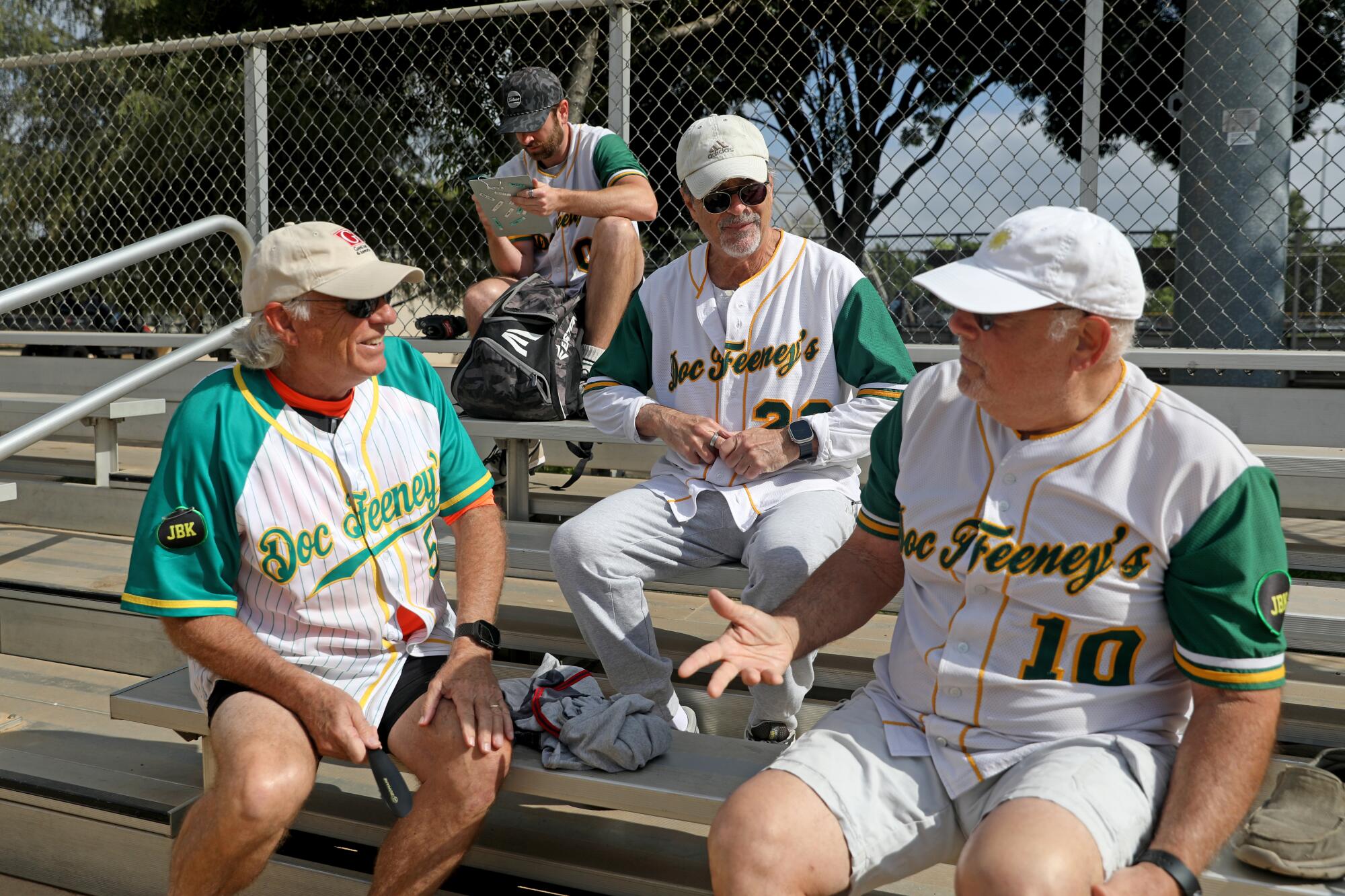
Doc Feeney’s All Stars veterans, Richie Greenberg, from left, Todd Lesner and Jeff Koppelman, all 72, sit together as team rookie Matt Michel, 33, works on the lineup. The trio has played on the team for nearly 50 years.
(Gary Coronado / For The Times)
The new generation of All Stars
The weekend he died last May, Jamie Krug had planned to play Sunday after attending his grandson’s musical performance Friday and going out to dinner with his wife, Simone, and friends Saturday. Krug heard the music and enjoyed a lovely night out, but he never made it to Sunday’s game.
The All Stars won, but learned Monday that Krug had gone to sleep and never woken up. Heart complications.
Family and friends remember Krug as many things: a reliable laugh, a saint of a father, a hell of a second baseman, a competitive but altruistic coach. At his funeral, his wife recalled, almost every speaker called him their “best friend.”
While some of the wives wouldn’t bother coming to games every Sunday, Michel said, many of the children saw the Feeney fathers as proper heroes. When she finally turned 14, Krug’s daughter, Ali, broke Municipal League barriers when she became the first woman to make an appearance as an All Star.
“My whole childhood was centered around baseball,” Ali said, recalling playing with her dad. “He’d set up these scenarios that were like, two outs, bottom of the ninth, World Series, bases loaded; he’d hit a huge fly ball and I’d catch it.”
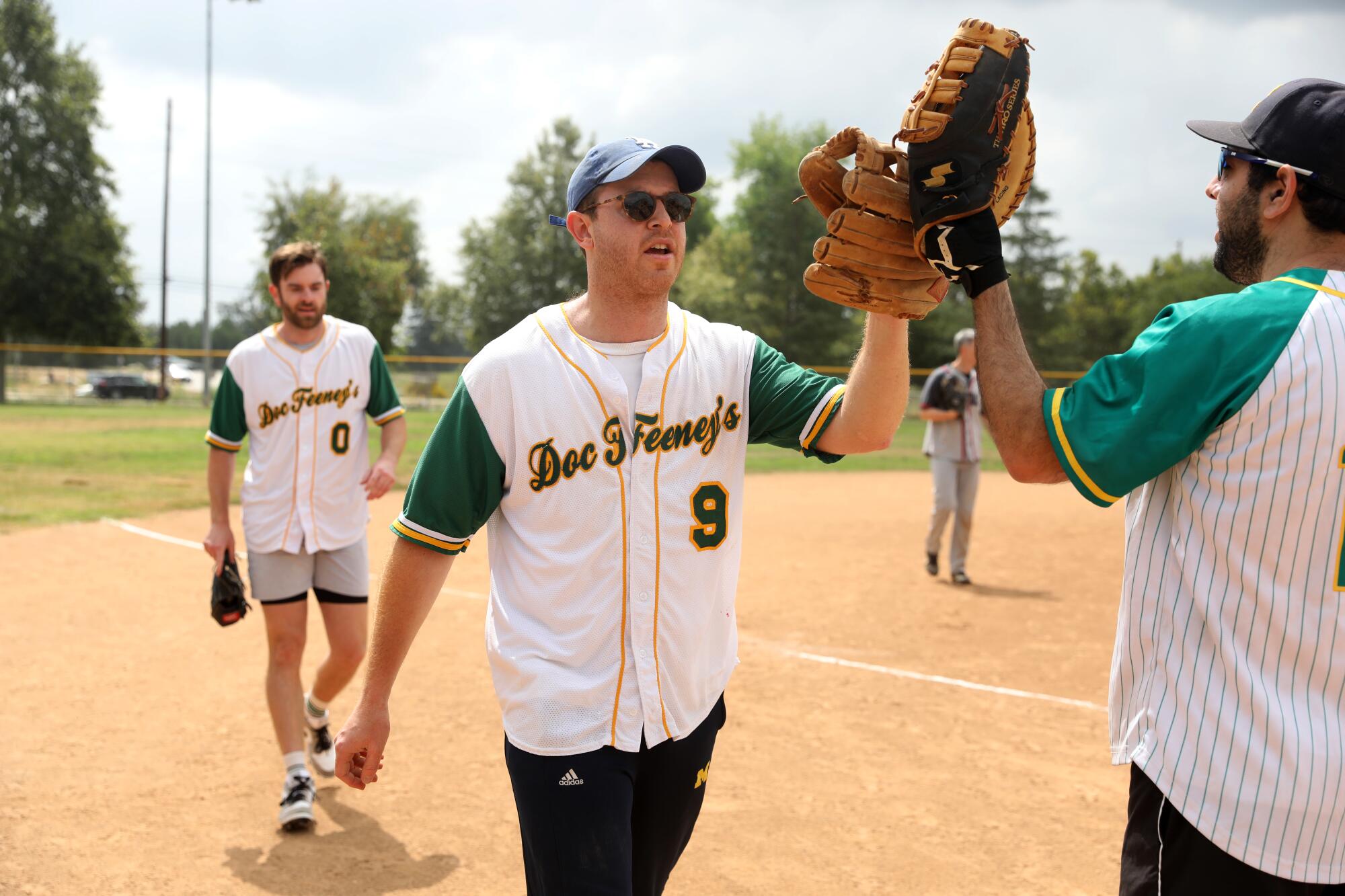
From left, Matt Michel, 33, Aaron Krug, 36, and Joel Gerson, 37, high-five after a Doc Feeney’s slowpitch softball game. Michel’s father, Al, and Krug’s late father, Jamie, are both original members of the team.
(Gary Coronado / For The Times)
Aaron — whose homer brought the Feeneys back into the memorial game — also joined the team at 14, playing alongside his father whenever he wasn’t too busy with his own sports schedule.
“Playing with your dad,” he said. “It’s hard to not get romantic about it.”
Michel’s son, Matt, has sought to modernize the team with a score-keeping app that has proved more reliable than Michel’s antiquated paper method.
“They used to pay me $20 to keep score,” Matt said. “I don’t have to pretend anymore, though.”
The game plan in a modern Feeney game revolves around strategically placing the elders in the batting lineup to avoid having two quick strikeouts or slow runners on base. Even though the Feeneys have gotten more competitive under the junior Michel’s management, the rascal-on-the-field ethos of the original team still prevails.
“The combined age of every Feeney in the infield could be 350 at any given time,” Lesner said before heading to the infield.
Winning like a Feeney
Due to some sloppy defensive errors from the silver-haired infield, the Feeneys allowed more runs in the top of the seventh. The Six Pack led, 18-16.
The Feeneys were in precarious waters as Greenberg stepped up to the plate with two outs. For the memorial game, the Feeneys had reverted to their old batting order, so after Greenberg, the lineup would be wholly composed of Feeney elders.
For the first time the whole game, all the players glued their eyes to the plate, conversations and catch-ups stopped mid-sentence.
Greenberg tried his best to ignore an irritating ankle injury that had plagued him the last couple of weeks and grimaced under the hazy sunlight as the pitcher, probably 20 or more years his junior, stared him down.
The high-arc pitch went up.

Jeff Koppelman, 72, drives a single during a slowpitch softball game. He has been a member of Doc Feeney’s All Stars for 48 years.
(Gary Coronado / For The Times)
Greenberg yanked his bat back, looking like a young Ken Griffey Jr. He struck the ball hard, but sent a one-hopper straight toward a third baseman no older than 40. Greenberg made it only about halfway up the basepath.
Out at first.
The Jamie Krug memorial game ended in a loss.
But instead of kicking up dust, breaking bats or throwing fits, the Feeneys coalesced in a green-and-yellow mass behind the dugout. They all high-fived, asked about each other’s families and went to dote on Ali’s 1-year-old daughter — Krug’s granddaughter, Eloise — who wore a shirt that traversed 50 years of family and friendship. It reads: “Littlest Feeney.”

Since leaving office, former Vice President Mike Pence founded the policy and advocacy organization Advancing American Freedom.
Drew Angerer/Getty Images
hide caption
toggle caption
Drew Angerer/Getty Images

Since leaving office, former Vice President Mike Pence founded the policy and advocacy organization Advancing American Freedom.
Drew Angerer/Getty Images
Former Vice President Mike Pence played a key role in bringing President Trump to power in 2016. By putting his name on the Republican ticket, he helped reassure the Republican establishment and evangelical voters who were wary of Trump’s brash brand of populism.
Pence’s departure from Trump’s leadership of the Republican party began when Trump called on Pence to refuse to certify the results of the 2020 election — pressure Pence rejected.
“For four years, we had a close working relationship. It did not end well,” Pence wrote in his memoir So Help Me God, which was released in 2022.
In the years since leaving office, Pence has been advocating for an ideological restructure of the Republican party, and founded the policy and advocacy organization Advancing American Freedom. Pence builds on the theme of reimagining the Republican party in his new book What Conservatives Want, which provides a critique of the second Trump administration and what he terms the “populist right.”
In an interview with Morning Edition, Pence detailed to NPR’s Steve Inskeep his critique of the second Trump administration, shared his perspective on civil rights legislation and challenged Trump’s tariffs and other interventions in the economy.
Listen to the full interview by clicking on the blue play button above; and read highlights from the conversation below.
‘The populist right’ does not represent conservative beliefs
Pence believes that Trump has embraced “the populist right” over traditional conservatives in the Republican party.
The sale of economic American company U.S. Steel to Nippon Steel in Japan exemplifies this shift, Pence said.
In his first term, President Trump opposed the sale. But in his second term, he approved the sale and took a golden share — a class of shares in which a government can own a very small percentage of the company but has outsized voting rights.
Pence said that he was taken aback by Trump’s decision to take a golden share.
Free trade is essential to American conservatism
Pence takes umbrage with his former boss’ tariff-laden economic policy.
Pence said it violates conservatism’s bedrock belief in the power of free trade, and Trump has gone about granting exceptions to tariffs in an unfair way.
Granting waivers to large corporations from certain tariffs is “one of the lesser reported aspects of the tariff regime that’s been imposed by the administration,” Pence added.
Trump and Pence ran in 2020 on a mission to “drain the swamp,” rooting out government corruption and wasteful spending. However, Pence said Trump appears to have shifted from those goals.
“There’s maybe nothing more swampy than the battle over getting tariff waivers for big business,” Pence said.
Women’s rights on the right
There is a debate among the ultraconservative right about the role of women in civic life.
The concept of “household voting,” has become a familiar talking point for ultra-right-wing communities online. Supporters of “household voting” advocate that every American household should get one vote, the vote being that of the husband’s. This concept has been promoted by figures such as Abby Johnson, a prominent anti-abortion activist who spoke at the 2020 Republican National Convention. When asked about whether he supported household voting, Pence said he is not aligned
“It’s one person, one vote in this country. And people have bled and died for that principle throughout the years of our history,” Pence said.
He added that American families don’t need to be propped up by government programs to boost childbirth. “What American families need is an application of the kind of principles that will create higher wages, more opportunities, more jobs,” Pence said.
Should conservatives stand for civil rights?
Pence said he was an admirer of senator and one-time presidential candidate Barry Goldwater.
Notably, Goldwater voted against the Civil Rights Act of 1964.
“Should conservatives stand for civil rights?” asked Inskeep.
Pence responded that civil rights are important to conservatives, but that equality of opportunity is what legislation ought to enshrine, not equality of outcome.
Pence added that he stood by the Supreme Court’s decision to ban partisan gerrymandering on the basis of race, rendering ineffective a key provision of the Voting Rights Act of 1965.

-

 Technology3 minutes ago
Ohio robot cop retires after zero arrests
-
 Business6 minutes ago
Commentary: Puncturing the myth of Alan Greenspan, whose policies gave us the Great Recession
-
 Entertainment11 minutes ago
On 10th anniversary, Boleros de Noche’s legacy is celebrated by L.A. City Hall
-
Lifestyle18 minutes ago
They started playing L.A. Municipal softball 50 years ago. They’re still at it
-
 Politics21 minutes ago
Newsom, California Legislature reach $351.7-billion budget deal
-
 Sports33 minutes ago
Roki Sasaki struggles with command early, Dodgers fall to Padres
-

 World41 minutes ago
Trump threatens 100% tariffs over EU digital tax
-

 News1 hour ago
Utah County declares State of Emergency as wildfires ‘ravage’ the state

