Lifestyle
When Posting Becomes Its Own Style of Politics


A growing number of conservative influencers are making content in which they claim to uncover fraud.
In December, the YouTuber Nick Shirley uploaded a video purporting to expose a scheme led by Somali refugees in Minneapolis.
It caught the attention of Vice President JD Vance, who shared the video online. Soon after, ICE was deployed to the city.
The video was inspiring to Amy Reichert, a 58-year-old San Diego resident, who started making her own videos claiming a similar scheme was afoot in her city.
She is one of many creators channeling populist rage and elite resentment into a style of posting.
It’s a mode of practicing politics some are calling “slopulism.”
Ms. Reichert doesn’t like to call herself a right-wing influencer.
She has a sizable following on social media (some 60,000 followers on X, and 80,000 on Instagram), where she posts videos of herself talking about what in her view is corruption in the Democratic-leaning city government of San Diego, usually while wearing rose-tinted aviator sunglasses.
Since the beginning of this year, Ms. Reichert, a licensed private investigator, has been making content that highlights what she thinks is a pattern of taxpayer fraud in her city’s child care centers. It’s a pivot she has made since watching the video by Mr. Shirley, the 23-year-old MAGA YouTuber, in which he claimed to have uncovered widespread fraud by a network of Somali Americans operating child care centers.
“I thought, How can I, as a private investigator and private citizen, do what Nick did in Minnesota?” Ms. Reichert said. “We are drowning in fraud in California.”
After just a few hours of researching state databases in early January, Ms. Reichert began to post screenshots on X of documents she claimed belonged to “ghost” day care centers in San Diego County. The posts spread widely. Soon, she was on television to discuss her work with the Fox News host Jesse Watters, and President Trump was sharing a clip of the segment on his Truth Social platform.
Then Ms. Reichert began making videos, sometimes standing outside the day care centers in question, in which she repeated the allegations while presenting little proof of wrongdoing. But her message — that foul play was taking place — was clear.
One video Ms. Reichert posted was quickly clipped and reshared on X by right-wing news aggregators. It earned close to half a million views — essentially a viral moment for a creator of Ms. Reichert’s stature.
She was also happy to see that Mr. Shirley, whose work Mr. Vance suggested was more consequential than Pulitzer Prize-winning journalism, began to follow Ms. Reichert on X.
“Quite amazing, these past few weeks,” Ms. Reichert said.
Ms. Reichert is one among many conservative content creators who have become the internet’s busiest sleuths in recent weeks. They create videos that are light on evidence and traditional journalistic techniques but are filled with sinister-sounding claims that neatly align with the Trump administration’s priorities.
Armed with digital cameras and publicly available documents, they claim to be documenting patterns of elite corruption, taxpayer fraud, abuse of power and government waste across the country, hoping their posts and videos will cross into the feeds of elected officials, as Mr. Shirley’s did.
Some of the biggest names in MAGA media have fanned out across the country to make this content.
The influencer Cam Higby claimed to have uncovered a nearly identical case of fraud, undertaken once again by Somali migrants, in Washington State.
Benny Johnson, a creator with close ties to the Trump administration, set out looking for fraud within state-run homeless programs and misspent Covid relief funds in California.
On YouTube, Tyler Oliveira, a 26-year-old creator with over eight million subscribers, posted videos claiming to have uncovered a “welfare-addicted” township in upstate New York.
Even Dr. Mehmet Oz, a Trump administration official, has made a video in which he claims a $3.5 billion medical fraud operation is happening in Los Angeles.
What Is ‘Slopulism,’ Exactly?
It’s a novel form of political behavior that has left many political commentators and researchers struggling to articulate what it is. Though many are quick to say what it’s not: investigative journalism. It is also, experts say, more than misinformation or disinformation, terms that fail to capture the nature of these misleading posts and how they are filtering up into the highest echelons of government.
Curt Mills, the executive director of The American Conservative magazine, called it “MAGA-muzak.”
Kate Starbird, a researcher at the University of Washington who studies online spaces and extreme politics, has called it “participatory propaganda.”
“Try ‘entrepreneurial opportunism,’” said A.J. Bauer, an assistant professor of journalism at the University of Alabama with a focus on right-wing groups.
“The real novelty here is the synchronization between the movement, the party and the state — but there isn’t a buzzword yet,” Mr. Bauer added.
The sameness of this politicized content, created overwhelmingly by figures orbiting the conservative cultural ecosystem, is, to many on the right and the left, not unlike digital “slop.” The term, which refers to low-quality, low-information, A.I.-generated content, has gradually expanded to more generally describe the gruel-like mixture of online ideas, images and memes flooding our feeds.
That’s how you get another term, “slopulism,” which has of late become a buzzword with X users and Substackers, many associated with the right, during the course of Trump’s second term.
Slopulism, as described by these commentators, is a kind of political post that elides concrete political concerns in favor of the fast-acting satisfactions of social media rage and culture-war jargon. It’s a political tendency that offers followers emotional gratification through mindless, performative gestures online.
Many of the content creators, like Ms. Reichert, were unfamiliar with the terms slop or slopulism.
These days, on platforms like X, slopulism is a pejorative label often applied to posts by politicians and pundits alike, anyone who shares out lowest-common-denominator ideas designed to appeal to loyal political bases.
On the right, this can look like gleeful cruelty, sadistic memes, posts that “own the libs” or sensationalized claims about fraud and conspiracy. On the left, it could be social justice messaging, online identity politics or populist economic proposals to, say, tax the rich.
The new wave of fraud-themed content, made by creators like Mr. Shirley, invokes familiar themes of populist rage and elite resentment. It seems to be the latest evolution in a culture where posting is a primary method of practicing politics — except these posts appear to be made not only to get in on a trending wave, but also to provoke policy action.
“Slopulism works by harnessing the excitement and vibe of a moment,” said Neema Parvini, a senior fellow at the University of Buckingham in England who is considered to have popularized the term. He believes it’s a way for populist leaders, like Mr. Trump, to keep their bases content.
“It convinces supporters to invest their emotions in story lines rather than the substantive politics or structure behind it,” he said. “It doesn’t lead anywhere, it’s just entertainment.”
‘Building for Years’
Renaming the Gulf of Mexico. The annexation of Greenland. A proposal to turn Gaza into a glittering resort town. All of these ideas found their potency in the form of viral content, circulated by those on the right, before they were fully embraced by the Trump administration. The online right podcaster Alex Kaschuta called this “the vibes-based international order.”
“This dynamic has been building for years,” said Dr. Starbird, the extremism researcher. “But in the second Trump administration, this relationship is more direct, with policies clearly being motivated, shaped and justified by and through digital content creation.”
As with most viral content, the ideas emerging from these online environs can be fleeting. Mr. Mills, of The American Conservative, described the administration’s recent policy priorities as having a “flavor of the month” feel.
Some on the right pushed back against the idea that slopulism, or any dynamic like it, is driving the administration’s actions.
“It’s a misread of the situation,” said Jesse Arm, vice president of external affairs at the Manhattan Institute, a conservative think tank. He pointed out that something like the Greenland annexation, which is often described as meme policy, could be traced to “far more serious conversations” between the president and his advisers as far back as 2019.
“I don’t think President Trump is hyper-invested in what’s happening online,” he said. “His administration is paying attention to what happens online, sure, but only in the sense that this is the main arena to gauge policy discourse.”
In a statement, Abigail Jackson, a White House spokeswoman, said Mr. Trump “always receives feedback and input from a variety of sources before making a decision that is in the best interest of the American people.”
Some see this as a positive style of governance, Mr. Mills said, adding, “It’s hyper-democratic in some ways: ‘Let’s look online and see what’s popular.’”
The content can have political consequences, but Mr. Bauer, the University of Alabama journalism professor, said he did not view its creation as a sincere political effort. Many of the creators he has observed making these videos aren’t highly ideological figures or even MAGA die-hards.
“They see an opportunity,” he said. “These are people that aspire to be famous online. They see that there’s a lot of desire and demand for right-wing content. And they are motivated by things like money and attention.”
Ms. Reichert said that the amount of money generated from her posts was “pathetically low,” but declined to offer further details.
Most of the fraud videos published in recent weeks resemble Mr. Shirley’s in both form and content. Almost always, the person suspected of wrongdoing is an immigrant or a member of a minority group, the most common ethnic category being that of Somali refugees, as in Mr. Shirley’s video about Minnesota.
While some, like Ms. Reichert, say they are inspired by Mr. Shirley, others deny any influence.
Until this January, David Khait, a conservative content creator with over 100,000 subscribers on YouTube, posted mostly man-on-the-street debates and interviews, a confrontational content style popularized by the conservative activist Charlie Kirk, who was assassinated in September. But recently, he has begun making videos about what he says is voter fraud in Fulton County, Georgia.
“There’s been no pivot here,” Mr. Khait, 26, wrote in a text message. “Call my content what it is: confronting institutional failure head-on because that’s what’s staring Americans in the face.”
The slopulist impulse may be most acute on the right at the moment — owing to the Republican control of the federal government — but some have argued this mode of online political engagement has its origins across the aisle.
Sean Monahan, the founder of the trend forecasting group K-Hole, has traced it back to the rise of the so-called “dirtbag left,” an online set of leftists who came to prominence during Bernie Sanders’s presidential run in 2016.
“It was a style of politics presented to younger, left-wing consumers, things like raising taxes on billionaires or modern monetary theory or controls on rent,” Mr. Monahan said. “There was a presumption that you could lay out a policy goal with no political trade-offs, no constituencies to navigate and no downsides.”
One recent example of slopulism on the left, he said, might be the mayoral campaign of Zohran Mamdani, whose platform included a promise to freeze the rent.
“He’s a little bit slopulist,” Mr. Monahan said of Mr. Mamdani, adding, “This is the feel-good model of politics where the mechanics are less important than taking credit and celebrating.”
For some, it is likely to be one of the more rewarding ways to practice politics in modern-day America.
“I don’t want to live a life of quiet desperation,” Ms. Reichert said.
Mr. Shirley, in recent days, has been staying the course, too. While he has moved on from Minnesota, he’s still making videos about fraud aimed at immigrant-operated day care centers. But this time he’s in California and has a new collaborator by his side: Ms. Reichert.
Last month, she posted a photograph of herself and Mr. Shirley on X that has been viewed 1.4 million times. Using a flame emoji, she wrote: “California, here we come!”




Artist renderings and diagrams for President Trump’s proposed triumphal arch released by the U.S. Commission of Fine Arts on April 10, 2026.
Jon Elswick/AP
hide caption
toggle caption
Jon Elswick/AP
President Trump on Friday unveiled official architectural renderings for the triumphal arch he plans to add to the National Mall in Washington, D.C.
The proposed monument would stand at one end of the Arlington Memorial Bridge next to the Arlington National Cemetery.
In addition to the president’s post on Truth Social, the plans were released by the Commission on Fine Arts, a federal agency that has review authority over the design and aesthetics of construction within Washington, D.C., and produced by Harrison Design, an architecture, interior and landscape design firm with offices in six U.S. cities, including D.C. The mockup shows a structure very similar to the 3D model that Trump touted at a fundraising dinner at the White House last October.

This model of President Trump’s proposed triumphal arch was shown at a White House press conference on Oct. 15, 2025.
Kevin Dietsch/Getty Images
hide caption
toggle caption
Kevin Dietsch/Getty Images
At 250 feet tall, the overall height of the structure is intended to serve as, “a fitting recognition of America’s 250th birthday,” the White House said in an email to NPR.
A monument aimed at honoring what and whom?
The proposed arch bears a striking resemblance to the Arc de Triomphe in Paris — though would stand almost 100 feet taller — and is topped with two golden eagles and a winged, crowned figure reminiscent of the Statue of Liberty (which was gifted to the U.S. by France in 1884.) On one side, the words “One nation under God” appear, with the phrase “Liberty and justice for all” on the other.
The structure would also loom over the nearby Lincoln Memorial — at more than twice the height.
“The Triumphal Arch in Memorial Circle is going to be one of the most iconic landmarks not only in Washington, D.C., but throughout the world,” said White House spokesperson Davis Ingle in an email to NPR. “It will enhance the visitor experience at Arlington National Cemetery for veterans, the families of the fallen, and all Americans alike, serving as a visual reminder of the noble sacrifices borne by so many American heroes throughout our 250 year history so we can enjoy our freedoms today. President Trump will continue to honor our veterans and give the greatest Nation on earth — America — the glory it deserves.”
When asked by CBS political correspondent Ed O’Keefe whom the monument was intended to honor after Trump initially unveiled his plans in October, Trump responded: “Me.” The exchange was captured in a social media video.
A group of Vietnam War veterans launched a lawsuit in February seeking to bar the Trump administration from constructing the arch. The plaintiffs argued the project violates statutes requiring express congressional authorization for the erection of commemorative works or any “building or structure” on federal park grounds in D.C., among other issues.

The Arc de Triomphe in Paris as part of the city’s Christmas celebrations (2007).
Christophe Ena/AP
hide caption
toggle caption
Christophe Ena/AP
“It’s textbook Trump,” said Sue Mobley, director of research at Monument Lab, of the proposed plans for the arch, in an interview with NPR. The nonprofit design studio based in Philadelphia reimagines public art and structures. “It has to be the biggest. That’s the authoritarian impulse.” Trump has repeatedly pushed back on accusations of authoritarianism, rejecting the label of dictator.
Mobley added that she doesn’t think the plans will come to fruition. “It will likely get tied up in court,” she said.
Approval process
The White House said it will “follow all legal requirements” in constructing the triumphal arch. As part of that process, it mentioned the National Park Service’s recent request to present potential designs to the Commission on Fine Arts. The plans are scheduled to be reviewed next week. At this point, that commission is composed entirely of members appointed by Trump. (In October 2025, Trump took the unusual step of firing six sitting members of the commission.) The National Capital Planning Commission, the federal government’s central planning agency for the National Capital Region, is also expected to weigh in on the plans.
The White House said the estimated cost of the project, which it anticipates will draw on a combination of public and private funds, is still being calculated. Harrison Design, the architecture firm behind the plans, did not immediately respond to NPR’s request for information about the price tag.
Multiple D.C. makeover projects
The arch plans are the latest in a series of current and potential architectural interventions from the White House in and around Washington, D.C.
Most dramatically, the administration is pushing for the creation of a $400 million neoclassical ballroom at the White House. A federal appeals court on Saturday temporarily allowed the construction of the ballroom to move forward while the administration challenges a March ruling that it required congressional approval. Whatever the outcome, the historic East Wing has already been demolished to make room for the new structure.
Trump has converted the White House Rose Garden into a stone-covered patio. He aims to shut down The Kennedy Center for two years to facilitate a major renovation (a coalition of groups including the National Trust for Historic Preservation, the American Institute of Architects, and the D.C. Preservation League, filed a lawsuit in the U.S. District Court for the District of Columbia in March opposing the plans.) And he has proposed architectural changes to the Washington Dulles International airport through an initiative the Department of Transportation launched late last year to overhaul the Northern Virginia airport. Several prominent architecture firms including Zaha Hadid Architects and Adjaye Associates have submitted proposals.
In August, the president also signed an executive order requiring that new federal buildings with construction budgets of more than $50 million be designed in “classical” or “traditional” styles.
Anastasia Tsioulcas contributed to this story.

Does having an affair with a married co-worker (who is in a loveless marriage, and whose wife is having an affair too, but they’re staying together for their child) make me, morally, a bad person?

That depends on what you believe a “bad” person to be. If your married co-worker and their spouse have both communicated and acknowledged the refined terms of their relationship to each other — that their romantic relationship is over, and that they are both free to pursue connections outside of their marriage while continuing their domestic partnership and performing whatever outer auspices of their relationship to ensure their child has a stable home until they come of age — then your co-worker and their spouse are essentially in an open relationship that prioritizes co-parenting. But the nature of this agreement, and the consequences of actions stemming from it, all depends on whether this agreement is mutually consensual and clear.
The word “morally” carries a weight with different subjective meanings. Generally it refers to undertaking an action in accordance with certain principles or values decided by an individual. So in that sense, what is “moral” in this situation can take on a variety of forms, depending on which definition of what is “right” is prioritized in your own mind.
Oftentimes we decide what is “wrong” for us based on how a certain idea or action makes us feel. That feeling can present in many ways — rumination, a knot in your throat or your chest, an unease in your stomach, the tensing of muscles. The fact that you’re asking this question tells me that something about this situation is likely making you feel a certain way. I invite you to explore what shape that feeling takes, not just in your mind, but in your body.
Instead of obsessively over-rationalizing or avoiding, try making friends with that feeling. If it’s uncomfortable or unsustainable to live with continuously, ask your body why — and how it can help you make decisions that are the kindest possible to your nervous system.
I would encourage you to get more clarity from your co-worker on the terms of their marriage, and exactly how open and honest they and their wife have been with each other. Have they both acknowledged to each other that they are seeing other people? If so, does their agreement have a “don’t ask, don’t tell” clause, or is your co-worker being asked to give details on the who, when, or how?
If one party isn’t as aware of what’s going on as the other party, this isn’t an objectively “right” or “wrong” vignette, per se. But it does mean that your new partner may come with some baggage, and perhaps with some growth opportunities in the area of communication. Ethical open relationships (ethical meaning different from morality, meaning more about a general societal consensus around what’s most evolved versus an individual’s codes for behavior) take a lot of maturity, humility, honesty and willingness to constantly grow. Taking on a partner in an open marriage, especially if a child and mutual source of income are involved, will likely present a certain requirement of effort for your heart and mind. And I would contend that even if you’ve already set a mental boundary that this relationship will be short-term or temporary, or purely sexual, chances are you’ll still have to undertake a degree of risk tolerance and emotional navigation through it, given the unique circumstances of the situation. Are you comfortable taking that on? Only you can answer this question for yourself.
Oftentimes we decide what is “wrong” for us based on how a certain idea or action makes us feel. That feeling can present in many ways — rumination, a knot in your throat or your chest, an unease in your stomach, the tensing of muscles. … I invite you to explore what shape that feeling takes, not just in your mind, but in your body.

Goth Shakira wears a Miss Claire Sullivan corset and skirt, Shushu/Tong shoes, Blumarine earring, Hirotaka earring, Pianegonda ring, Xeno underwear and stylist’s own collar.
The most important question here becomes: Is this a situation that is sustainable for you? Are you comfortable with the degree of honesty present among all three people involved in this (four, counting the child)? If there’s something that bothers you about it, what is it exactly that leaves you unsettled? Sitting with these questions will lead you to the best course of action for you, because you are the only person who has to live with you at the end of the day.
And if you were my friend, what I would say to you is this — are you truly infatuated with your co-worker, or do you just see them 40 hours a week? Consistency and proximity, especially in the professional context of teamwork, collaboration and problem-solving, can make a work connection feel like it has more potential for romantic intimacy, depth and longevity than it actually does. Dating your co-worker can be hard (there’s no workplace escape from your personal life if you get into a fight, and one or both of you can find your material stability threatened if the romantic relationship sours). Dating someone with a child can be hard. Dating someone in an open marriage can be hard. In your mind, body and heart, is your connection with this person worth what it comes with? Considering all angles of the situation through the lens of your own well-being first and foremost will give you all the answers you need.
Photography Eugene Kim
Styling Britton Litow
Hair and makeup Jaime Diaz
Visual direction Jess Aquino de Jesus
Production Cecilia Alvarez Blackwell
Photo assistant Joe Elgar
Styling assistant Wendy Gonzalez Vivaño

DBenitostock/Moment RF/Getty Images
Forty percent of Americans have their daily lives interrupted by uncomfortable bowel symptoms, according to the American Gastroenterological Association. That’s a lot of troubled guts.
But Dr. Trisha Pasricha says at the other end of the spectrum, there are people who experience “poophoria.” That’s Pasricha’s term for a state of being where doing your business is painless and worry-free. “ I just want you to poop quickly, effortlessly, and then go live your best life,” she says.
Want the latest stories on the science of healthy living? Subscribe to NPR’s Health newsletter.
Pasricha is the director of the Institute for Gut-Brain Research at Beth Israel Deaconess Medical Center, an assistant professor of medicine at Harvard Medical School, and writes for the Washington Post. She also treats patients with IBS and other painful digestive issues that can be tricky to diagnose.
Pasricha’s is not a one-size-fits all approach. There’s no magic number of times you need to go in a day, nor a perfect color or consistency that means you’re healthy or normal, she says. But if you often struggle with issues like bloating, constipation or diarrhea she wants you to know: There’s a better way to poop.

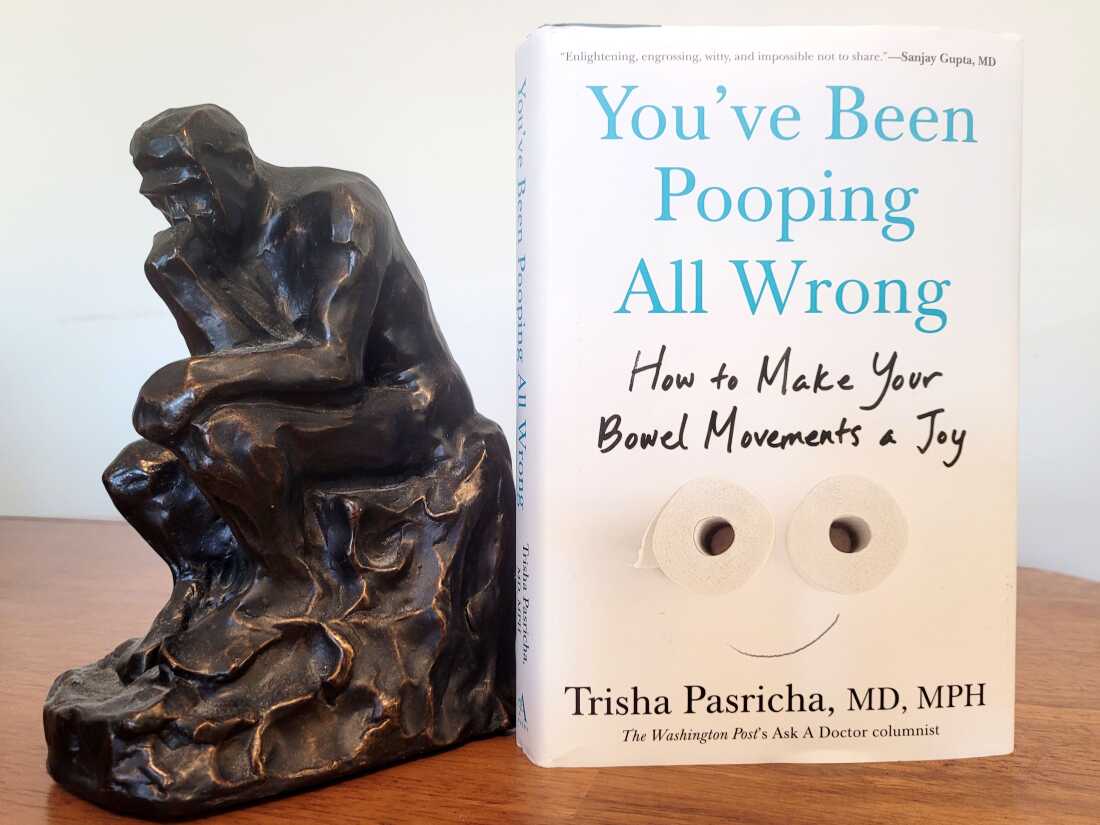
In her new book You’ve Been Pooping All Wrong: How to Make Your Bowel Movements a Joy Pasricha lays out evidence-based habits and practices to make your relationship with your solid waste as smooth as possible. Here are some of her most tried-and-true tips. Pasricha offers much of this advice to her patients — but following it just might save you a trip to the doctor.
Do: Take a look at your Number 2
A lot of people are shy about looking at the toilet bowl but Pasricha says you can learn a lot if you do. Very hard, small lumps or watery, soupy liquid are both cause for concern. A spectrum of shades is fine — but seek medical attention if you see black or whitish stool. A red or maroon color may indicate bleeding, or it can just give you insight on how long it took you to digest those beets.
When it comes to how often you go, there is a normal range: Pasricha says having a bowel movement anywhere from three times a day to three times a week can be perfectly healthy.

Do: Eat more fiber, and experiment with spices
Why is fiber at the top of the list when it comes to digestive health? It’s a real problem-solver even in the short term, Pasricha says. “If you have diarrhea, it forms this gel that kind of pulls it together and makes it more formed. If you have constipation, it softens it up,” she says.
Even more importantly, fiber is food for the microbes in your colon. Those microbes in turn produce short-chain fatty acids that reduce inflammation in the gut. Some of these fatty acids like have been linked to lower risk of colon cancer, and reduced risk of heart attack and dementia.
Since most people don’t get enough fiber in their diets, Pasricha often recommends a psyllium supplement — a plant-based powder that you can mix into water or coffee. Or you can learn which foods are high in fiber and amp up your intake.
Loading up on spicy food cooked with hot peppers can sometimes kick your bowel movements into overdrive, and not in a good way. ”But if you eat just the right amount, it can actually, in the long term, prevent pain and help you stay regular,” Pasricha says. Other seasonings including mustard, oregano, garlic and horseradish have been shown to stimulate the same nerve receptors.

Don’t: Consume a lot of ultra-processed foods and artificial sweeteners
Research has found concerning links with ultra-processed foods and digestive troubles. Specifically some additives and emulsifiers appear to “decrease the mucus barrier that’s on our guts, and can change the microbes,” Pasricha says. A study she cites in her book of over 200,000 human participants found that people who ate higher amounts of ultra-processed foods were 20% more likely to have irritable bowel syndrome compared to those who ate the least.
Pasricha also advises her patients to steer clear of foods with artificial sweeteners — often advertised as sugar-free — because they’re known to cause diarrhea and bloating.
Don’t: Spend more than 5 minutes on the toilet
Researchers think that sitting for extended periods on a toilet seat with an unsupported pelvic floor can increase risk for hemorrhoids. Hemorrhoids are actually something we all have, Pasricha says. They’re cushions of veins that sit inside the rectum. Sitting suspended over the toilet bowl for too long may weaken the connective tissue around the hemorrhoids, “and those veins start to bulge, then they pop out and they become inflamed and angry,” she explains.
What to do instead: Get up and move your body
If you’re perched in the bathroom for more than five minutes without results, take a movement break. Any amount of exercise can be beneficial, Pasricha says. “Studies have found that even just a brisk walk will be enough to help stimulate contractions of your bowel movement.”
Don’t: Bring your phone to the throne
After seeing a study from Great Britain from 1989 about people reading the newspaper in the loo, Pasricha decided to try an updated version in her own lab. She focused, of course, on smartphone use. Her team at Beth Israel surveyed 125 people about their lifestyle and bowel habits. Then the patients went in for colonoscopies and the doctors noted whether each patient had hemorrhoids or not.
The result? People who said they used their smartphones on the toilet were 46% more likely to have hemorrhoids than those who went device-free. “We found out that you were five times as likely to spend more than five minutes in the bathroom if you brought your smartphone in,” Pasricha says.
Aside from distracting you from the job at hand, Pasricha points out that there’s plenty of research on the stress-inducing effects of social media. “ You’re doom scrolling. You’re like getting caught by some rage bait,” she says. And stress can make it harder for the muscles in your pelvic floor to relax enough to clear the pipes..
What to do instead: Try some light print material
When she was a kid, people used to keep “bathroom reading” within easy reach of the seat, Pasricha notes with nostalgia. “To me, the ideal bathroom reader is something that gives you quick takes like a comic book, like short magazine articles, and ideally it should be from like three months ago,” she says.
If you absolutely must look at your phone, Pasricha tells patients to set a “two TikTok limit.” ”That’s, I have to bring my phone in, but after two TikToks, I’m gonna check in with myself and make a decision.”
Do: Squat, and lean forward
When you’re sitting at a 90-degree angle, a muscle called the puborectalis curves around the colon like a sling and helps keep it shut. But when you’re defecating, you want the tube of your bowel to be able to straighten out. And that’s where squatting comes in.
Pasricha says there’s no need to abandon the comfort of a modern toilet — instead put a stool or a pair of yoga blocks under your feet to raise your knees higher than your hips. “That basically allows that muscle to relax so that the tube straightens up again,” Pasricha says.
And to perfect your pooping posture, look to the famous sculpture, The Thinker by August Rodin. The figure is leaning forward, resting his elbows on his knees. There’s research suggesting “that’s the optimal way,” to help straighten the angle of the tube, says Pasricha.
Gut health is complex, and can change with age, shifts in lifestyle, and a whole number of other factors. If something seems off, don’t be shy about bringing it up with your doctor, Pasricha says. “ I get a lot of pictures of poop in my clinical messaging tool and I mean, it’s very helpful.”

Boos rain down on Red Wings after missing playoffs for 10th straight season

Aztec Dancers Brave Rain at San Francisco’s Rebranded Farmworkers Day Celebration – San Francisco Today

Heika’s Take: Stars wrap up regular season home slate with stingy shutout win over Rangers | Dallas Stars

Fleet’s sold-out homecoming at TD Garden a resounding victory for women’s sports in Boston

Championship-caliber defense not enough for Wisconsin to secure NCAA hockey title

Florida High School Football Rankings: Top 25 teams – Oct. 21

How old is Bo Nix? What to know about Oregon quarterback ahead of 2024 NFL Draft

Cleary's 21 help Le Moyne down Central Connecticut State 69-64 in OT

99th annual Pony Swim held in Virginia

Indiana Members Credit Union announced as new anchor tenant at Bottleworks District

Video: Police Fatally Shoot Man After Stabbings at Grand Central Subway Station

Trump blasts Spanberger ahead of Virginia meetings, says state faces tax base exodus like New York, California

Pope Leo urges world leaders to reject war and negotiate peace

Manhattan DA’s office to investigate Swalwell sexual assault allegation

NASA’s Artemis II mission in 20 minutes
-

 Atlanta, GA1 week ago
1 teenage girl killed, another injured in shooting at Piedmont Park, police say
-

 Movie Reviews1 week ago
Vaazha 2 first half review: Hashir anchors a lively, chaos-filled teen tale
-

 Georgia5 days ago
Georgia House Special Runoff Election 2026 Live Results
-

 Pennsylvania5 days ago
Parents charged after toddler injured by wolf at Pennsylvania zoo
-

 Arkansas2 days ago
Arkansas TV meteorologist Melinda Mayo retires after nearly four decades on air
-
 Milwaukee, WI6 days ago
Potawatomi Casino Hotel evacuated after fire breaks out in rooftop HVAC system
-

 Indianapolis, IN1 week ago
Fighting Illini begin Final Four preparations in Indianapolis
-

 Detroit, MI1 week ago
Puppy rescued after getting stuck on chimney in Detroit