Lifestyle
Vet care costs are skyrocketing in California. 8 people share their bill horror stories

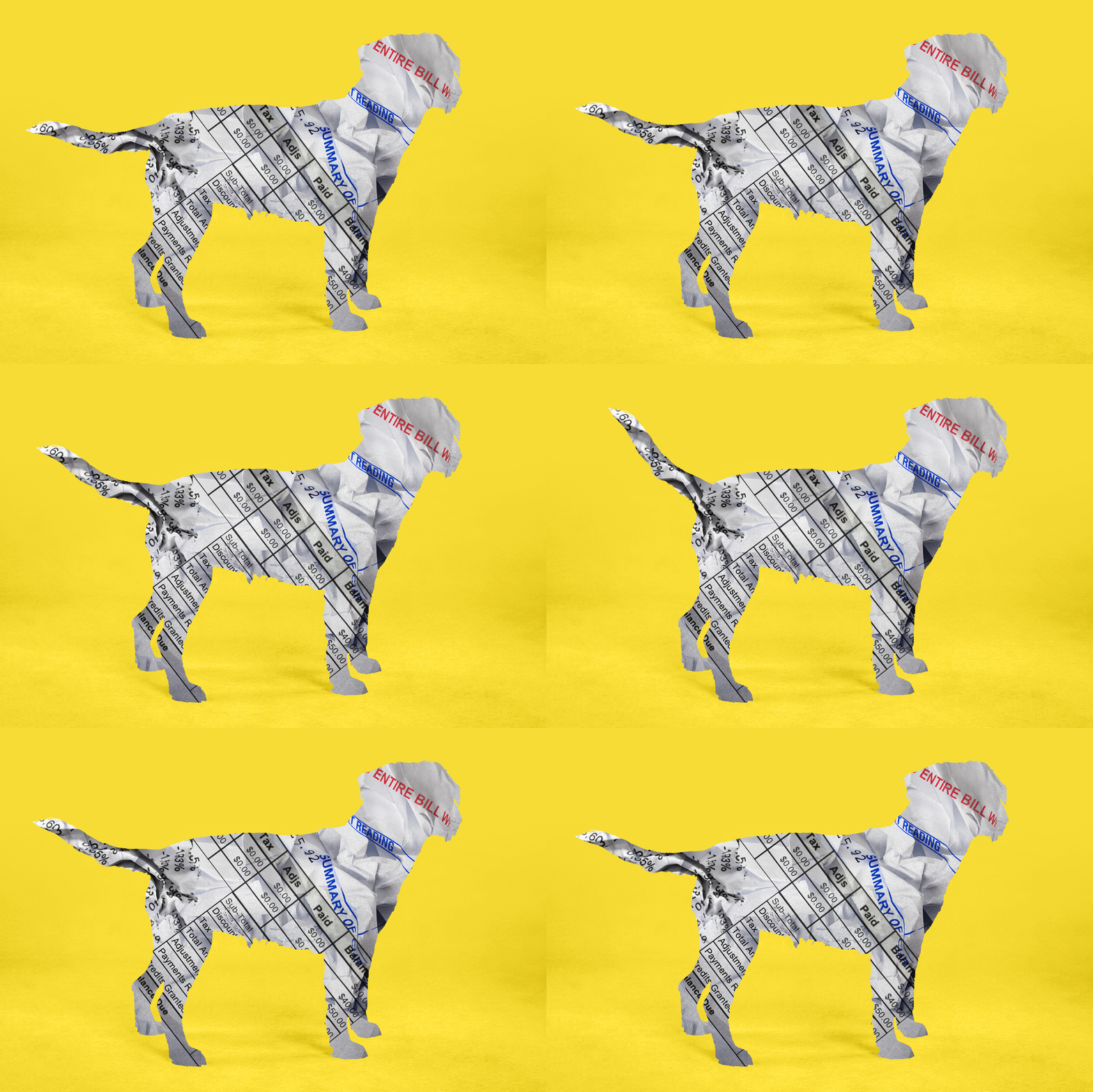
Two things are certain in pet parenting: 1) your furry loved one will one day have to visit the vet and 2) the cost of veterinary care is increasing, rising more than 60%, over the last decade, according to a recent New York Times report.
Stacie Straw, in Long Beach, Calif., spent about $30,000 in 2022 on her English Bulldog rescue, Blanche, which she mostly paid for with a CareCredit card at zero interest, she said in response to a Times survey inquiring about readers’ vet expenditures. The cost was due to the “unfortunate confluence,” she said, of the dog needing ACL surgery and then developing mast cell cancer. Ultimately, Blanche passed away after several months of treatment.
“I have a lot of empathy for vets because they’re doing the best they can,” Straw said in a follow-up interview. “But it’s really hard and expensive for most people — it’s difficult to spend $100 to take your dog to the vet just to know if there’s an issue. That’s not chump change. And you may have to make trade-offs in your spending decisions to [pay for] that.”
Stacie Straw’s English bulldog rescue, Blanche.
(Stacie Straw)
Ballooning veterinary costs are not necessarily your mom and pop vet’s fault. A combination of factors in the industry is driving up vet bills. Drugs and vaccines are more expensive than ever. As is the cost of staffing vet offices, rent, utilities and medical equipment. Because there are more advanced medical technologies and treatments for pets now — MRIs, allergy testing, even acupuncture — there’s often more to charge for. And the ongoing corporatization of independent veterinary practices — in which big businesses look to maximize profits — is driving costs through the roof.
In addition to readers who have emptied their pockets at the vet, we heard from more than two dozen veterinarians across the country in response to our survey, nearly all of them citing the exorbitant cost of their veterinary school tuition. Many of them also noted that vets have a higher suicide rate than the general population — between 2.1 to 3.5 times higher, according to a 2019 Centers for Disease Control and Prevention study.
Dr. Jessica Bachmann, of Ira, Vt., noted her “$400,000, eight-year education” to become a veterinarian.
But an industry in crisis doesn’t make caring for our pets any easier. If you’re enduring the outrageous cost of veterinary care, take some solace that you are not alone. Here’s what some Times readers had to say on the topic.

Raquel Cypert’s rescue chihuahua-pug, Luna.
(Raquel Cypert)
Raquel Cypert and Luna, Upland, CA
Highest vet bill: $3,800 — after having spent $800 the day prior on Luna at the vet.
What happened: “Luna became really lethargic and was vomiting one day. I took her to our regular vet and they ran some tests and gave her some fluids and said it was probably a stomach virus and sent us home. She spent the night vomiting and seizing. The next morning I took her back to that vet who said they could put her down or she could go to an emergency hospital.
I red lined [my] Audi a couple of times to the hospital and we ran in where they were waiting for us. The vet called us into the room about 20 minutes later and said she has Addison’s disease which is a deficiency of her stress hormones and she would need emergency meds and IV fluids and need to stay overnight to get her stable. $3,800 later we got our baby back.”
The outcome: “She needs monthly injections and daily meds but her condition is pretty manageable.”
Any cheaper alternative care options? “Because I am a nurse, I am able to inject her myself. So it saves about $1,000 a year avoiding monthly vet visits.”
William G Keiner and his dog, Los Angeles
Highest vet bill: $400 quickly escalated to $5,000 “before we were forced to decline treatment.”
What happened: “Our dog, about one year old, slipped his leash and ran into a car. Being a rescue who had distemper, he does not qualify for pet insurance. So when we took him to the emergency vet, we were presented with an ever-escalating stream of estimates … before we were forced to decline treatment. Essentially they admitted our dog, quoted a price to assess him and give him pain meds. They assessed and came out with a higher estimate. Went back in, came out with another higher estimate. This happened two-three times before we had to decline treatment. We still ended up paying close to $2,000. The vets were neither able to reset the broken leg or properly splint the leg.”
The outcome: “We opted for pain killers to get us through the weekend [and] to see a non-profit vet.”
Any cheaper alternative care options? “We took our dog to a non-profit vet who worked with the rescue group we foster for. He was treated but it didn’t go well. The pins they put in his leg got infected. This vet, we learned, was [ultimately] shut down by the city. We eventually found an independent vet who agreed to a reasonable [price]. Still thousands of dollars to remove the pins, which did the trick.”
Misty Dailey and Elfin, Spring Branch, TX
Highest vet bill: $2,200 (in Sacramento, Calif., 1992)
What happened: “Gastric Tortion. Deep barrel-chested dogs like Dobermans, boxers, Great Danes, etc., can have a tendency to woof their food down. If it’s not watered down or the bowl raised so they don’t have to bend down so much, it causes too much air to go into their gut. Their gut starts expanding (like a horse with colic) and their intestines will twist, killing them. I was leaving for a weekend in Lake Tahoe and saw my Doberman was all swelled up and looked like a chubby Shetland pony. My vet saw Elfin, whisked her away from me and took her to X-ray. She said she’d never seen a dog so bloated and still alive. She put her under, sliced her belly open, whooshed the air out of her, and then basically stitched her organs to the side of her so if it ever happened again, she wouldn’t twist up.”
The outcome: “I began raising up all my dogs’ dry food meals off the floor so it wouldn’t happen again.”
Any cheaper alternative care options? “No. I was grateful to pay the $2,200. They saved her! Elfin has [since] gone to Heaven.”

Michelle Min’s newly adopted dog, Lola.
(Michelle Min)
Michelle Min and Lola, San Gabriel Valley, CA
Highest vet bill: Over $1,300 (in 2013)
What happened: “One heart ultrasound [was] needed for a freshly adopted (doctor mandated) ADA dog, whom I completely adored, she saved my life. I was on a fixed income and pet insurance refused to cover it, despite collecting premiums. Turned out that she had serious, congenital heart issues. Lifelong medications (about five a day) and expensive, home cooked chicken breast/rice/veg diet followed for her whole life. She was worth every penny, there was nothing I wouldn’t have done for her, but I cannot go through this again. Too painful, not to mention the expense.”
The outcome: “It only confirmed the vet’s diagnosis prior to the test. She was already given meds and supplements to address her heart problems. No changes or adjustments were made following the test.”
Any cheaper alternative care options? “No. It’s outlandishly expensive to properly care for your companion, even if she serves a life-saving purpose as an ADA animal. This may be the hardest part. Living as a disabled person on a fixed income, I (willingly) sacrificed for years, so she could have proper care.”

Daniel Smith-Ramirez’s dog, Legoshi.
(Daniel Smith-Ramirez)
Daniel Smith-Ramirez and Legoshi, Cocina, CA
Highest vet bill: $2,300 with $4,000 on the horizon.
What happened: “This month, my dog has had bouts of stomach issues. He’s had to be treated with five different meds and hospitalized for three days. He will also potentially need an endoscopy. [He’s] been diagnosed with an ulcer, but [the] exploratory endoscopy [will] confirm.”
The outcome: “The first set of meds was not [helpful], so now we are trying stronger meds.”
Any cheaper alternative care options? “This is actually the cheapest in the area. We were told that other hospitals would charge roughly $10,000-20,000.”
Juan Chavez and Sugar, Pasadena
Highest vet bill: $10,000
What happened: “Our dog, Sugar, was hospitalized for pancreatitis. She had to be interned in a pet hospital for 24 hours, for one week.”
The outcome: “She was put to sleep after seven days.”
Any cheaper alternative care options? “No. Our neighborhood is notorious for good, but high-cost, vets. I’m under no illusion about getting cheaper vets, but perhaps we need to shop around outside our location using Reddit or NextDoor recommendations.”

Shelley Keith’s dog, Olive.
(Shelley Keith)
Shelley Keith and Olive, Sherman Oaks, CA
Highest vet bill: $3,000
What happened: “My dog was having seizures and I took her to an ER animal hospital.”
The outcome: “Lots of diagnostic tests but nothing wrong.”
Any cheaper alternative care options? “No.”
Jamie Tran and Grady, Santa Maria, CA
Highest vet bill: $12,149.43
What happened: “My dog that I had just adopted five days before became very ill out of the blue. He was so critical that they weren’t sure he’d make it through the night. He remained critical for the next several days with no definitive diagnosis. He was treated for potential sepsis, anaphylaxis and leptospirosis.”
The outcome: “I know that if he had still been at the shelter, they would have made the decision to let him go. Because they treated him for a myriad of things based on his symptoms, they were able to get him stable. When they discharged him, they provided seven medications to continue for two-three weeks after. Oddly enough, they discharged him saying there was nothing more that they could do and we would need to continue treatment at home and see if he continues to improve. I didn’t leave with the most confidence that he would make a full recovery. I don’t regret paying to save his life, but it’s something I’ll be paying for a long time.”
Any cheaper alternative care options? “No. The cost of veterinary care is quite expensive. Unfortunately where I live, the options for care are quite limited or nonexistent. They potentially wanted to transfer him elsewhere to be seen by a specialist. The options for that were an hour or two away as there are no specialists available anywhere closer. If your pet is in need of a specialist, they most likely are not well enough to travel long distance to receive the care they need.”


Students walk on the Stanford University campus on March 14, 2019, in Stanford, Calif.
Ben Margot/AP
hide caption
toggle caption
Ben Margot/AP
When Theo Baker arrived at Stanford University a few years ago, he joined the student newspaper, following the path of his journalist parents, Peter Baker, a White House correspondent for The New York Times, and Susan Glasser, a writer for The New Yorker.
Through his reporting as a student journalist, he eventually broke a story about manipulated data in Stanford President Marc Tessier-Lavigne’s neuroscience research that helped lead to the university president’s resignation.
Theo Baker’s book, How to Rule the World: An Education in Power at Stanford University was released May 19. In it, Baker describes Stanford as a place where proximity to Silicon Valley gives rise to a parallel system of influence, recruitment and money, with investors looking to identify promising students almost as soon as they arrive on campus.
He told Morning Edition host Steve Inskeep there was “a sort of Stanford inside Stanford,” where elite students are drawn into an “alternate reality” of excess and access to cut corners.
In the interview, he discusses how Stanford is not just a university but also a pipeline where status and power can matter as much as ideas.
We reached out to Stanford University for comment and have not heard back.
Listen to the interview by clicking play on the blue box above.


The scoreboard shows the results of the women’s singles final match between Iga Swiatek of Poland and Amanda Anisimova of the U.S. at the Wimbledon Tennis Championships in London, Saturday, July 12, 2025.
Kirsty Wigglesworth/AP
hide caption
toggle caption
Kirsty Wigglesworth/AP
Fifteen points in tennis? Nice. Thirty, 40 — even better. Advantage — that sounds good. “Love” — that also must be great, right? Well, not quite.
As the French Open rolls on and Serena Williams has announced her return to the sport, maybe you’ve been paying a little more attention to tennis. The sport’s scoring system is notably distinct, and can sometimes be hard to grasp for newcomers. But even tennis aficionados might not know why, or how, “love” became the unmistakable callout for zero points. For this installment of NPR’s Word of the Week, we’re exploring how a word that signifies trailing behind got such a sweet name.
“Love” comes from the heart — or an egg?
It’s hard to pinpoint when the first tennis ball went over the net. Tennis is a derivative of lots of other sports, such as “jeu de paume,” a handball game played in France, said JT Buzanga, the collections manager at the International Tennis Hall of Fame museum.

But tennis became a patented, official sport in 1874, said Steve Flink, a journalist whose tennis coverage got him inducted into the International Tennis Hall of Fame. It has retained its unique, mysterious scoring system ever since.
“By and large, the original system has held up almost entirely,” Flink said.
The use of “love” goes back to the late 18th century, said Jesse Sheidlower, a lexicographer. But it was used earlier than that in card games such as whist and bridge. Before the term made its way to tennis, the sport favored plain old “nothing,” or “nil,” he said.
Why love in the first place, though? Historians don’t really know for sure, but there are a few theories.
The French could have something to do with it. Some historians believe “love” derives from “l’oeuf,” which means “the egg” in French. Because eggs are shaped like zeros, terms such as “goose egg” and “duck’s egg” have been used in other contexts to mean zero, Sheidlower said.
It’s also possible English speakers mispronounced l’oeuf as “love.” But Sheidlower isn’t convinced that’s the answer.
“It’s the French equivalent of an English expression. But since that expression doesn’t appear in French, the French word wouldn’t have been used,” he said.
To be sure, France has had a lot of influence on tennis culture, Buzanga said. For example, “deuce” or a game tied at 40 points, comes from the French word for “two”: “deux.” But he prefers another prominent theory: that “love” comes from the idiom “for the love of the game.” Even if a player hasn’t scored, it doesn’t matter, because their heart is in it. It’s the theory Sheidlower said is the most plausible, because the idiom was used by the English before tennis was popularized.

Another variation of the “love of the game” theory is that the word could have come from the Dutch “lof,” or “honor” — or the Latin “amare,” meaning “to love,” Flink said.
But if tennis’ “love” doesn’t come from a French word, the theory at least has a French sensibility.
“I think the ‘for the love of the game’ is kind of romantic,” Buzanga said.
“Love” probably isn’t going anywhere
Tennis used to be a sport of leisure. The style of play has changed a lot over the years; players are more athletic and competitive, for instance, Flink said. But the rules of the sport are more steadfast, he said.
“There’s this incredible, enduring respect for tradition in tennis,” he said. “Changes are not made easily.”
There has been one major change in modern history: the tie-break. Matches can go on and on because players have to score two consecutive points to break a deuce, or by two games to break a tied set. But the onset of television meant matches would have to get shorter if the sport wanted to capture a larger audience, Flink said.

Change even came for “love.” An alternative sprouted up in the 1970s, and is still used today: “bagel,” named for its zero shape, Sheidlower said. Novices may say “zero,” and insiders will understand what they mean, but they “will needle them about it,” Flink said.
But “love” still prevails.
“People kind of like it,” Flink said. “It’s different. Why say zero when you can say love?”
-

 Washington1 minute ago
Ivey announces Alabama National Guard support for America250 events in Washington
-
 Wisconsin6 minutes ago
Wisconsin Senate leader leaves door open for another budget surplus vote
-

 West Virginia13 minutes ago
CTC Council approves presidential appointments at BridgeValley, Pierpont, and West Virginia Northern – WV MetroNews
-

 Wyoming16 minutes ago
Wyoming lawmakers reject upfront bonding for industrial projects, advance state fund alternative
-

 Crypto21 minutes ago
Pred Opens to Public as $5M Beta Volume Fuels World Cup Sports Trading Push
-

 Fitness31 minutes ago
It works up a sweat: At 79, Susan Sarandon swears by this one surprising exercise for toned arms
-

 Movie Reviews43 minutes ago
Bandar Movie Review: Bobby Deol roars in Anurag Kashyap’s unsettling legal thriller that refuses to spoon-feed
-

 World51 minutes ago
Taormina Film Festival Head Tiziana Rocca Says She Wants to Deliver a ‘Human Festival’ Amidst AI Boom, Asks Stars to Be ‘Generous’ to Local Audiences

