Lifestyle
Up First from NPR


NPR’s Up First is the news you need to start your day. The three biggest stories of the day, with reporting and analysis from NPR News — in 10 minutes. Available weekdays at 6:30 a.m. ET, with hosts Leila Fadel, Steve Inskeep, Michel Martin and A Martinez. Also available on Saturdays at 9 a.m. ET, with Ayesha Rascoe and Scott Simon. On Sundays, hear a longer exploration behind the headlines with Ayesha Rascoe on “The Sunday Story,” available by 8 a.m. ET. Subscribe and listen, then support your local NPR station at donate.npr.org.
Support NPR’s reporting by subscribing to Up First+ and unlock sponsor-free listening. Learn more at plus.npr.org/upfirst
- NPR App
- Apple Podcasts
- Spotify
- Amazon Music
- iHeartRadio
- Youtube Music
- RSS link



This summer, when soccer and the World Cup come to America, FIFA will have a tough task: hosting a global competition during a period of political violence and instability. It won’t be the first time for FIFA, soccer’s governing body.
Take the 1978 World Cup in Argentina. A coup had just taken place two years before in 1976. And before a tournament ball was ever kicked in the summer of 1978, a “Dirty War” was taking place. Tens of thousands of people were either killed or kidnapped throughout Argentina, and a brutal junta ruled the country using violence and fear.
But in 1978, soccer offered the country a respite. This is where Roger Bennett’s new book, We Are the World (Cup), starts. It isn’t a story about soccer and war. The book is a love letter first to the beautiful game. It brings you into one man’s safe space, a space that he shares with millions of people around the world where joy, pain, love, and community dance together in a synchronized trance. The World Cup, as he writes, being a thing “far more precious than mere sport.”
Every four years, the tournament is hosted in a different city. The 1978 games in Argentina was the first time Bennett experienced the spectacle. It was also his first glimpse at how soccer often mirrors life and all its complications. At age 7, he saw Argentina win the final against the Netherlands, 3-1. The tournament was an enthralling spectacle but was also used for political propaganda — a smokescreen for Gen. Jorge Videla’s state-sponsored terror campaign. He writes:
“When two teams take the field, their nation’s histories, politics, and cultures take the field alongside them. It is that fusion of sporting, cultural, and geopolitical aspects that make the storytelling so epic, poetic, and multilayered. Like Walt Whitman, the tournament contains multitudes. With the games dripping out, one at a time, the entire planet is focused on a single match while it is being played, all the eyes of the world resting on twenty-two elite athletes acting out a sporting telenovela, living making decisions without a script, under conditions of hysterical pressure.”
This 300-plus page account of Bennett’s life during the weeklong competition weaves through history — both personal and global. The book is a mostly light-hearted exploration of Bennett’s relationship with the tournament, from growing up in England rooting for his local soccer heroes, to watching in amazement every four years as teams from all over the globe take the spotlight on the World Cup stage. It’s a personal account, yes, but at its best, the book is an entrance point for new soccer fans in America. We Are the World (Cup) takes readers through the growth and history — and sometimes the hatred — of soccer in America.

Bennett eventually adopts America as his new home; his story takes readers through the pains and labor of his “one-man crusade to expand the vacuum that was American football coverage.” (Football, as the sport is called around the world, refers to American soccer here.)
The last time the U.S. hosted the World cup was in the summer of 1994. A poll taken before the 1994 World Cup, Bennett writes, revealed that 71% of Americans didn’t know the World Cup was coming to America and the other 29% didn’t care. Another study released then said soccer was America’s 67th favorite sport. “Tractor pulling was 66,” he writes. Americans, at the time, “didn’t just not care about soccer, they actively hated it.”

But American soccer is different now. Mia Hamm walked years ago so Trinity Rodman could run today. By now most Americans know that an Argentine man called Lionel Messi is living somewhere in South Florida with a pink shirt. Soccer jerseys are en vogue. Bars across the country not only play soccer but support local and European clubs. In We Are the World (Cup) readers also get a behind the scenes look at how Bennett and his Men in Blazers media network transformed how we talked about soccer in the U.S.
When the World Cup takes place in the Americas again this summer, some games will be hosted in Mexico and Canada. There will be nearly 50 countries participating. And when the teams take the field, as Bennett writes, their nation’s political tensions will also be on display. For countries like Haiti, Senegal, and Ivory Coast, players and staff will receive certain immigration exemptions, but citizens from those countries expect added visa restrictions under U.S. administration policies. And adding to the complications, Iranian officials are reportedly negotiating to have their matches played in Mexico instead of the U.S.
Just a few months out, there are so many unanswered questions. Is American soccer here to stay? Will the war with Iran, immigration raids, ungodly expensive tickets and a polarized U.S. sour the games? Will Ronaldo sail off into the sunset lifting the trophy like Messi did in 2022? And most importantly: Will the games offer us all a moment of peace and healing? We Are the World (Cup) may not have answers but it will help you understand the storm on the horizon.

Early winter rains followed by multiple heat waves sped up the timeline of spring’s arrival in Los Angeles well ahead of its official start on Friday. Although that meant breaking out flip-flops and scheduling picnics earlier than normal, it has also dashed hopes of a superbloom in Southern California.
Superbloom or not, what’s blooming outside right now is still visually spectacular and worth an Instagram post. Massive amounts of wildflowers can still be found across the region, says Katie Tilford, director of development and communications for the Theodore Payne Foundation in Sun Valley.
“It doesn’t have to be the extreme highest number possible of flowers blooming all at once to be enjoyed,” she says, noting that the term “superbloom” has no scientific definition and is “just a word people use.”
“All things considered, it’s still a great year for wildflowers when compared to drier years,” Tilford says.
For 43 years, the Theodore Payne Foundation’s Wildflower Hotline has compiled reports of wildflower hot spots, sharing weekly findings from March through May. The free service, narrated by podcaster Tom Henschel, lists publicly accessible wildflower viewing points in Southern and Central California.
“We want people to spread out and not all go to the most popular tourist destinations for flowers, so we’re hoping to share things that are maybe lesser known, but still worthy of being appreciated,” Tilford says.
There are plenty of spots to snag spectacular views and perfumed air, from Chino Hills, where the bright hues of redmaids (Calandrinia menziesii) pop from the hillsides, to the poppy clusters in the Santa Susana Mountains and the lupines and mariposa lilies nestled in the Santa Monica Mountains.
This year’s wildflower timeline has been arriving at different rates across Southern California with fleeting blooms subject to daily-changing weather events. Time of day is also important as certain flowers like the California poppies are sun sensitive, opening their petals only once the sun comes out in full force around midday.
Tilford advises making wildflower sojourns as soon as sightings come in. Check for the latest updated Wildflower Hotline — (818) 768-1802, extension 7 — report each Friday and visit citizen science sites such as iNaturalist for other sightings.
Remember to be a courteous visitor when viewing wildflowers. Don’t trample or pick the flowers and stay on the paths because even barren ground could have seeds germinating beneath. Flowers are things of beauty to humans, but don’t forget they are food, breeding and mating sources for smaller creatures. Also, those with insect phobias should consider this when planning a visit.
To date, here are the best spots to see wildflowers in Southern California.
Don Mathewson, 86, left, and Barbara Mathewson, 83, of Orange County celebrate their 60th anniversary last week by visiting the wildflowers bloom near the Antelope Valley California Poppy Reserve State Natural Reserve in Lancaster.
(Kayla Bartkowski / Los Angeles Times)
Santa Monica Mountains
Numerous trails and parks in the Santa Monica Mountains have wildflower clusters right now, particularly California and fire poppies, lupines and mariposa lilies. Best visited early March to April; head to Upper Las Virgenes Canyon Open Space Preserve in Woodland Hills, Topanga State Park, Fryman Canyon Park near Studio City and Malibu Creek State Park.
Altadena
After the Eaton fire, Altadena resident René Amy planted a quarter billion California poppy seeds across more than 750 properties in the area. Not all sprouted, but those that have are blooming the best in the subterranean burn scars of former homes, many of which are located high in the hills making them not easily viewable to the public. A drone would be your best bet to get stunning aerial views of Amy’s so-called Great Altadena Poppy Project efforts.
San Gabriel Valley
The northern portion of Irwindale’s Santa Fe Dam Recreation Area offers a spectacular view of the San Gabriel Mountains and a promising cropping of wildflowers along its paths, including ombre-colored linanthus, California suncups and blue dicks (which are actually purple).
Newhall/Santa Clarita
Towsley Canyon in Newhall, nestled in the Santa Susana Mountains just off the Golden State Freeway, and Placerita Canyon State Park, situated between the San Gabriel Mountains and Mojave Desert, are reliable spots to see California poppies and other common annuals.

Wildflowers bloom in Walker Canyon in Lake Elsinore.
(Gina Ferazzi / Los Angeles Times)
Sun Valley
Wildflower Hill at the Theodore Payne Foundation Nursery is thriving with a few species of phacelia, including lavender-blue lacy phacelia and violet Canterbury bells. You’ll find the hill through the nursery to the right.
Puente Hills
Lupines, fiddlenecks and bush sunflowers, among other native wildflower species, are just starting to take off in the Puente Hills, particularly in Turnbull Canyon, Powder Canyon and on the Purple Sage Loop.

Basket evening primrose and the deep pink desert sand-verbena grow in the area around Henderson Canyon Road in Borrego Springs in December 2025. After last fall’s rains, a mini wildflower bloom colored the area with flowers much earlier than usual.
(Raul Roa / Los Angeles Times)
Thousand Oaks
Home to hundreds of different flowers, the hillsides of Conejo Open Space are covered in yellow monkeyflowers, lupine, California poppies and owl’s clover. The Aqiwo Trail and Wishbone Loop Trail are two strong options for seeing blooms.
Chino Hills
A premiere destination for wildflower viewing, Chino Hills State Park is host to wild hyacinth, poppies, Canterbury bells and redmaids through May.
Ventura
Spring is in full bloom at the 132-acre Arroyo Verde Park. With multiple trail options, the hillsides of this dried-up river valley are rife with vibrant blooms, particularly bush sunflowers and lacy phacelia.

Patches of wildflowers bloom in Walker Canyon in Lake Elsinore in early March.
(Gina Ferazzi / Los Angeles Times)
Riverside County
Lake Elsinore’s Walker Canyon, a popular superbloom-viewing hot spot in recent years, is being outshined this season by Diamond Valley Lake in Hemet where California poppies, fiddlenecks, phacelia and stunning cobalt-hued baby blue eyes are coming up in large numbers mostly around the inner part of the lake.
Antelope Valley
Poppies are at their peak and viewable in and around the Antelope Valley California Poppy Preserve as well as at Arthur B. Ripley Desert Woodland State Park. Many of the poppy fields are intermixed with fellow orange-hued filddlenecks, giving hillsides the appearance of a superbloom.

A man explores the abundant wildflowers on Henderson Canyon Road in Borrego Springs on Dec. 28, 2025.
(Raul Roa / Los Angeles Times)
Anza-Borrego Desert State Park
Wildflowers started blooming here late last year and are mostly past their prime at lower elevations, including at popular viewing sites Henderson Canyon Road and Coyote Canyon. Head to higher elevations above 2,000 feet where there is more moisture to see slopes brightened with desert lily, sand verbena and flowering Orcutt’s woody aster.

Flowers blooming in Death Valley in early March.
(Eric Thayer / Los Angeles Times)
Death Valley
Experiencing its best bloom year since 2016, Death Valley is best visited sooner rather than later particularly in lower elevations. Expect desert sunflowers, gold poppies, dandelions and a number of other small, low-to-the-ground flowers.

Oksana Masters poses with one of her gold medals in Italy. Out of her 24 total medals from both Summer and Winter Paralympics, 14 are gold.
Buda Mendes/Getty Images
hide caption
toggle caption
Buda Mendes/Getty Images
Multi-sport athlete Oksana Masters arrived in Milan Cortina as the most decorated U.S. Winter Paralympian in history, with 19 medals already under her belt from both summer and winter Games.
But a series of setbacks had her wondering if she would add to her collection — let alone make it to the start line in Italy.

Just two days before the opening ceremony, Masters announced on Instagram that she had been in and out of hospitals with a concussion and recurrent leg infection that kept her from training — not long after recovering from hand surgery for a torn ligament. She said she cried every day leading up to the Games, admitting, “I’m not the same skier as I was training to be.”
But she didn’t give up.
“I might not be my best, but I will have the will to not give up and to keep fighting — for my village, for little Oksana — and do what I can do,” Masters said. “Because that’s what I’ve been doing my whole entire life.”
Masters, 36, was born in Ukraine with birth defects caused by radiation poisoning. She grew up shuffling between orphanages, enduring physical and emotional abuse, until she was adopted by an American single mom and moved to the U.S. at age 7.
She had each of her legs amputated when she was 9 and 14, and underwent multiple reconstructive surgeries on her hands. She got into adaptive rowing at age 13, falling in love with the sport because it gave her what she called “a new sense of freedom and control that was taken from me so many times throughout my past.”
“I found out quickly the more I pushed myself, the stronger, faster and more in control I became,” Masters wrote on her website.

Masters pictured at a rowing world cup event in 2012; she won her first Paralympic medal in the sport that year but had to pivot due to injuries.
Srdjan Stevanovic/Getty Images
hide caption
toggle caption
Srdjan Stevanovic/Getty Images
A decade later, Masters and her rowing partner won bronze at her first Paralympics in 2012, when she was 23. And she’s competed in every Summer and Winter Games since, pivoting to cycling, cross-country skiing and biathlon after a back injury stopped her from rowing.
Masters said she knew her eighth Paralympics “would be a battle from start to finish,” and in some ways had already counted herself out. But she made it to the starting line of her first race, the 7.5 km sitting biathlon sprint, where she told herself her usual mantra: “I am strong.”
“I do doubt myself so much that it’s just the last thing I want to hear and believe … that I am strong and I’ve got this,” she told NPR.
She won that race by 16 whole seconds. And she didn’t stop there.

Oksana Masters crosses the finish line in first place during the women’s 10km para cross-country skiing sitting race in Italy last week. She won five medals at the 2026 Paralympics, four of them gold.
Buda Mendes/Getty Images
hide caption
toggle caption
Buda Mendes/Getty Images
Masters leaves Italy with five new medals — four of them gold — bringing her overall total to 24 (she stores them in her sock drawer). Nineteen of those are from winter sports, extending her reign as the most decorated U.S. Winter Paralympian of all time. And she’s now the third most-decorated Paralympian in U.S. history.
“These medals, each of them are so different,” Masters told NPR in a video call on Saturday, the day before she won bronze in her final race of the Games. “They’ve had a different story for each one — to get to the start line, to earning them and fighting for them, so they all mean something special.”
But the losses have shaped her too
Even as Masters celebrates her wins, she is quick to point out that she didn’t medal at two of her biathlon races at these Games. She finished in fourth and sixth place.
She says she will remember that, just as she remembers failing to qualify for the Paralympics in 2008 and falling short of the podium in 2016.
“It took me my fourth Paralympic Games to get a gold medal,” she said, referring to her 2018 golds in cross-country skiing and biathlon. “I’m not the athlete that walked in and knew success right away.”

Masters was also part of the U.S. cross-country skiing mixed relay team that won gold for the second Winter Paralympics in a row, alongside Joshua Sweeney, Sydney Peterson, Jake Adicoff and his guide Reid Goble.
Luke Hales/Getty Images for IPC
hide caption
toggle caption
Luke Hales/Getty Images for IPC
But she says not letting those failures define or stop her has become almost like a “secret weapon.” And that perseverance has clearly paid off.
Perhaps the best encapsulation of that is Masters’ second gold medal of these Games, in the women’s cross-country sprint race. She won that event in Pyeongchang in 2018 but placed second at Beijing in 2022 (despite a broken elbow), later calling it “the one that got away.”
And she looked to be headed for silver again this time as she approached the final ascent of the race in second place — only to overcome a 131-foot gap, overtake the leader and power through ahead of the pack.

Oksana Masters reclaimed her 2018 title in the women’s cross-country sprint, after finishing second in 2022.
Buda Mendes/Getty Images
hide caption
toggle caption
Buda Mendes/Getty Images
Masters raised her arms in triumph as she crossed the finish line and screamed with joy on the other side. She later described the win as “relief and redemption from Beijing.”
Speaking to NPR, Masters said she hopes others can similarly learn and grow from their own setbacks — and move at their own pace.
“Don’t compare your timeline to the person next to you or what someone’s achieved and whether you’ve achieved it or not,” Masters says. “Create those small goals within yourself, and just trust yourself.”
What’s next for Masters
Masters has a lot to celebrate. Beyond her medals, she’s looking forward to marrying her fiance Aaron Pike, a fellow dual-season U.S. Paralympian, in Italy (#Pikesana). It’s a fitting destination, since the two grew close — bonding over their love of coffee — at the 2014 Paralympics in Sochi.

Oksana Masters celebrates with her fiancé, Aaron Pike. This was the eighth Paralympics for both of them.
Alex Grimm/Getty Images
hide caption
toggle caption
Alex Grimm/Getty Images
“Our story began in snow, it started in the mountains,” Masters said. “And for us, we feel like that’d be a great way to start the next chapter in that journey and future together, in Italy in the mountains.”
And Masters is already thinking about her next Paralympics: Los Angeles 2028. She’ll pivot quickly to train for Para-cycling, and hopes to add to her four medals in the sport (the most recent two earned in Paris 2024).
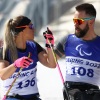
“It’s a home Games for me, and it would be the most full-circle moment to line up on the start line,” Masters says, but it’s not her only goal for the next season. “I obviously want to stand on the podium on a home course, but I [also] want to help make the sport of cycling or, just in general, para sport better.”
Masters co-founded the Sisters in Sports Foundation in 2020, which supports female athletes with disabilities through financial grants for training, travel and adaptive equipment, plus mental health resources and mentorship.

Masters pictured after winning one of her two gold medals in para-cycling at the 2024 Paralympics in Paris. She holds five summer medals and 19 winter medals.
Michael Steele/Getty Images Europe
hide caption
toggle caption
Michael Steele/Getty Images Europe
She has said she wishes she could have benefited from that kind of community and mentorship when she was younger, and is eager to be a resource for the next generation. The advice she gives them is largely the same as what she tells herself:
“Even with these gold medals, I’ll go into the next season doubting myself and not believing myself, because I’ve always kind of struggled with that as an athlete,” Masters says. “I think what I take away from this, going forward in the future and to LA and other endeavors of my life, [is] just to never count myself out. Just because you might not have the best approach and smooth process in the way you imagined doesn’t mean it’s determined right there and then, until you line up on the start line.”

I haven’t had access to a gym for three months—this is the 30-minute Pilates practice I’ve been relying on to keep me strong and injury-free

Movie Review: UNDERTONE – Assignment X

‘CBS Evening News’ Viewership Drops Below 4 Million After Tony Dokoupil’s Colorful Start

Video: Trump Says U.S. Doesn’t Need Help From U.S. Allies in Iran
Geopolitics may test the World Cup — a new book draws lessons from the past

Florida High School Football Rankings: Top 25 teams – Oct. 21

How old is Bo Nix? What to know about Oregon quarterback ahead of 2024 NFL Draft

Cleary's 21 help Le Moyne down Central Connecticut State 69-64 in OT

99th annual Pony Swim held in Virginia

Indiana Members Credit Union announced as new anchor tenant at Bottleworks District

Dem congressional candidate Bobby Pulido depicts lewd behavior in controversial music video for his song

Ukraine ‘informally’ opens all six clusters in EU membership bid

World Baseball Classic scores, results: Venezuela defeats Team USA to win first WBC title

Map: Small Earthquake Shakes Northern California

Mamdani references Palestinian ‘genocide’ during St Patrick’s Day event
-

 Oklahoma1 week ago
OSSAA unveils Class 6A-2A basketball state tournament brackets, schedule
-

 Oklahoma3 days ago
Family rallies around Oklahoma father after head-on crash
-

 Michigan1 week ago
Operation BBQ Relief helping with Southwest Michigan tornado recovery
-

 Nebraska5 days ago
Wildfire forces immediate evacuation order for Farnam residents
-

 Southeast1 week ago
‘90 Day Fiancé’ alum’s boyfriend on trial for attempted murder over wild ‘Boca Bash’ accusations
-

 Health1 week ago
Ancient herb known as ‘nature’s Valium’ touted for improving sleep and anxiety
-

 Connecticut1 week ago
Exclusive | Ex-CBS anchor Josh Elliott back on Connecticut dating scene after ugly Liz Cho split
-

 Georgia2 days ago
How ICE plans for a detention warehouse pushed a Georgia town to fight back | CNN Politics