Lifestyle
Turf is out. Native grasses are in. Here are 4 lush low-water options

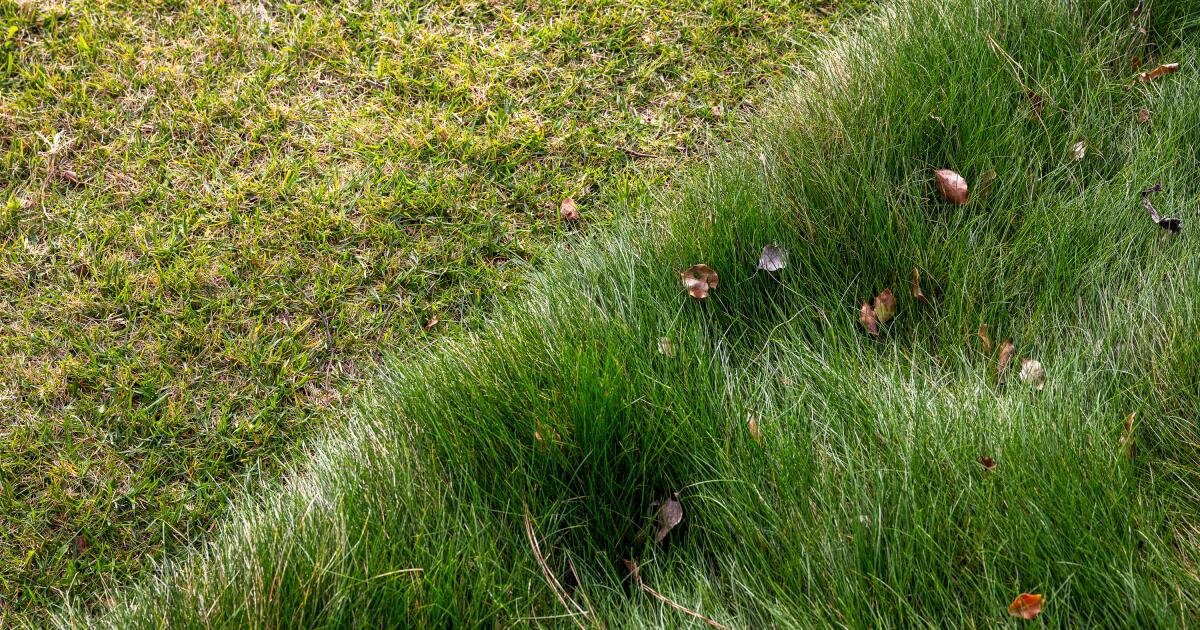
Tearing out your lawn can be a tough decision, especially if you have children or dogs who love to roll and play.
Or — no judgment here — maybe you just enjoy the visual serenity of a swath of green in a region where the hills go brown in the summer.
The good news is there are low-water, lushly green native lawn alternatives to tall fescue, the most popular water-guzzling king of turf grasses. But here’s the truth about these other options:
“There isn’t anything out there, native or exotic, that is going to stay green all year round in Southern California without some water,” said horticulturist Carol Bornstein, native plant guru and author of two definitive books about California landscaping, including “Reimagining the California Lawn.”
Christie Mahr casts a shadow across a patch of Kurapia groundcover in the backyard of her Ventura home.
(Michael Owen Baker / For The Times)
The trick is understanding that less is more when it comes to watering any lawn, native grasses or no, she said.
“There is no lawn in Southern California that needs water every day, even in a super hot, dry microclimate,” she said, “You want to wean your lawn off that kind of life support by watering less often and more deeply — basically water when it needs it.”
Unfortunately many lawn owners haven’t gotten this message, said Jim Blair, a turfgrass specialist who oversees UC Riverside’s Turfgrass Research program. Most people are still overwatering their traditional turf lawns with frequent short sessions that encourage shallow, easily dried-out roots. And when they change over to native grass lawns, they don’t change their watering patterns, Blair said, ending up with diseased or dead native lawns due to overwatering.
Native grasses usually require less water than traditional turf lawns because their roots grow much deeper — up to 10 feet deep in some cases — allowing them to find water stored in the ground and weather longer periods of drought.
They’ve also adapted by going dormant during certain parts of the year, like Bermuda, a warm-season grass, which does fine in hot summer months but turns brown during the winter.
For instance Blue grama (Bouteloua gracilis) is one of the native grasses Bornstein favors for lawns. It does go dormant in the winter, she said, “with a blond coloration which I think is quite beautiful. But trying to keep it green all year is challenging because too much water will kill them” by rotting the roots.
So that’s another lesson about native grasses — your expectations will have to change along with your irrigation techniques, because turf lawns and native grass lawns aren’t interchangeable, said Baird.
John Ellis’ yard features his lawn of native fescue grasses, and an agave ‘blue glow’ plant.
(Michael Owen Baker / For The Times)
John Ellis lays in his lawn, surrounded by three kinds of native fescue grasses.
(Michael Owen Baker / For The Times)
Traditional turf grasses like tall fescue and Bermuda were developed for two purposes — “to withstand persistent low mowing and regular traffic,” Baird said. If that’s what you want, Baird said there is a Bermuda hybrid on the market, developed in Georgia called TifTuf that has the same low-water needs as native grasses.
But if you’re sick of mowing (or paying someone else to do it), or you just want to reduce water use while creating habitat for local pollinators, birds and other creatures, then native grasses can give you the (mostly) green you crave with a lot less effort and expenses.
These will not be the flat carpet lawns of yore — although Kurapia lawns come close, at least from a distance. Native bent grass (Agrostis pallens) or native fescues like Festuca rubra grow in graceful mounding swirls and tufts that catch the light like glistening swells on a lake. They are beautiful to behold but not so easy to run through.
And unless you plant sod, which is available with some native grasses or grass mixes, it can take a while for the grasses to knit together into what we think of as a traditional lawn.
That’s one of many reasons you should consider reducing the dimensions of your old turf lawn when you decide to plant a new lawn with native grasses. Create planting beds in part of the old lawn area to grow food for your family and/or support pollinators, birds and other local wildlife by planting native trees, shrubs and flowers.
Good drainage is critical to maintaining the health of native lawns, said Briana Lyon of California Wild Gardens in Pasadena, an online-only nursery whose products include native grass lawns. Some native wetland grasses like California Meadow Barley (Hordeum brachyantherum ssp. californicum) can live for a short time in standing water, but these are best used to line bioswales where you want to clean rainwater running off from roofs or streets.
Most native grasses prefer dry conditions and full sun. Some, like the fescues, can do well in shade, but Lyon recommends prepping the soil by tilling the top soil 4 to 6 inches deep and adding a mixture of compost and a drainage medium like decomposed granite or sand to encourage good drainage, especially if the ground previously had standing water during heavy rains.
The Kurapia groundcover, juxtaposed with concrete, in the backyard of Ray and Christie Mahr’s home.
(Michael Owen Baker / For The Times)
A corner of John Ellis’ fescue grass lawn.
(Michael Owen Baker / For The Times)
You don’t want to add too many amendments like compost or worm castings, however. “You don’t want to discourage the roots from doing a deep exploration by staying with the yummy stuff on top,” she said.
Weeds are also a problem, especially when the native grasses are trying to get established. Kurapia and some of the grasses can eventually grow dense enough to crowd out most weeds, as long as the weeds don’t get a foothold and crowd the natives out first, so expect to do some regular weed patrols the first year to keep unwanted plants away.
Finally, understand that the type of native grass you choose really depends on how you plan to use the space. If you want a relatively flat, easy-care space where pets and children can frolic then Kurapia may be your best choice. But if your biggest interest is creating an ornamental lawn that’s a feast for the eyes, then look towards the sculptural, undulating bent grasses or fescues.
Here’s a list of some of the more popular native grasses to consider, with this note too: Some of these grasses are native to other parts of North America too, or even other countries, in addition to California, so if in doubt, check the botanical names, consult with guides like Bornstein’s books or talk to native plant experts at the Theodore Payne Foundation, Tree of Life Nursery, the California Botanic Garden in Claremont or the Santa Barbara Botanic Garden.
A close up view of Kurapia groundcover at Christie and Ray Mahr’s Ventura home.
(Michael Owen Baker / For The Times)
1. Kurapia
People use lots of exclamation points when they talk about Kurapia, which, for the record, isn’t a grass at all. It’s a sterile patented hybrid of a native broadleaf groundcover from the verbena family commonly known as frog fruit or lippia (Phyla nodiflora), named after the Japanese hybridizer, Utsunomiya University professor Hitoshi Kuramochi, and the origin plant, lippia. Robert Sjoquist of Soils Solutions in Ventura can’t sing its praises high enough. Sjoquist is a distributor who sells native grasses all over Southern California, but Kurapia is one of his favorites, he said, because it spreads like a carpet with pretty clover-like flowers, requires almost no water or maintenance to stay beautifully green, quickly stabilizes hillsides and slopes and helps prevent wildfire damage by snuffing out embers as they fall.
It also spreads quickly and is relatively easy to propagate, which is why the breeder, Kurapia Inc., carefully guards its latest strains, Kurapia New White and Kurapia Pink (named for the color of its flowers). These new strains can only be purchased online, through the company, said senior manager Lawrence Ziese. They’re only available in plug form now, although the company hopes to have a sod version available soon. A flat of 72 plugs, which covers roughly 97 square feet, costs $173 for the “new white” color and $187 for the pink.
Ziese said the new versions grow more densely than the company’s first offering, known as Kurapia S1, which is grown in 2-by-5-foot sod sections by Delta Bluegrass in Stockton and delivered by truck. (West Coast Turf of Palm Desert also sells Kurapia S1 sod, but is currently out of stock.) Sod is more expensive — about $315 to $340 to cover roughly 100 square feet — but you also get an established lawn in less than half the time, said Sjoquist.
Christie and Ray Mahr stand with their dogs Maggie, front, and Colt on the Kurapia groundcover in their backyard.
(Michael Owen Baker / For The Times)
“It looks so good it almost looks like fake grass because of how uniform and low growing it is,” said Lyon. It thrives in poor soils, even sand and salty soils, as long as it has good drainage, she said. It’s important to keep it weeded in the beginning, until it becomes established.
Christie and Ray Mahr of Ventura say they and their dogs love the 3-year-old Kurapia lawn in their backyard. They planted the lawn themselves from plugs — a job that took just a couple hours, Christie said — and it took some maintenance the first few months to keep weeds from resprouting. But she and Ray say that’s nothing compared to the work that went in to mowing and watering the Marathon turf lawn they had before. Now they rarely water the lawn. It seems to get enough water from the drip lines for trees and other plants.
They use hand clippers to keep tendrils from growing beyond the lawn boundaries and Ray mows just once or twice a year to remove the flowers that come in the spring to early summer. “They most definitely brings bees to your garden,” Christie said. “I won’t even come out here and walk unless I’ve got tennis shoes on because otherwise you know you’re going to step on a bee or a butterfly.”
Lippia, used as an alternative to traditional lawn, in Redlands.
(Brian Chau)
2. Frog fruit, a.k.a. lippia (Phyla nodiflora)
The parent of Kurapia is endemic to California and many other parts of the world, including Texas and the southeastern coast of the United States. Like Kurapia, it needs very little water and thrives in heat. Southern California landscape designers looked into lippia as a lawn replacement in the 1970s, Lyon said, but quickly abandoned the idea “because it seeded so aggressively,” spreading into neighboring yards or planting areas where it wasn’t wanted.
But Brian Chau of Redlands said he hasn’t really seen that problem in his front yard. Chau usually blogs about fishing, but he created a YouTube video to show off his lush lippia lawn, which he planted in 2021. He first tore out his traditional lawn and planted yarrow, which didn’t do very well, so he tilled the yard again, removing the yarrow (which still sprouts up now and again) and planted lippia. Chau said he chose lippia rather than Kurapia because it was a “fraction of the cost” to purchase — $15 for a flat of roughly 50 plugs at the time, versus around $60 for Kurapia, he said.
He buried a drip irrigation system in his yard, which he doesn’t use at all during the cooler months, and turns on for just a few minutes two or three times a week during the hottest part of summer to keep his lawn watered. “It’s just a burst of water during those times, but now I’m trying to do it just once a week for a longer period, just to experiment.”
The lawn grows more leggy and less vigorously in shady parts of his yard, and like Kurapia, its flowers are a huge draw for bees and other pollinators, Chau said. “So if you’re allergic or terrified of bees, this lawn isn’t for you, but if you don’t mind bees, the lippia is great for attracting pollinators to our fruit trees and native plants.”
Chau said his son plays on the lawn regularly. “He runs around and beats the lawn down, but it doesn’t complain too much,” he said. “It always bounces back, but it would be detrimental to have an animal rooting around in it.” He uses hand clippers to trim back the plants trying to grow outside the lawn borders, and replants those cuttings to fill in areas that are looking thin. The cuttings “root very easily in water or moist soil,” he said, “so I don’t have to buy flats anymore.”
Native bent grass at the Carpenteria Seaside Park.
(Jeanette Marantos / Los Angeles Times)
3. Native bent grass (Agrostis pallens)
If you love the look of a wild meadow-like lawn, native bent grass is a beautiful and fairly durable choice. Lyon said bent grass makes one of the most pet and kid friendly native grass lawns.
The city of Carpenteria planted a bent grass lawn from seed when it created Seaside Park near the library in 2014, and it’s been a handsome, easy-care choice that requires little water, said Tiffany Smith, the city’s parks and facilities maintenance supervisor.
“We mow it probably every three months at the most, so three or four times a year, and the water savings are huge. We water with regular lawn sprinklers once a week in the summer for 20 minutes or so, just enough to get the water down 2 inches,” she said. “And we’ve had almost no weeds. Every once in a while a broad leaf weed comes up and we just pull it. … We love it.”
She said they mow the lawn down to about 3 inches tall, but it grows back quickly into luxuriant waves.
Carpenteria rarely sees summer temperatures much higher than 90, but in the hottest months the lawn never seems stressed — even after people have been sitting in it. It only gets light foot traffic, Smith said, but the city is so pleased with its performance after 10 years that it’s considering whether to remove the turf lawn around the library and replant with bent grass to create a uniform look.
“I bet we could easily cut our water use by two thirds,” she said.
Three native fescue grasses create a lush green meadow effect in the front yard of John Ellis’ Westlake Village home.
(Michael Owen Baker / For The Times)
4. Native fescues (Festucas)
If you want a lush, light-catching lawn to gaze upon, native fescues are one of your best bets, especially in a shady area, said Lyon.
Delta Bluegrass makes a mow-free sod mix of three native fescues — Idaho fescue (Festuca idahoensis), Molate fescue (Festuca rubra) and Western Mokelumne fescue (Festuca occidentalis) that requires very little care, said John Ellis, who replaced the 1,000-square-foot turf lawn outside his Westlake Village home with mow-free fescues in December 2022.
His children are grown and no pets play on the lawn out front, so it doesn’t get much traffic, Ellis said, “but I will tell you that every kid or dog that comes by rolls around the grass. They touch it and they’re walking in it.”
Too much traffic isn’t great for the fescues, however, said Lyon, because the fescues are probably the least drought tolerant of the native grasses, and incompatible with pets. “It kills patches of the lawn if a dog pees on it.”
But if you’re looking for sculptural beauty, this is the lawn for you. Ellis figures his irrigation costs have dropped by 60%, even in his area near Thousand Oaks where temperatures can easily hover around 100 degrees during the summer. He bought the sod through Soils Solutions and hired Robert Olsen of Goldenstate Landscapes in Camarillo to remove the old lawn and install a copper-lined drip irrigation system on a smart system that adjusts watering based on moisture in the ground. All told, he figures he spent $9,000 on the project, and is delighted with the results.
John Ellis’ lawn of native fescue grass, left, by his neighbor’s lawn, right.
(Michael Owen Baker / For The Times)
His biggest comment from neighbors is wondering if he plans to mow his lawn, Ellis said, but he likes the look of the grass flopping over. His work included installing a 12-inch barrier between his yard and his neighbor’s to ensure his grasses didn’t mingle with theirs, but the difference in color is startling. His neighbors’ lawns are both green and thick, but they look pale in comparison to his deep green growth.
Ellis said he’s had some issues with tendrils of his old Bermuda grass trying to grow through. But most weeds have been smothered, and he’s been able to pull out any Bermuda grasses he finds. “You have to stay on top of it,” he said, “but so far this has been the best choice for us.”


A tarp covers the facade of the John F. Kennedy Memorial Center for the Performing Arts in Washington, D.C., on June 13. A federal judge has asked the arts complex’s leadership to explain the purpose of the tarp and the surrounding scaffolding.
Alex Wroblewski/AFP via Getty Images
hide caption
toggle caption
Alex Wroblewski/AFP via Getty Images
On Wednesday, the federal judge overseeing the Kennedy Center lawsuit ordered the center to give him a status report on the center’s operation and programming within the next few weeks. Judge Christopher R. Cooper also said that the Kennedy Center must explain the purpose and status of the tarp and scaffolding that have been placed over the front of the arts complex, where until recently both President Trump and President John F. Kennedy’s names were both displayed.
In a directive issued last Tuesday, Judge Cooper had given Kennedy Center administrators three days to update him on the arts complex’s immediate plans regarding construction, programming and public access. Trump, who now serves as the center’s chairman, had announced July 5 as the date the venue would close for major renovations.

Last Friday, on Cooper’s due date, lawyers for the Kennedy Center filed a request asking for an extension. In that filing, Matt Floca, who was promoted as the center’s president and CEO in March, said that the Kennedy Center’s current management intends to present its board with “an array of options” for trustees to vote on at their next meeting on an unspecified date in mid-July.
According to Floca, the options are a complete closure for extensive renovations; a partial closure “enabling some continued public access and limited programming” while some renovations are undertaken; and “a highly limited series of phased closures to address only the center’s most serious infrastructure needs while scheduling and maintaining a full slate of programming.”
In his newest order, Cooper denied Floca’s request for an extension. And he mandated that the center file a status report within seven days of the center’s July board meeting or by July 31, whichever date is earliest. He also ruled that the report must “indicate the purpose for and status of the tarp and scaffolding,” which were erected by workers over the center’s front signage in the early morning hours of June 13.
When asked for comment Wednesday, the Kennedy Center pointed back to the documents its legal team submitted to the court.
The tarp and scaffolding on the center’s front portico went up after the Kennedy Center’s administration slow-walked the court-mandated removal of President Trump’s name from the front of the center and from all digital materials, which was supposed to happen no later than June 12. Workers removed the lettering overnight into the following morning, hours after the federal court’s original deadline, and covered the center’s sign with a tarpaulin.
As of Monday, the sign remains hidden from the public.

Trump’s name was scrubbed from all of the Kennedy Center’s digital content on June 4, the same day an email order to do so was issued by the complex’s legal team; NPR obtained this memo the day it was sent out to Kennedy Center staff.
These court orders are part of the ongoing lawsuit filed by Rep. Joyce Beatty, D-Ohio, against President Trump and the board of the Kennedy Center. Earlier this year, Cooper ruled that Beatty, an ex-officio member of the Kennedy Center board, must be allowed to participate in board meetings. NPR has asked Beatty if she plans to vote at the July board meeting, but did not receive an immediate response.
It would be very difficult for the Kennedy Center to revive a thriving programming lineup for the months ahead. Over the past year, many prominent artists canceled their planned appearances, citing the politicization of the venue. Most of the center’s programming staff have departed, either via layoffs or resignations. Unlike top administrators at other major performing arts venues around the country, Matt Floca has no experience in artistic direction, fundraising or arts administration; formerly, he was the center’s head of facilities, and he holds a bachelor’s degree in construction management.
Established artists who typically perform at the Kennedy Center generally have their touring schedules set at least a year in advance, if not multiple years ahead. In years past, the center has publicly announced its upcoming season in mid-spring for performances beginning in September and running through the following summer.

Currently, only a handful of outdoor free movie screenings of nostalgic favorites like The Princess Diaries and Clue appear on the center’s calendar of events, along with some participatory workshops for kids. In the past, the Kennedy Center presented over 2,000 arts and education events each year.
The center also recently became ensnarled in litigation with one of its longtime tenants and artistic partners. On June 12, the Washington National Opera, a company formerly in residence at the Kennedy Center, sued the complex for $17 million. It claims that the Kennedy Center had withheld “years’ worth of donor gifts, bequests and endowment funds” that had been intended specifically for the WNO.

Denis Novikov/Getty Images
I tend to romanticize summer. The movies and TV shows I grew up with made me think that the season was about adventure and big-time transformation.
I imagined myself building a tight-knit friend group and getting out of a pickle together, like in The Sandlot or Camp Nowhere. Or traveling across the world, say, to Greece, like Lena Kaligaris, a character in The Sisterhood of the Traveling Pants, having a whirlwind summer romance and returning an entirely different person.
I’ve never actually had a summer like that.
Even when your expectations are more modest than mine, “so often, the summer just flies by, and we haven’t taken the picnics or gone for the day trip or whatever it was that we thought we were gonna do,” says happiness expert Gretchen Rubin.
Rubin, author of The Happiness Project and host of the podcast Happier With Gretchen Rubin, has been sharing ideas on social media about how to make the season more memorable and satisfying.
She walks through four exercises to help you get what you want — and more — out of the season. Print out our worksheet here, fill it out and stick it on your fridge to keep you accountable. Or take a screenshot and post it to Instagram (don’t forget to tag @NPRLifeKit!).
🍑 Give your summer a theme
Pick a single word or phrase that you want to embrace this season — something that captures the feeling you want to have over the next few months.
“My theme for the summer is ‘ketchup,’” Rubin says. “It has a kind of a summer feeling, because you think of putting ketchup on your burger.”
“It’s a metaphor,” she says. It means to look for “whatever I could add [this season] to make something elevated and more fun.”
Meanwhile, my theme word this summer is “juice.” I no longer think that I need to travel far or completely transform to have a delicious summer. I just need to take advantage of the abundance that the season offers: ripe peaches and tomatoes, juicy softball pitches and the opportunity to feel juicy in my body when I wear a bathing suit.

Print out our worksheet here, fill it out and stick it on your fridge to keep you accountable. Or take a screenshot and post it to Instagram (don’t forget to tag @NPRLifeKit!).
Malaka Gharib/NPR
hide caption
toggle caption
Malaka Gharib/NPR
🪣 Create a summer bucket list
What do you want to do this summer? On my bucket list: ride the Ferris wheel at a summer fair, have more barbecues at my parents’ house and see the sunrise at least once.
There might even be something you don’t necessarily want to do but have been trying to accomplish for a long time — like cleaning out the garage or learning how to swim.
“Some people love a long list with a lot of easy things to cross off,” Rubin says. “I’m a fan of that approach myself.”
But some people like a list with fewer goals that are more ambitious. If you take this path, just make those items realistic, she says. “It’s easy to get discouraged if you set the bar too high.”
🏁 Set a fun challenge
It could be fun to gamify a few of the items on your bucket list — or to come up with an entirely different kind of dare for yourself.
You might try 10 new taco joints this summer or read five romance novels. Or you might come up with a theme, like “Freaky Flavor Friday,” Rubin says. Every Friday, you go to a different ice cream shop and try a new and ambitious flavor.
A good challenge can make your summer feel more memorable, she says. “If you did ‘Freaky Flavor Friday’ all summer long, that would stand out in your mind. Years later, you’d be like, ‘That’s the summer I discovered creamed corn ice cream.’”
Two challenges I’m considering: taking a swim class and rewatching all the best Pixar movies.
🖼️ Take a “five-senses portrait”
Experience the summer through your five senses — then reflect on each one. What does summer look like, smell like, taste like, sound like and feel like?
“It’s one thing to look at photographs, but that’s very flat,” Rubin says. “A ‘five-senses portrait’ puts you back into that experience. It’s a creative, fun way to look back on summer and capture the memories that you’ve created.”
Do this exercise either for your whole summer or for a specific summer adventure, she says. Do it with yourself or with a group. You can journal about it, make a collage, draw a picture or simply have a conversation.
When I think of summer, here’s what comes to mind: the smell of smoke from a crackling outdoor fire and the taste of toasted marshmallows on a stick.
More summer-worthy goals from Life Kit
Learn how to swim. Knowing how to swim can help you have fun at the pool or beach this summer. But it could also save your life. Here are some tips to start swimming at any age.
Focus on rest and relaxation. In Dr. Saundra Dalton-Smith’s book Sacred Rest, she outlines different kinds of rest you may be craving. From the mental to the physical, Dalton-Smith shares how to identify what kind of respite you need and how to embrace rest.
Get into running. Ready to kick-start a new running habit? Coach Martinus Evans breaks down a common misconception to get you into the mindset and offers quick tips on pace, form and more.
Declutter your home. Got piles of stuff you just can’t seem to get rid of? Professional organizer Star Hansen explains how to let go of unnecessary items and keep your home neat and tidy.
This episode was produced by Clare Marie Schneider. The story was edited by Meghan Keane. The visual editor is CJ Riculan. We’d love to hear from you. Leave us a voicemail at 202-216-9823, or email us at LifeKit@npr.org.
Listen to Life Kit on Apple Podcasts and Spotify, and sign up for our newsletter. Follow us on Instagram: @nprlifekit.

Night is falling in Altadena as bats circle, peacocks wail and photographer Kevin Cooley tries to capture what’s left of a tree.
Using strobes and a long exposure time to allow the maximum amount of available light to hit his lens, Cooley snags about 50 shots of the 20-foot-tall tree, which stands vigil over a street where nearly all the homes burned. The tree’s limbs were lopped off in the wake of January 2025’s Eaton fire, which ravaged Altadena and part of Pasadena, but all these months after the fire, there’s new growth on the tree.
Photographer Kevin Cooley sets up a camera to take photos for his series.
(Jason Armond / Los Angeles Times)
Little tufts of green leaves have emerged from the raw cuts where the burned branches once were, proving the tree to be more resilient than its otherwise relatively stark exterior might suggest.
A fine art and news photographer for decades, Cooley, 51, is using pictures like the one he snapped of the tree as part of his new project, “In the Gardens of Eaton.” A collection of 6,000 photos and counting that Cooley has taken around Altadena on wild lots where homes once stood, “In the Gardens of Eaton” aims to capture bits of natural beauty that have endured despite the ravages of the fire and its aftermath.
Cooley has lived in Altadena since 2000 and he knew his neighbors well. He started working on the photo project several months after losing his home in the fire. He’d enlisted a group called Samaritan’s Purse to come up to his lot, where he’d found a metal flat file he’d used to store his photographic prints. Cooley was hopeful some had survived, but when the group popped it open, he says it quickly became clear that the burning metal had acted somewhat like an oven, burning almost everything inside to a charred crisp.

A ponytail palm on Athens Street photographed for Kevin Cooley’s “In the Gardens of Eaton.”
(Kevin Cooley)
One piece Cooley could identify, though, was a 2020 copy of Wired magazine for which he’d shot the cover. It featured a swirling plume of smoke, accompanying the story “The West’s Infernos Are Melting Our Sense of How Fire Works,” and the irony wasn’t lost on him.
“You could still kind of make out the word Wired across the top of the masthead and something about that just blew me away,” Cooley says. “It’s as if the whole thing had come full circle. I immediately wanted to photograph it in the same way I had originally photographed the smoke, which was in a studio with lighting, and I guess that made something click for me. I started feeling like there was a way to make something positive after the fire, and that’s when I started spending more time back in Altadena.”
Driving around town, looking at the lots and the wreckage, Cooley says he started to notice the bits of nature that were trying to persevere. He spotted a begonia poking through a burned fence on his neighbor’s property and snapped a photo, and soon he was accumulating more and more similar images. Cooley says if you’d told him before the fire he’d be taking so many pictures of flowers, he’d have scoffed, but now images like one he captured recently of a group of blooming roses in front of a cluster of dead vines remind him that perseverance is possible no matter the odds.

Cooley stands in front of some of his photos on display in a gallery in Culver City.
(Jason Armond / Los Angeles Times)
“It’s inspiring what nature is doing up there,” Cooley says. “We live in this environment where fire is very much part of the ecology, but people’s gardens are also pushing through. Nonnative species and native species are both there. And people are planting more wildflowers, and it feels cathartic. It’s making me excited to rebuild too, because I really can’t wait to get back.”
Letizia Ragusa, an Altadena resident who lost her home, says Cooley shot her flower-filled lot without her even knowing it. Before the fire, her yard was a wonderland of 16 fruit trees, a koi pond and both a vegetable and an herb garden. All of that was lost in the blaze. As a method of coping and of shoring up the land, Ragusa enlisted a Sierra Madre company called Hardy Californians to plant a remediation seed mix across her lot.

El Molino geraniums captured for Cooley’s “In the Gardens of Eaton.”
(Kevin Cooley)
Seeing the native plants and flowers begin to pop up on her lot was important, Ragusa says. She’s been living in a rental with her family since the fire, and there’s no yard or room for a garden.
“It’s just really comforting to me to have some sense of control when everything else feels so out of control right now,” Ragusa says. “At least I have this little piece of land that I can plant things on and I know it’s what’s going to happen. It’s very predictable, and I also think it makes other people happy. I see people driving and walking by that stop to look at it. And our neighbors have all commented on it too, so that’s nice.”
The pictures Cooley took on Ragusa’s property were of rows of pink and purple native flowers and sunflowers set amid city lights and a dreamy sunset. Ragusa says they’re surreal and beautiful.
“It’s outdoor photography, but with a studio element,” she says, noting that she’s especially open to Cooley’s process because she’s an artist herself, previously producing ceramics and sculpture from a home studio that she also lost.

Cooley works sets up lights for a recent photo shoot.
(Jason Armond / Los Angeles Times)
While the initial photos Cooley took of her yard were from the street and her driveway, she’s since given him permission to go deeper into her lot. It’s something Cooley says is important to him because he knows firsthand that a lot of people’s lots are what he calls “hallowed ground.”
Most of the pictures Cooley has taken so far have been from a distance, though he has set up his equipment near the end of people’s driveways to get a good photo. As word of Cooley’s project has gotten around Altadena — with one resident posting a photo of him on their lot captured via trail cam to a local Facebook group, looking for more information — more and more people have expressed an openness to having him come shoot their gardens.

Honeysuckle on Via Maderas captured for “In the Gardens of Eaton.”
(Kevin Cooley)
Cooley has created a Google Form for interested residents to use and he keeps a spreadsheet of the responses in a clipboard on his car’s dashboard. When he’s at a loss for what to shoot next, he’ll glance at it, mentally mapping out addresses in his mind and looking at resident-submitted descriptions of their lots, which include phrases like “We don’t have much left, but we saved our banana plant” and “[Our house] made me into the gardener I am and I adorned her in plants.”
Cooley says he intends to shoot photos for all the owners who have responded to his Google Form, hoping to gift them prints when the project is complete. Starting in July, he’s headed to Portugal for a six-month art fellowship, but says he plans to continue the photo project later. Cooley would also like to produce an art book of his favorite photos from the project.
He’s also aware that, in some respects, he’s up against a time limit in terms of what he can shoot. He says he spent the beginning part of the project “rushing against the Army Corps” as they were clearing lots, and now he’s trying to photograph rough-and-tumble lots full of nature before their owners level them and start to rebuild.

Calaveras roses photographed for “In the Gardens of Eaton.”
(Kevin Cooley)
Sometimes, Cooley says, he had to shoot on lots where he hadn’t known the owner. When he started the project, he made an effort to track down who lived on the property before he set up his camera, but the process was surprisingly arduous and he’d often lose his intended shot as flowers or plants died or changed shape.
“It wasn’t practical,” Cooley says. “It’s not that I didn’t want to, but I just couldn’t figure it out. I will eventually, though, and then I’ll be able to present people with a photograph when they’re back in their new homes.
“I just think Altadena is a special place,” he says on a spring day. “Six months ago, it was so depressing to come up here, but now it’s not. It’s still emotional, of course, but seeing all the rebuilding, it’s clear that people see value in being here, even now. When all this is done, if Altadena is even 50% or 75% as special as it was before, it’ll still be great.”
-
 Business37 seconds ago
An electric truck for less than $25,000? Deliveries begin this year
-
 Entertainment8 minutes ago
Kylie Jenner hit with third lawsuit as former chef claims Palm Springs party led to miscarriage
-
 Politics16 minutes ago
Trump refuses to sign landmark housing bill, demanding Congress pass voter ID law
-
 Sports26 minutes ago
Mexico celebrates magical World Cup win over Czechia at rowdy Azteca Stadium
-

 World38 minutes ago
Venezuela rocked by 7.5 and 7.2 earthquakes: What we know
-
 News1 hour ago
With a Round of 32 spot already clinched, the U.S. takes on Turkey in the World Cup
-

 Los Angeles, Ca2 hours ago
Hospital needs help identifying man found unconscious in downtown Los Angeles
-

 Detroit, MI3 hours ago
Large police presence for an investigation on Detroit’s west side

