Lifestyle
Trump’s name must come off of the Kennedy Center, judge rules


Julia Demaree Nikhinson/AP
A federal judge has blocked President Trump from adding his name to the Kennedy Center, saying that the Washington, D.C. arts complex was named for the late president John F. Kennedy. In a ruling on Friday, the judge also temporarily blocked the administration from closing the Kennedy Center for a planned two-year renovation that was slated to begin in July.
U.S. District Court Judge Christopher Cooper wrote in his ruling that: “The Kennedy Center’s organic statute makes crystal clear that the Center is to be named for President Kennedy, and it cannot bear any other formal name or public memorial based on the Board’s unilateral say-so. Congress gave the Kennedy Center its name, and only Congress can change it.”
A Kennedy Center spokesperson told NPR in an email Friday afternoon that it will appeal the decision. Roma Daravi, vice president of public relations for the complex, wrote: “We will review the decision carefully though the reality remains — the Center requires an urgent and significant restoration – a truth that even the plaintiff acknowledges. With $257 million secured by President Trump and approved by Congress, the resources are in place and we remain committed to pursuing every lawful avenue to ensure the Trump Kennedy Center is restored as a national cultural landmark for all Americans to enjoy.”
NPR has requested comment from the White House, but did not receive an immediate reply.

As part of his ruling, Judge Cooper ordered that all signage and online materials referring to the “Donald J. Trump and John F. Kennedy Memorial Center for the Performing Arts,” the “Trump Kennedy Center,” or anything similar must be removed within 14 days.
The judge also blocked, for now, plans to close the Kennedy Center for two years of renovations. Trump and the center’s current voting board members – all of whom were selected by the president, who also became chairman of the center last year – had planned to start the renovations in early July, just after the 250th anniversary celebrations. In his 94-page ruling, Judge Cooper called the renovation plans “murky,” and wrote: “None of the board members had sufficient information in advance of the March 16 meeting to make a well-considered decision to close the center.” The center has been winding down its programming and has already dismissed most of its programming staff.
Referring to a Truth Social post written by President Trump in February, the judge also wrote: “There was no ‘one year review of the Trump Kennedy Center, that has taken place with Contractors, Musical Experts, Art Institutions, and other Advisors and Consultants, deciding between’ complete and partial closure, as President Trump claimed.”
Cooper’s ruling resulted from a lawsuit filed in March by Rep. Joyce Beatty of Ohio, an ex-officio member of the Kennedy Center board whose voting rights there were stripped last year.
The ruling does not prevent the Kennedy Center’s board from a future closure, but the judge said that it should do so only after the board has “sufficient information to make a considered, independent decision, taking account of its obligation to both maintain and operate a premiere arts venue and its solemn duty to memorialize a fallen President.”


My favorite memory of the 2026 World Cup happened last month. By the late morning of June 18 in Koreatown, hours ahead of the Mexico vs. South Korea group-stage match, it was apparent that the neighborhood would be unrecognizable by kickoff.
I had heard rumblings about the Korean Festival Foundation’s watch party, but once I found out it would take place at Seoul International Park, I was almost dissuaded entirely. Although it is the beloved destination of my dog’s morning walks, its insignificant size and awkward location just off Olympic Boulevard didn’t seem appropriate for such a coveted event. So, I went to scout it out beforehand — and I almost couldn’t believe my eyes. There were already about 100 to 200 fans in the park, about six hours before the first whistle; laughing, drinking, lending a hand to vendor setups.
My apartment is only about six-odd blocks from the park, but closer to the game, I noticed a gigantic wave of red, lavender and white jerseys already crashing toward the watch party. It took my roommates and me about 30 minutes to walk the half-mile at 4 p.m., squeezing past fervent fans to eke out a spot in front of one of the two humongous screens situated on either side of Irolo Street.
Unfortunately for us, all of the good vantage points were taken. A mass in front of both screens was impenetrable; smaller televisions hooked up to generators were already seized by 10 too many eyes; even the roofs surrounding the park were full of attendees much bolder and athletic than me. We settled on the soccer field in the park, where we could juggle a ball around a bit while watching the match on our phones (and thank you to my girlfriend’s dad for his Peacock subscription).
The first half onscreen was mostly uneventful, but off-screen, I was able to witness a sort of camaraderie seen rarely in sprawling Los Angeles. People were swarming vendors from eateries all around Koreatown, dance circles formed around speakers blasting banda music, and “oohs” and “ahhs” at every missed shot were in perfect sync. Then, it happened: a goal in the 50th minute by Luis Romo of the Mexican side. The park and its surroundings exploded into a collective cheer that tickled my rib cage and resonated deep in my ear canal to the point I had to cover my ears. I can hardly remember if I joined the chorus, or if the excitement was so heavy that I just felt like an equal part of it.
Seeing my neighborhood in this light will stick with me much longer than the 1-0 result, or the fact that neither of these teams (both of which I partially rooted for) made it far into the tournament. But these memories, I believe, are what the World Cup is really about.
So tell us about your most cherished memory of the 2026 World Cup in L.A. so far. And remember, no moment is too small. We may feature it in an upcoming story.
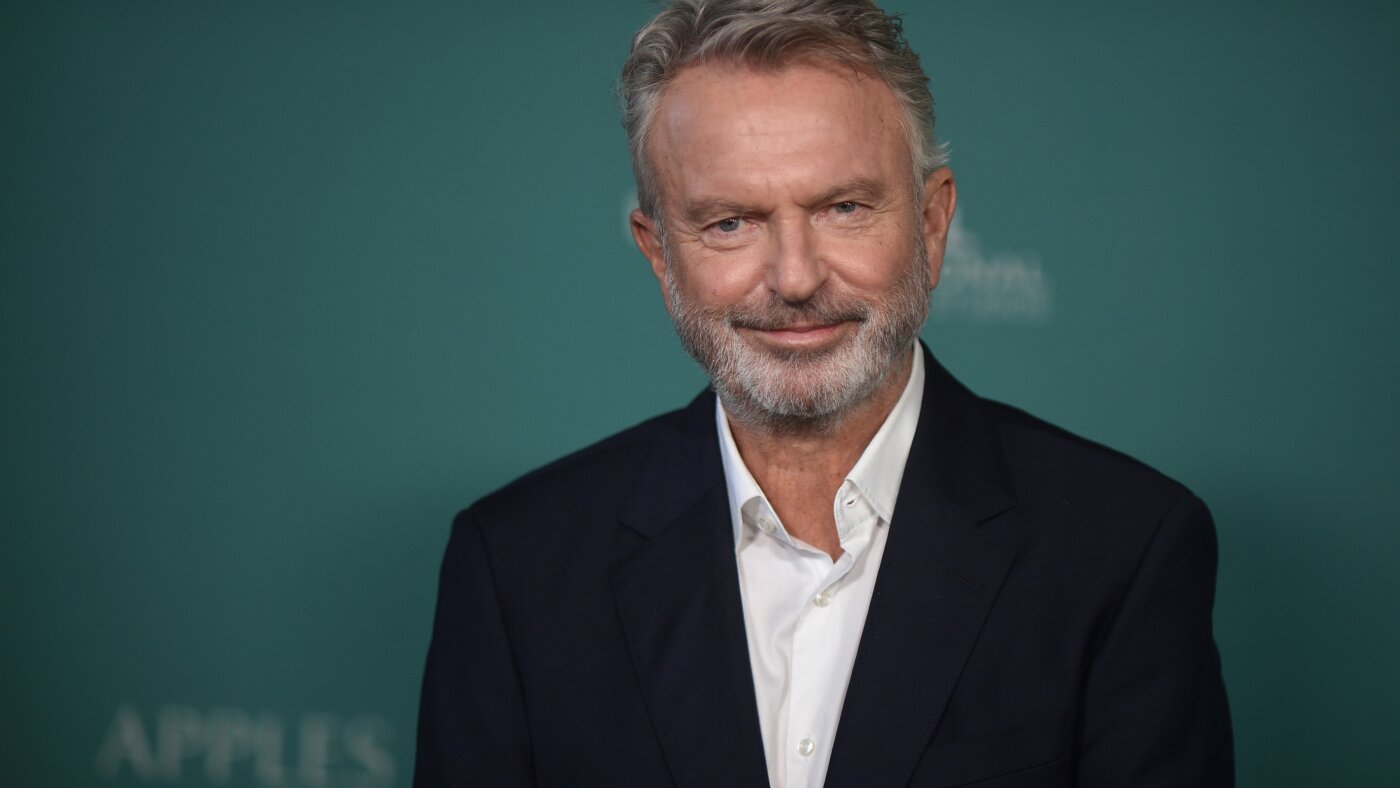
Sam Neill arrives at the premiere of “Apples Never Fall” on March 12, 2024, in Los Angeles.
Richard Shotwell/AP Photo/Invision
hide caption
toggle caption
Richard Shotwell/AP Photo/Invision
WELLINGTON, New Zealand — Sam Neill, a smoothly elegant and versatile actor whose career moved from art film to blockbuster as he dodged velociraptors in “Jurassic Park” to playing Holly Hunter’s husband in “The Piano,” has died. He was 78.
In 2023, Neill disclosed he had been diagnosed with angioimmunoblastic T-cell lymphoma, a rare type of non-Hodgkin lymphoma. Neill died on Monday in Sydney, according to a statement posted to the actor’s social media page.
His death was “sudden and unexpected,” the statement said, adding that he “remained cancer free” when he died. A cause of death wasn’t specified.
“Sam was surrounded by family and passed with the dignity that has characterised his whole life,” his family wrote.
Actor came to world’s notice with ‘Dead Calm’ and ‘My Brilliant Career’
Neill was one of a host of actors and directors who achieved international fame after an explosion of Australian films that began in the late 1970s, a list that includes Paul Hogan, Mel Gibson, Geoffrey Rush, Russell Crowe, Jane Campion, Peter Weir and Gillian Armstrong. His range was remarkable, playing opposite Helena Bonham Carter in the Alan Ayckbourn comedy “Sweet Revenge” to chopping off Hunter’s finger in “The Piano” to poking his own eyes out in the sci-fi horror “Event Horizon.”
In “Omen III: The Final Conflict,” he played Damien the Antichrist and he also played Cardinal Thomas Wolsey in “The Tudors.”
The actor first came to the attention of international audiences in Armstrong’s 1979 film “My Brilliant Career,” which also introduced Judy Davis. He later appeared in Phillip Noyce’s “Dead Calm,” a classy thriller set at sea and co-starring the then-relatively unknown Nicole Kidman.
Neill twice co-starred with Meryl Streep, in Australian director Fred Schepisi’s “Plenty” and — again for Schepisi — in “A Cry in the Dark,” a film about the sensationalized aftermath of a dingo killing a baby in the Australian Outback. He earned an Emmy nomination for his performance in the title role of the 1998 miniseries “Merlin” and another as narrator of 2017’s “Wild New Zealand.”
‘Jurassic Park’ was his best-known film
Perhaps Neill achieved his highest level of fame in “Jurassic Park” playing paleontologist Alan Grant, who is summoned to an island off Costa Rica where a theme park has been built to house herds of cloned dinosaurs. He co-starred alongside Laura Dern, Jeff Goldblum and Richard Attenborough.
His character was thoughtful and reasonable, a scientist who warned the mastermind of the theme park before the chaos: “Dinosaurs and man, two species separated by 65 million years of evolution have just been suddenly thrown back into the mix together. How can we possibly have the slightest idea what to expect?”
Grant survived the harrowing events when the creatures get loose, but didn’t return for “The Lost World: Jurassic Park II” in 1997. He came back for the third episode in 2001 and “Jurassic World: Dominion” in 2022.
“It’s probably a little late to learn these things,” he told the Daily New of New York in 2001, “but I finally feel I’ve worked out how to be an action hero. I’m happier with Grant this time. He’s gnarly and grizzled, but he looks like he knows what he’s doing.”
Neill grew up in Northern Ireland, then New Zealand
Born in 1947 in Northern Ireland, Neill emigrated to New Zealand at the age of 7. He was born Nigel Neill, but told interviewers he started to go by Sam because there were too many Nigels at his school.
His family settled in Dunedin on the South Island and he was sent to boarding school in Christchurch. After college, he took the lead in “Sleeping Dogs” in 1977, the first feature made in New Zealand in more than a decade.
Neill’s other film roles included playing a Soviet submarine officer who memorably dreams of a home in Montana in “The Hunt for Red October” and an investigator in director John Carpenter’s “In the Mouth of Madness.”
On the small screen, Neill played the malign Chester Campbell in TV’s “Peaky Blinders” and Thomas Jefferson in the four-hour CBS miniseries, “Sally Hemings: an American Tragedy.” On Apple TV+, he was on “Invasion,” playing Oklahoma Sheriff John Bell Tyson, a man late in his career searching for his purpose. In 2024 he starred opposite Annette Bening in the Peacock series “Apples Never Fall.”
Actor beloved in New Zealand as an unassuming celebrity
The actor became known in New Zealand as a modest and unassuming person who didn’t embrace celebrity. On social media, he often posted images of his farm animals, many of them affectionately named after celebrities and friends, like Laura Dern the chicken, Kylie Minogue the duck and Helena Bonham Carter the cow.
New Zealand Prime Minister Christopher Luxon mourned Neill as “one of the greats” in a statement posted to social media.
“He started out when there was barely a film industry to speak of,” Luxon wrote. “For more than fifty years he took New Zealand stories to the world and his talents helped make our film industry into what it is today.”
Neill was also a vintner and under his Two Paddocks brand, he produced pinot noir and riesling wines from his winery in the Central Otago region of New Zealand’s South Island.
His memoir “Did I Ever Tell You This?” came out in March 2023 and he was awarded a knighthood in recognition of his “outstanding contribution to film,” a title approved by the late Queen Elizabeth II.
“I can’t pretend that the last year hasn’t had its dark moments,” Neill told The Guardian in 2023, referring to his cancer diagnosis and treatment. “But those dark moments throw the light into sharp relief, you know, and have made me grateful for every day and immensely grateful for all my friends.”
He is survived by his four children and eight grandchildren.
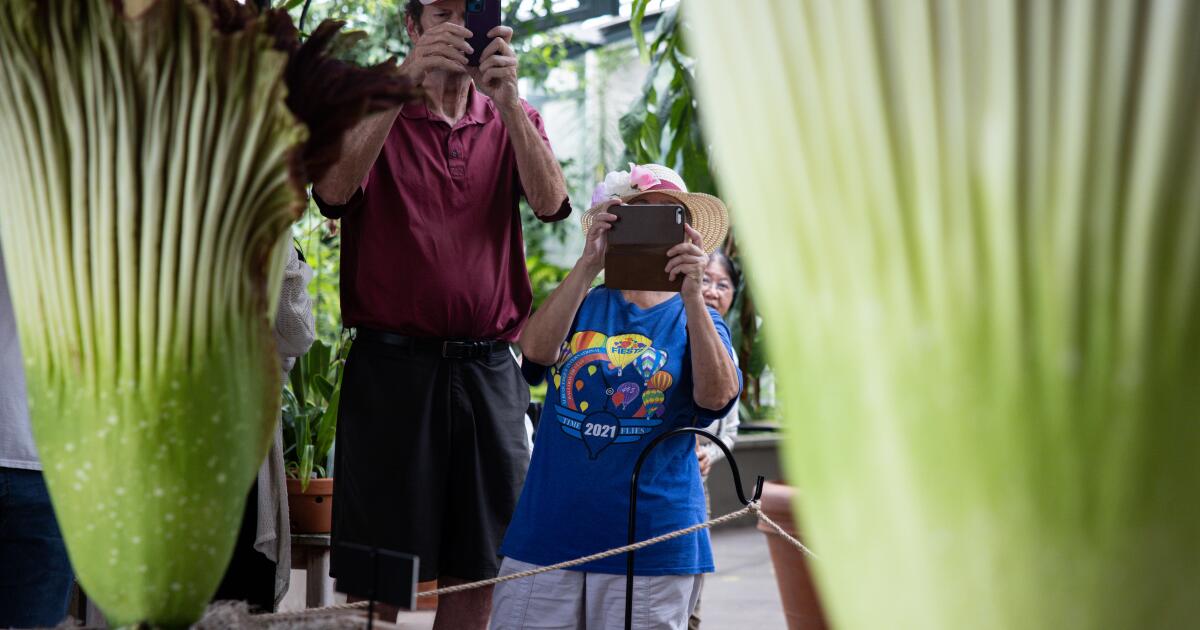
The Huntington’s long-awaited stink has arrived. Two corpse flowers nicknamed Odora and Odorysseus have bloomed at the San Marino conservatory, drawing thousands for the rare occasion and quickly surpassing last year’s numbers.
Corpse flowers have been a staple of the Huntington since 1999, when the garden exhibited its first corpse flower. Native to Sumatra, Indonesia, these plants are endangered in the wild and only bloom for 24 to 48 hours every few years. Once bloomed, they reek of rotting flesh.
As the day goes on, these smelly specimens will close back up and collapse, losing their infamously rotten odor.
The double bloom this summer was “definitely a surprise,” said Brandon Tam, the Huntington’s associate curator of orchids. The last time multiple corpse flowers bloomed on the same day at the Huntington was in 2018.
“We knew that Odorysseus was going to bloom probably Sunday,” Tam said. “But what surprised us was that we saw that Odora was opening just a few hours after.”
As an “inflorescence” — a plant structure containing hundreds of male and female flowers at the base — the plant usually staggers its bloom to avoid self-pollination.
A developmental irregularity caused Odora’s spadix to cave in, but the plant remains healthy, said Brandon Tam, the associate curator of orchids at the Huntington.
(Kayla Bartkowski / Los Angeles Times)

Jaime Holmes from San Gabriel holds her nose in front of the blooming corpse flowers.
(Kayla Bartkowski / Los Angeles Times)
But sometimes, “these plants have a mind of their own,” Tam said.
Climate factors can influence when they bloom. Tam said Southern California’s recent high humidity may have signaled a prime environment for the plants to unfurl.
Visitors may have noticed that Odorysseus’ spadix — the conic protrusion emerging upward from the plant — was much taller than Odora’s, which had caved in. Tam said Odora’s spadix was a developmental irregularity, but emphasized the plant remains healthy.
“It just looks a little different — completely normal,” Tam said. “When it reblooms for us in three to four years, it’ll look just perfectly fine.”
At the time of the bloom, Odorysseus measured 71 inches in height, and Odora measured 41.
As of 8:51 a.m., the Huntington recorded over 5,700 reservations, said Keisha Raines, the Huntington’s assistant director of news and media relations. That number easily surpassed last year’s bloom, which drew about 4,900 visitors. It also excludes walk-ins and any more reservations made throughout the day.
Parking lots quickly filled inside the Huntington, forcing some visitors to park on the streets outside.
Raines thinks the rare double bloom influenced the spike in reservations. She also believes general awareness of the corpse flower increases each summer.
“It’s kind of lore,” Raines said. “It’s just continuing to build, and more people want to see it.”
Inside the conservatory, eager sniffers took selfies and marveled at the plants’ size and smell. Outside, the line ran all throughout the walkways, extending past the exit.
Ventura resident Michelle Shock and her 8-year-old daughter, Fable, initially came to the Huntington for a tea party at the Rose Garden, and dressed for the part in light-colored, semi-formal dresses. They scheduled the party two weeks ago and got lucky when they heard the corpse flowers were in bloom on the same day.
“I’ve always wanted to see one,” Shock said while waiting in line. “I think the last time I knew of one blooming was when I was pregnant with her. We were up in the Bay, and I missed it. So here we are now, together, which is better.”

Gastonia Goodman, 72, peers through the window at the blooming corpse flowers.
(Kayla Bartkowski / Los Angeles Times)
Fable predicted the plants would smell like “rotten flesh from Minecraft.” Shock guessed they’d smell like forgotten meat in a broken freezer or animal remains on a farm.
For spouses Jennifer Kraus and Abigail Cruz, the plants smelled like rotten garbage.
“It was pretty ripe,” Kraus said. “Totally enjoyed it though.”
The couple drove two hours from the Inland Empire to catch the bloom, which had been on Cruz’s bucket list.
“The minute that we saw it on Facebook, [Kraus] started following it and making sure that we’re here when it had bloomed,” Cruz said.
They were among the first to arrive, so the wait was short. “We were here at o-dark-30 this morning, ready to go,” Kraus said.
North Hollywood resident Lilla Saito took two hours off work to witness the corpse flowers for the first time and tracked the livestream every day, “just waiting for it to bloom.” Saito stood in line for about 45 minutes to catch a whiff, which Saito said “smelled like a trash room.”
It was Paige Patino’s first bloom too. Patino lives 10 minutes away from the Huntington and wore a T-shirt with flowers on it for the occasion. It was “really cool” to “see both of them active,” Patino said.
For Tam, this year’s stench ranks in the top three. He thinks each individual plant stinks more than previous blooms, but on top of that, he said: “The fact that we have two in bloom makes it stinkier.”
-
 Entertainment5 minutes ago
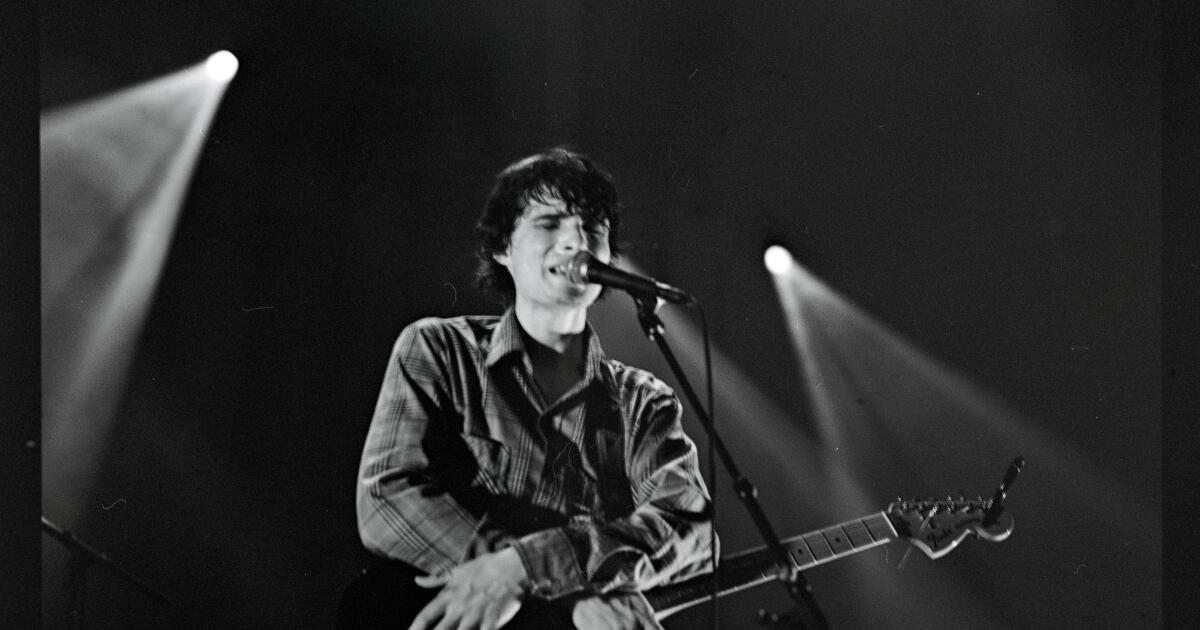
Finn Wolfhard is taking ‘control of the narrative’
-
Lifestyle11 minutes ago
What are your most cherished memories of the 2026 World Cup in L.A.?
-
 Politics17 minutes ago
Commentary: Two Lorenzos from Mexico. One fulfilled his American dream. ICE killed the other
-
 Sports29 minutes ago
What will the Sparks do next? The franchise is at a crossroads after firing its GM
-
World41 minutes ago
Euronews explains: can Hungary's PM Magyar really remove president Sulyok from office?
-

 News1 hour ago
Mexico files criminal complaints in US over migrant deaths in custody
-

 Videos3 hours ago
New explosions near Iranian port cities, says state media | BBC News
-

 Los Angeles, Ca3 hours ago
Big rig crash spills cinder blocks on 101 Freeway; lanes blocked in Tarzana

