Lifestyle
To become the 'Maestro,' Bradley Cooper learned to live the music


Bradley Cooper plays composer Leonard Bernstein in Maestro.
Jason McDonald/Netflix
hide caption
toggle caption
Jason McDonald/Netflix

Bradley Cooper plays composer Leonard Bernstein in Maestro.
Jason McDonald/Netflix
As a child, actor Bradley Cooper was so fascinated by music conductors that he asked for a baton as a birthday gift. He remembers whirling his arms around in his bedroom — and feeling like a wizard.
“There was something magical about being able to physically move to a rhythm,” he says. “And then, in my imagination, [to] be able to perceive that I was actually harnessing and commanding that music. I mean, it was really like a magic trick, every time.”
Cooper channeled that energy as the co-writer, director and star of Maestro, a film about the internationally famous composer and conductor Leonard Bernstein. Widely considered the first great American conductor, Bernstein led the New York Philharmonic from 1957 to ’69, and also composed classical music, as well as music for Broadway and film.
Cooper says conducting as Bernstein in the film was tricky: “I had no desire to imitate what he was doing, because that would have been a soulless, in my experience, endeavor.” Instead, the actor consulted with conductor Yannick Nézet-Séguin, who helped him find his own rhythm on the podium.
Nézet-Séguin is the artistic and music director of the Philadelphia Orchestra, music director of the Metropolitan Opera Orchestra, and music director and principal conductor of the Orchestre Métropolitain in Montreal. Though he was 15 when Bernstein died, Nézet-Séguin refers to the conductor as, “hands down, always my greatest conducting model.”
“I always felt even when I was a teenager, that this is the way I wanted to express music on the podium, just expressing with all my body and not being shy of showing my emotions on the podium,” Nézet-Séguin says.
For Nézet-Séguin, Bernstein’s influence is both professional and personal. He notes that Bernstein’s sexuality — he was married to a woman but also had relationships with men — helped open doors for others in the classical music field.
“The fact that he lived this and didn’t hide it completely, well, it allowed people like [conductor] Michael Tilson Thomas or like me to now live it fully, have husbands,” Nézet-Séguin says. “This is … one of the many reasons why this film is so important. It’s not so much that it’s about a bisexual or a gay character, but more about how complex it is.”
YouTube
Interview highlights
On the centerpiece of the film, the final movement of Mahler’s “Symphony No. 2”
Nézet-Séguin: This, just from a logistics point of view, for a conductor, it’s the most complex. Now, this specific moment also comes at the very end of a very long symphony that’s about 90 minutes long. So you’re almost one hour and a half into blood and sweat and tears of some of the most soulful and profound music that’s ever been written. And as a conductor, you have to keep your mind cool because you need to still direct the traffic … well, but also be completely emotionally involved in the meaning of this music.
Cooper: There’s this incredible video of Lenny conducting this piece in 1973 in Ely Cathedral with the London Symphony Orchestra, which is exactly what we replicated. But I always knew that I wasn’t going to just imitate what he was doing. It was actually finding that middle ground. And Yannick was in particular so supportive of me, as Lenny, finding whatever that mode of conducting is, which was, of course, infused entirely by not only the interpretation of the score, which is what we did in terms of tempo, but also in terms of his gesticulating and all of that. But having it be original because the goal was to conduct in real time this piece and record it.
On the theatricality that Bernstein displayed while conducting
Cooper: Bernstein himself, he was often asked about his antics, as you know, on the podium. And he would always talk about how it was all about his relationship to the orchestra, and to the musicians that he was making music with, and not about him performing for the audience. … At any moment, [he] was always just completely in the music.
Nézet-Séguin: Maybe it’s something that Lenny had been accused of in his lifetime. Because, of course, he was a completely larger than life person and therefore a larger than life conductor. … Well, I can say really, like Bradley just said, that no orchestra in the world would respond to a conductor who would be theatrical in [that] way of performative for an audience. This is something that many people forget. They think that the conductor is so aware of the audience that they do something for them. But then orchestras smell that miles away and they stop looking at the conductor, and then therefore the conductor cannot have a career, or at least not a career in the scope that Bernstein did.
On Bernstein’s signature jumping on the podium while conducting
Cooper: Yeah, there’s wonderful photographs of him levitating above the podium and many recordings of one being able to hear his feet stomping on the podium after having been a foot in the air. So, yeah, that was one of his trademark sonic gifts to his conducting.
Nézet-Séguin: It’s still taught that conducting should be this and that, and in a box, and not too much of this, and not too much of that. And I don’t want here to insult any great conducting teachers around the world. They’re doing amazing work. But sometimes we forget that conducting is about just living the music. And at that moment, that’s what Lenny taught all of us in a way. At that moment, the music is jumping. … It’s almost like the whole world is waking up. So one needs to illustrate that and why not jump, you know? As long as it’s organic.
Cooper and Nézet-Séguin on the set of Maestro.
Jason McDonald/Netflix
hide caption
toggle caption
Jason McDonald/Netflix
Cooper and Nézet-Séguin on the set of Maestro.
Jason McDonald/Netflix
On conducting with an open mouth
Nézet-Séguin: I cannot imagine conducting [with my] mouth closed, especially not when there’s a chorus. I mean, conductors, we don’t sing. … Lenny did that a lot and I think we all do it, because it’s kind of breathing. … It’s letting even more the sound feeling open, when we let our mouth open. … The arms are open, the heart is open, and therefore the mouth is just opening up — all that’s possible for one of the greatest climactic moments in the music.
Cooper: I did notice that I opened my mouth a lot, just conducting to a recording of anything. And thank goodness Lenny did that. In the video from 1973, as I recall, he’s only opening his mouth when he’s actually saying the words of Mahler’s “Resurrection” that the chorus is saying. … What’s in the movie is the last take. The way it went down is I really messed up the whole first day, because I had entered into it with fear and 99% of the movie I went into fearlessly. But I had set up all of these cameras really thinking that deep down I wasn’t going to be able to conduct it and I’d have to edit, create a scene out of in the editing room. And so I went into it already fearful. And obviously when you do that, you can be struck by fear and then not be able to succeed. And so I was behind tempo. I forgot to cue people and I messed up. And then the second day, which we weren’t even supposed to shoot that scene, I brought in the techno crane, which is a manner of filming from outside into the hall, and I created one single shot, which is what it always should have been. So because I really let loose that last take and I did an audible prayer in front of everybody to Lenny, thanking him and thanking them, and we did it one more time. And I really allowed myself true abandon and that’s why my mouth was open. And that’s sort of more than I would have liked – but it was so pure and real that I thought, “No this is it. This is it. And it is 100% authentic.”
Lauren Krenzel and Thea Challoner produced and edited this interview for broadcast. Bridget Bentz, Molly Seavy-Nesper and Meghan Sullivan adapted it for the web.



Arsenio Hall speaks onstage during the Emmy Awards on Jan. 15, 2024.
Kevin Winter/Getty Images North America
hide caption
toggle caption
Kevin Winter/Getty Images North America
As a kid in Cleveland, Arsenio Hall remembers watching The Tonight Show Starring Johnny Carson and feeling that something was missing. “I could watch … for weeks at a time maybe never see a minority perform,” he says.
Hall yearned to create something different: “My dream was to one day grow up and show the other side of show business,” he says. “I wanted to do this show that didn’t exist when I was a kid. … I wanted those things that Johnny didn’t do.”
The Arsenio Hall Show, which ran from 1989 until 1994, delivered just that. At its peak, the show was syndicated on nearly 200 stations, running second in the late-night ratings to Hall’s idol, Carson.
Some of the most indelible moments in American culture happened on Hall’s set. In 1991, Magic Johnson chose the show as the first place to speak after announcing his HIV diagnosis. That same year, a 6-year-old Bruno Mars won a week of free groceries after performing his Elvis impression on the show. And Bill Clinton famously played his saxophone on set during the run-up to the 1992 presidential election.
But Hall says he faced criticism on multiple fronts: White audiences thought the show was too Black, while Black audiences accused the show of not being Black enough.
“In America, you’re never gonna be No. 1 if you have this insatiable desire to do Toni Braxton instead of Dolly Parton,” Hall explains. “And by the way, I tried to do both. I would try to mix it up; I would put Dolly Parton on and then have something for the culture after it.”
In 1994, Hall decided to walk away: “I realized I couldn’t go any higher, and I was gonna lose my affiliates when [David] Letterman came into the game. And the CBS affiliates were very important to my strength, my success, and my profits. … I always said, when I end it, I want to go out on the top,” he says.
Hall’s new memoir is Arsenio.
Interview highlights
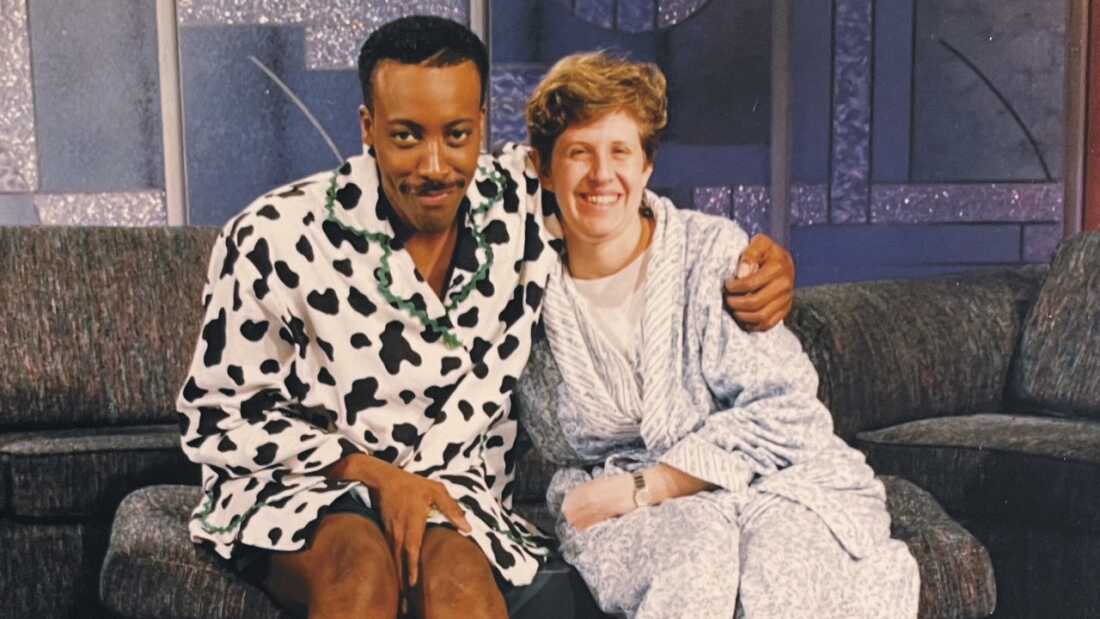
Arsenio Hall and executive producer Marla Kell Brown pose during the show’s staff PJ party.
Simon & Schuster
hide caption
toggle caption
Simon & Schuster
On why his stage had couches instead of the desk that other late-night shows used
Marla Kell Brown, my partner in crime, the executive producer, partner of the show … she had seen me do stand-up, and she talked about how I moved, and how free I was. She wanted me to be able to get up, to touch a guest, to decide to sit next to a guest. She felt — and she was right — the desk was this shield. This desk was something I was hiding behind. This desk was protective. And she wanted to take it away from me. When I took over for Joan Rivers, they let me host The Joan Rivers Show when she quit. And she had a desk. So at Fox, I’m sitting behind the Joan Rivers’ desk, and Marla said, “Why don’t you try it without the desk? I think you’ll like it. I would love to see you without that desk.” And we tried it. I had to admit she’s right, and the rest is history. I have to listen to Marla more often. …
It worked really well. When I watched it the first time, I knew it. To be able to lean into a guest and not have something between you. I remember doing an interview with Rosie Perez … [and] I held her hand during the interview because she was nervous. I remember an interview where Diana Ross kissed me. You can’t kiss me with the desk in between us. It created a different visual of a show and it became a thing.
On Magic Johnson‘s 1991 appearance, in which he talked about his HIV diagnosis
I call him Earv, Magic Johnson. He was a friend. And he called me because I had been worried about him. … And one of the things I remember most is he was afraid of losing friends, losing the love of friends and family. I remember the sentence, “I want people to still give me my hugs,” because Magic is a warm and fuzzy guy, and he’s that guy. I hugged him to show him I love him and I care.
I had heard a comic do an AIDS joke. And it was a very homophobic type joke. … We were so ignorant. We didn’t even know the rules of how you get it. And there were basketball players who didn’t want to play with Magic. So I think God gave me that hug or the inspiration to do that, to show people we don’t have to be afraid. …
I asked Earvin to go on Larry King or do Mike Wallace or something. I was like, “No, man, I can’t do that interview. You know me, I’m a crier. … You need a serious platform, dude. You need a journalist. I’m a comedian and infotainment late night guy.” And he says, “No I need you. I need to come there. I need come where I’m comfortable, because I’ve got to talk to the nation. And I’ve gotta give them my point of view. And I want to do it where I am comfortable.” So the point guard ran the play, and I just followed. And like he did in basketball, he makes everybody better.
On his angry reaction to being heckled by activists from Queer Nation in 1990
I think you become more angry and you become stronger when you realize you are right, because a huge part of my staff was gay, many of my guests were gay, but it was at a time when you didn’t always know it. So the gay people on my show couldn’t even come to my defense. Ellen [DeGeneres] couldn’t come and say, “Oh, wait a minute, you guys don’t know.” … And Rosie [O’Donnell] was on the show a lot and a lot of people that may be still in the closet, so I won’t mention their names, but, it wasn’t my job to say, “Ladies and gentlemen, balladeer and homosexual, put your hands together …” It wasn’t my job to introduce a singer that way.
I think part of my anger was at that point [was] I’m being told by the Black community that it ain’t Black enough. I’m being told by the Paramount executives that it ain’t white enough. And now the gay community is gonna attack me during the show? You’re gonna take money out of my wallet and food off my family’s plate? In the middle of my job here, when you don’t know what you’re talking about? You’re gonna blame me for something that is absolutely not true? I think I was sick of being criticized by everyone because everyone wanted it to be something else. It’s hard being the first Black anything in late night.
On the success of his show
I changed the culture in a way that I exposed America to some things they might not have seen if I didn’t come along then. If I came along now, it would be irrelevant. Everybody would now be gathering to watch Hammer, or this little Bruno Mars, or the Magic Johnson announcement. Timing is also very important. Talent is important. Hard work is important. But timing — if I came along 10 years before that, or if I came a long 10 years from now, it wouldn’t work. And that’s what’s really cool about life. Sometimes it’s the timing that matters.
Anna Bauman and Nico Gonzalez Wisler produced and edited this interview for broadcast. Bridget Bentz, Molly Seavy-Nesper and Clare Lombardo adapted it for the web.
Lifestyle
L.A. Times Concierge: Where can we go for a fun morning out with our toddler before nap time?

I’m looking for something that’s open early on the weekends (9 a.m.?) where we can take our 2-year-old daughter. We don’t want it to be an indoor play place or something that is solely designed for kids. Ideally, it would be something that adults enjoy too. Maybe something outdoors or with a restaurant/cafe where we can give ourselves a little treat. We are in Manhattan Beach and have to be back home by 12:30 p.m. for nap time. We’ve been able to make drives to Pasadena and Orange County and make it back in time (bonus of leaving on a Saturday or Sunday because there’s no traffic!) — Brittany Newell
Here’s what we suggest:
Finding places that will keep both you and your toddler entertained can be tricky. But don’t fret, Brittany! I’ve enlisted the help of some of my colleagues who are also parents that understand the need to flee the house before nap time. I’ve compiled a list of fun mini adventures that you can start early-ish.
For an activity close to home, Michelle Woo, The Times’ West Coast experiences editor, suggests renting a toddler bike trailer or bike seat from one of the local shops and taking a ride along the Strand from Manhattan to Redondo and back to Hermosa for a stop at Good Stuff, a beachside restaurant where you can enjoy a refreshing smoothie, mimosa or Woo’s go-to order, “the Good Stuff Breakfast with a pork sausage patty — simple yet comforting.” Then let your daughter play in the sand for a while. And if you haven’t been to the Roundhouse Aquarium before, it’s definitely worth a visit. The free, donation-based marine educational center is home to swell sharks, sea urchins, jellyfish and more that will leave visitors of any age in awe.
About 12 miles up the coast in Venice Beach is the newly renovated Windward Plaza Playground, a nautical-themed fun zone equipped with slides, swings, climbers and more. The best part is that it’s located on the sand at the beach just steps away from the famous boardwalk. Before you get to the park, my colleague Amy King suggests stopping by Breakaway Cafe for yummy breakfast burritos or Menotti’s for coffee.
For an early morning adventure, Times entertainment and features editor Brittany Levine Beckman recommends visiting the Riverside bike path in Frogtown, which opens at 6 a.m., so you can start as early as you’d like. She and her husband usually take turns pushing their 18-month-old daughter in a tricycle along the pathway and get their steps in. Afterward, she suggests going to Lingua Franca, a restaurant situated along the river. “We’ve arrived a few times as soon as the restaurant opens at 10 a.m. on the weekend and been the only early-bird brunchers,” she tells me. “We grab a table outside in the back and our daughter meanders without us feeling annoying.” The restaurant also serves a toddler-approved Dutch baby and a parent-approved bloody Mary, she adds. If you prefer to just grab a coffee, go to Tadaa.Coffee, which has a sand pit that your daughter can play in.
Another fun option is the Natural History Museum in Exposition Park, where you can wander through the awe-inspiring Dinosaur Hall, learn about the evolution of mammals, roam through the enchanting nature gardens and admire more than 2,000 gems and minerals from across the globe. The museum opens at 9:30 a.m., but there’s still plenty of time to explore before nap time. Levine Beckman also enjoys taking her daughter to the museum. “Our toddler loves the animal dioramas,” she tells me. “She likes staring up at the dinosaur bones too (and can say “roar” now), but the big stuffed animals are her favorite.” For food, my colleague Sophia Kercher recommends South LA Cafe, which is located at the museum.
Now for some rapid-fire ideas: Kercher suggests the Stoneview Nature Center, which is a plant-filled city sanctuary nestled in Culver City’s Blair Hills. Here you can chase hummingbirds, roam through the never-crowded garden and “visit Stoneview’s resident quails, which have their own fenced-in compound called, ‘Quallywood,’” she says. Times contributor Rachel Kraus, who recently wrote about the rise of mall parks in Southern California (and why parents are loving them), suggests the Proud Bird near LAX, which she calls “a one stop shop parent and kid utopia.” She adds, “You can order food and drinks (including from a full bar) and let your kids run around on the outdoor play structure, kick a ball on the turf or explore the vintage airplanes.” Also, be sure to check out our list of L.A. playgrounds that are close to coffee shops where you can get a jolt of energy if needed.
I hope these suggestions are helpful with planning your next morning adventure with your toddler and that you are able to create some fun new memories together. Happy exploring!

Zendaya in The Drama.
A24
hide caption
toggle caption
A24
The Drama is a dark and twisty comedy starring Zendaya and Robert Pattinson as a storybook couple preparing for their upcoming wedding. But just days before the big day, she reveals a horrifying truth about her past self that threatens to undo their nuptials, and their bond. In this spoiler-packed episode, we’re getting into that reveal, and all the surprising drama of the movie.
Follow Pop Culture Happy Hour on Letterboxd at letterboxd.com/nprpopculture

‘What was that?’: SpaceX rocket launch lights up Central California sky

Road to Mount Blue Sky expected to open Memorial Day weekend after 2024 closure, construction

Meet the Boricuas behind the scenes at ESPN’s Connecticut headquarters

Crash on Del. highway leads to man hit, killed by passing truck on Saturday, police say

Florida Lottery Powerball, Fantasy 5 results for April 6, 2026

Florida High School Football Rankings: Top 25 teams – Oct. 21

How old is Bo Nix? What to know about Oregon quarterback ahead of 2024 NFL Draft

Cleary's 21 help Le Moyne down Central Connecticut State 69-64 in OT

99th annual Pony Swim held in Virginia

Indiana Members Credit Union announced as new anchor tenant at Bottleworks District

Map: Minor Earthquake Strikes Near San Diego

Trump claims he’d win as the president of Venezuela — just needs to ‘quickly’ learn Spanish

US Supreme Court clears path for Steve Bannon criminal case dismissal
Trump reiterates threats to bomb Iran’s power plants and bridges

Trump threatens Iranian infrastructure over Strait of Hormuz | BBC News
-

 Atlanta, GA2 days ago
1 teenage girl killed, another injured in shooting at Piedmont Park, police say
-

 South-Carolina1 week ago
South Carolina vs TCU predictions for Elite Eight game in March Madness
-

 Vermont1 week ago
Skier dies after fall at Sugarbush Resort
-

 Movie Reviews5 days ago
Vaazha 2 first half review: Hashir anchors a lively, chaos-filled teen tale
-

 Politics1 week ago
Trump’s Ballroom Design Has Barely Been Scrutinized
-

 Politics1 week ago
JD Vance says he was ‘obsessed’ with UFOs, believes aliens are actually ‘demons’
-
 Entertainment5 days ago
Inside Ye’s first comeback show at SoFi Stadium
-

 Atlanta, GA1 week ago
Fetishist ‘No Kings’ protester in mask drags ‘Trump’ and ‘JD Vance’ behind her wheelchair