Connect with us

Lifestyle

This TV writer crafted her most powerful narrative yet — in the form of a board game

Published

on

This TV writer crafted her most powerful narrative yet — in the form of a board game

I knew “The Morrison Game Factory” had its hooks in me when I started talking back to it. There I was, alone and at home, and in conversation with a fictional machine.

Puzzles were sprawled around me. Colorful dice, a small board, little plastic rocket ships and a stack of cards with seemingly disconnected drawings on them — a golfer, a mushroom, a diver and more. I was about two hours into Lauren Bello’s puzzle game, but I was devouring it more as a story. That’s because “The Morrison Game Factory” unfolds as an interactive narrative, one in which each challenge unlocks another mini-chapter in a tale of friendship, loneliness and even grief.

There were some moments the puzzles stumped me. I used the hint system on one involving numbers. But more often I found myself pausing to reflect — affected by a touching phrase. An example: “I like that, that talking to me isn’t work for him,” an observation about what it feels like to be in true conversation and connection with someone. It certainly wasn’t what I was expecting when I opened a bewitching, vintage-tinged box detailing a fantastical assembly line and saw a smattering of board game figurines. Later, I felt an urgency to complete the game, especially once the relationship at its core is severed.

Lauren Bello’s game, “The Morrison Game Factory.”

(Carlin Stiehl / For The Times)

Advertisement

That’s when I wanted to communicate with the main character of “The Morrison Game Factory.” I sat, caught in contemplation, mulling over moments in my life in which I’ve had to navigate separation and heartbreak. Such is the power of Bello’s tabletop puzzle tale. There was no time to dwell, however. In seconds I was back at it, arranging little wooden people — meeples, as they’re known — around a pinwheel with numbers at the end of each spoke. There were puzzles to solve, and a story of loneliness to cure.

Bello’s “The Morrison Game Factory” was one of the best narratives I encountered — or played — this summer. Bello, an L.A.-based television writer who has written for such series as “Foundation” and “The Sandman,” began crafting the game for friends during the worst days of the pandemic. It’s a love letter to play as a form of communication, a treatise on how games can connect us and enable vulnerability in our relationships. It’s also a hopeful statement, one of moving on with gratefulness rather than sadness, and how every day can be full of a new playful discovery.

“I think grief can feel so sharp that you can’t look at it directly or else you’ll be blinded,” Bello, 36, says. “Games, and fiction and other forms of media can be a way to process your grief and your overwhelming feelings in the background without forcing you to look at it directly. If they’re done well, you kind of realize you and your grief are standing side by side and hand in hand, and you realize, ‘Now I can turn to face you.’”

To explore “The Morrison Game Factory” is a delight. The conceit: We are handed a box of stray board game pieces, all of them, we’re told, rescued from an abandoned game factory and seemingly connected. The game is a constant act of discovery — maintenance logs will lead us to a website, where we’ll get to know the characters who once worked at the now-defunct game warehouse. We’ll be tasked to look at crossroad puzzles in unexpected ways, to piece together visual obstacles, construct actual puzzles and partake in one task that feels like a mini science experiment.

Advertisement

We’re given numbers to call, and at times we’ll read the deeply intimate thoughts of the main character, which we learn via the opening puzzle is a machine that has been able to gain the gifts of human thought and compassion. The slight sci-fi bent came naturally to Bello.
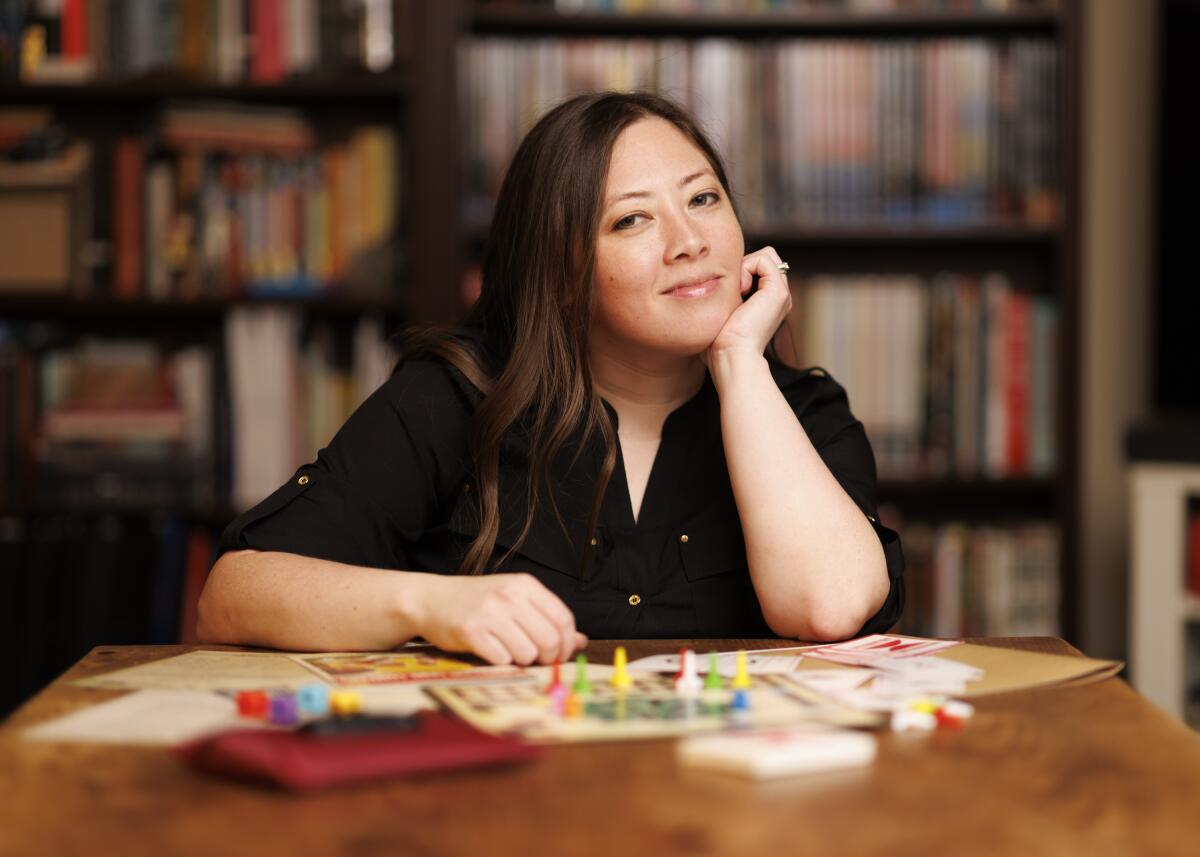
Lauren Bello sits at a table with her game, "The Morrison Game Factory," spread out in front of her

Lauren Bello, a L.A.-based television writer, with her game, “The Morrison Game Factory.”

(Carlin Stiehl / For The Times)

“I’m definitely drawn to genre,” Bello says. “I feel like the world is changing very quickly — the way that people speak, the way that people act, the things people have access to. Genre is a fun way to say what you have to say while also inoculating against the effects of time.”

What would become “The Morrison Game Factory” started as a holiday exchange for a puzzle enthusiast Facebook group. Bello’s game attracted attention, and eventually it reached Rita Orlov, whose Bay Area company, PostCurious, would go on to publish the title. “When I played it, I was most enamored with the range of emotions I felt while experiencing the narrative — it made me laugh, it made me feel sadness and empathy, and it really made me care for the main character, all of which feels like a rarity in tabletop games,” Orlov says.

Advertisement

“The Morrison Game Factory” reorients us to look for a story more than a solution, meaning at times we may make the puzzle more difficult than it actually is. I played solo, although up to three is recommended, and at times I wished I had someone to bounce ideas off of. That’s because sometimes the answer is simply hiding in a catalog description. In that sense, working out what the puzzles are asking us to do is occasionally more of a challenge than the actual puzzle, but the underlying narrative drive helps create a sense of urgency.
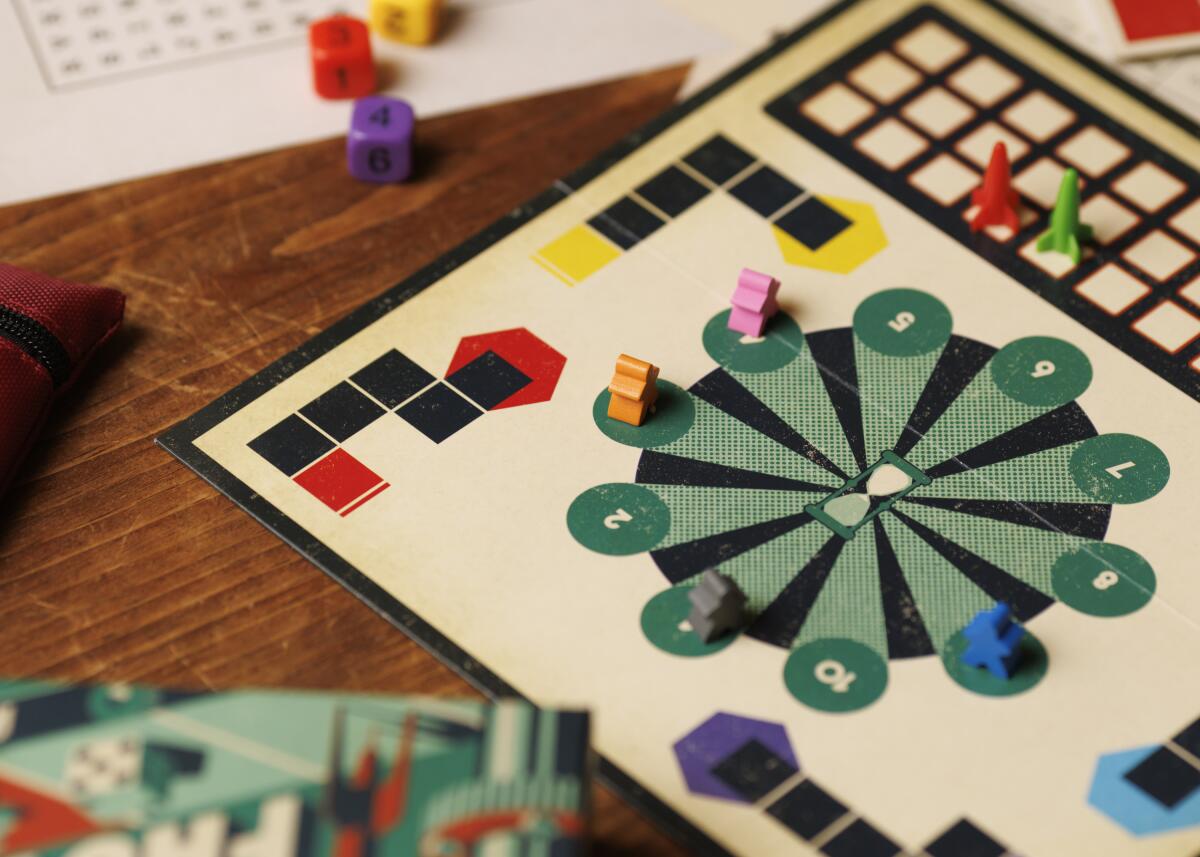
Game board and pieces for "The Morrison Game Factory"

“The Morrison Game Factory” is a constant act of discovery set at a now-defunct game warehouse.

(Carlin Stiehl / For The Times)

Bello says writing television helped her create the framework for the game, especially when it came to building tension.

“I think that ‘Morrison Game Factory’ naturally fell into three acts,” Bello says. “My experience in writing other kinds of stories told me what those acts were. Also, good stories control a flow of energy. They have a very intentional sense of momentum. I tried in the game to start off with it easy and an expected momentum, and then ramp up the energy. By the third act, you feel, ‘I’m on a roll. I’m on fire.’ The puzzles get a little shorter, and you start feeling like everything that came before is now coming together. That’s a skill set I learned from other writing.”

Advertisement

Still, the fact that the game is reaching a wider audience now has Bello rethinking some of her approach. “The Morrison Game Factory” started with a Kickstarter and quickly exceeded its $30,000 goal in just a few hours (PostCurious has a dedicated following in the tabletop arena for its narrative-focused games, notably the tarot-inspired “The Light in the Mist”). Reviews beyond the board-game world, in the escape room and immersive communities, have been positive and have praised the title as an approachable and emotional story-first game, with some even asking if it’s possible for a board game to make you cry.

“The magic trick of ‘The Morrison Game Factory’ is that you aren’t thinking about the puzzles. You want to solve them not for the sake of the puzzles themselves but for the sake of the character and the story,” says Lisa Spira, co-founder of Room Escape Artist, a site dedicated to the escape room sector.

And Bello wonders today if the opening puzzle — a cipher challenge — can overwhelm some of those new to the space. “I try not to waste people’s time unnecessarily,” she says. “Sometimes it’s easy to turn things into a puzzle. I always try to be more experience-focused. Like, is this going to enhance your experience to have this puzzle? is there going to be an ‘aha moment’ or a moment of delight, or is it going to lead to, ‘Oh great, now I have to put a lot of work into this puzzle?’”
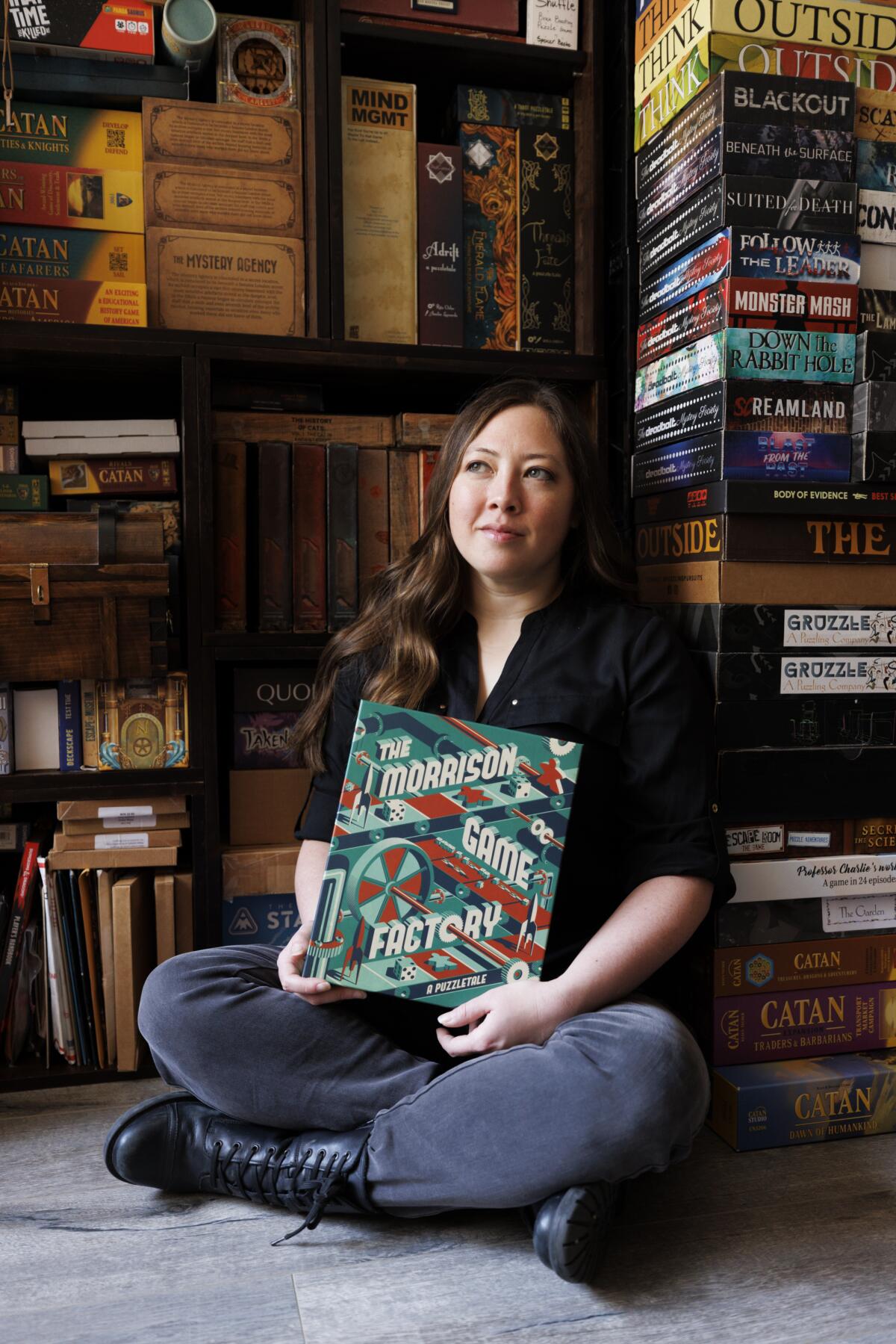
Lauren Bello sits cross-legged on the floor, holding her game, “The Morrison Game Factory,” in its box

Lauren Bello’s “The Morrison Game Factory” unfolds as an interactive narrative, one in which each challenge unlocks another mini-chapter in a tale of friendship, loneliness and even grief.

(Carlin Stiehl / For The Times)

Advertisement

And yet the game is relatively forgiving. When we’re led to the accompanying website, a robust hint system delicately gives away the solutions. The goal here is joy — games as a dialogue, which comes through as we emotionally heal the story’s protagonist.

“I played a lot of games with my family and I loved the way that games could become a shorthand for things,” Bello says. “I loved when one person could lay down a piece and everyone would go, ‘Ohhh.’ You immediately knew what they were doing. It was a whole unspoken language behind the movement of the pieces. You could be expressing allegiance with someone, or standing up to someone, and it was this other world of language.”

To experience “The Morrison Game Factory” is essentially to have a conversation, one in which we learn a dialect centered on play. And it turns out it’s a vernacular that’s adept at far more than offering a challenge.

“At the end of the day,” Bello says, “it’s used to express love. That’s what it is for me.”

Advertisement

Lifestyle

N.F.L. Style Will Never Beat N.B.A. Style

Published

on

N.F.L. Style Will Never Beat N.B.A. Style

You want to see some real fashion ingenuity? Watch the N.F.L. draft.

I’m not saying it’s all good, but where else are you going to see someone in a double-breasted suit made by a company better known for making yoga pants? Or an Abercrombie & Fitch suit jacket so short that it exposes the belt loops on the pants beneath?

On the whole, the style on display at the N.F.L. draft last night was very overeager senior formal: a lot of suits in colors beyond basic blue. The quarterback Ty Simpson wore a custom suit by the athleisure label Alo, which, I have to say, looked better than I would have envisioned had you said the words “Alo Yoga suit” to me.

I thought it might have been from Suitsupply, but the conspicuous “Alo” pin on his right lapel put that idea to rest. Simpson, smartly, unfastened that beacon before appearing onstage as the 13th pick to the Los Angeles Rams. He had, perhaps, satisfied his contractual obligations by that point.

Earlier in the evening, as the wide receiver Carnell Tate threw up his arms in exaltation after being picked fourth by the Tennessee Titans, his cropped Abercrombie & Fitch jacket revealed a swatch of rib cage. He looked like a mâitre d’ who had just hit the Mega Millions.

Advertisement

During the N.B.A.’s extended fashion awakening, its draft has become a sandbox for luxury brands to cozy up to would-be endorsers. The Frenchman Victor Wembanyama broke a kind of cashmere ceiling when he wore Louis Vuitton to go first overall in the 2023 N.B.A. draft.

The N.F.L. draft has none of that. The brands you see are often not brands at all, but custom tailors that reach the league’s neophytes through a whisper network among players. The draft is also a platform to raise the curtain on longer-term brand deals that better suit these rookies. We may, for instance, never see Simpson in a suit again. Nearly every photo from his time at Alabama shows him in a T-shirt or hoodie. It makes sense for him to sign with Alo.

Football is the most mainstream of American cultural entities. And it’s one that still hasn’t, in spite of the league’s best efforts, taken off overseas. Few players, save some quarterbacks and a tight end who happens to be engaged to a pop star, feel bigger than the game itself. If you’re a new-to-the-league linebacker, you’ll most likely never harness the star power to grab the attention of Armani, but you might have just the right pull for Abercrombie.

The N.F.L. draft is therefore one of the few red carpets where the brands worn by the athletes may also be worn by those watching at home. How many people watching the Oscars will ever own clothes from Louis Vuitton or Chanel? People may comment online about Lady Gaga wearing Matières Fécales to the Grammys, but how many of those fans and viewers could afford to buy clothes from it?


Advertisement

Yesterday, I published a deep dive into how a newish crop of Japanese designers are soaking up all the attention in men’s fashion right now. This was a piece I was writing in my head long before I sat down and finally started typing. I remember sitting at a fashion show in Paris over a year ago — I believe it was Dior — and being asked by my seatmate if I’d made it over to a showroom in the Marais to check out A.Presse. That Tokyo-based brand is now part of a vanguard of Japanese labels that, on many days, seems to be all anyone in fashion wants to talk about. I spent months talking with designers, store owners and big-time shoppers to make sense of why these brands have kicked up so much buzz and, more than that, what makes their clothes so great. You can read the story here.


Continue Reading

Lifestyle

How to have the best Sunday in L.A., according to Tig Notaro

Published

on

How to have the best Sunday in L.A., according to Tig Notaro

Thirty years ago, comedian and actor Tig Notaro didn’t have a clear direction in life, so she followed some childhood friends who wanted to get into entertainment to Los Angeles. Secretly wanting to do stand-up, Notaro decided to try her luck at various outlets in town, which became the start of her successful career.

“I stayed on my friends’ couch near the Hollywood Improv on Melrose, and a couple months later, got my own studio apartment in the Miracle Mile area,” Notaro says. “I love all the options for everything in L.A. — the entertainment, the restaurants. I like to stay active. So many people love the hiking options in Los Angeles, and I’m one of them.”

Sunday Funday infobox logo with colorful spot illustrations

In Sunday Funday, L.A. people give us a play-by-play of their ideal Sunday around town. Find ideas and inspiration on where to go, what to eat and how to enjoy life on the weekends.

Advertisement

Notaro appears in Season 3 of Apple TV’s “The Morning Show” and is a series regular on Paramount+’s “Star Trek: Starfleet Academy,” as she was on “Star Trek: Discovery.” She’s also a touring stand-up comic and hosts “Handsome,” a comedy podcast, with Fortune Feimster and Mae Martin. The trio will be taping a live show May 4 at the Wiltern with the cast of Netflix’s “The Hunting Wives.” The live shows include interviews, but also “incorporate some ridiculous things,” she says. For example, upon hearing that some of the hosts always wanted to learn to tap dance, Notaro “hired a tap instructor to come to our live show in Austin and teach us how to tap dance in front of the audience.”

Notaro lives near Hollywood with her wife, actor Stephanie Allynne, their 9-year-old fraternal twin boys, Max and Finn, and three cats, Fluff, Linus and Skip. When she’s not touring, her ideal Sundays include sampling vegan restaurants, wandering through bookstores or museums, and doing something physically active with the family.

This interview has been lightly edited and condensed for length and clarity.

6 a.m.: Up with the kids

Because we have active children, we still wake up at 6 a.m. or 6:30 a.m. on Sunday, but there’s not as much of a rush to get going. Stephanie and I will often have coffee and chat in the living room together. I love that part of the day. Stephanie may cook breakfast, but Max and Finn are pretty self-sufficient and can make certain little meals for themselves. Max is really starting to take an interest in cooking, so he’d make breakfast for himself. Our family is vegan, but he eats eggs, so he makes himself an egg sandwich with avocado a lot of times.

Advertisement

9 a.m.: Daily morning walk

After breakfast, we usually have a morning walk around our neighborhood. That’s a daily thing I like to do, regardless of what’s going on. Now that I’m not touring as much, tennis is back on the schedule. So I’d go to Plummer Park in West Hollywood and play for a while, then join the family for lunch.

11:30 a.m.: Hike with a side of chickpea sandwich

I love Trails, a cafe in Griffith Park, where you can eat outdoors. It serves simple food, and has good vegan options. I usually get their chickpea salad sandwich. The food there is great. Afterward, we’d visit Griffith Observatory, where there’s lots to see. There are lots of great trails in the park, so we’d go for an hour hike before leaving.

3 p.m.: Browse the shelves for rock biographies

Advertisement

Bookstores are fun, so we’d head downtown for the Last Bookstore, which is in a historic building with lots of vintage books. I really love all things plant-based, and I’m a very big music fanatic. So I love to look for vegan books, nutrition books, rock biographies and autobiographies. It’s just fun to browse around the stacks.

If we didn’t go to the bookstore, we’d probably go to LACMA. Our sons are huge fans of art and want to go for each new exhibit. They love Hockney, Basquiat and Picasso, to name a few.

4 p.m.: Cuddle with cuties at a cat cafe

We’d then make a quick stop at [Crumbs & Whiskers], a kitten and cat cafe on Melrose for coffee, snacks and to pet the cats. It’s best to make reservations in advance. There’s cats all around the place that need to be adopted. You can visit and pet them, or find a new roommate. I’d love to take some home, but we already have three.

5:30 p.m. Italian or sushi, but make it vegan

Advertisement

We’re an early dinner family. One restaurant we like is Pura Vita in West Hollywood. It’s the greatest vegan Italian food, and for non-vegans, nobody ever knows the difference. It’s the first 100% plant-based Italian restaurant in the United States. They make an incredible kale salad and I love the San Gennaro pizza. It’s got cashew mozzarella, tomato sauce, Italian sausage crumble and more.

Then there’s Planta in Marina del Rey. It’s right on the harbor and you can sit outside and look at the boats coming in and out. They have sushi, salads and other plant-based entrees. They’ve got a really great spicy tuna roll that’s made out of watermelon. They are magicians.

Or there’s Crossroads Kitchen in West Hollywood. They play the best classic rock, and the atmosphere is upscale, fine dining. The appetizers that we always get are called Moroccan Cigars, which are vegan meat substitutes fried in a rolled batter. I really like the grilled lion’s mane steak, their mushroom steak with truffle potatoes, or the scallopini Milanese, that has a chicken or tofu option. I get the chicken with arugula on top. I always love to have a decaf espresso with dessert, which is either a brownie sundae or banana pudding.

7:30 p.m.: Comfort watch or word games

After dinner, the kids often like to watch an episode of “Friends,” a show that all ages enjoy, sports or “The Simpsons.” Or we’d play a game where each of us will add a word to a sentence and create a weird or funny long sentence until one of our sons says period. Then they’ll try and remember the whole sentence and repeat it back.

Advertisement

9:30 p.m.: Bubble bath then bed

The boys usually go to bed at 8:30 p.m. and bedtime for us is 9:30 p.m. Stephanie and I would read or chat. I like to take a bubble bath, if people must know. The best Sundays for me mean finding a good balance of relaxing and being active. I feel very lucky that my family and I can do those things together.

Advertisement
Continue Reading

Lifestyle

It Started with a Midnight Swim and a Kiss Under the Stars

Published

on

It Started with a Midnight Swim and a Kiss Under the Stars

When Marian Sherry Lurio and Jonathan Buffington Nguyen met at a mutual friend’s wedding at Higgins Lake, Mich., in July 2022, both felt an immediate chemistry. As the evening progressed, they sat on the shore of the lake in Adirondack chairs under the stars, where they had their first kiss before joining others for a midnight plunge.

The two learned that the following weekend Ms. Lurio planned to attend a wedding in Philadelphia, where Mr. Nguyen lives, and before they had even exchanged numbers, they already had a first date on the books.

“I have a vivid memory of after we first met,” Mr. Nguyen said, “just feeling like I really better not screw this up.”

Before long, they were commuting between Philadelphia and New York City, where Ms. Lurio lives, spending weekends and the odd remote work days in one another’s apartments in Philadelphia and Manhattan. Within the first six months of dating, Mr. Nguyen joined Ms. Lurio’s family for Thanksgiving in Villanova, Pa., and, the following month, she met his family in Beavercreek, Ohio, at a surprise birthday party for Mr. Nguyen’s mother.

Ms. Lurio, 32, who grew up in Merion Station outside Philadelphia, works in investor relations administration at Flexpoint Ford, a private equity firm. She graduated from Dartmouth College with a bachelor’s degree in history and psychology.

Advertisement

Mr. Nguyen, also 32, was born in Knoxville, Tenn., and raised in Beavercreek, Ohio, from the age of 7. He graduated from Haverford College with a bachelor’s degree in political science and is now a director at Doyle Real Estate Advisors in Philadelphia.

Their long-distance relationship continued for the next few years. There were dates in Manhattan, vacations and beach trips to the Jersey Shore. They attended sporting events and discovered their shared appreciation of the 2003 film, “Love Actually.”

One evening, Mr. Nguyen recalled looking around Ms. Lurio’s small New York studio — strewed with clothes and the takeout meal they had ordered — and feeling “so comfortable and safe.” “I knew that this was something different than just sort of a fling,” he said.

It was an open question when they would move in together. In 2024, Ms. Lurio began the process of moving into Mr. Nguyen’s home in Philadelphia — even bringing her cat, Scott — but her plans changed midway when an opportunity arose to expand her role with her current employer.

Mr. Nguyen was on board with her decision. “It almost feels like stolen valor to call it ‘long distance,’ because it’s so easy from Philadelphia to New York,” Mr. Nguyen said. “The joke is, it’s easier to get to Philly from New York than to get to some parts of Brooklyn from Manhattan, right?”

Advertisement

In January 2025, Mr. Nguyen visited Ms. Lurio in New York with more up his sleeve than spending the weekend. Together they had discussed marriage and bespoke rings, but when Mr. Nguyen left Ms. Lurio and an unfinished cheese plate at the bar of the Chelsea Hotel that Friday evening, she had no idea what was coming next.

“I remember texting Jonathan,” Ms. Lurio said, bewildered: “‘You didn’t go toward the bathroom!’” When a Lobby Bar server came and asked her to come outside, Ms. Lurio still didn’t realize what was happening until she was standing in the hallway, where Mr. Nguyen stood recreating a key moment from the film “Love Actually,” in which one character silently professes his love for another in writing by flashing a series of cue cards. There, in the storied Chelsea Hotel hallway still festooned with Christmas decorations, Mr. Nguyen shared his last card that said, “Will you marry me?”

They wed on April 11 in front of 200 guests at the Pump House, a covered space on the banks of Philadelphia’s Schuylkill River. Mr. Nguyen’s sister, the Rev. Elizabeth Nguyen, who is ordained through the Unitarian Universalist Association, officiated.

Although formal attire was suggested, Ms. Lurio said that the ceremony was “pretty casual.” She and Jonathan got ready together, and their families served as their wedding parties.

“I said I wanted a five-minute wedding,” Ms. Lurio recalled, though the ceremony ended up lasting a little longer than that. During the ceremony, Ms. Nguyen read a homily and jokingly added that guests should not ask the bride and groom about their living arrangements, which will remain separate for the foreseeable future.

Advertisement

While watching Ms. Lurio walk down the aisle, flanked by her parents, Mr. Nguyen said he remembered feeling at once grounded in the moment and also a sense of dazed joy: “Like, is this real? I felt very lucky in that moment — and also just excited for the party to start!”

Continue Reading
Advertisement

Trending
