Lifestyle
This L.A. couple kissed on a bridge and went viral. Now they're getting married

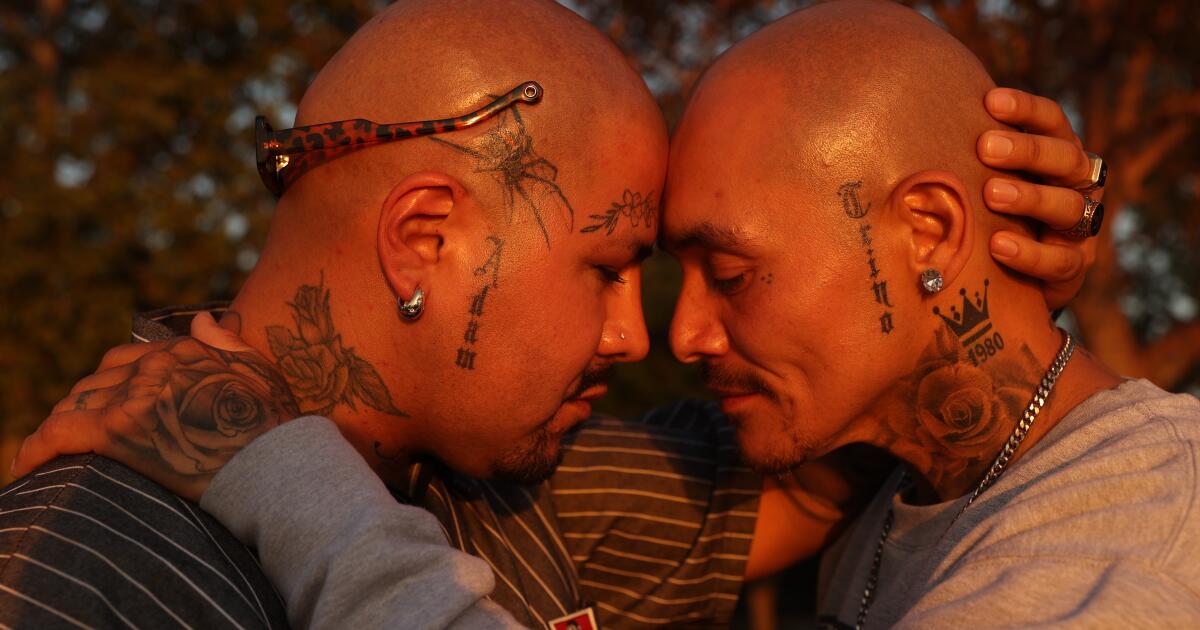
• Trino Garcia and Adam Vasquez, known on social media as TrinoxAdam, went viral when their kiss on a bridge was shared by photographer Henry Jiménez Kerbox.
• Today, with more than 2 million followers on TikTok, the Angeleno couple is challenging perceptions of masculinity, sexuality and Chicano culture.
• On Nov. 30, the two will get married, after nearly 20 years together, in a celebration in downtown L.A.
In May 2023, Adam Vasquez and Trino Garcia walked across a bridge overlooking the 110 Freeway, right next to Sycamore Grove Park, feeling nervous and a little shy. It was their first time being photographed as a couple, holding hands and sharing a kiss in public.
Henry Jiménez Kerbox, a photographer with more than 7 million followers on TikTok, had seen them and asked to take their picture. Little did they imagine that the impromptu photo shoot would go viral, their tender moment resonating with millions on TikTok and Instagram. Now, people know the couple as TrinoxAdam.
On the side of Garcia’s face, “Adam” is inked on the right and “Mexicano” on the left. Vasquez’s face mirrors this, with “Trino” on the left and “Chicano” on the right. As Garcia rolls up the loose, baggy sleeves of his jersey, he reveals a tender tribute to his childhood, family and God — etched into his skin is Charlie Brown, the face of his daughter Natalie when she was a baby and a portrait of the Virgin Mary.
With their tattooed faces, piercings and street-style clothing, Garcia, 39, and Vasquez, 44, don’t exactly fit the stereotypical image of social media influencers. But with more than 2 million followers on TikTok, they’re breaking barriers and challenging perceptions of masculinity, sexuality and Chicano culture. Here, the couple, who live in Van Nuys, share the story of their journey from closeted teens to beloved internet personalities.
An instant crush — and a soul connection
Nearly two decades ago, in Bakersfield‘s Central Valley, Garcia, then 20, spotted a photo of Vasquez in a friend’s work locker and was instantly smitten. It took him a month to finally spot Vasquez’s contact information on a friend’s phone at a party. “I have a really bad memory, but that day, I remember it,” Garcia says. He borrowed a pen and wrote the number down on his hand. The next day, he called Vasquez.
Adam Vasquez, left, and Trino Garcia.
Before he met Garcia, everyone Vasquez hung out with was dealing with drugs in some way. Vasquez himself was addicted to crystal meth, which he’d begun using when he was 12. But when the two went on their first date, to a Del Taco, Vasquez says he saw in Garcia a lifeline to normalcy: “Everyone I associated with always did what I did. So I never had that outlet to escape that.”
On a later date, they’d planned to see a movie, but Vasquez’s body started to ache and shake due to withdrawal.
“I told him, ‘I can’t go inside,’” Vasquez says. “So he took me back to my place. I went beneath the table and made myself feel better.” As he continued using, Garcia waited “and stood by my side.”
In Vasquez, Garcia recognized a kindred spirit yearning for acceptance. Garcia had struggled himself, as a single dad to baby Natalie and in not being accepted by his family after coming out. “I was drowning,” says Garcia. “He was struggling with his own struggles, and it made me feel really connected with him.”
After a month of dating, they moved in together. Vasquez continued to battle his addiction; Garcia would catch him using drugs under the table or find drugs in his pockets. But the two stuck it out. For Vasquez, Garcia and Natalie were part of the motivation to stop using. “I had our daughter that I wanted to be better for,” he says.
Vasquez has now been drug-free for more than a decade, and this year marks the couple’s 19th anniversary. On Nov. 30, they plan to get married in downtown L.A. at Scam and Jam, a monthly throwback dance party and celebration of Chicano culture hosted at the Regent Theater. At the first-ever Scam and Jam wedding, Vasquez says the couple hope people will “just dance and vibe together to share this special moment.”
“It’s an honor to find somebody that you’re with for so long,” Vasquez says. “There are so many levels to us at this point: We are friends, we are lovers, we are homies, and most importantly, we are fathers.”
A family forged in love
When Vasquez entered Garcia’s life, Garcia’s daughter was just 2 years old. Raising Natalie as a gay couple in Bakersfield came with its own set of challenges.
When they went to parent meetings at Natalie’s school, Vasquez was always the “uncle,” because they didn’t want their daughter to have unnecessary attention or trouble. Once, a mother of Natalie’s elementary school classmate confronted Garcia, saying she thought Natalie should go to counseling because she was missing a mother in her life. Garcia was offended, but he also felt fear: “What if we did something wrong?” he would ask himself. He also worried Natalie might reject them, as other family members had done, for “a normal life.”
“I’m never ashamed of them,” says Natalie, now 21, though she has noticed the judgments of others due to her fathers’ appearance. For instance, when she went shopping with Garcia and Vasquez, people would follow them to make sure her dads weren’t stealing anything, she says. The stereotyping bothers her, but in school, “People actually found it really interesting and cool” that she had two dads. (She calls Garcia Papi and Vasquez Pops.)
“[Queerness] has been something normal in my life,” she says. Growing up, she was surrounded by Garcia and Vasquez’s friends and would go to Pride parades with them, holding a little rainbow flag. “I never felt I was missing out on something. I always felt content having my two dads, because they were just so involved in my life.”
“We raised her as two parents,” Vasquez says. “Trino was there with her to get her nails and hair done. I would work hard to make sure she had everything she needed.”
They also encouraged her passion for dance. When Natalie was a baby, Garcia would record her moving to music; later, he took her to dance classes.

Adam Vasquez and Trino Garcia dance alongside rapper Snow Tha Product at Beaches WeHo in West Hollywood.
“I wanted her to see life the way I didn’t see it,” he says. “I wanted her to dream big and express herself.”
That involved some sacrifices. Eight years ago, with just $3,000 in their pockets, the family moved to L.A. from Bakersfield so Natalie could get better opportunities in dance. Their first apartment, in Rowland Heights, cost $1,600 monthly. Vasquez, who was working at both Red Robin and Chili’s, transferred to the Whittier locations so he could have a better commute.
“I became one of the best servers at Red Robin and Chili’s,” he says.
Garcia, after taking Natalie to dance classes, would stay late to clean the studios to cover her tuition. He asked Natalie to join him. “I’d be like, ‘You’re working for your dance, so put pride in it,’” he says. “And we cleaned it together.”
Their dedication paid off — Natalie is now in her second season as a dancer for the L.A. Clippers. She also recently introduced her first boyfriend to her dads, who “have always been a big support system,” she says. “They were willing to drop everything they had in Bakersfield to come over to L.A. [for me to] pursue what I really want to do.”
The journey to self-acceptance
Growing up as the only sons in their Catholic families, Vasquez and Garcia both felt the weight of cultural expectations and religious beliefs.
Brenda Garcia, Trino’s second eldest sister, was the only one in his family who initially accepted his queerness. She said he was “quiet,” “sensitive” and “a sweetheart” as a kid. When their father saw Garcia was attracted to the “girls’ stuff” of his four sisters, he put him on baseball and basketball teams to make him act more like a “boy,” she says.
“Those kids were my brother’s bullies,” Brenda Garcia says. “He is just not a sporty guy, and I could feel so much pressure on him.”
In fourth grade, Garcia went to church to confess to the priest that he found himself attracted to other boys. The priest told him to pray, so he kept praying. As he got older, to be the tough Chicano man that his father wanted him to be, Garcia intentionally had “become bad,” says Brenda Garcia. He fought with other kids, had lots of girlfriends and started to smoke.
Throughout it all, “[my attraction to men] didn’t go away,” he says. “It wasn’t until my daughter was born that the reality told me I need to wake up” and accept who he was. It was then, at age 20, that he came out and left Oxnard for Bakersfield.

Adam Vasquez, left, and Trino Garcia have a sip while talking to each other outside of a friend’s house in Compton.
With three sisters, Vasquez also was the only boy in his family. His father left the family for another woman when Vasquez was little. “He had a baby with her and called that son the ‘junior,’ but I was his first boy,” he says. “There was a lot of anger and emptiness, so I turned to drugs to fill up the void.”
Baptized as a Catholic, Vasquez now identifies as Christian. He said he found it hard to pray when he realized his sexual orientation and that he got into drugs as he felt he had turned his back on God.
Vasquez says in many Hispanic families, having a gay son can be the worst shame, especially as the only son in a Catholic family. When he told his mother he was gay, her initial reaction was devastating: “I don’t have a son anymore.” He moved out that same day.
“I’ve been told this is wrong, but I’ve never been so happy in my life,” Vasquez says. “Why [is] loving this man going to send me to hell?”
Redefining masculinity
In a world that often equates gayness with flamboyance, Vasquez and Garcia stand out. Their appearance — tattoos, baggy clothes and a style rooted in Chicano culture — might challenge stereotypes about what it means to be gay.
But beneath the tough exterior lie hearts filled with love and a desire for acceptance. Their tattoos, far from being gang-related, depict flowers, butterflies and words like “love” and the name of their daughter. This juxtaposition of traditional masculinity and open vulnerability is at the core of their appeal. They’re showing a generation of young men that there’s no one way to be gay, no one way to be a man.
Their viral moment in 2023 catapulted them into the spotlight in a way they never expected. On the June day the video was posted, Vasquez was working at Chili’s. His notifications “just went crazy” with people sending likes and following the couple. Later that month, they went to L.A. Pride, and, for the first time, people started to line up and take pictures with them.

Trino Garcia during L.A. Pride at Los Angeles State Historic Park in June.
The attention has led to a sense of freedom for the couple.
Now, on Instagram, TikTok and YouTube, they perform lip-sync music videos, share their outfits and post daily life or travel vlogs. They’re using their platform to challenge stereotypes and promote acceptance, particularly within the Chicano community.
“We’re being transparent, and we’re not hiding in the closet anymore,” Vasquez says. “We’re going outside, going to places where we shouldn’t be embraced. But people are finding the love in us. Because we could be their uncle. We could be their son.”
During this interview at a Starbucks in Van Nuys, a young girl approached, her eyes wide with recognition. “Are you Trino and Adam?” she asks, her voice trembling with excitement.
Without hesitation, the couple stood up, their faces breaking into warm smiles. They embraced the girl and her mother, taking time to chat and pose for photos.
Their message resonates beyond the LGBTQ+ community. They’ve been welcomed at lowrider shows and spoken at prisons, breaking down barriers and fostering understanding.
“Maybe you don’t agree with it,” Vasquez says, “but there’s someone we’re touching, someone that looks like us, someone that’s been hiding all their lives.”
From TikTok, a new chapter
Today, Vasquez and Garcia balance their social media presence with their day jobs as community integration facilitators at the organization Social Vocational Services, working with individuals with developmental disabilities and taking them on recreational activities.
“Living in the social media world can make you lose yourself fast,” says Garcia. “The bigger the numbers get, you feel like you’re floating, but when we go to work, clock in and [are] with all these people, it makes us grateful for where we’re at in life. I want to continue to be grounded.”

Adam Vasquez, left, and Trino Garcia dance while filming a TikTok and singing along to the Usher song “Burn.”
Their plan is not to be influencers, forever known as “the guys on the bridge,” he adds, but to use their social media presence to “speak about something powerful.” They’re also planning on writing a book about their love story and where they came from.
In October, the couple released their first original rap song, “Vibe Out”; Natalie dances in the music video. “Adam is rapping a lot in this piece,” Garcia says, looking at Vasquez proudly. “I think he’s a natural, and I’m a No. 1 fan.”
‘People have been embracing us’
For the most part, they’ve found public reaction heartwarming and encouraging. But getting full acceptance from their families may be a lifelong journey. For Garcia in particular, it’s bittersweet: “The people that I wanted to see me is my mother, my father and my sisters, and they still don’t see me.”
His sister Brenda Garcia, however, continues to be a supportive force in his life. When her youngest daughter asked her about Garcia and Vasquez’s relationship, “I just told her, ‘Gay does not affect who you are. It’s just love. Is that going to make you change the way you see your uncle?’ And she said no.”
Although she initially rejected him, Vasquez’s mother, Lupe, is proud of the men Vasquez and Garcia have become and the life they’ve built together. “No matter what, he’s my son, and I love him dearly,” she says.
For their Nov. 30 nuptials, Garcia and Vasquez have invited about 20 family members and friends from their personal circle. “People have been embracing us,” Garcia says. “And we want to celebrate with the people that have been healing us.”
Following a short ceremony onstage, several DJs will play at the “club-vibe party with music,” the couple says. Tickets are available to the public via Ticketmaster, and the event will be livestreamed on TikTok.
Along with the wedding, there’s another milestone in the works: After Nov. 30, Vasquez will be Adam Issac Vasquez Garcia, “so that the three of us can be Garcia,” he says.
“We’re like a beautiful plant that grows slowly and blooms more beautifully,” Garcia says of their relationship. “We were like two broken pieces,” Vasquez adds, “and coming together we became a full, complete person.”


Javier Bardem plays villain Max Cady in the Apple TV series Cape Fear.
Apple TV
hide caption
toggle caption
Apple TV
Cape Fear, based on a 1957 novel by John D. MacDonald, already has inspired two intense films about a man who, recently released from prison, goes on to terrorize his former attorney. Now there’s a new 10-part miniseries from Apple TV, which premieres its first two episodes June 5.
The first Cape Fear movie was in 1962, starring Robert Mitchum as ex-convict Max Cady, and Gregory Peck as attorney Sam Bowden. Peck’s Bowden was heroic and strong, but Mitchum’s ex-con was a playful, vengeful force of nature. One of the most powerful scenes in that movie was when Cady cornered Bowden’s wife, played by Polly Bergen, in a kitchen, grabbed and crushed a raw egg, then smeared it across her exposed shoulders as she shuddered with fear.

Mitchum’s very verbal sociopath has provided the template for dozens of movie and TV predators since. Those would include, most prominently, the eccentric killers played by Javier Bardem in No Country for Old Men, and Billy Bob Thornton in the first season of TV’s Fargo. And Robert De Niro, of course, who played Max Cady in the 1991 remake of Cape Fear, opposite Nick Nolte as the defense attorney.
The most gripping and uncomfortable scene in that version, which was directed by Martin Scorsese, may have been the moment in which DeNiro’s Cady is alone with Bowden’s teenage daughter, played by Juliette Lewis, and approaches her with a mix of charisma and menace. Scorsese kept Cady as evil as before, but made Bowden a much less noble protagonist. And that’s why, I suspect, Scorsese has returned as an executive producer, along with Steven Spielberg, to present Apple TV’s new, expanded version of Cape Fear. This time, the shades of gray are everywhere you look.

Nick Antosca, who created and oversaw this new miniseries, has made some bold choices from the start — beginning with the casting and the primary characters. In the two movies, Bowden’s wife and family were targeted by Cady purely to get revenge on Bowden. In this new story, Bowden’s wife, Anna, was Cady’s defense attorney, and Bowden was the prosecutor. It puts her in the narrative more centrally, and pays off.
Amy Adams and Patrick Wilson are really, really good as the Bowdens, and play their parts with shifting layers of innocence and guilt. And playing Cady? It’s none other than Bardem, who already has embodied one world-class villain — and here he comes again.
Apple TV provided eight of the 10 episodes for preview, so I don’t know how this Cape Fear ends. But I know how cleverly it updates and expands the story. It’s set in today’s world, so there are cell phones, podcasters, rideshares, catfishing and public shaming — all of which figure into the plot.
There are also flashbacks, not only to Cady’s prison years, but to Bowden’s childhood, which is similarly fleshed out. And best of all, major new supporting characters are presented — some of whom inherit the stalking behaviors exhibited by Cady in the film versions. And those films are echoed with respect. Just as Scorsese found room for Peck and Mitchum to appear as other characters in his 1991 remake, this new Cape Fear pulls the same trick by casting someone from Scorsese’s film.
Bardem is riveting here, but he’s by no means the only reason to watch. The story may be familiar, but this new Cape Fear rolls out one surprise after another. Some scenes are scary, some are violent and some are creepy. And part of the suspense, in this new adaptation, is figuring out who the creeps really are — and where the evil really lies.


Students walk on the Stanford University campus on March 14, 2019, in Stanford, Calif.
Ben Margot/AP
hide caption
toggle caption
Ben Margot/AP
When Theo Baker arrived at Stanford University a few years ago, he joined the student newspaper, following the path of his journalist parents, Peter Baker, a White House correspondent for The New York Times, and Susan Glasser, a writer for The New Yorker.
Through his reporting as a student journalist, he eventually broke a story about manipulated data in Stanford President Marc Tessier-Lavigne’s neuroscience research that helped lead to the university president’s resignation.
Theo Baker’s book, How to Rule the World: An Education in Power at Stanford University was released May 19. In it, Baker describes Stanford as a place where proximity to Silicon Valley gives rise to a parallel system of influence, recruitment and money, with investors looking to identify promising students almost as soon as they arrive on campus.
He told Morning Edition host Steve Inskeep there was “a sort of Stanford inside Stanford,” where elite students are drawn into an “alternate reality” of excess and access to cut corners.
In the interview, he discusses how Stanford is not just a university but also a pipeline where status and power can matter as much as ideas.
We reached out to Stanford University for comment and have not heard back.
Listen to the interview by clicking play on the blue box above.
-

 World1 minute ago
Map: 3.8-Magnitude Earthquake Shakes Las Vegas
-

 News8 minutes ago
How Trump’s Proposed Arch Could Complicate D.C.’s Congested Airspace
-
Lifestyle41 minutes ago
A new ‘Cape Fear’ remake rolls out one surprise after another
-

 Technology53 minutes ago
Valve says it’s ready to launch the Steam Machine this summer
-

 World56 minutes ago
As Hezbollah rejects truce, families on Israel’s northern border describe life under fire
-

 Politics1 hour ago
Rubio sanctions Cuban groups with ties to US nonprofit network funded by communist donor Neville Roy Singham
-

 Health1 hour ago
People taking common sleep drug may not realize they’re too impaired to drive, study finds
-

 Sports1 hour ago
Seth Jarvis scores overtime game-winner as Hurricanes storm back from 2-0 deficit to even Stanley Cup Final

