Lifestyle
This daredevil has one of the most dangerous jobs. His priest is on standby

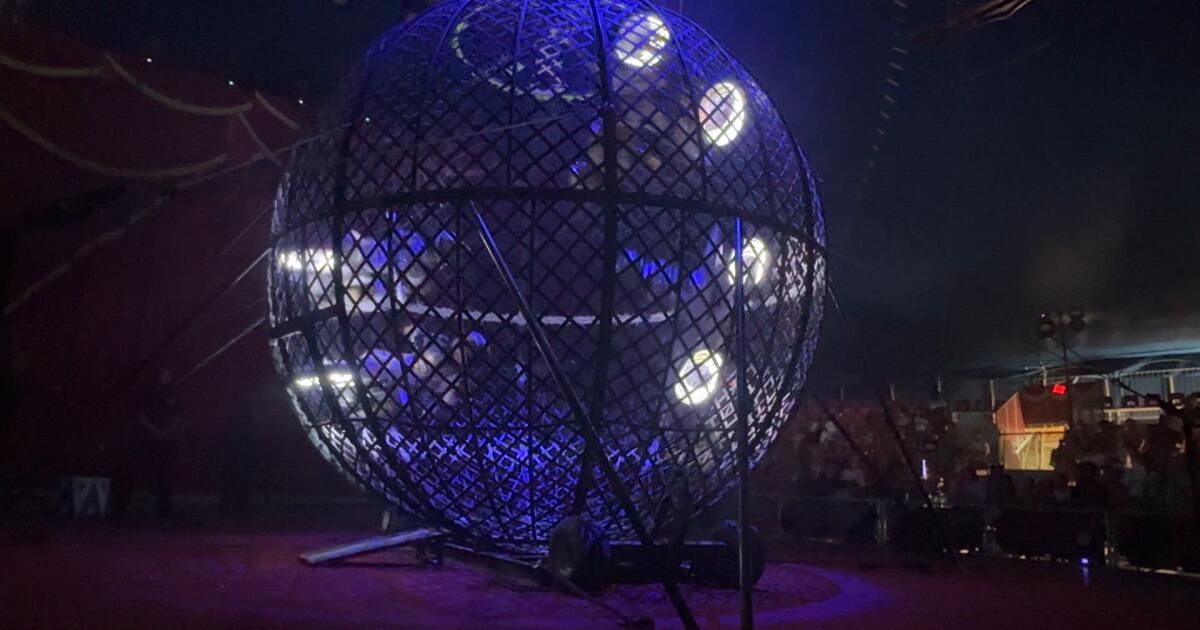
• Fifth-generation circus performer Daniel Eguino is guided by his focus and his faith as he performs inside the locked metal cage known as the Globe of Steel at Circus Vargas.
• A Sunday with the “most unique congregation on Earth”: from the jugglers to the flying trapeze artists to the daredevils — and Father Frank, their clown-turned-chaplain.
It’s almost 11 a.m. on a Sunday in early September, and it’s already 103 degrees here. Around 20 jugglers, trapeze artists and concession stand workers are filtering into the big top that the majestic Circus Vargas uses to perform across 25 California cities 11 months out of the year.
Seated in red chairs arranged in neat rows inside the ring, these members of the circus community have gathered to attend Mass, an optional circus tradition that happens at least once a year. In the space under the tent, you can see popcorn spilled from the previous day’s slate of three shows.
In the front row sits Daniel Eguino, 36, a daredevil who rides the Globe of Steel, or, as it’s also known in the circus world, the Globe of Death. For the act, Eguino and three other motorcyclists swoop about inside an 18-foot-high locked steel cage at speeds of up to 60 miles an hour, thrilling the watching crowds.
Father Frank Cancro leads Mass at Circus Vargas on Sept. 8 in Folsom, Calif., for a group of circus workers that includes jugglers, trapeze artists and concession stand workers.
On his lap is his wide-eyed 1-year-old daughter, Natasha, and next to him is his wife of eight years, Thatiana Fischer, 35. The two, who have been with Vargas for three years, met when they were with Ringling Bros. and Barnum & Bailey. She’s a jazz dancer working as a “line manager” — someone who helps performers retain choreography — for Vargas, and appears in three acts, along with ushering.
Earlier that morning, Father Frank Cancro, 74, the National Circus Chaplain, laid out water, wine, communion wafers and a cross on a folding table adorned with a black tablecloth. Cancro is a former clown turned retired priest turned chaplain, appointed by the United States Conference of Catholic Bishops Circus and Traveling Shows Ministry, which dates back 100 years and serves more than 50 circuses around the world. For the past 15 years, he’s been going on the road with circuses to preside over Mass, perform sacraments and provide pastoral care. He doesn’t earn a salary and lives off his diocese retirement and special collections.
Serving what he calls the “most unique congregation on Earth,” he caters to the “spiritual and personal needs of all those who travel down the road without a ZIP Code.”
With his priest stole decorated with embroidered clowns, Cancro is part minister, part grandparent, part therapist and part human resources professional for a population that research shows can struggle with their mental health. (He sees two to three suicides per year in his work as circus chaplain, he says.)
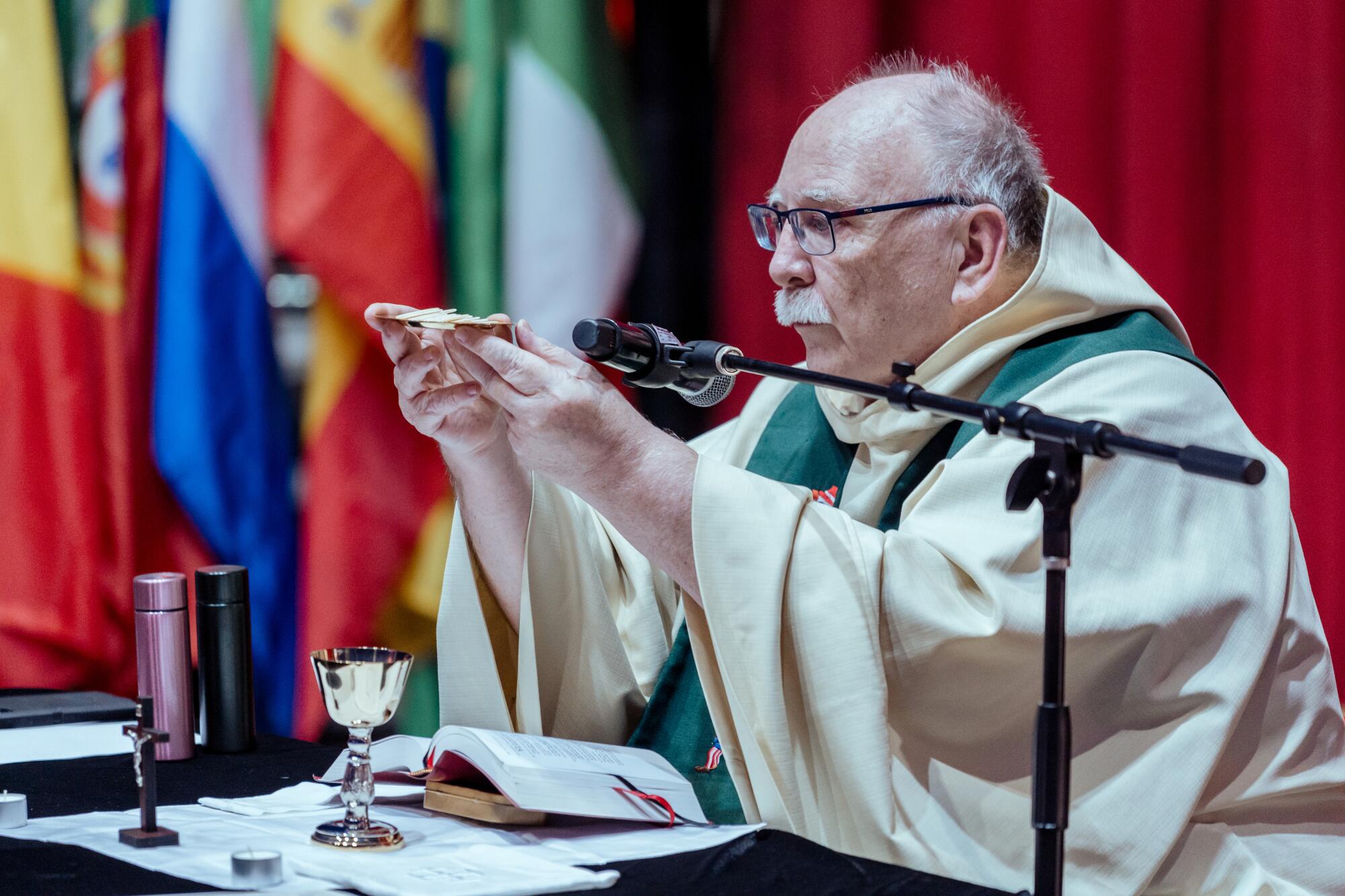
Father Frank Cancro during Mass.
Eguino, Fischer and Cancro have been friends for years. In 2017, the priest assisted with the couple’s Holy Communion and confirmation; when he’s not traveling with them, he stays in touch via the Meta platform Messenger. For Eguino and Fischer, his presence brings comfort. “Sometimes it’s only 20 minutes, but the words he says during the Mass, sometimes it’s all we need to hear in that moment,” said Fischer.
Back under the tent, small fans around the ring blow cool air on the intimate group. Flying trapeze artist Mariella Arata-Quiroga, daughter of Nelson Quiroga and Katya Arata-Quiroga, Vargas owners and longtime friends of Cancro, turns to smile at her grandfather, Victor Arata, a retired high-wire performer. The Faltyny family from the Czech Republic, who perform as jugglers and unicyclists, look on contently.
Cancro preaches embracing wholeness — in other words, health, happiness and belonging — while on the road. He teaches from the book of Mark, telling the story of Jesus’ journey to Decapolis, where he restored a deaf man’s hearing and ability to speak, a physical healing signaling awe. When circus-goers witness acts like a triple somersault on the trapeze or spinning in a human hamster wheel without a harness, they see a fleeting moment that is said to have divine impact. “There’s an opportunity for people to see the reality of God’s presence and God’s face in you,” Cancro tells the group.
Eguino, who says he was “born in the circus,” with five generations of his family performing, has worked in the Globe for the last 21 years — first in the Argentine circuses where he grew up, then in America starting in 2007. The son of a contortionist mother and a Globe of Steel rider father, Eguino has a tattoo of the steel cage on his left forearm along with a $100 bill, representing the act as his livelihood.
The Globe of Steel is also informally considered one of the 10 most dangerous circus acts, along with fire breathing and sword swallowing. Eguino knows of riders from Brazil and Colombia who have died or faced near-death experiences. Globe accidents were reported in Russia and the U.S. in 2015 and in the U.K. in 2018.
“My act is very dangerous,” Eguino says. He doesn’t like to talk about the accidents for fear people will judge him for continuing in his line of work. Instead, he emphasizes safety, practice, equipment maintenance, trust between riders and focus. And he relies on his faith to ground him: “After the Mass, I feel like I am protected. I feel more comfortable to do everything.”
Nearly 10 years ago, Cancro performed the anointing of the sick — laying hands on a person who is ill, spreading oil on their forehead and praying — on Eguino. The sacrament is often associated with end-of-life care, but in the circus it can occur in the context of accidents. Eguino was in the hospital awaiting surgery after breaking his jaw during practice at the Bradenton, Fla., winter quarters of Feld Entertainment, the company that owns Ringling. As Eguino recovered, no other rider would enter the Globe for fear of getting hurt. Cancro blessed it, sprinkling holy water both inside and out.
Under the tent, Cancro asks the crowd, “Is there anything or anyone someone wants to pray for? Just shout it out.”
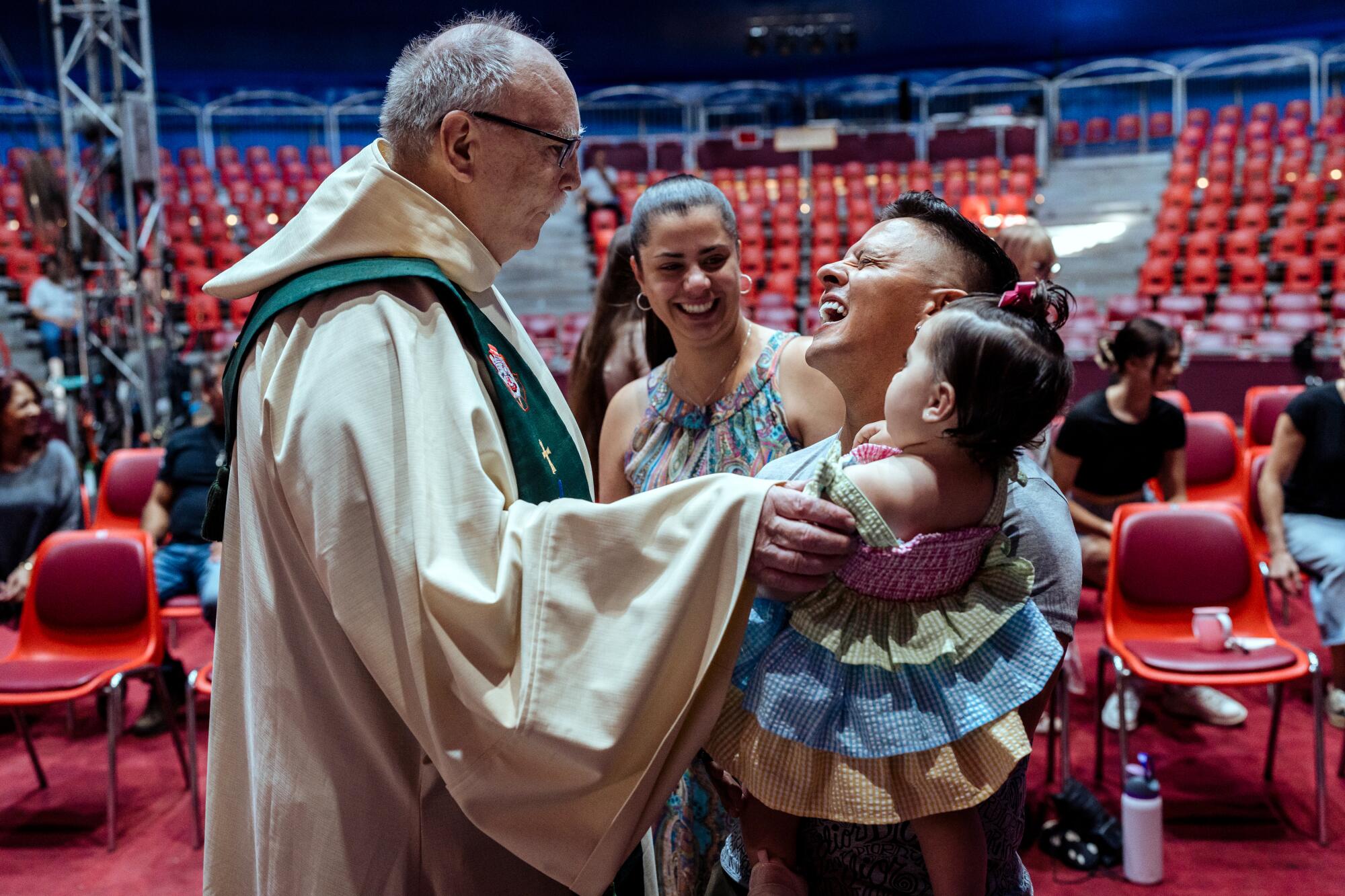
Father Frank Cancro speaks with Daniel Eguino, holding Natasha, and Thatiana Fischer.
At first, silence follows. In a middle row, Ringmaster Johnathan Lee Iverson, who has known Cancro for two decades, and his wife, Priscilla Iverson, a dancer turned show liaison, hold hands.
One by one, people stand to offer requests.
“I want to pray for Larry, a visitor to the circus every year in Escondido, who I would chat with often. He knew many performers’ names. He passed away in April, and I just found out,” says juggler and unicyclist Emil Faltyny.
“I pray for a member of the circus community who is in the hospital,” Fischer says.
Following the 40-minute service, a sense of jubilation fills the tent.
“Today I feel very happy,” Eguino says. “It was the first Mass with my child.” During the service, Natasha had been seated on her father’s lap without a peep until the very end, when she spotted Arata’s dog and had to say hello. Afterward, she waddles through the ringside seating in her white and pink sparkly sneakers.
By the time the doors open at 2 p.m. for the show, Fischer is in her polyester usher uniform, helping audience members to their seats.
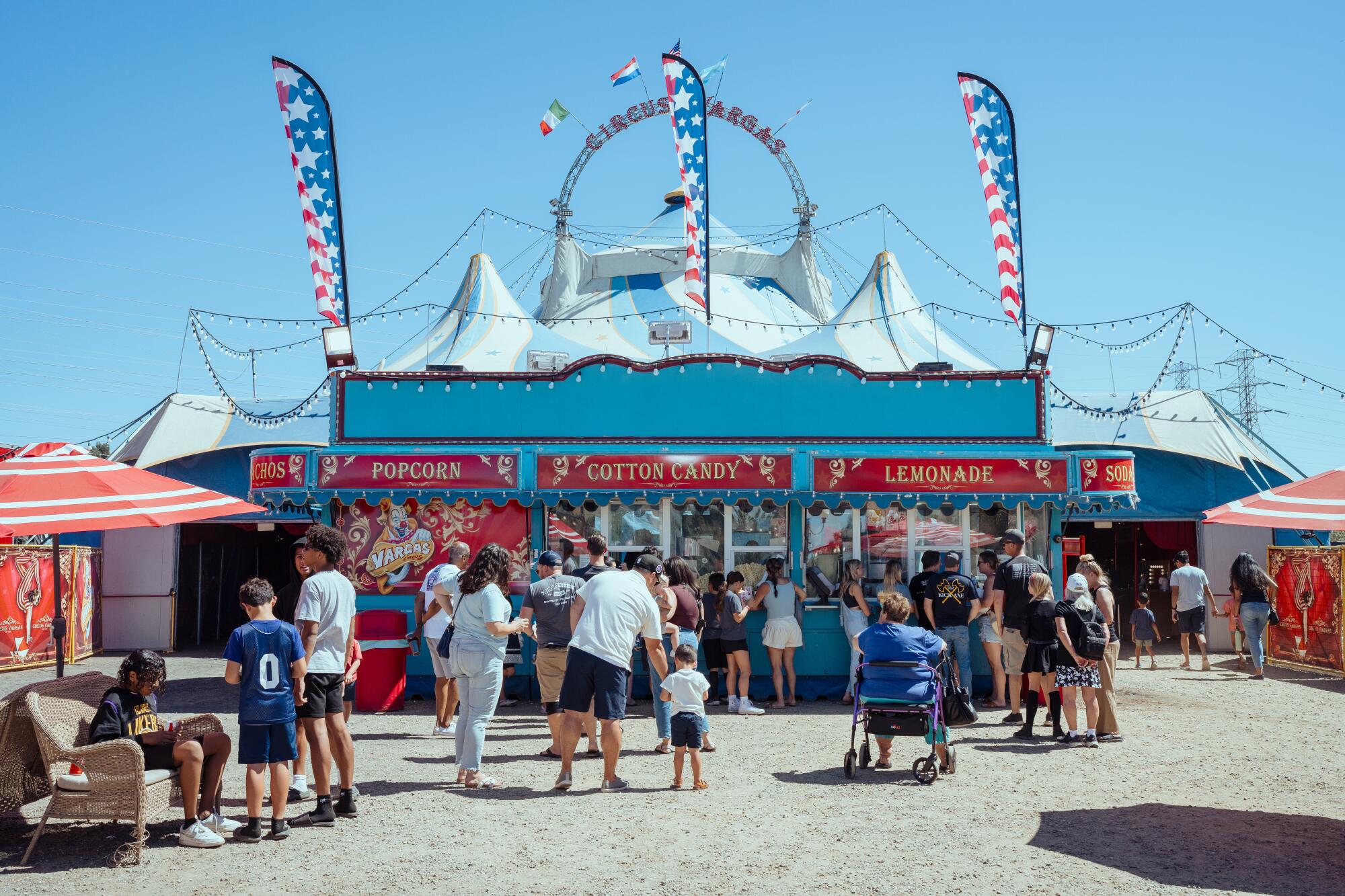
Attendees buy refreshments before entering the Circus Vargas tent.
By 2:15 p.m., she is dressed in a green gown with a fruit headdress on her head, representing her home country of Brazil, for the opening act: a roll call in which costumed performers greet the audience with song and dance introducing the 13 countries — from Italy to Bulgaria — they collectively represent.
By 3:30 p.m., the Globe riders are warming up, stretching and playing a quick game of pingpong at a table behind the tent.
At 3:40 p.m., the four motorcyclists head to their truck to claim their bikes and don chest protectors, heavy-duty knee-high boots, knee pads and bedazzled helmets. In selecting their matching white-and-gold outfits, Eguino, who is in charge of costumes, was inspired by Tommy from the Power Rangers franchise.
Backstage, Eguino leans his body against his motorcycle and closes his eyes for a quick prayer. Growing up in Argentina, faith was always a part of his life, he says, but it’s deepened as he’s grown closer to Cancro.
Fischer whispers “good luck” in her husband’s ear, and they kiss.
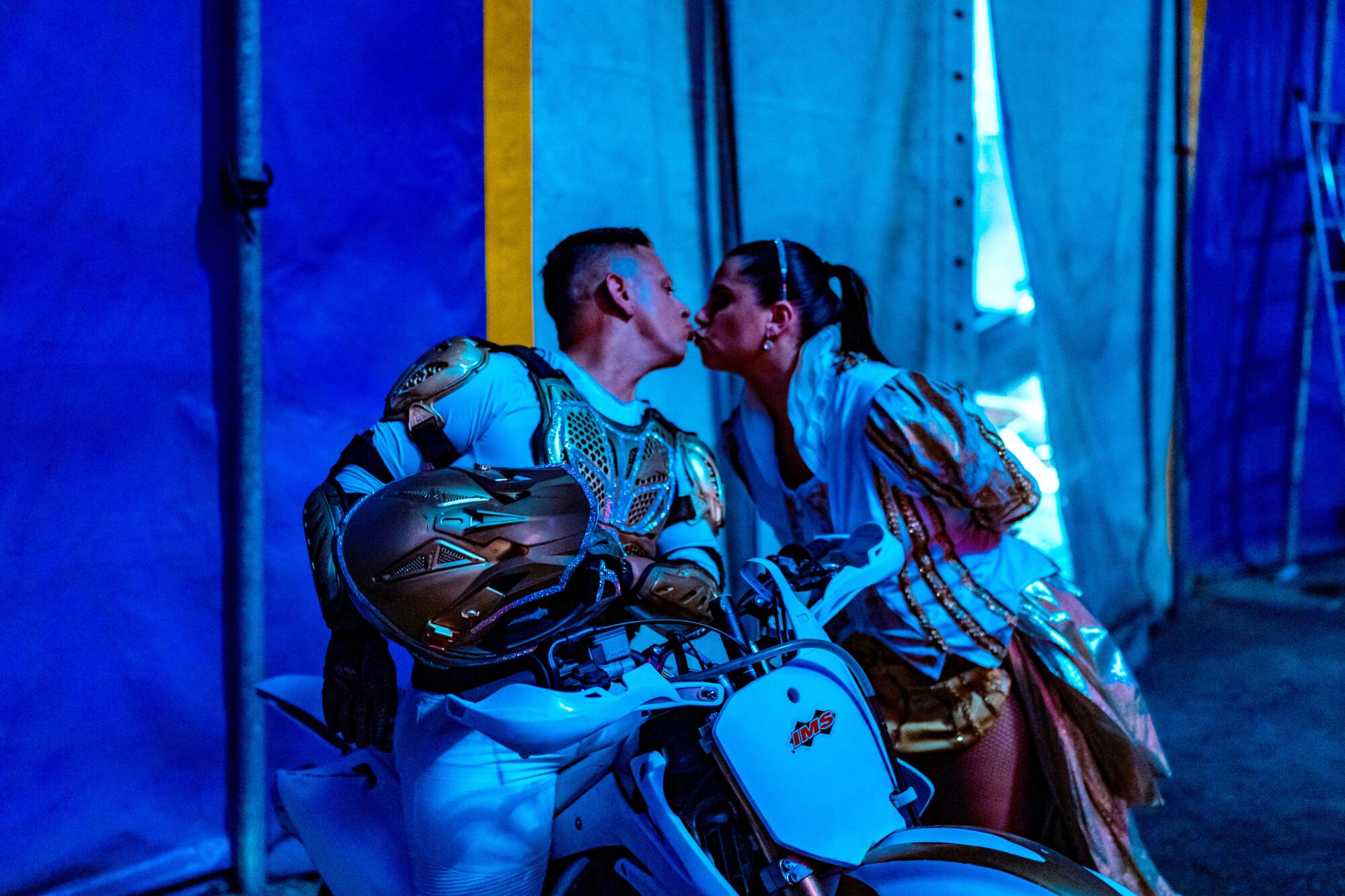
Daniel Eguino kisses his wife, Thatiana Fischer, before the Globe of Steel act.
“Are you ready?” the ringmaster roars from inside the tent.
On his bike backstage, Eguino steps on the gas twice.
Techno music plays as the riders enter the stage. Sweat is visible on their faces. Some 900 attendees stare, rapt, as the daredevils loop and arc on their bikes, the wheels illuminated. The tent is immersed in a deafening motorcycle hum. A mere arm’s length from one another, the riders stay steady, thanks to centripetal force and prayers.
1
2
3
4
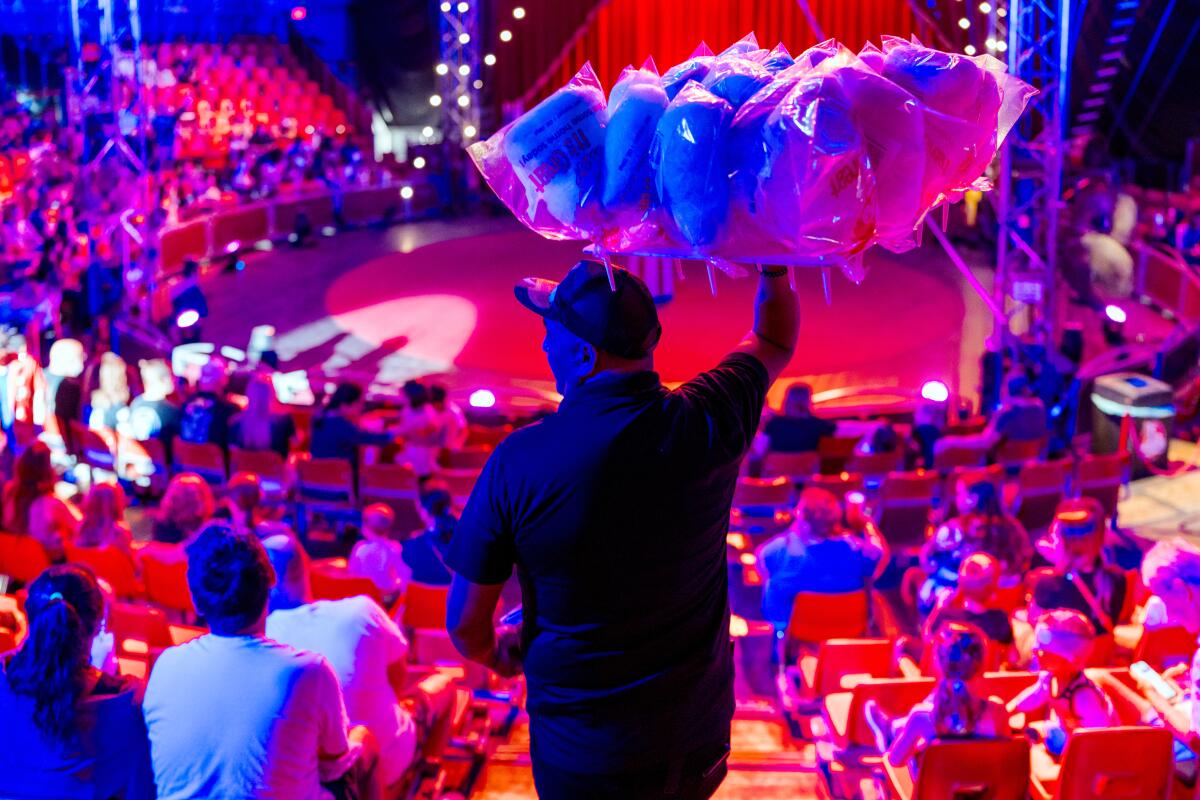
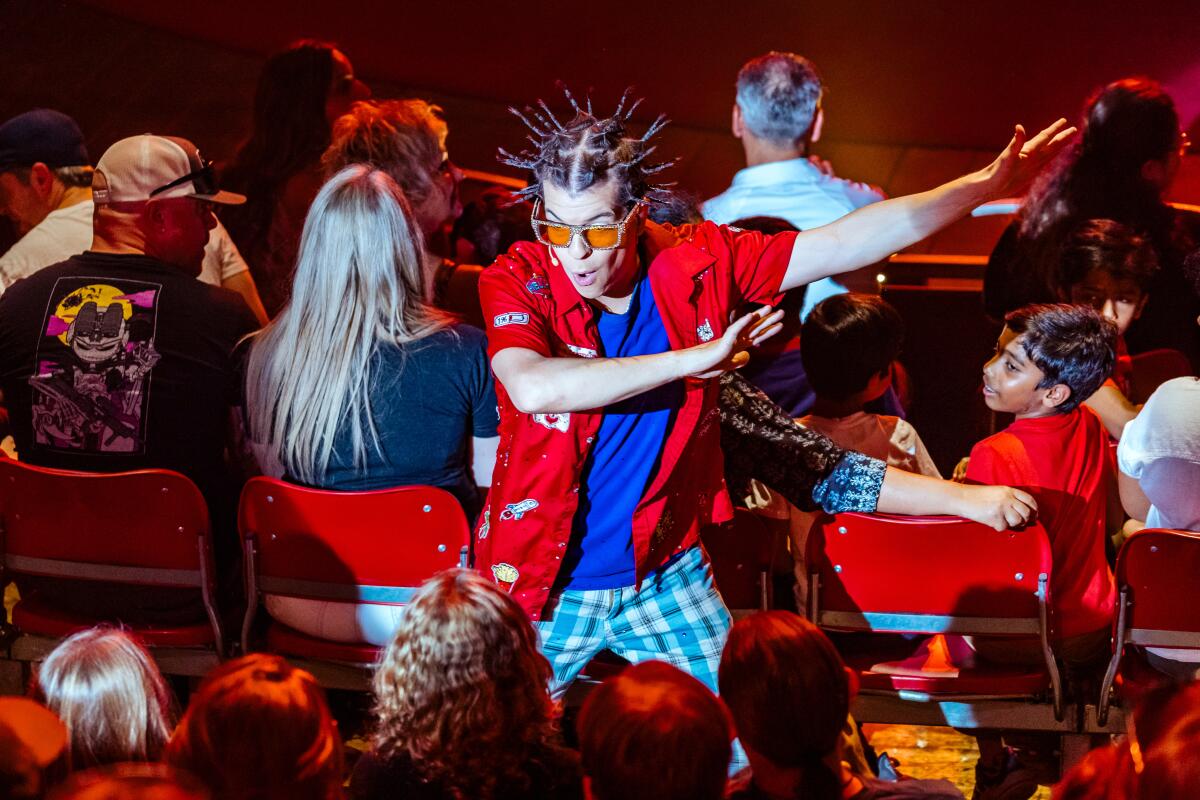
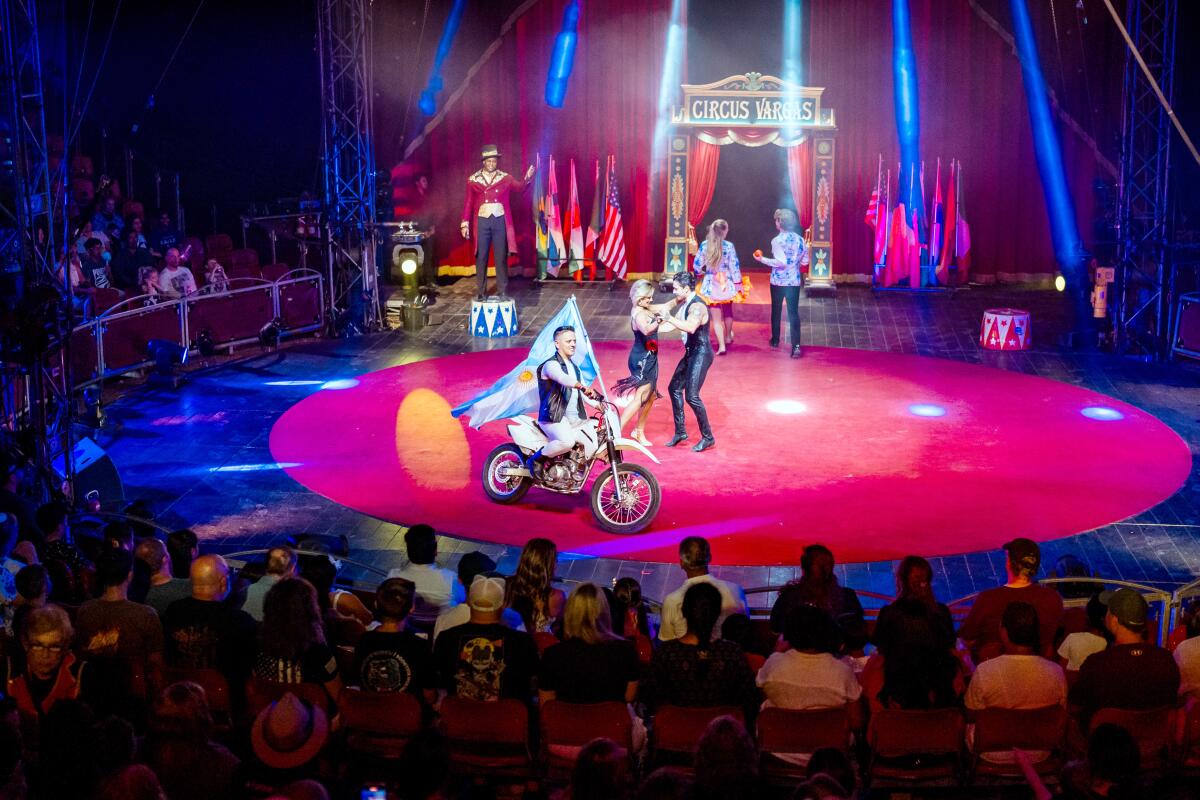
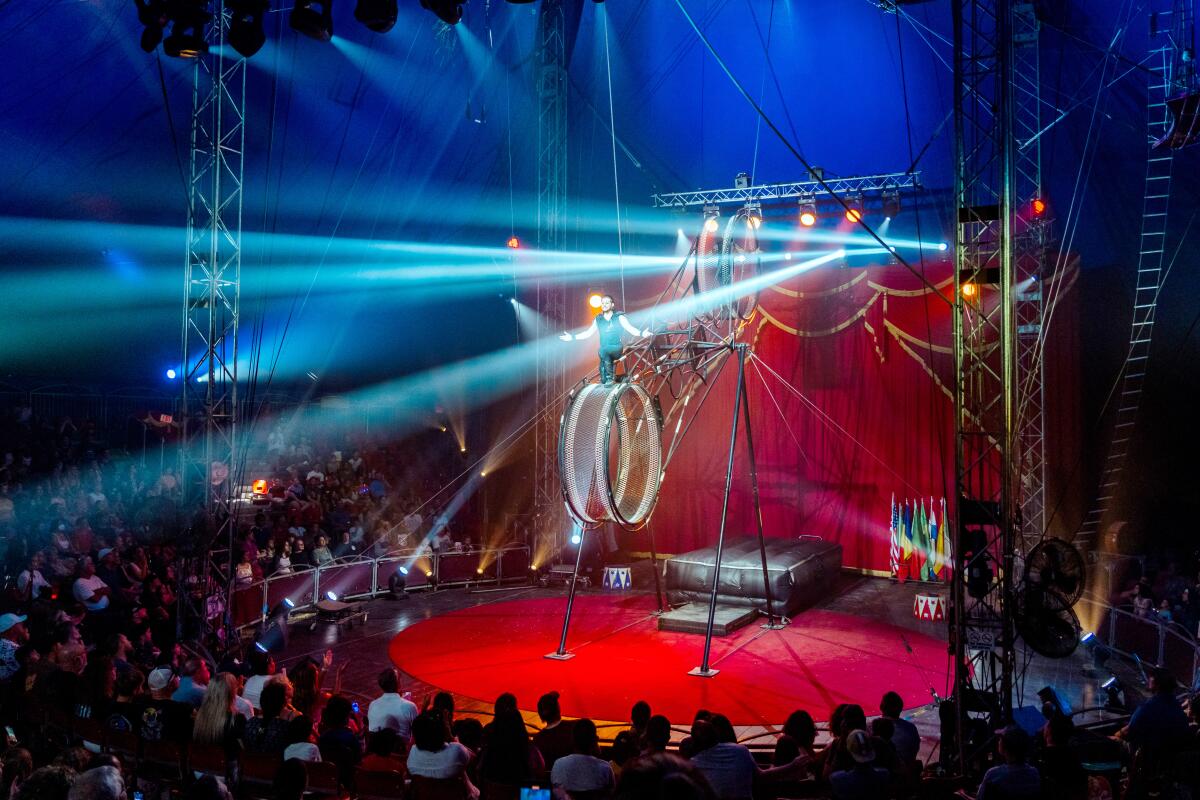
1. Circus performer Steve Caveagna entertains the crowd. 2. Daniel Eguino circles the ring holding Argentina’s flag. 3. Patrick and Josue Marinelli brave the spinning Wheel of Destiny. 4. A vendor sells cotton candy before the performances begin.
After five minutes, the riders come to a halt. A crew member opens the Globe’s gate, and Fischer enters the ring, handing a flag to each rider — Bulgaria for Lyubo Karamitrev, leader of the act; Colombia for Neker Mesa; Mexico for Tony Vetty; and Argentina for her husband. The riders circle the ring on their bikes, waving their flags and beaming with pride as the audience roars.
As the stage crew rolls the Globe out of the tent, the riders exit the ring, lingering by the large fan set up backstage. They’ll appear in the last act, when the whole cast sings “We Are One.” Then there’s a short break before the next show starts at 5:30 p.m.
Around intermission of the second show of the day, about a half-hour until the Globe of Death act, the sun sets over the lot in Folsom. Dressed in sweat-shorts and a T-shirt, with a calmness incongruous with his upcoming performance, Eguino sits on his patio. The air has cooled to below 100 degrees for the first time all week.
Fischer steps out of the trailer in a sundress, holding a baby monitor showing a sleeping Natasha. Cancro joins her and Eguino in their outdoor living room, where they talk about the next sacrament the family wants to tackle. Fellow Globe rider Mesa has a 5-month-old baby, and the families are considering a joint baptism. In 2019, Circus Vargas hosted six baptisms and six confirmations in one ceremony. Cancro tells the couple he’ll come back anytime to do it.
Eguino and Fischer express contentment with life, although they have had some struggles with finances. Working as independent contractors who aren’t reimbursed for travel expenses, making enough for groceries, clothing, the dogs (the couple have a Yorkie, a Maltese and a husky), the truck and the costs involved with having a baby can be a challenge. Fuel for the trailer, which they live in throughout the year — sometimes taking it on the road during their month off in December — can be particularly burdensome. They’re also navigating the constant transformation that comes with a new baby.
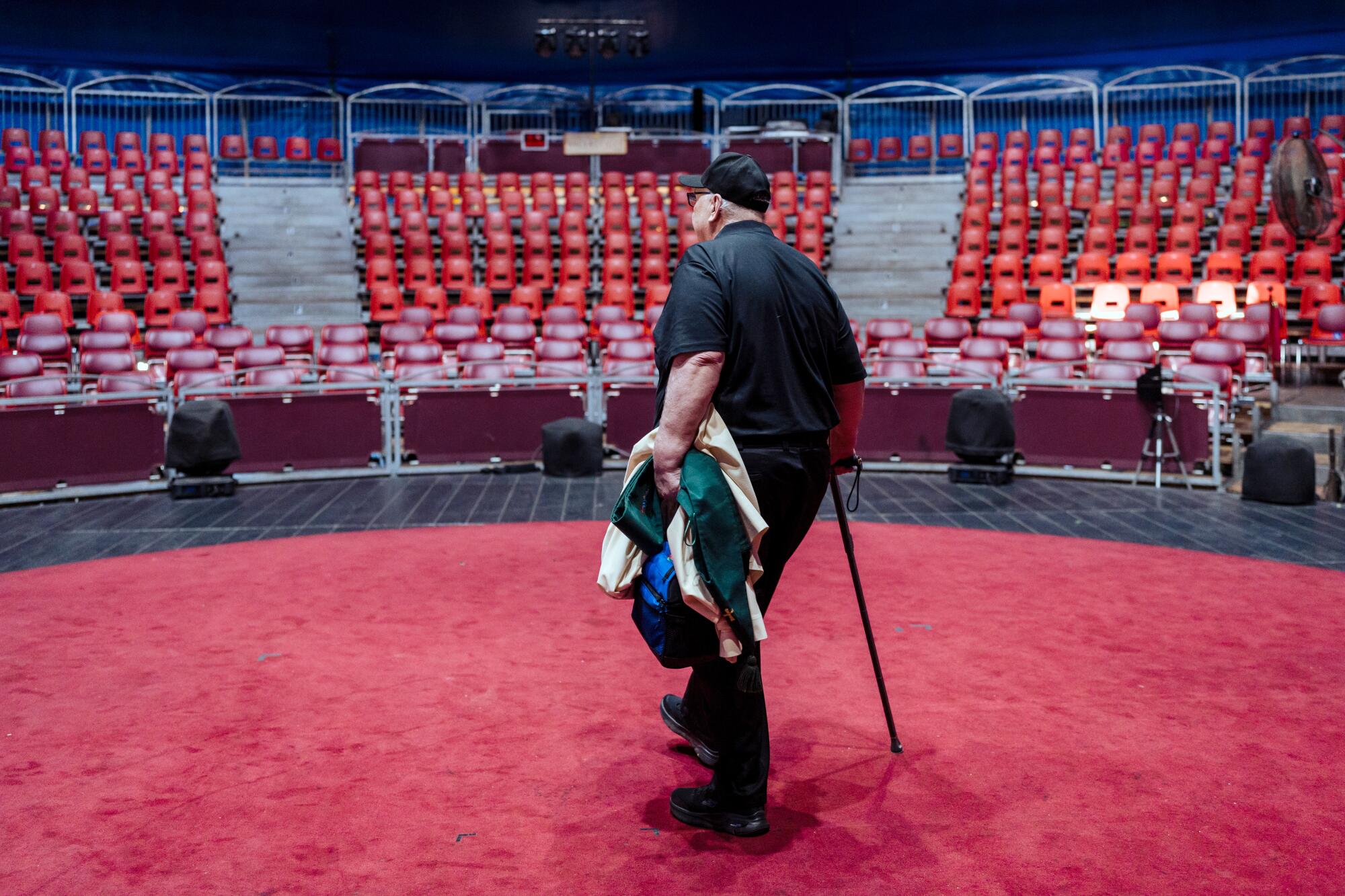
Father Frank Cancro exits the tent after leading Mass at Circus Vargas.
All three of them stare into the baby monitor as Natasha stirs but doesn’t wake.
“Father, can you give us a prayer before I go?” Eguino asks.
The three hold hands as Cancro prays for protection for the family. Fischer tears up at the mention of her daughter’s name, explaining she’s often emotional, whether it’s a sad movie or a visit with the circus priest. Eguino smiles and stands to go suit up for his last ride of the day.
Without really knowing it, every circus attendee shows up to see if the juggler will keep the balls in the air, if the flying trapeze artist will catch their partner, if the rider will survive the Globe. Today, with a little faith, Eguino emerges unscathed and ready for his next high-stakes ride.
Catch Circus Vargas in SoCal
Santa Clarita: Valencia Town Center, 24201 Valencia Blvd., Santa Clarita, through Sept. 23
Woodland Hills: The Promenade mall, CA-27 and Erwin Street, Los Angeles, Sept. 27-Oct. 14
Torrance: Del Amo Fashion Center, 3525 W. Carson St., Torrance, Oct. 18-Nov. 4
Get tickets and more information here.
This story was supported by a grant from the Chaplaincy Innovation Lab at Brandeis University in partnership with Templeton Religion Trust.



Lifestyle
L.A. Affairs: It’s hot when a man drives to me. But would this new guy make the trek from the Valley?

I met Dan on Hinge.
He lives in Woodland Hills, and I live in Venice. In Los Angeles, this is considered a long-distance relationship. In another city it might be nothing. Here, it’s a factor.
But I believe that with the right person, you can make anything work, so I stay open. I’m a native New Yorker, and if I were living in Brooklyn and a guy lived on the Upper West Side, that would be a 45-minute subway ride, which is truly nothing in New York. So with that same logic, I try to have flexibility with men in L.A.
When we started planning our first date, Dan suggested three options: a hike on mushrooms, a wine tasting or a walk on the beach.
A hike on mushrooms is something I’d only do with someone I already trust, not someone I just met online. I don’t do first-date hikes because I don’t like feeling trapped if the guy’s a dud. So I chose the wine tasting.
Then I learned the wine tasting was in West Hills.
On a Friday night, driving there from Venice would be insane. So I said I didn’t want to meet there because of the traffic. He suggested Malibu. That was also not ideal on a Friday.
I was getting annoyed — this was a pink flag because in my dating world, the guy is supposed to come to the woman’s neighborhood in the early days. I’ve gone out with plenty of men from the Valley who effortlessly suggested they come to me. It’s not rare or impossible.
I suggested he come to the Westside. I didn’t specifically say Venice, and in hindsight, I probably should have. He landed on Brentwood, which was manageable for both of us. On our first date, we met at an Irish pub on Wilshire Boulevard. He was cuter and more interesting than I had expected, and with the Guinness flowing, we had fun.
When I got home, he texted me: “Well, I like you 🙂 Less the tik tok and the lack of rock music in your life, but it’s not a deal breaker — there are other qualities 🙂 What are your thoughts?”
I noticed the slight negativity but was mostly dazzled that a man texted immediately after the date to say he liked me. In the modern dating economy, this felt rare.
The next day, both of our evening plans fell through, so we made a last-minute date. The wine tasting he originally suggested still sounded like fun, and although it meant me driving to the Valley, I was up for it now that we’d met.
We sipped flights at Malibu Wines & Beer Garden in its airy, romantic courtyard and played a flirty version of Truth or Dare. Halfway through, he dared me to kiss him.
We ended with sushi on Ventura Boulevard and a short make-out session in his car. He invited me to Thanksgiving at his uncle’s, which felt too soon, but also sweet.
After the second date, he texted and said he had his kids that week and was also hosting an event on Thursday, so his only day to meet was Wednesday. I said great.
On Tuesday night, he checked if we were still on, and I said yes.
Then he texted: “I’m flexible on time but not on location. I have a big event on Thursday, hopefully you can come to me again.”
My stomach tightened. This again?
So I texted back: “I drove to you last time, which was a bit of an exception for me especially in the early days, but the wine tasting location sounded special. Usually guys come to my area. How about we switch it up this time?”
He replied: “I appreciate the effort! Because of my event, I’d rather be close to a computer just if needed … Here is what i offer:
— I’ll come to your area anytime next week/end
— Lunch/dinner on me
I want to continue where we stopped last time 😉 No pressure of course, but let’s snuggle”
I responded: “Ok let’s meet next week. Snuggles sound nice … let’s see what happens …”
Then he wrote: “So I won’t see you tomorrow?”
I replied: “Unless you wanna come to me and bring your laptop along, let’s rain check until you have more flexibility.”
He said: “Dang, you are hard. I’ll let you know tomorrow around midday if it’s ok.”
And then — surprise — he decided to come.
He drove to Venice for a 5 p.m. date. He said his ETA was 5 p.m., and it ended up being 5:25 p.m., typical 405 Freeway.
When he showed up, he was in a cranky mood. On our way to KazuNori in Marina del Rey, I thanked him for picking me up and told him I think it’s hot when the guy comes to the girl.
“You’re just saying that because you want me to come to you more,” he said, not playfully, but aggressively.
That was basically the end for me. But there I was, in his car, heading to dinner. So I stayed pleasant and tried to make the best of it.
I shared that in the early stages of dating, I find it’s good etiquette for the guy to come to the woman’s neighborhood. He immediately disagreed and started ranting about how dating rules are ridiculous and how they swing in women’s favor. He resented paying for dates and declared he wasn’t looking to “sponsor a woman’s life.”
“If women want equality and equal rights,” he said, “then it should apply all across the board, including dating, and the man shouldn’t have to pay.”
I said women don’t actually have equal rights because we get paid less than men and often receive lower salaries than men in the same position.
I tried to change the subject and reset the mood, but he insisted we keep hashing it out.
I tried to explain masculine/feminine dynamics: providing and protecting, giving and receiving.
“What does the man get out of this arrangement?” he asked.
It was like watching someone’s personality warp into Mr. Hyde. Then he brought up another point: He’s a single dad of two kids, so he gets tired; and because I don’t have kids, that should factor into who drives where.
At this point, I was barely engaging and focused on eating my hand rolls, and I couldn’t wait to get home.
The check came, and I happily split it, wanting nothing further from him.
In the car back to my place, he remarked: “It’s obvious we’re never gonna see each other again.”
Obvious, but did it need to be stated?
Then he showed me a Spotify playlist he’d made for me of his favorite electronic music, because he knows I like EDM.
“Oh, that’s sweet,” I said.
“Yeah, that’s how I show interest. Through things like this, not who drives to who,” he replied.
When I got out of the car, we wished each other luck, and I headed inside and shut the door.
Two hours later, he sent me the playlist. I’ve yet to listen to it.
It wasn’t the distance that ruined it. It was the resentment. I’m not looking for a man who feels burdened by the effort. I’m looking for a man who sees the value of courting a woman in the first place.
The author is a writer, comedian and former psychologist who lives in Venice. She is the creator of the new vertical series “Manfari.” She’s on Instagram: @solange_neue and @manfari.show.
L.A. Affairs chronicles the search for romantic love in all its glorious expressions in the L.A. area, and we want to hear your true story. We pay $400 for a published essay. Email LAAffairs@latimes.com. You can find submission guidelines here. You can find past columns here.

Lonnie Bunch III is the 14th Secretary of the Smithsonian. He’s pictured above in September 2017.
J. Scott Applewhite/AP
hide caption
toggle caption
J. Scott Applewhite/AP
In a memo addressed to staffers sent Tuesday, the secretary of the Smithsonian, Lonnie G. Bunch III, defended the institution after the White House issued a 162-page report that characterizes the National Museum of American History as a place which has become “subject to institutional capture by a radical, activist ideology that is fundamentally opposed to telling the noble, honest story of the great country we know and love.”
In his email, which NPR has obtained, Bunch wrote in part: “While there will always be room for improvement, this report is not a fair characterization of the work and totality of the National Museum of American History. At the Smithsonian, our work is driven by scholarship, accuracy and an uncompromising commitment to tell the fullness of America’s story. As public servants and the keepers of this institution, we are charged with helping a nation find understanding, hope and clarity and as part of that duty, we are dedicated to excellence, reflection and growth.”

He continued: “We remain focused on what grounds us: a steadfast commitment to scholarship, nonpartisanship, independence, accuracy and integrity. For nearly 180 years, the Smithsonian has worked alongside partners across government — from the White House to Congress to our governing Board of Regents — guided by our enduring mission to increase and diffuse knowledge. That purpose remains: to pursue knowledge with rigor and to serve the American public with clarity and care.”
The White House report was issued on July 4 by the Domestic Policy Council under the title “Saving America’s Story: How Ideological Capture at the Smithsonian Institution’s National Museum of American History Erases Our Heritage.”

The council faults the National Museum of American History on a multitude of fronts, saying it underemphasized the Founding Fathers and early colonial and Revolutionary history; was not sufficiently celebratory of the country’s 250th anniversary; and that it engaged in “anti-white,” “illegal alien” and transgender activism.
It also accuses the museum of trying to “indoctrinate” teachers and students through its exhibitions, programming and teaching resources.
In the report, the council also specifically criticizes museum director Anthea Hartig, who has led the National Museum of American History since 2019 and is concurrently the president of the Organization of American Historians, calling her “an activist advancing an ideological agenda contradictory to the museum’s founding purpose of fostering patriotism.”

The Trump administration has made the Smithsonian museums one of its primary targets in its efforts to reshape cultural narratives to align with its viewpoints. In August 2025, the White House requested a “comprehensive internal review” of eight Smithsonian museums, including the National Museum of American History, following an executive order issued by President Trump in March 2025 in which he called for the removal of “improper ideology” from the Smithsonian’s offerings.
According to the Smithsonian’s charter, all of its 21 museums, 14 education and research centers, and the National Zoo are meant to be run independently of the federal government. The Smithsonian is overseen by Bunch and a board of regents, which includes Vice President Vance, Supreme Court Chief Justice John Roberts and other members appointed by Congress.
In an interview with NBC’s Meet the Press on Sunday, Bunch spoke about the Smithsonian’s 250th anniversary special exhibition at the Smithsonian Castle, which is called “American Aspirations.”
He told NBC: “It’s really important for people to understand that America is much an ideal as it is a place, that it’s a series of aspirations that have really shaped who this country is. And so for me, what is so powerful is to say, ‘Let us honor the words of Thomas Jefferson and the founders, but let us use those to challenge us to be better.’”
Jennifer Vanasco edited this story.

-

 New Jersey6 minutes ago
NJ Legislators Are Considering a Bill That Could Ban Tesla Robotaxis Due to Their Tech Choice
-

 New Mexico9 minutes ago
New gay bar opens in Nob Hill
-
North Carolina14 minutes ago
Explore on the water: How, where to kayak in Raleigh
-

 North Dakota21 minutes ago
Schulz to transition from ND Parks and Recreation to ND Department of Corrections and Rehabilitation
-

 Ohio24 minutes ago
Marion lecture to focus on expanding youth learning programs
-
 Oklahoma29 minutes ago
‘THE SPIRIT OF OKLAHOMA!’ Cherokee artist restores landmark to honor father’s legacy
-

 Oregon36 minutes ago
Oregon ‘mega-mansion’ sits unfinished 30 years later
-

 Pennsylvania39 minutes ago
Here’s how to see Big Boy, the world’s largest steam locomotive, in western Pennsylvania

