Lifestyle
These viral L.A. 'head spas' will show you what's been hiding in your scalp (Ew!)

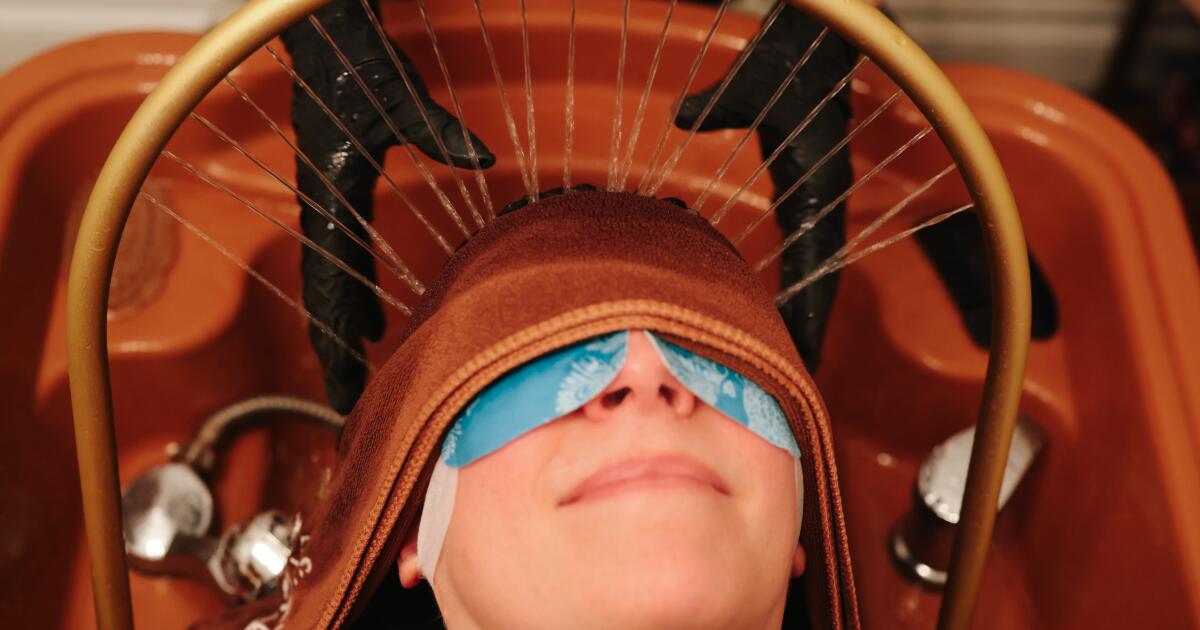
I’ve never given much thought to my scalp. Aside from the occasional subconscious scritch-scratch or vigorous shampooing, it’s kind of just … there. A necessary but often-overlooked cranium cover.
But the humble scalp is the focus of an increasingly popular wellness trend: elaborate Chinese and Japanese-inspired treatments at so-called head spas. At these businesses, visitors receive a scalp analysis followed by head and neck massages and repeated deep cleanses. Ogling the inner workings of the scalp, an otherwise forgotten body part — and addressing its needs through blissful hydrotherapy treatments — has driven the hashtag #headspa to draw attention on Tiktok for more than a year now. In one viral video of an L.A.-area head spa, a towel-clad influencer claims it will “change your life.”
I was intrigued. Which is how I came to find myself sitting in a salon chair at Cai Xiang Ge, or “CXG,” in San Gabriel, with a practitioner weaving a tiny digital camera through my hair. I faced a 250-times-magnified view of my scalp on a nearby screen. And what I saw resembled an eerie underwater kelp forest, with dark, swaying stalks growing out of a glistening, spongy field dotted with red patches. It looked like something out of a sci-fi film. Ew.
Deborah Vankin undergoes a scalp exam to determine the direction of her treatment at Cai Xiang Ge head spa.
The process was embarrassingly revealing. Turns out I have an oily scalp with bits of dandruff, CXG owner Ning Chen told me. “And see these red parts? You’re not getting enough sleep. Stress,” she said.
But there’s also a strange delight in examining your dirty scalp up close. As humans, we are nothing if not fascinated by our own bodies, whether that’s picking a scab, prodding a canker sore or popping a pimple. (You know you’ve done it.) The shock factor of scalp treatments is integral to its appeal, according to Sara Hallajian, a Santa Monica-based trichologist and hair loss and scalp specialist at Âme Salon.
“It’s about: ‘Oh, let’s look at your dandruff up close and how dirty your scalp is before and how clean after,’ because it’s not something you see with the naked eye,” Hallajian said.
After my scalp’s close-up, Chen led me into a dimly lighted room with multiple spa beds and traditional Chinese harp music. Birds chirped on the soundtrack as I changed into a robe and reclined on the bed. On one end was a shampoo basin, at the other a foot bath, filled with warm water steeped with Chinese herbs. It was early February, and I generally appreciate rituals around renewal this time of year, cliche as it may seem.
The $135 Royal Treatment scratched that itch. For 90 minutes, CXG’s Alyssa Nevins repeatedly scrubbed my scalp and washed my hair as part of a six-step process. The aromatherapy head massage was a dry one, in which Nevins rubbed tingly feeling tea tree oil into my scalp and then applied an electronic, cephalopod-like device, its multiple arms whirling away tension. That was followed by four shampooings, each with a head and neck massage.
The highlight: Nevins left me lying there for 10 minutes with a circular, waterfall-like device bathing my head and neck in herb-treated water. I wore a heated eye mask, my head was tilted backward and my face was immersed in plumes of steam. Thin jets of water massaged my neck and shoulders. It was heavenly; I nearly fell asleep. I also got a hydrating, collagen-boosting facial, an herbal hair steam and a conditioning hair masque.
Deborah Vankin receives a hydrating, collagen-boosting facial during her 90-minute Chinese scalp treatment at Cai Xiang Ge.
(Dania Maxwell / Los Angeles Times)
The experience ended in the salon, with tea and sweets and an “antihair loss treatment.” Nevins sprayed an herbal serum all over my scalp. She then used a high frequency scalp therapy device to disinfect my pores, a treatment the spa said would fortify hair follicles.
Head spas claim that scalp treatments promote circulation and detoxify, calm and hydrate skin, all of which help prevent dandruff, itchiness, dryness, inflammation and hair loss. I wasn’t sure whether that was true or not, but it sure beats injecting my own plasma into my scalp at $1,500 per session, another recently en vogue beauty treatment aimed at promoting hair growth.
Tea and light snacks are offered after the cleanse, and before the blowout, at Cai Xiang Ge.
(Dania Maxwell / Los Angeles Times)
The claims that head spas make are “fundamentally correct,” said Dr. Carolyn Goh, a dermatologist at UCLA Health. “A deep clean and massage can help with circulation and reduce inflammation. My first recommendation to anyone suffering from hair loss is to make your scalp clean. But if you have psoriasis or eczema, it’s not going to help. I’d also caution if you’re sensitive and using essential oils — you can develop an allergy.”
The treatment stimulates acupressure points in the head, particularly one called bai hui, where the so-called meridians meet, according to Dr. Ka-Kit Hui, director of the UCLA Health Center for East-West Medicine. “That may help people with insomnia, anxiety, headaches. It’s costly, but it’s relaxing.”
Scalp treatments have been an integral part of wellness culture for centuries in many parts of Asia, including in China, Japan, Vietnam and Korea.
In China, head spas are so common that “there’s one on every street,” Chen said. They caught on here in L.A. around 2020 and have proliferated in the last year and a half. Now, Chen says, there are about two dozen in the L.A. area, with “about four new ones opening nearby in the past two months alone.” Most of them are in San Gabriel, Temple City, Arcadia and Rosemead — hubs for Asian communities. In addition to CXG, other popular local head spas include Yang Si Guan in San Gabriel, Tou Dao Tang in Temple City and M Head Spa in Rosemead, all of which have opened within the last year and a half.
Cai Xiang Ge owner Ning Chen at the front desk of her head spa.
(Dania Maxwell / Los Angeles Times)
Chen said her head spa helped kick off the trend in L.A. when CXG opened in mid-2021. CXG plans to expand into Beverly Hills within the next year.
Like many head spas, CXG serves one-timers as well as members who visit weekly or biweekly to relax and maintain scalp health. Chen’s clientele was initially 70% Asian and 30% non-Asian; by summer 2023, it was the opposite, which she said is due to social media promotion.
Videos of Chinese scalp treatments on social media are popular among seekers of ASMR — autonomous sensory meridian response — in which certain sounds promote tingling, goosebumps and other relaxing sensations.
In person, the ASMR experience is even more pronounced. Throughout the treatment, there are the sounds of repeated brush swooshes, shampoo lathering and sloshing water. This was especially evident at Tou Dao Tang when I visited.
Tou Dao Tang originated in China, where it has more than 9,000 locations. But in fall 2022, the company launched its first U.S. outlet in Temple City. It has plans to expand into Glendale later this year. Openings are also in the works for Tustin, Las Vegas, San Francisco and New York.
“It’s the new thing,” manager Hannah Lin says of scalp treatment’s growing popularity. “And people want to try the new thing.”
My scalp analysis, conducted by Tou Dao Tang’s Sherry Zhu, again suggested oily skin, dandruff and sleep deprivation as well as a possible nutrition deficiency, Zhu said. The latter was suggested by a few pale-colored hairs.
The subsequent $108 Classic Scalp treatment was a five-step process. It was especially massage-oriented, with repeated scalp kneading, hair combing and cleansing over 90 minutes, and involved five teas, or “herbal soups,” each infused with different organic herbs. The rounds of tea-washing focused, respectively, on detoxification, rejuvenation and stress relief, nourishment and calming, repairing PH balance and hair loss prevention.
These treatments have become so essential for some patrons of Tou Dao Tang that members often keep their own combs and brushes at the spa, labeled with their names, for practitioners to use when they visit.
Deborah Vankin receives a Chinese scalp treatment from Tou Dao Tang head spa.
(Dania Maxwell / Los Angeles Times)
A close-up of Deborah Vankin’s squeaky clean scalp after her treatment at Cai Xiang Ge.
(Dania Maxwell / Los Angeles Times)
Deborah Vankin after her Cai Xiang Ge treatment, which ended with a blowout and styling.
(Dania Maxwell / Los Angeles Times)
“In China, the head spa is so popular,” Lin said. “We wanted to bring it to the U.S. and let people know about our culture.”
The head spas I visited were very different experiences. CXG’s environs were especially luxurious, complete with multicolored lights, aromatherapy and a warm foot bath, while Tou Dao Tang’s home-brewed, organic “tea bath” washings felt more down to earth. They both left me feeling squeaky clean and relaxed — so much so that at Tou Dao Tang, I accidentally floated out the door without paying. (I called back later and took care of the bill.)
After both treatments, my hair was shiny and extra-soft for days.
Needless to say, the itch I had for a feeling of renewal was sufficiently scratched.


Students walk on the Stanford University campus on March 14, 2019, in Stanford, Calif.
Ben Margot/AP
hide caption
toggle caption
Ben Margot/AP
When Theo Baker arrived at Stanford University a few years ago, he joined the student newspaper, following the path of his journalist parents, Peter Baker, a White House correspondent for The New York Times, and Susan Glasser, a writer for The New Yorker.
Through his reporting as a student journalist, he eventually broke a story about manipulated data in Stanford President Marc Tessier-Lavigne’s neuroscience research that helped lead to the university president’s resignation.
Theo Baker’s book, How to Rule the World: An Education in Power at Stanford University was released May 19. In it, Baker describes Stanford as a place where proximity to Silicon Valley gives rise to a parallel system of influence, recruitment and money, with investors looking to identify promising students almost as soon as they arrive on campus.
He told Morning Edition host Steve Inskeep there was “a sort of Stanford inside Stanford,” where elite students are drawn into an “alternate reality” of excess and access to cut corners.
In the interview, he discusses how Stanford is not just a university but also a pipeline where status and power can matter as much as ideas.
We reached out to Stanford University for comment and have not heard back.
Listen to the interview by clicking play on the blue box above.


The scoreboard shows the results of the women’s singles final match between Iga Swiatek of Poland and Amanda Anisimova of the U.S. at the Wimbledon Tennis Championships in London, Saturday, July 12, 2025.
Kirsty Wigglesworth/AP
hide caption
toggle caption
Kirsty Wigglesworth/AP
Fifteen points in tennis? Nice. Thirty, 40 — even better. Advantage — that sounds good. “Love” — that also must be great, right? Well, not quite.
As the French Open rolls on and Serena Williams has announced her return to the sport, maybe you’ve been paying a little more attention to tennis. The sport’s scoring system is notably distinct, and can sometimes be hard to grasp for newcomers. But even tennis aficionados might not know why, or how, “love” became the unmistakable callout for zero points. For this installment of NPR’s Word of the Week, we’re exploring how a word that signifies trailing behind got such a sweet name.
“Love” comes from the heart — or an egg?
It’s hard to pinpoint when the first tennis ball went over the net. Tennis is a derivative of lots of other sports, such as “jeu de paume,” a handball game played in France, said JT Buzanga, the collections manager at the International Tennis Hall of Fame museum.
But tennis became a patented, official sport in 1874, said Steve Flink, a journalist whose tennis coverage got him inducted into the International Tennis Hall of Fame. It has retained its unique, mysterious scoring system ever since.
“By and large, the original system has held up almost entirely,” Flink said.
The use of “love” goes back to the late 18th century, said Jesse Sheidlower, a lexicographer. But it was used earlier than that in card games such as whist and bridge. Before the term made its way to tennis, the sport favored plain old “nothing,” or “nil,” he said.
Why love in the first place, though? Historians don’t really know for sure, but there are a few theories.
The French could have something to do with it. Some historians believe “love” derives from “l’oeuf,” which means “the egg” in French. Because eggs are shaped like zeros, terms such as “goose egg” and “duck’s egg” have been used in other contexts to mean zero, Sheidlower said.
It’s also possible English speakers mispronounced l’oeuf as “love.” But Sheidlower isn’t convinced that’s the answer.
“It’s the French equivalent of an English expression. But since that expression doesn’t appear in French, the French word wouldn’t have been used,” he said.
To be sure, France has had a lot of influence on tennis culture, Buzanga said. For example, “deuce” or a game tied at 40 points, comes from the French word for “two”: “deux.” But he prefers another prominent theory: that “love” comes from the idiom “for the love of the game.” Even if a player hasn’t scored, it doesn’t matter, because their heart is in it. It’s the theory Sheidlower said is the most plausible, because the idiom was used by the English before tennis was popularized.

Another variation of the “love of the game” theory is that the word could have come from the Dutch “lof,” or “honor” — or the Latin “amare,” meaning “to love,” Flink said.
But if tennis’ “love” doesn’t come from a French word, the theory at least has a French sensibility.
“I think the ‘for the love of the game’ is kind of romantic,” Buzanga said.
“Love” probably isn’t going anywhere
Tennis used to be a sport of leisure. The style of play has changed a lot over the years; players are more athletic and competitive, for instance, Flink said. But the rules of the sport are more steadfast, he said.
“There’s this incredible, enduring respect for tradition in tennis,” he said. “Changes are not made easily.”
There has been one major change in modern history: the tie-break. Matches can go on and on because players have to score two consecutive points to break a deuce, or by two games to break a tied set. But the onset of television meant matches would have to get shorter if the sport wanted to capture a larger audience, Flink said.

Change even came for “love.” An alternative sprouted up in the 1970s, and is still used today: “bagel,” named for its zero shape, Sheidlower said. Novices may say “zero,” and insiders will understand what they mean, but they “will needle them about it,” Flink said.
But “love” still prevails.
“People kind of like it,” Flink said. “It’s different. Why say zero when you can say love?”
-
Lifestyle18 minutes ago
‘How to Rule the World’ explores education and power at Stanford University
-

 Technology31 minutes ago
Cyberdecks used to look like little laptops, but now they’re getting more personal
-

 World34 minutes ago
Pete Hegseth warns narco-terrorists as U.S. backs Bolivia’s government amid coup warnings
-

 Politics38 minutes ago
Democrats split over Tlaib’s Lebanon measure as Republicans seize on Hezbollah omission
-

 Health46 minutes ago
Popular weight-loss diet shows surprising impact on serious mental health condition
-

 Sports48 minutes ago
NBA bans two fans for life after court invasion during Knicks-Spurs Game 1
-

 Technology54 minutes ago
Charter breach warning: What customers should know
-
 Business1 hour ago
Trump announces new coal export terminal in Oakland

