Lifestyle
These SoCal vintage motels have found new life. But you can't sleep there


There were no vacancies beneath the old neon Farm House Motel sign last Saturday — no guest rooms at all, in fact. But the 1950s Riverside property, now known as the Farm House Collective, was busier than it has been for decades.
By 10 a.m., when a ribbon-cutting marked the Farm House’s rebirth as a mini-mall, food hall and music venue, the parking lot was full.
The motel’s old carports next to the guest rooms were enclosed and became indoor retail spaces.
(David Fouts / For The Times)
By midday, Steve Elliott of Smokey Steve’s barbecue had sold about 160 pounds of meat from his pop-up booth and there was a long line for $6 tacos at Bar Ni Modo.
By sundown, an audience of several hundred had gathered to see L.A. indie rock band Allah-Las take the outdoor stage.
Until this redesign, the Farm House Motel “was a homeless encampment for a long time,” said James Elliott, 29, standing by the pop-up market at the grand opening event. “As long as you have the vision, you can change anything.”
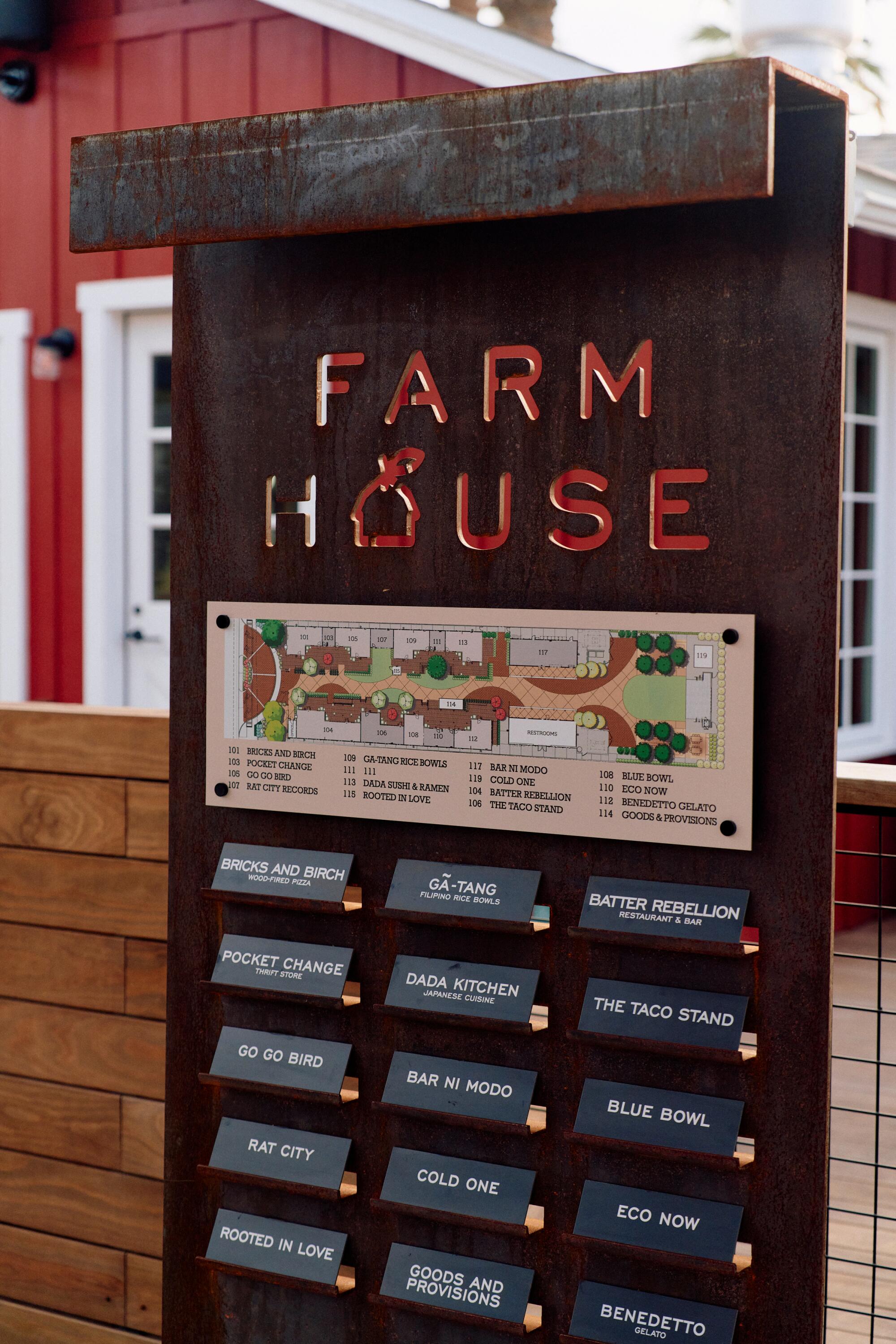
The Farm House Collective hasn’t reached full strength yet; about half of its tenants are yet to open.
(David Fouts / For The Times)
The renovation project — which has included more than $4 million in design and construction work — has held onto the old motel’s rural theme, the red buildings trimmed to evoke barns, a vintage Ford F-100 truck parked alongside the walkway. Next to the repainted, rewired Farm House sign stand a fiberglass horse and buggy, contributed by the Camou family, owners of the motel for decades.
As midcentury motels fade into history, some move upscale and become boutique hotels, some are leveled or acquired by government agencies as transitional housing. And a rare few in Southern California — including the Farm House, Roy’s Motel in Amboy and the Pink Motel in Sun Valley — have taken on new commercial afterlives that don’t involve sleepovers but do evoke the past. At each location, a vintage sign flickers, inviting guests to step into a throwback American scene or capture it with a camera.
The most dramatic nonprofit example of motel rebirth may be the Lorraine Motel in Memphis, Tenn., which was the site of the Rev. Martin Luther King Jr.’s 1968 assassination and reopened in 1991 as the National Civil Rights Museum. Recent commercial examples include Fergusons Downtown in Las Vegas, a 1940s motel reborn as a food and retail center in 2019. A shopping center project at the former La Hacienda Motel in Albuquerque is due to open this year.
“There are a lot of these midcentury buildings that still have possibilities if people want to get in there and save them,” said Beverly Bailey, co-founder and development director of the Farm House project. “They’re jewels, and it brings life to a city.”
Roy’s of Amboy, a desert icon
In the desert outpost of Amboy, along Route 66 about 210 miles east of Los Angeles, a small team of workers sustains California’s most iconic nonfunctional lodging: Roy’s Motel and Cafe. Its 1959 sign may be misleading (neither the motel nor the cafe has been open for at least 30 years), but the crew sells gas, souvenirs and snacks and sometimes hosts filming and special events.
Every day, Amboy manager Ken Large said, desert rats, lovers of Route 66 and many travelers on their way from Las Vegas to Joshua Tree converge beneath the red, blue, black and yellow sign, which rises 50 feet and is lighted nightly. About 80% of those who stop, Large said, have come from Europe.
“It’s shocking how many tattoos I’ve seen of that sign,” Large said. “I bet I’ve seen a thousand.”
The owner of Roy’s (and all of Amboy) is Kyle Okura, whose late father, entrepreneur and philanthropist Albert Okura, bought it in 2003. He relighted the sign in 2019, ending more than 30 years of darkness. The younger Okura and company have been upgrading infrastructure steadily and would like to reopen the motel — perhaps even get the six cottages open in time for the Route 66 centennial in 2026.
But as Large acknowledges, that “might be a stretch.” The groundwater in Amboy is about 10 times saltier than the sea, Large said, and for years, all drinking water has been trucked in. To grow substantially, Large said, Roy’s and Amboy need easier access to potable water, probably through a groundwater purification process.
For now the cottages stand idle by the glass-walled motel office and its rakishly tilted roof. The office includes an ancient Zenith TV, a typewriter, a grand piano and the switches that light up the sign — all the makings of a stage set for a play in the spirit of Sam Shepard or Samuel Beckett.
If there are travelers on hand at sunset, Roy’s assistant manager Nicole Rachel said, “We’ll invite them to come in and light the sign themselves. I’ve had people in tears.”
“I’m fascinated with this part of the country,” said Chris Birdsall, a 51-year-old trucker from Omaha who lingered as sunset neared one recent night. “I want to see the sign lit up. That big arrow. … It’s almost got an extraterrestrial connection.”
A few minutes later, Rachel invited Birdsall in to throw the switch, and the sign blinked to life over the windswept desert.
In Sun Valley, movies and midcentury grit
At the Pink Motel on San Fernando Road in Sun Valley, the last overnight guest checked out about 10 years ago. But the film crews keep coming.
The family-run 3.5-acre property, which includes a 20-room motel and the closed-to-the-public Cadillac Jacks Cafe, has entered a very L.A. afterlife as a filming and special event location. Instead of cash-strapped travelers and dangerous liaisons, the motel hosts music videos, dog shows, wedding photos, car club meetings, social media gatherings and skateboarding events in its empty pool.
To be sure, this is not what Maximillian Joseph Thomulka and his wife, Gladys Thomulka, imagined when they built and opened the place in the aftermath of World War II.
“It was built in 1946. But the vibe is like 1955, ’56,” said co-owner Tonya Thomulka, granddaughter of the founders, in early 2025. (Subsequent messages were not returned.)
The cafe was built in 1949, the pool in 1959, when San Fernando Road was part of Highway 99, seething with drivers heading to and from the San Joaquin Valley. Then came Interstate 5. The neighborhood went south.
By the late 1970s, the founders’ son, Monty Thomulka, was running the motel, restoring old cars and just beginning to rent the location out occasionally. In 1986, the restaurant closed. Then in 2015, the year Monty Thomulka died, the family stopped renting rooms overnight.
But production crews, lured by the midcentury style and gritty vibe, kept coming. Among the motel’s television credits: episodes of “Law & Order,” “The Incredible Hulk,” “Dexter,” “The O.C.” and “GLOW” (2017-19). Among its movie credits: “Drive,” “Grease 2,” “Pink Motel” and Stacy Peralta’s “The Search for Animal Chin,” a 1987 skateboarding film that features a teenage Tony Hawk.
Nowadays the property (not open to the public, but partially visible from the street) is full of throwback visuals, including its sign, the restaurant and seven rooms outfitted in ’50s and ’60s styles. The Los Angeles Conservancy calls it “a wonderful example of the mid-century roadside commercial resources that are so swiftly disappearing from the landscape.”
New life at Riverside’s Farm House

On the calendar of events at Farm House Collective: pop-up markets, Coachella watch parties and a gospel brunch.
(David Fouts / For The Times)
Before 1969, University Avenue in Riverside was a busy highway, part of U.S. 395, making the Farm House Motel a prime stop for travelers. But as that traffic moved to State Routes 60 and 91, commerce faded along that stretch of University Avenue, despite the growth of UC Riverside nearby. The neighborhood faded further, locals say, after the 1989 closing of nearby Riverside International Raceway (now the Moreno Valley Mall). Farm House Motel shut down in 2007, and a year later, the property passed to city ownership.
The Baileys, whose Perris-based family business, Stronghold Engineering, has been doing electrical, design and construction work for more than 30 years, bought the old motel from the city in 2018. Under that deal, the family paid the city $210,000 for the 1-acre Farm House property, which “we thought at the time was a great buy,” said Beverly Bailey.

The Farm House Collective on its opening day on Saturday, March 29, 2025.
(David Fouts / For The Times)
The family hired the Orange County consulting firm LAB Holding, which has worked on retails projects including the LAB Anti-Mall, the Camp and Anaheim Packing District (housed in a historic building complex). The old carports next to the guest rooms were enclosed and became indoor retail spaces — an acai bowl eatery, plant shop, artisan boutique and other spots have opened, with more to come.
An outdoor stage, which stands where the motel swimming pool was, is flanked by 10 elm trees and assorted kid-friendly games. The Baileys plan one or two music performances per month, perhaps more later, and the stage will also offer movie screenings, TV sports viewing and other events.
Not every motel is a strong candidate for a nonlodging afterlife, as developers elsewhere have learned the hard way. But with a university handy, local leaders in support and an encouraging start, several locals said the Farm House seems suited for the challenge.
“It’s a super cool place that you can just chill at,” said Amy Martinez, who grew up in Riverside, moved to Upland and returned to see the opening with her family. The neighborhood has come a long way, she said, and “to see the rest of the shops open up, that’ll be nice.”
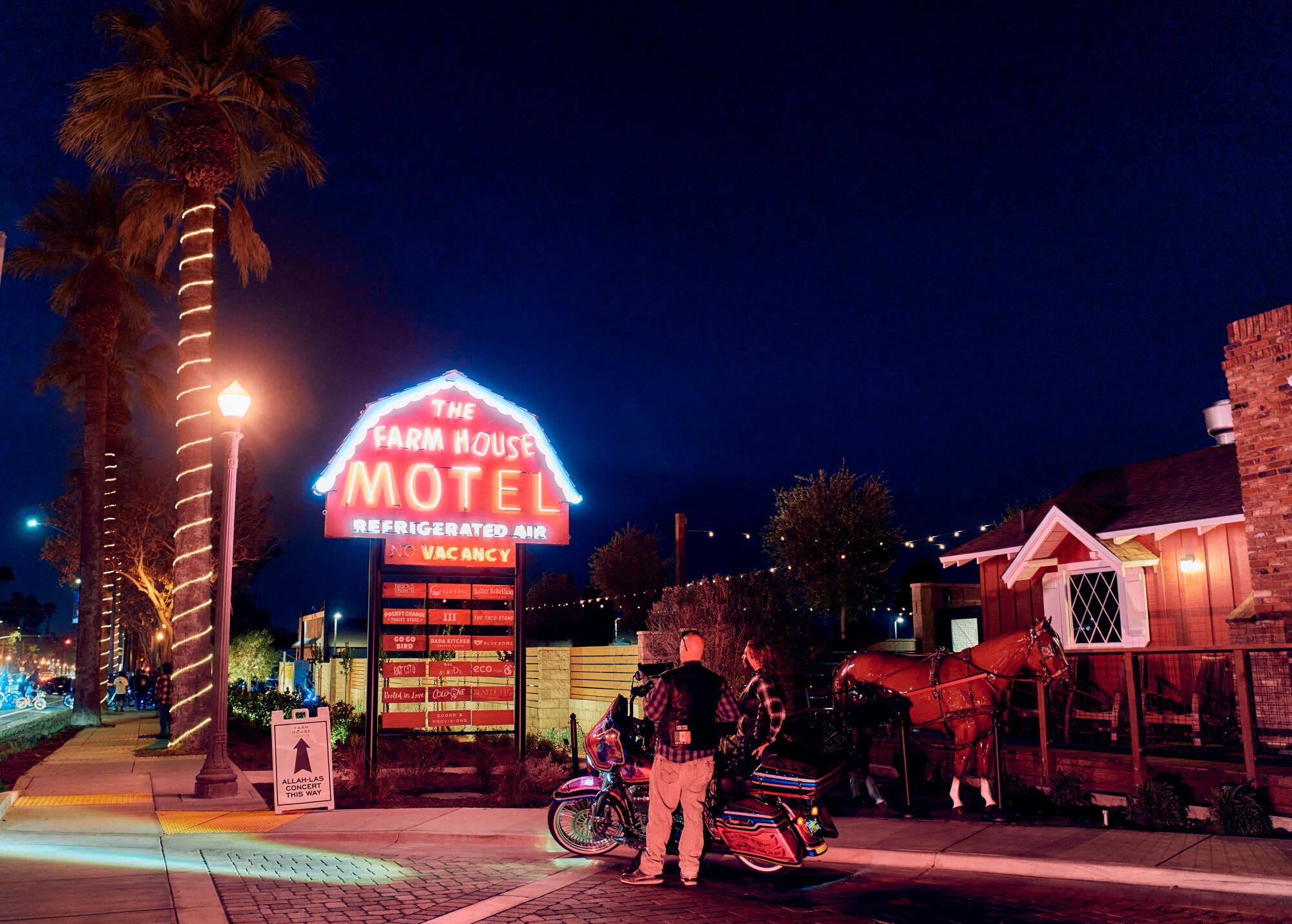
The Farm House Collective’s opening March 29 marked the end of a long idle spell after closure of Riverside’s Farm House Motel.
(David Fouts / For The Times)



A firefighter works as homes burn during the Eaton fire in the Altadena area of Los Angeles County, Calif., on Jan. 7, 2025.
Josh Edelson/AFP via Getty Images
hide caption
toggle caption
Josh Edelson/AFP via Getty Images
On New Year’s Eve 2024, journalist Jacob Soboroff was sitting around a campfire with a friend when he made an offhand comment that would come back to haunt him: The last thing he wanted to do in the new year, Soboroff said, was cover a story that would require donning a fire-safe yellow suit.
Just one week later, Soboroff was dressed in the yellow suit, reporting live from a street corner in Los Angeles as fire tore through the Pacific Palisades, the community where he was raised.
“This was a place that I could navigate with my eyes closed,” Soboroff says of the neighborhood. “Every hallmark of my childhood I was watching carbonize in front of me. … There were firefighters there and first responders and other journalists there, but it was an extremely lonely, isolating experience to be standing there as everything I knew burned down around me in real time.”

In his new book, Firestorm: The Great Los Angeles Fires and America’s New Age of Disaster, Soboroff offers a minute-by-minute account of the catastrophe, told through the voices of firefighters, evacuees, scientists and political leaders. He says covering the wildfires was the most important assignment he’s ever undertaken.
“The experience of doing this is something that I don’t wish on anybody, but in a way I wish everybody could experience,” he says. “It’s given me insane reverence for our colleagues in the local news community here, who, I think, definitionally were exercising a public service in the street-level journalism that they were doing and are still doing. … It was actually beautiful to watch because they are as much a first responder on a frontline as anybody else.”
Interview highlights

On the experience of reporting from the fires
You’re choking with the smoke. And I almost feel guilty describing it from my vantage point because the firefighters would say things to me like: “My eyeballs were burning. We were laying flat on our stomach in the middle of the concrete street because it was so hot, it was the only way that we could open the hoses full bore and try to save anything that we could.” …
I could feel the heat on the back of my neck as we stood in front of these houses that I remember as the houses that cars and people would line up in front of for the annual Fourth of July parade or the road race that we would run through town. Trees were on fire behind us — we were at risk of structures falling at any given minute. It was pretty surreal because this is a place I had spent so much time as a child and going back to as an adult. … I had no choice but to just open my mouth and say what I saw to the millions of people that were watching us around the country.
On undocumented immigrants being central to rebuilding the city

These types of massive both humanitarian and natural disasters give us X-ray vision for a time into sort of the fissures that are underneath the surface in our society. And Los Angeles, in addition to being one of the most unequal cities between the rich and the poor, has more undocumented people than virtually any other city in the United States of America. Governor Newsom knew that with the policies of the incoming administration, some of the very people that would be responsible for the cleanup and the rebuilding of Los Angeles may end up in the crosshairs of national immigration policy. And I think that that was an understatement. …
Pablo Alvarado in the National Day Laborer Organizing Network said to me that often the first people into a disaster — the second responders after the first — are the day laborers. They went to Florida after Hurricane Andrew, to New Orleans after Katrina, and they’d be ready to go in Los Angeles. And I went out and I cleaned up Altadena and Pasadena with some of them in real time.
And only months later did this wide-scale immigration enforcement campaign begin … on the streets of LA as sort of the Petri dish, the guinea pig for expanding this across the country. And it’s not an exaggeration to say that the parking lots of Home Depots, where workers [were] looking to get involved in the rebuilding of Los Angeles, has been ground zero for that enforcement campaign.
On efforts to rebuild
The pace is slow and it’s sort of a hopscotch of development. And I think for people who do come back, for people who can afford to come back, it’s going to be a long road ahead. You’re going to have half the houses on your street under construction for years to come. And for people that do inhabit those homes, it’s going to an isolating experience. But there’s an effort underway to rebuild. …
There’s also a lot of for-sale signs. And that’s the sad reality of this, is that there are people who, whether it’s that they can’t afford to come back … or that they just can’t stomach it, I think, sadly, a lot people are not going to be returning to their homes.
On what the Palisades and Altadena look like today

They both look like very big construction sites in a way. There are still some facades, some ruins of the more historic buildings in the Palisades. … But mostly it’s just empty lots. And in Altadena, the same thing. If you drive by the hardware store, the outside is still there. But it’s a patchwork of empty lots. Homes now under construction. And lots and lots of workers. … There are still a handful of people who are living in both the Palisades and in Altadena, but for the most part, these are communities where you’ve got workers going in during the day and coming out at night. …
We have designed this community to be one that’s in the crosshairs of a fire just like the one we experienced and that we will certainly, certainly experience again, because nobody’s packing it up and leaving Los Angeles. People may not return to their communities after they’ve lost their homes, but the ship has sailed on living in the wildland urban interface in the second largest city in the country.
On seeing this story, personally, as his “most important assignment”

Jacob Soboroff is a correspondent for MS NOW, formerly MSNBC.
Jason Frank Rothenberg/HarperCollins
hide caption
toggle caption
Jason Frank Rothenberg/HarperCollins
I don’t think I realized at the time how badly I needed the connections that I made in the wake of the fire, both with the people who have lost homes and the firefighters, first responders who were out there, but also honestly with my own family, my immediate family, my wife and my kids, my mom and my dad and my siblings and myself. I think that this was a really hard year in LA, and I think in the wake of the fire, I was experiencing some level of despair as well. Then the ICE raids happened here and sort of turned our city upside down. And this book for me was just this amazing cathartic blessing of an opportunity to find community with people I don’t think I ever would have otherwise spent time with, and to reconnect with people who I hadn’t seen or heard from in forever.
Anna Bauman and Nico Wisler produced and edited this interview for broadcast. Bridget Bentz, Molly Seavy-Nesper and Beth Novey adapted it for the web.


Tom Layward, the narrator and main character of Ben Markovits’ new novel, The Rest of Our Lives, introduces himself in a curious way: On the very first page of the book, he talks, matter-of-factly, about the affair his wife, Amy, had 12 years ago, when their two kids were young.
Amy, who’s Jewish, got involved at a local synagogue in Westchester; Tom, who was raised Catholic and is clearly not a joiner, remained on the sidelines. At the synagogue, Amy met Zach Zirsky, who Tom describes as “the kind of guy who danced with all the old ladies and little pigtailed girls at a bar mitzvah, so he could also put his arm around the pretty mothers and nobody would complain.”
After the affair came out, Tom and Amy decided to stay together for the kids: a boy named Michael and his younger sister, Miriam. But, Tom tells us “I also made a deal with myself. When Miriam goes to college you can leave, too.” The deal, Tom says, “helped me get through the first few months … [when] we had to pretend that everything was fine.”
Twelve years have since passed and the marriage has settled back into a state of OK-ness. Miriam, now 18, is starting college in Pittsburgh and because Amy is having a tough time with Miriam’s departure, Tom alone drives her to campus.
And, once Tom drops Miriam off, he just keeps driving, westward; without explanation to us or to himself; as though he’s a passenger in a driverless car that has decided to carry him across “the mighty Allegheny” and keep on going.

The three-page scene where Tom passively melds into the trans-continental traffic flow constitutes a master class on how to write about a character who is opaque to himself. “[Y]ou don’t feel anything about anything,” Amy says early on to Tom — an accusation that’s pretty much echoed by Tom’s old college girlfriend, Jill, whom he spontaneously drops in on at her home in Las Vegas, after being out of touch for roughly 30 years.
But, if Tom is distanced from his own feelings (and vague about the “issue” he had “with a couple of students” that forced him to take a leave from teaching in law school), he’s a sharp diagnostician of other people’s behavior. What fuels this road trip is Tom’s voice — by turns, wry, mournful and, oh-so-casually, astute.
There’s a strain of Richard Ford and John Updike in Tom’s tone, which I mean as a high compliment. Take, for instance, how Tom chats to us readers about a married couple who are old friends of his and Amy’s:
[Chrissie] was maybe one of those women who derives secret energy from the troubles of her friends. Her husband, Dick, was a perfectly good guy, about six-two, fat and healthy. He worked for an online tech platform. I really don’t know what he did.
So might most of us be summed up for posterity.

As Tom racks up miles, taking detours to visit other folks out of his past, like his semi-estranged brother, his meandering road trip accrues in suspense. There’s something else he’s subconsciously speeding away from here besides his marriage. Tom tells us at the outset that he’s suffering from symptoms his doctors ascribe to long COVID: dizziness and morning face swelling so severe that daughter Miriam jokingly calls him “Puff Daddy.” Shortly after he reaches the Pacific, Tom also lands in the hospital. “Getting out of the hospital,” Tom dryly comments, “is like escaping a casino, they don’t make it easy for you.”
The canon of road trip stories in American literature is vast, even more so if you count other modes of transportation besides cars — like, say, rafts. But, the most memorable road trips, like The Rest of Our Lives, notice the easy-to-miss signposts — marking life forks in the road and looming mortality — that make the journey itself everything.
‘Everything I knew burned down around me’: A journalist looks back on LA’s fires

Nvidia’s GeForce Now is getting native Linux and Fire TV apps

Iran offers citizens $7 monthly payments as protests spiral over economic crisis: report

Federal officials to halt more than $10B in funding to 5 states over non-citizen benefit concerns: report

Flu hospitalizations hit all-time weekly high in densely populated state, officials warn

Florida High School Football Rankings: Top 25 teams – Oct. 21

Cleary's 21 help Le Moyne down Central Connecticut State 69-64 in OT

How old is Bo Nix? What to know about Oregon quarterback ahead of 2024 NFL Draft

99th annual Pony Swim held in Virginia

Video: ‘It Didn’t Have to Happen This Way:’ U.Va. Faculty Call for Review of Police Response to Protests
Federal officials to halt more than $10B in funding to 5 states over non-citizen benefit concerns: report

US critics and allies condemn Maduro’s abduction at UN Security Council

Maduro seized, norms tested: Security Council divided as Venezuela crisis deepens

Video: Welcome to Rennie Harris’s Dance Floor

Fraud fallout forces Democratic Gov Tim Walz to abandon Minnesota re-election bid
-

 World1 week ago
Hamas builds new terror regime in Gaza, recruiting teens amid problematic election
-

 Indianapolis, IN1 week ago
Indianapolis Colts playoffs: Updated elimination scenario, AFC standings, playoff picture for Week 17
-

 News1 week ago
Roads could remain slick, icy Saturday morning in Philadelphia area, tracking another storm on the way
-

 Politics1 week ago
Most shocking examples of Chinese espionage uncovered by the US this year: ‘Just the tip of the iceberg’
-

 World1 week ago
Podcast: The 2025 EU-US relationship explained simply
-
 News1 week ago
For those who help the poor, 2025 goes down as a year of chaos
-
 News1 week ago
Winter storm brings heavy snow and ice to busy holiday travel weekend
-

 Politics1 week ago
‘Unlucky’ Honduran woman arrested after allegedly running red light and crashing into ICE vehicle