Lifestyle
These Olympic medals don’t exist — so we made them up

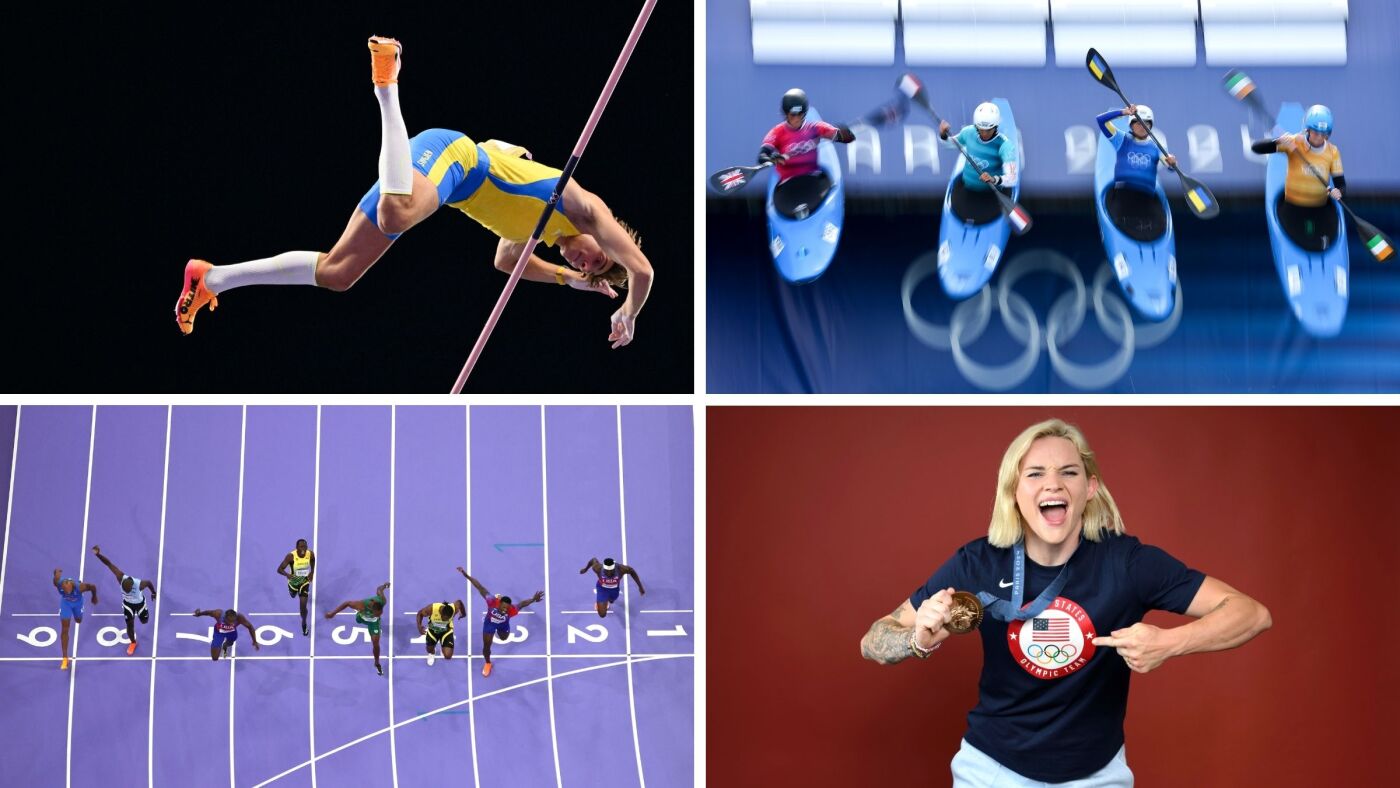
Clockwise from left, pole vaulter Armand Duplantis, the Canoe Slalom Women’s Kayak Cross, women’s rugby player Sammy Sullivan, and the Men’s 100m Final.
Kirill Kudrtavtsev/AFP via Getty Images; Alex Davidson/Getty Images; Kristy Sparow/Getty Images; Richard Heathcote/Getty Images
hide caption
toggle caption
Kirill Kudrtavtsev/AFP via Getty Images; Alex Davidson/Getty Images; Kristy Sparow/Getty Images; Richard Heathcote/Getty Images
NPR is in Paris for the 2024 Summer Olympics. For more of our coverage from the Games, head to our latest updates.
The real Olympic medals are given out according to rules about speed, scores, perfection, actually defeating your opponent, all that boring stuff. But what if they weren’t?

What if there were another set of medals we could give to some of the best achievements of the games, even if they weren’t in officially recognized sports? We tried to think of what we’d hand out. So here are nine additional medals — call them the Extra Golds — for some of the additional feats of strength and cleverness that have delighted us in the last two weeks.
The one-man lift of one man

Mijain Lopez Nunez (right) celebrates with his coach on Aug. 6, 2024.
Punit Paranjpe/AFP via Getty Images
hide caption
toggle caption
Punit Paranjpe/AFP via Getty Images
It would have been enough that Cuba’s Mijain Lopez Nunez won his fifth consecutive gold medal for Greco-Roman wrestling — becoming the first Summer Olympian ever to hit that milestone. After he finished, he unlaced his shoes and set them on the mat to mark his retirement. But it wasn’t all poignancy — he also playfully flipped one coach onto his back, then lifted another and carried him a few steps. It’s one thing to win your match; it’s another to set a record in a grueling event and then celebrate by picking up an entire wrestling coach and carrying him around.
The 400 meter WHAAAAT?

Quincy Hall on the home straight in the Men’s 400m final on Aug. 7, 2024.
Richard Heathcote/Getty Images
hide caption
toggle caption
Richard Heathcote/Getty Images
Team USA sprinter Quincy Hall was going to lose the men’s 400 meters. It was obvious. Heading into the last 150 meters or so, he seemed to have been bested by not one, not two, but three of the other guys in the race. And then he just accelerated. It looked magical. One of the curious things about sprinters is that when they’re speeding up, it can almost look like they’re slowing down. As Hall pushed toward the finish line, if you were watching him in a vacuum, you might think he was more spent, more tapped out. But he was somehow passing everybody! And he leaned at the finish line and just edged out Matthew Hudson-Smith of Great Britain to win the gold medal. We still have to admit: We don’t entirely get what happened.
The athlete drop

The beginning of the Canoe Slalom Women’s Kayak Cross heats on Aug. 4, 2024.
Alex Davidson/Getty Images
hide caption
toggle caption
Alex Davidson/Getty Images
Olympic sports begin in a lot of ways. A whistle blows, or a pistol bangs, or an athlete runs or serves or jumps. But the gold medal in athlete-dropping can only go to the kayak cross. In this event, several competitors are kept suspended above the course they are about to paddle through. Then they are dropped. Yes, they are flat-out indifferently dumped into the water the way you would release an undersized fish. And, crowded together, they have to navigate a course of buoys and get to the finish line. Anybody can run when a whistle blows or start a game when the referee says so. This is something entirely different.
The 6.25-meter maximum flex

Armand Duplantis set the new Olympic record in the men’s pole vault final on Aug. 5, 2024.
Kirill Kudrtavtsev/AFP via Getty Images
hide caption
toggle caption
Kirill Kudrtavtsev/AFP via Getty Images
Swedish-American pole vaulter Armand Duplantis — Mondo — already was guaranteed a gold medal. He didn’t need to jump anymore. But Mondo does not jump because he needs to. No, Mondo jumps because he wishes to. And at the Paris finals, even when he already knew he had won, he wished to do something more: swipe the world record held by his greatest rival … [checks notes] himself. Earlier this year, Duplantis jumped 6.24 meters. So what was next? 6.25 meters, obviously. Never one to deny his loyal audience the drama they crave, he took three jumps to clear the bar at that height, but on that last one, he nailed it. Who knows what he’ll do next? Dare we hope for … 6.26 meters?
Audience participation

Léon Marchand reacts after competing in the Men’s 400m Individual Medley Heats on July 28, 2024.
Sarah Stier/Getty Images
hide caption
toggle caption
Sarah Stier/Getty Images
The Paris crowds have been thrilling to listen to, overall. Particularly in support of French athletes, they cheer, they yell, they chant, they roar. But they may have peaked when swimmer Léon Marchand was in the pool. Marchand swam in four individual races, and he won four gold medals. And every time, the crowd didn’t just yell for him; they pulsated for him. Whenever he was doing a stroke that brought him rhythmically up out of the water, the crowd made sure that every time they saw his head, they gave him a fresh shout. Let’s be honest: It’s hard to know whether any of this is intelligible to a guy whose head is still mostly underwater and who is hyperfocused on things like his own arms and legs. But it was as if the people watching his races wanted you to be sure they were cheering for no one else, sure they were there for him. And indeed, we knew.
The out of left field leader

Kristen Faulkner passes the finish line during the women’s road race of cycling on Aug. 4, 2024.
Wu Huiwo/Xinhua – Pool/Getty Images
hide caption
toggle caption
Wu Huiwo/Xinhua – Pool/Getty Images
U.S. competitor Kristen Faulkner didn’t think until relatively recently that she was going to compete in the women’s road race that runs almost 100 miles through the streets of Paris and surrounding towns. She didn’t even think she was coming to the Olympics until another competitor resigned from the team in July. As in, this July, last month. But things happen, and there she was. Late in the road race, she was in a chasing pair with another cyclist, separated by a few seconds from the leading pair. The announcers talked about whether the chasing pair could make a move — did they have enough left to get close? Could they close the gap? Well, they did close the gap. But almost as soon as the two pairs met and became four competitors together, Faulkner took off. Nobody followed. The announcer yelled, “Nobody is chasing! Nobody is chasing the American, Kristen Faulkner, the gap is exploding!” Faulkner — who only picked up cycling in 2016 – started her move with about two miles to go, and she ultimately won by almost a full minute. She was simply gone. Oh — and a couple days later, she won a gold medal in the track cycling team pursuit, making her the first U.S. woman to win gold medals in two different disciplines. Not the August she thought she was going to have in July, huh?
The last-minute lean

Noah Lyles crosses the finish line to win the Men’s 100m Final on Aug. 4, 2024.
Richard Heathcote/Getty Images
hide caption
toggle caption
Richard Heathcote/Getty Images
All of the sprinting events rely on the lean, for the simple reason that the rules state that you cross the finish line with your torso, not your head or your foot. (Quincy Hall, noted above, leaned, too.) Even after the men’s 100 meter dash, many of us believed that Team USA’s Noah Lyles had not won it. We were not even sure he had medaled. When they said he had, in fact, won the gold by five one-thousandths of a second, it felt like … no, he didn’t. He didn’t, did he? As it turned out, he did. Kishane Thompson of Jamaica looked like his essence, his general being, was ahead of Lyles. Your eyes might have told you he was the winner — at least one commentator’s eyes told her he was. Ah, but Lyles has the lean. He won by pushing his chest forward just enough. Lyles ran a remarkable race overall; he’d been in last place at the 40-yard mark. But you have to respect the lean that ultimately sealed the deal.
A note: It was only after I first added Lyles to this list that the news broke that he had competed in the 200 meters after testing positive for COVID. It was a sobering reminder of the lingering effects of COVID on these games that what had been such a uniformly great story turned troubling. Lyles is far from the only athlete who has gotten COVID or competed with COVID. But he has asthma, and particularly given what we know about long COVID, the sight of him leaving the field in a wheelchair was a reminder of the risks that remain, especially in the absence of meaningful precautions.
Use of an accessory

Stephen Nedoroscik celebrates after the Artistic Gymnastics Men’s Pommel Horse Final on Aug. 3, 2024.
Jamie Squire/Getty Images
hide caption
toggle caption
Jamie Squire/Getty Images
Look, by now we all know about Stephen Nedoroscik, “Pommel Horse Guy,” who helped clinch the bronze medal for the U.S. men’s gymnastics team. We know that he is great at pommel horse – a specialist, in fact. We know that he was the last to go, that he had to hit and hit hard in order to win the bronze that was obviously so special to those guys that it might as well have been gold. But we must also recognize the power of his accessory game. Nedoroscik has a couple conditions — coloboma and strabismus — that affect his eyesight, and he says that when he competes on pommel horse, he’s doing it by feel, so he leaves his glasses behind. We (his fans) got to the point where the sight of his glasses hanging on the chalk bowl – as they did during the team final, and as they did when he won an individual bronze medal in pommel horse – had an unmistakable, “Oh, it’s HAPPENING” feeling. Like lots of us, he doesn’t wear his glasses for fashion, but that doesn’t mean they can’t be cool.
Enthusiasm management

Sammy Sullivan wasn’t ready to celebrate until the win was official.
Kristy Sparow/Getty Images
hide caption
toggle caption
Kristy Sparow/Getty Images
When the U.S. women won a bronze medal by beating Australia in rugby sevens, it was an absolutely classic last-minute sports moment. With Team USA down 12-7 in the closing seconds, Alex Sedrick ran all the way down the field from almost the opposite end and scored a “try,” tying the match at 12. Team USA would still need a conversion — a pretty easy-looking one, but still – in order to actually win. And so, as the team celebrated Sedrick’s score, one face on the sideline was not ready to celebrate. Sammy Sullivan served the very important function of jinx avoider, because as they waited to see whether they would actually get that conversion, she told her teammates: “SHUT UP.” We’ve all been there, teetering on the edge of jubilation, afraid that other people will ruin it just by admitting it’s happening. We have all lived with the fear that our moment of victory is impossibly fragile and hubris will make it shatter. Sammy Sullivan was all of us: “SHUT UP.”
This piece also appeared in NPR’s Pop Culture Happy Hour newsletter. Sign up for the newsletter so you don’t miss the next one, plus get weekly recommendations about what’s making us happy.
Listen to Pop Culture Happy Hour on Apple Podcasts and Spotify.




“You kinda have this Wednesday Addams vibe going on.”
I shrieked.
I was wearing my best armor: a black dress that accentuated my curves, a striped bolero to cover the arms I’ve resented for years and black platform sandals displaying ruby toes. My dark hair was in wild, voluminous curls and my sultry makeup was finished with an inviting Chanel rouge lip.
I would’ve preferred the gentleman at the speed dating event had likened my efforts to, at least, Morticia, a grown woman. But in this crowd of men and women ages ranging from roughly 21 to 40, I suppose my baby face gave me away.
My mind flitted back to a conversation I had with my physical therapist about modern love: Dating in L.A. has become monotonous.
The apps were oversaturated and underwhelming. And it seemed more difficult than ever to naturally meet someone in person.
She told me about her recent endeavor in speed dating: events sponsoring timed one-on-one “dates” with multiple candidates. I applauded her bravery, but the conversation had mostly slipped my mind.
Two years later, I had reached my boiling point with Jesse, a guy I met online (naturally) a few months prior who was good on paper but bad in practice.
Knowing my best friend was in a similar situationship, I found myself suggesting a curious social alternative.
Much of my knowledge of speed dating came from cinema. It usually involved a down-on-her-luck hopeless romantic or a mature workaholic attempting to be more spontaneous in her dating life, sitting across from a montage of caricatures: the socially-challenged geek stumbling through his special interests; the arrogant businessman diverting most of his attention to his Blackberry; the pseudo-suave ladies’ man whose every word comes across rehearsed and saccharine.
Nevertheless, I was desperate for a good distraction. So we purchased tickets to an event for straight singles happening a few hours later.
Walking into Oldfield’s Liquor Room, I noticed that it looked like a normal bar, all dark wood and dim lighting. Except its patrons flanked the perimeter of the space, speaking in hushed tones, sizing up the opposite sex.
Suddenly in need of some liquid courage, we rushed back to the car to indulge in the shooters we bought on our way to the venue — three for $6. I had already surrendered $30 for my ticket and I was not paying for Los Angeles-priced cocktails. Ten minutes later, we were ready to mingle.
The bar’s back patio was decked out with tea lights and potted palm plants. House-pop music put me in a groove as I perused the picnic tables covered with conversation starters like “What’s your favorite sexual position?” Half-amused and half-horrified, I decided to use my own material.
We found our seats as the host began introductions. Each date would last two minutes — a chime would alert the men when it was time to move clockwise to the next seat. I exchanged hopeful glances with the women around me.
The bell rang, and I felt my buzz subside in spades as my first date sat down. This was really happening.
Soft brown eyes greeted me. He was polite and responsive, giving adequate answers to my questions but rarely returning the inquiry. I sensed he was looking through me and not at me, as if he had decided I wasn’t his type and was biding his time until the bell rang. I didn’t take it personally.
Bachelor No. 2 stood well over six feet with caramel-brown hair and emerald eyes. He oozed confidence and warmth when he spoke about how healing from an accident a few years prior inspired him to become a physical therapist.
I tried not to focus on how his story was nearly word-perfect to the one I heard him give the woman before me. He offered to show me a large surgery scar, rolling up his right sleeve to reveal the pale pink flesh — and a well-trained bicep. Despite his obvious good looks and small-town charm, something suspicious gnawed at me. I would later learn he had left the same effect on most of the women.
My nose received Bachelor No. 3 before my eyes. His spiced cologne quickly engulfing my senses. He had a larger-than-life presence, seeming to be a character himself, so I asked for his favorite current watch.
“I love ‘The Summer I Turned Pretty,’” he actually said.
“Really?”
“Oh yeah, it’s my favorite. Oh, and ‘Wednesday.’ You kinda have this Wednesday Addams vibe going on.”
I was completely thrown to hear this 40-something man’s favorite programs centered around teenage girls, and by his standards, I resembled one of them. Where was the host with the damn bell?
Although a few conversations clearly left impressions, most of the dates morphed into remnants of information like fintech, middle sibling, allergic to cats, etc. Perhaps two minutes was too short to spark genuine chemistry.
After a quick lap around the post-date mingling, we practically raced to the car. A millisecond after the doors closed, my friend said, “I think I’m going to call him.” I knew she wasn’t referring to any of the men we met tonight. The last few hours were all in vain. “And you should call Jesse.”
I scoffed at her audacity.
When I arrived home and called him, it only rang once.
The following three hours of witty banter and cheeky innuendos were bliss until the call ended on a low note, and I remembered why I tried speed dating in the first place.
Jesse and I had great chemistry but were ultimately incompatible. He preferred living life within his comfort zone while I craved adventure and variety. He couldn’t see past right now, and I was too busy planning the future to live in the moment.
Still, in a three-hour call, long before the topic of commitment soured things, we laughed at the mundanity of our day, traded wildest dreams for embarrassing anecdotes, and voiced amorous intentions that would make Aphrodite’s cheeks heat.
Why couldn’t I have had a conversation like that with someone at the event?
It’s possible I was hoping to find the perfect replica of my relationship with Jesse. But when I had the opportunity to meet someone new, I reserved my humor and my empathy.
Also, despite knowing Jesse and I weren’t a good match, I thought we had a “chance connection” that I needed to protect. In reality, if I had shown up to speed dating as my complete self, that would have been more than enough to stir sparks with a new flame.
It would be several more weeks before I was ready to release my attachment to Jesse. But when I did, I had a better appreciation for myself and my capacity for love.
The author is a multidisciplinary writer and mother based in Encino.
L.A. Affairs chronicles the search for romantic love in all its glorious expressions in the L.A. area, and we want to hear your true story. We pay $400 for a published essay. Email LAAffairs@latimes.com. You can find submission guidelines here. You can find past columns here.
Editor’s note: On April 3, L.A. Affairs Live, our new storytelling competition show, will feature real dating stories from people living in the Greater Los Angeles area. Tickets for our first event will be on sale starting Tuesday.

Warner Bros. Discovery said Thursday that it prefers the latest offer from rival Hollywood studio Paramount over a bid it accepted from Netflix.
Bloomberg/Bloomberg via Getty Images/Bloomberg
hide caption
toggle caption
Bloomberg/Bloomberg via Getty Images/Bloomberg
The Warner Bros. Discovery board announced late Thursday afternoon that Paramount’s sweetened bid to buy the entire company is “superior” to an $83 billion deal it had struck with Netflix for the purchase of its streaming services, studios, and intellectual property.
Netflix says it is pulling out of the contest rather than try to top Paramount’s offer.
“We’ve always been disciplined, and at the price required to match Paramount Skydance’s latest offer, the deal is no longer financially attractive, so we are declining to match the Paramount Skydance bid,” the streaming giant said in a statement.
Warner had rejected so many offers from Paramount that it seemed as though it would be a fruitless endeavor. Speaking on the red carpet for the BAFTA film awards last weekend, Netflix CEO Ted Sarandos dared Paramount to stop making its case publicly and start ponying up cash.
‘If you wanna try and outbid our deal … just make a better deal. Just put a better deal on the table,” Sarandos told the trade publication Deadline Hollywood.
Netflix promised that Warner Bros. would operate as an independent studio and keep showing its movies in theaters.
But the political realities, combined with Paramount’s owners’ relentless drive to expand their entertainment holdings, seem to have prevailed.
Paramount previously bid for all of Warner — including its cable channels such as CNN, TBS, and Discovery — in a deal valued at $108 billion. Earlier this week, Paramount unveiled a fresh proposal increasing its bid by a dollar a share.
On Thursday, hours before the Warner announcement, Sarandos headed to the White House to meet Trump administration officials to make his case for the deal.

The meetings, leaked Wednesday to political and entertainment media outlets, were confirmed by a White House official who spoke on condition he not be named, as he was not authorized to speak about them publicly.
President Trump was not among those who met with Sarandos, the official said.
While Netflix’s courtship of Warner stirred antitrust concerns, the Paramount deal is likely to face a significant antitrust review from the U.S. Justice Department, given the combination of major entertainment assets. Paramount owns CBS and the streamer Paramount Plus, in addition to Comedy Central, Nickelodeon and other cable channels.
The offer from Paramount CEO David Ellison relies on the fortune of his father, Oracle co-founder Larry Ellison. And David Ellison has argued to shareholders that his company would have a smoother path to regulatory approval.
Not unnoticed: the Ellisons’ warm ties to Trump world.

Larry Ellison is a financial backer of the president.
David Ellison was photographed offering a MAGA-friendly thumbs-up before the State of the Union address with one of the president’s key Congressional allies: U.S. Senator Lindsey Graham of South Carolina, a Republican.
Trump has praised changes to CBS News made under David Ellison’s pick for editor in chief, Bari Weiss.
The chair of the Federal Communications Commission, Brendan Carr, told Semafor Wednesday that he was pleased by the news division’s direction under Weiss. She has criticized much of the mainstream media as being too reflexively liberal and anti-Trump.

“I think they’re doing a great job,” Carr said at a Semafor conference on trust and the media Wednesday. As Semafor noted, Carr previously lauded CBS by saying it “agreed to return to more fact-based, unbiased reporting.”

‘The Wire’ Star Bobby J. Brown
He’s Trapped Inside Barn Fire!!!
Listen To Dispatch Audio
Published
Broadcastify.com
Here’s the dispatch audio from the fatal barn fire that killed “The Wire” actor Bobby J. Brown … and you hear dispatchers saying he’s trapped in the building after trying to start an old Cadillac.
TMZ obtained the dispatch audio, which also reveals Bobby’s wife called for help. It sounds like a huge inferno, the barn is 50-feet-by-100 and — by the end of the call — it’s all up in flames.
We broke the story … Bobby died Tuesday from smoke inhalation. The deadly fire started after Bobby entered the barn to jump-start a car. His wife suffered severe burns trying to save him.
Bobby played Officer Bobby Brown on the hit HBO series “The Wire” … and his other credits include “Law & Order: SVU” and “We Own This City.”
He was 62.

Anthony Richardson free to seek trade after injury setbacks amid Colts’ shift to Daniel Jones

300,000 Chrome users hit by fake AI extensions
Commentary: How Trump helped foreign markets outperform U.S. stocks during his first year in office
Philip Glass canceled a Kennedy Center show, but this conductor brings his work center stage at L.A. Opera
L.A. Affairs: Sick of swiping, I tried speed dating. The results surprised me

Florida High School Football Rankings: Top 25 teams – Oct. 21

Cleary's 21 help Le Moyne down Central Connecticut State 69-64 in OT

How old is Bo Nix? What to know about Oregon quarterback ahead of 2024 NFL Draft

99th annual Pony Swim held in Virginia

Indiana Members Credit Union announced as new anchor tenant at Bottleworks District

Has India’s influence in Afghanistan grown under the Taliban?

Bill Clinton to testify before House committee investigating Epstein links

Read Judge Schiltz’s Order

Vulnerable House Dem lashes out at Trump’s ‘racist’ SOTU challenge: ‘That was uncomfortable’

Italy calls for suspension of EU carbon market
-

 World1 day ago
Exclusive: DeepSeek withholds latest AI model from US chipmakers including Nvidia, sources say
-

 Massachusetts2 days ago
Mother and daughter injured in Taunton house explosion
-

 Montana1 week ago
2026 MHSA Montana Wrestling State Championship Brackets And Results – FloWrestling
-

 Oklahoma1 week ago
Wildfires rage in Oklahoma as thousands urged to evacuate a small city
-

 Louisiana4 days ago
Wildfire near Gum Swamp Road in Livingston Parish now under control; more than 200 acres burned
-

 Technology6 days ago
YouTube TV billing scam emails are hitting inboxes
-

 Denver, CO2 days ago
10 acres charred, 5 injured in Thornton grass fire, evacuation orders lifted
-

 Technology6 days ago
Stellantis is in a crisis of its own making