Lifestyle
These Olympic medals don’t exist — so we made them up

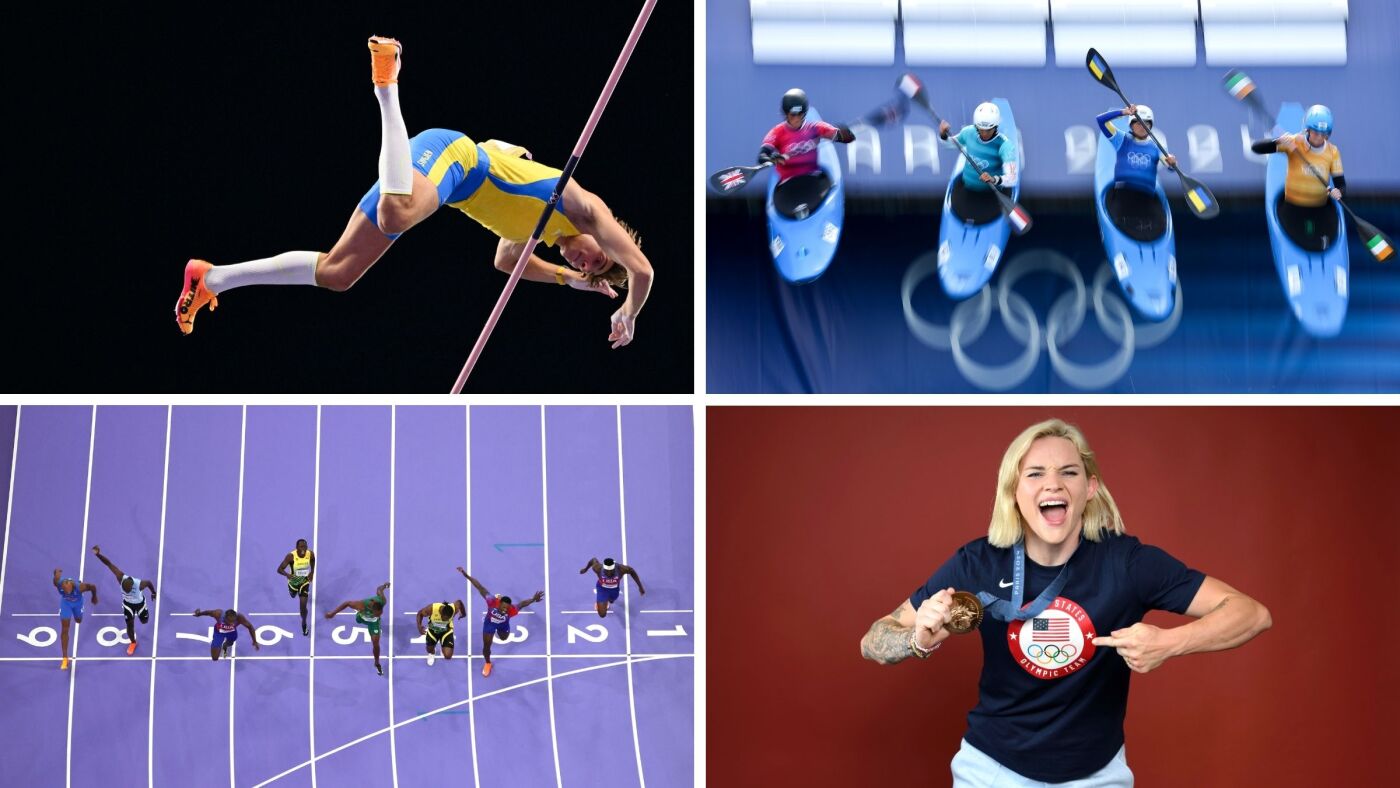
Clockwise from left, pole vaulter Armand Duplantis, the Canoe Slalom Women’s Kayak Cross, women’s rugby player Sammy Sullivan, and the Men’s 100m Final.
Kirill Kudrtavtsev/AFP via Getty Images; Alex Davidson/Getty Images; Kristy Sparow/Getty Images; Richard Heathcote/Getty Images
hide caption
toggle caption
Kirill Kudrtavtsev/AFP via Getty Images; Alex Davidson/Getty Images; Kristy Sparow/Getty Images; Richard Heathcote/Getty Images
NPR is in Paris for the 2024 Summer Olympics. For more of our coverage from the Games, head to our latest updates.
The real Olympic medals are given out according to rules about speed, scores, perfection, actually defeating your opponent, all that boring stuff. But what if they weren’t?

What if there were another set of medals we could give to some of the best achievements of the games, even if they weren’t in officially recognized sports? We tried to think of what we’d hand out. So here are nine additional medals — call them the Extra Golds — for some of the additional feats of strength and cleverness that have delighted us in the last two weeks.
The one-man lift of one man

Mijain Lopez Nunez (right) celebrates with his coach on Aug. 6, 2024.
Punit Paranjpe/AFP via Getty Images
hide caption
toggle caption
Punit Paranjpe/AFP via Getty Images
It would have been enough that Cuba’s Mijain Lopez Nunez won his fifth consecutive gold medal for Greco-Roman wrestling — becoming the first Summer Olympian ever to hit that milestone. After he finished, he unlaced his shoes and set them on the mat to mark his retirement. But it wasn’t all poignancy — he also playfully flipped one coach onto his back, then lifted another and carried him a few steps. It’s one thing to win your match; it’s another to set a record in a grueling event and then celebrate by picking up an entire wrestling coach and carrying him around.
The 400 meter WHAAAAT?

Quincy Hall on the home straight in the Men’s 400m final on Aug. 7, 2024.
Richard Heathcote/Getty Images
hide caption
toggle caption
Richard Heathcote/Getty Images
Team USA sprinter Quincy Hall was going to lose the men’s 400 meters. It was obvious. Heading into the last 150 meters or so, he seemed to have been bested by not one, not two, but three of the other guys in the race. And then he just accelerated. It looked magical. One of the curious things about sprinters is that when they’re speeding up, it can almost look like they’re slowing down. As Hall pushed toward the finish line, if you were watching him in a vacuum, you might think he was more spent, more tapped out. But he was somehow passing everybody! And he leaned at the finish line and just edged out Matthew Hudson-Smith of Great Britain to win the gold medal. We still have to admit: We don’t entirely get what happened.
The athlete drop

The beginning of the Canoe Slalom Women’s Kayak Cross heats on Aug. 4, 2024.
Alex Davidson/Getty Images
hide caption
toggle caption
Alex Davidson/Getty Images
Olympic sports begin in a lot of ways. A whistle blows, or a pistol bangs, or an athlete runs or serves or jumps. But the gold medal in athlete-dropping can only go to the kayak cross. In this event, several competitors are kept suspended above the course they are about to paddle through. Then they are dropped. Yes, they are flat-out indifferently dumped into the water the way you would release an undersized fish. And, crowded together, they have to navigate a course of buoys and get to the finish line. Anybody can run when a whistle blows or start a game when the referee says so. This is something entirely different.
The 6.25-meter maximum flex

Armand Duplantis set the new Olympic record in the men’s pole vault final on Aug. 5, 2024.
Kirill Kudrtavtsev/AFP via Getty Images
hide caption
toggle caption
Kirill Kudrtavtsev/AFP via Getty Images
Swedish-American pole vaulter Armand Duplantis — Mondo — already was guaranteed a gold medal. He didn’t need to jump anymore. But Mondo does not jump because he needs to. No, Mondo jumps because he wishes to. And at the Paris finals, even when he already knew he had won, he wished to do something more: swipe the world record held by his greatest rival … [checks notes] himself. Earlier this year, Duplantis jumped 6.24 meters. So what was next? 6.25 meters, obviously. Never one to deny his loyal audience the drama they crave, he took three jumps to clear the bar at that height, but on that last one, he nailed it. Who knows what he’ll do next? Dare we hope for … 6.26 meters?
Audience participation

Léon Marchand reacts after competing in the Men’s 400m Individual Medley Heats on July 28, 2024.
Sarah Stier/Getty Images
hide caption
toggle caption
Sarah Stier/Getty Images
The Paris crowds have been thrilling to listen to, overall. Particularly in support of French athletes, they cheer, they yell, they chant, they roar. But they may have peaked when swimmer Léon Marchand was in the pool. Marchand swam in four individual races, and he won four gold medals. And every time, the crowd didn’t just yell for him; they pulsated for him. Whenever he was doing a stroke that brought him rhythmically up out of the water, the crowd made sure that every time they saw his head, they gave him a fresh shout. Let’s be honest: It’s hard to know whether any of this is intelligible to a guy whose head is still mostly underwater and who is hyperfocused on things like his own arms and legs. But it was as if the people watching his races wanted you to be sure they were cheering for no one else, sure they were there for him. And indeed, we knew.
The out of left field leader

Kristen Faulkner passes the finish line during the women’s road race of cycling on Aug. 4, 2024.
Wu Huiwo/Xinhua – Pool/Getty Images
hide caption
toggle caption
Wu Huiwo/Xinhua – Pool/Getty Images
U.S. competitor Kristen Faulkner didn’t think until relatively recently that she was going to compete in the women’s road race that runs almost 100 miles through the streets of Paris and surrounding towns. She didn’t even think she was coming to the Olympics until another competitor resigned from the team in July. As in, this July, last month. But things happen, and there she was. Late in the road race, she was in a chasing pair with another cyclist, separated by a few seconds from the leading pair. The announcers talked about whether the chasing pair could make a move — did they have enough left to get close? Could they close the gap? Well, they did close the gap. But almost as soon as the two pairs met and became four competitors together, Faulkner took off. Nobody followed. The announcer yelled, “Nobody is chasing! Nobody is chasing the American, Kristen Faulkner, the gap is exploding!” Faulkner — who only picked up cycling in 2016 – started her move with about two miles to go, and she ultimately won by almost a full minute. She was simply gone. Oh — and a couple days later, she won a gold medal in the track cycling team pursuit, making her the first U.S. woman to win gold medals in two different disciplines. Not the August she thought she was going to have in July, huh?
The last-minute lean

Noah Lyles crosses the finish line to win the Men’s 100m Final on Aug. 4, 2024.
Richard Heathcote/Getty Images
hide caption
toggle caption
Richard Heathcote/Getty Images
All of the sprinting events rely on the lean, for the simple reason that the rules state that you cross the finish line with your torso, not your head or your foot. (Quincy Hall, noted above, leaned, too.) Even after the men’s 100 meter dash, many of us believed that Team USA’s Noah Lyles had not won it. We were not even sure he had medaled. When they said he had, in fact, won the gold by five one-thousandths of a second, it felt like … no, he didn’t. He didn’t, did he? As it turned out, he did. Kishane Thompson of Jamaica looked like his essence, his general being, was ahead of Lyles. Your eyes might have told you he was the winner — at least one commentator’s eyes told her he was. Ah, but Lyles has the lean. He won by pushing his chest forward just enough. Lyles ran a remarkable race overall; he’d been in last place at the 40-yard mark. But you have to respect the lean that ultimately sealed the deal.
A note: It was only after I first added Lyles to this list that the news broke that he had competed in the 200 meters after testing positive for COVID. It was a sobering reminder of the lingering effects of COVID on these games that what had been such a uniformly great story turned troubling. Lyles is far from the only athlete who has gotten COVID or competed with COVID. But he has asthma, and particularly given what we know about long COVID, the sight of him leaving the field in a wheelchair was a reminder of the risks that remain, especially in the absence of meaningful precautions.
Use of an accessory

Stephen Nedoroscik celebrates after the Artistic Gymnastics Men’s Pommel Horse Final on Aug. 3, 2024.
Jamie Squire/Getty Images
hide caption
toggle caption
Jamie Squire/Getty Images
Look, by now we all know about Stephen Nedoroscik, “Pommel Horse Guy,” who helped clinch the bronze medal for the U.S. men’s gymnastics team. We know that he is great at pommel horse – a specialist, in fact. We know that he was the last to go, that he had to hit and hit hard in order to win the bronze that was obviously so special to those guys that it might as well have been gold. But we must also recognize the power of his accessory game. Nedoroscik has a couple conditions — coloboma and strabismus — that affect his eyesight, and he says that when he competes on pommel horse, he’s doing it by feel, so he leaves his glasses behind. We (his fans) got to the point where the sight of his glasses hanging on the chalk bowl – as they did during the team final, and as they did when he won an individual bronze medal in pommel horse – had an unmistakable, “Oh, it’s HAPPENING” feeling. Like lots of us, he doesn’t wear his glasses for fashion, but that doesn’t mean they can’t be cool.
Enthusiasm management

Sammy Sullivan wasn’t ready to celebrate until the win was official.
Kristy Sparow/Getty Images
hide caption
toggle caption
Kristy Sparow/Getty Images
When the U.S. women won a bronze medal by beating Australia in rugby sevens, it was an absolutely classic last-minute sports moment. With Team USA down 12-7 in the closing seconds, Alex Sedrick ran all the way down the field from almost the opposite end and scored a “try,” tying the match at 12. Team USA would still need a conversion — a pretty easy-looking one, but still – in order to actually win. And so, as the team celebrated Sedrick’s score, one face on the sideline was not ready to celebrate. Sammy Sullivan served the very important function of jinx avoider, because as they waited to see whether they would actually get that conversion, she told her teammates: “SHUT UP.” We’ve all been there, teetering on the edge of jubilation, afraid that other people will ruin it just by admitting it’s happening. We have all lived with the fear that our moment of victory is impossibly fragile and hubris will make it shatter. Sammy Sullivan was all of us: “SHUT UP.”
This piece also appeared in NPR’s Pop Culture Happy Hour newsletter. Sign up for the newsletter so you don’t miss the next one, plus get weekly recommendations about what’s making us happy.
Listen to Pop Culture Happy Hour on Apple Podcasts and Spotify.

Lifestyle
John Cena wanted to step away from the WWE ring before he became ‘too slow for the show’ : Wild Card with Rachel Martin

A note from Wild Card host Rachel Martin: First a confession: I have never watched a WWE match in its entirety. Don’t get me wrong, I appreciate the athleticism and the performance, it’s just not my thing. But there is something about John Cena I’ve never been able to shake.
Yes, he is a wrestling legend, but he has built a career as an entertainer that transcends the ring. The first time I saw him lead a cast was the 2019 family movie “Playing with Fire” and his rapport with kids in that film didn’t seem like acting at all. The man contains multitudes!
He co-stars with Eric Andre in his newest film, “Little Brother.”

Xie Miao and Yang Enyou in The Furious.
Norachai Kajchapanont/Lionsgate
hide caption
toggle caption
Norachai Kajchapanont/Lionsgate
There have been some fantastic movies released this year, and we know you can’t see them all. So we’re recommending four recent movies we missed that you should add to your watchlist: The Furious, Tuner, She’s The He, and Heresy.
If you need a few more fun film recommendations, check out these episodes:
Fun movies you may have missed
Our favorite movies on Tubi
We debate the best movies to watch on an airplane
Connect with Pop Culture Happy Hour:
Letterboxd / Facebook
Our weekly newsletter
Support Pop Culture Happy Hour+

A tarp covers the facade of the John F. Kennedy Memorial Center for the Performing Arts in Washington, D.C., on June 13. A federal judge has asked the arts complex’s leadership to explain the purpose of the tarp and the surrounding scaffolding.
Alex Wroblewski/AFP via Getty Images
hide caption
toggle caption
Alex Wroblewski/AFP via Getty Images
On Wednesday, the federal judge overseeing the Kennedy Center lawsuit ordered the center to give him a status report on the center’s operation and programming within the next few weeks. Judge Christopher R. Cooper also said that the Kennedy Center must explain the purpose and status of the tarp and scaffolding that have been placed over the front of the arts complex, where until recently both President Trump and President John F. Kennedy’s names were both displayed.
In a directive issued last Tuesday, Judge Cooper had given Kennedy Center administrators three days to update him on the arts complex’s immediate plans regarding construction, programming and public access. Trump, who now serves as the center’s chairman, had announced July 5 as the date the venue would close for major renovations.

Last Friday, on Cooper’s due date, lawyers for the Kennedy Center filed a request asking for an extension. In that filing, Matt Floca, who was promoted as the center’s president and CEO in March, said that the Kennedy Center’s current management intends to present its board with “an array of options” for trustees to vote on at their next meeting on an unspecified date in mid-July.
According to Floca, the options are a complete closure for extensive renovations; a partial closure “enabling some continued public access and limited programming” while some renovations are undertaken; and “a highly limited series of phased closures to address only the center’s most serious infrastructure needs while scheduling and maintaining a full slate of programming.”
In his newest order, Cooper denied Floca’s request for an extension. And he mandated that the center file a status report within seven days of the center’s July board meeting or by July 31, whichever date is earliest. He also ruled that the report must “indicate the purpose for and status of the tarp and scaffolding,” which were erected by workers over the center’s front signage in the early morning hours of June 13.
When asked for comment Wednesday, the Kennedy Center pointed back to the documents its legal team submitted to the court.
The tarp and scaffolding on the center’s front portico went up after the Kennedy Center’s administration slow-walked the court-mandated removal of President Trump’s name from the front of the center and from all digital materials, which was supposed to happen no later than June 12. Workers removed the lettering overnight into the following morning, hours after the federal court’s original deadline, and covered the center’s sign with a tarpaulin.
As of Monday, the sign remains hidden from the public.

Trump’s name was scrubbed from all of the Kennedy Center’s digital content on June 4, the same day an email order to do so was issued by the complex’s legal team; NPR obtained this memo the day it was sent out to Kennedy Center staff.
These court orders are part of the ongoing lawsuit filed by Rep. Joyce Beatty, D-Ohio, against President Trump and the board of the Kennedy Center. Earlier this year, Cooper ruled that Beatty, an ex-officio member of the Kennedy Center board, must be allowed to participate in board meetings. NPR has asked Beatty if she plans to vote at the July board meeting, but did not receive an immediate response.
It would be very difficult for the Kennedy Center to revive a thriving programming lineup for the months ahead. Over the past year, many prominent artists canceled their planned appearances, citing the politicization of the venue. Most of the center’s programming staff have departed, either via layoffs or resignations. Unlike top administrators at other major performing arts venues around the country, Matt Floca has no experience in artistic direction, fundraising or arts administration; formerly, he was the center’s head of facilities, and he holds a bachelor’s degree in construction management.
Established artists who typically perform at the Kennedy Center generally have their touring schedules set at least a year in advance, if not multiple years ahead. In years past, the center has publicly announced its upcoming season in mid-spring for performances beginning in September and running through the following summer.

Currently, only a handful of outdoor free movie screenings of nostalgic favorites like The Princess Diaries and Clue appear on the center’s calendar of events, along with some participatory workshops for kids. In the past, the Kennedy Center presented over 2,000 arts and education events each year.
The center also recently became ensnarled in litigation with one of its longtime tenants and artistic partners. On June 12, the Washington National Opera, a company formerly in residence at the Kennedy Center, sued the complex for $17 million. It claims that the Kennedy Center had withheld “years’ worth of donor gifts, bequests and endowment funds” that had been intended specifically for the WNO.
-
 News11 minutes ago
The Supreme Court says the U.S. can turn away asylum seekers at the border
-

 Los Angeles, Ca1 hour ago
Jury says it is deadlocked in trial of man accused in Palisades Fire
-

 Detroit, MI2 hours ago
Scene active as police shoot, kill man on Detroit’s west side
-

 San Francisco, CA2 hours ago
Civil grand jury report warns of wildfire risk at SF’s Glen Canyon Park
-

 Dallas, TX2 hours ago
Ivory Coast advances at World Cup, how to buy Ivory Coast tickets
-

 Miami, FL2 hours ago
Men used fake credentials to enter Brazil vs. Scotland match at Miami Stadium, deputies say
-

 Boston, MA2 hours ago
3 arrested after trying to break into downtown building, Boston police say – The Boston Globe
-

 Denver, CO2 hours ago
RTD to bring back BroncosRide bus service after 5-year suspension

