Lifestyle
The U.S. is facing a youth mental health crisis. These skaters want to help


Frank “The Tank” Watkins has been skating for more than two decades. “When people feel like they are having issues or they don’t fit in, a lot of times they end up at the skatepark,” he says.
Sean Salamon
hide caption
toggle caption
Sean Salamon
On an unseasonably warm fall afternoon, Frank “The Tank” Watkins welcomes me to one of his favorite places: the skatepark at Pier 62 in Manhattan.
“This is my community, my sanctuary, my second home,” says Watkins, 28, who’s currently a psychology graduate student at the New School.
As the park begins filling up, Watkins seems to know everyone arriving. While he chats with veteran skater Jon “Porkchop” Nicholson, a crew of young girls put on their gear and start whipping around the bowl. One of them is 12-year-old Sora Kaneko-Wolfe, who says one of her favorite things about the skatepark is the friends she’s made there.
“Everyone supports each other,” she says. “If you had a bad week, you can come here and talk to everyone and relieve your stress.”

Watkins agrees. He’s been skating for more than two decades — he won best trick at a local competition three years in a row, he’s sponsored by several shops and he’s even traveled across the country to compete in California. One of the reasons Watkins loves the sport so much, he tells me, is because it’s always been a way to regulate his mental health. He also loves how diverse the culture is — people of different genders, races and ages hang out at the park, making it a safe and inclusive community.
“When people feel like they are having issues or they don’t fit in, a lot of times they end up at the skatepark,” he says.
Often, that means skaters are on the margins; in turn, they might be struggling with their mental health, just like millions of Americans. According to the National Alliance on Mental Illness, one in six young people experience a mental health disorder every year. When it comes to adults, that number is even higher. Watkins is all too familiar with these numbers. That’s why he started working with the Harold Hunter Foundation, an organization in memory of the late New York City skater that aims to provide urban youth with resources and support through the skateboarding community.
Across town, Adam Brown was having similar conversations. He’s a clinical psychologist and director of the New School Center for Global Health. Brown also frequents his local skatepark with his kids. Over the summer, he was at Uncle Funkys Boards buying a few things when he started chatting with the owner about the connection between skating and mental health. “And he said, ‘You really gotta talk to this guy Frank,’” Brown remembers.
Brown felt inspired seeing professional skaters like John Rattray partner with Nike on a “Why So Sad?” campaign to bring attention to mental health and suicide prevention. But Brown wanted to find a more direct way to bring care into his community. Once he met Frank Watkins, the two decided to embark on a new initiative together: The Skate Mind Project, a program from The New School that leads psychological first aid trainings for skaters.
“Psychological first aid, in many ways, is just providing people with a very basic toolkit and framework for how to support other people when they’re feeling overwhelmed,” says Brown. “What we’re trying to do is increase access to care through the training of non-mental health specialists. Not to take away the role of professionals, but in many contexts, people are not getting access to care.”

Skaters gather for a PFA — psychological first aid — training in New York City.
Tina Xu
hide caption
toggle caption
Tina Xu
During the first training session at Uncle Funkys in partnership with the NYC Skateboard Coalition, people piled pizza onto paper plates as Watkins, Brown and Vassar College student Sophia Ryder explained the three core tenets of PFA: Look, listen and link. Skaters were paired into groups to go through several exercises together. The main idea, Brown says, is to learn how to identify when someone is in distress, how to engage in conversation to help them feel less overwhelmed and how to direct them to professional care when needed.
Another goal for Brown and Watkins is to promote stronger relationships within skating culture, and to emphasize the role of skateparks and skate shops as community centers. As more and more people pick up skateboards every year, Brown and Watkins hope PFA trainings arm them with the resources to better support themselves and their loved ones. They’re planning to expand the trainings in partnership with Gotham Park, a local organization focused on transforming a public park under the Brooklyn Bridge. Gotham helped to reopen one of New York’s most iconic skate spots, Brooklyn Banks, after it spent years closed down.

Adam Brown, Frank Watkins and Sophia Ryder hope psychological first aid can promote strong relationships in the skate community.
Tina Xu
hide caption
toggle caption
Tina Xu
“If you don’t have space to meet people and to talk to people, then how do you form those relationships? Because you’re not doing it in your apartment by yourself,” says Rosa Chang, co-founder and president of Gotham Park. “That is what the purpose of our public spaces are. The key is to be able to reach people where they are, when they are, and to help build that muscle of mental health so you don’t reach a crisis point, hopefully, but also, frankly, so that you don’t feel alone.”
Back at the Pier 62 skatepark, Jon “Porkchop” Nicholson says the PFA trainings and increased conversations around mental health have the potential to make a huge difference. He’s 51, and in his decades of skating, he says he’s lost several friends in the community to suicide and drug-related deaths.
“Even though skating is a communal thing, skateboarders are also loners,” he says. “If you know how to handle your emotions, you’ll know there are better ways to self-regulate than some of the things you might find walking these streets by yourself or skating these streets by yourself.”
If you or someone you know may be considering suicide or is in crisis, call or text 9-8-8 to reach the Suicide & Crisis Lifeline.

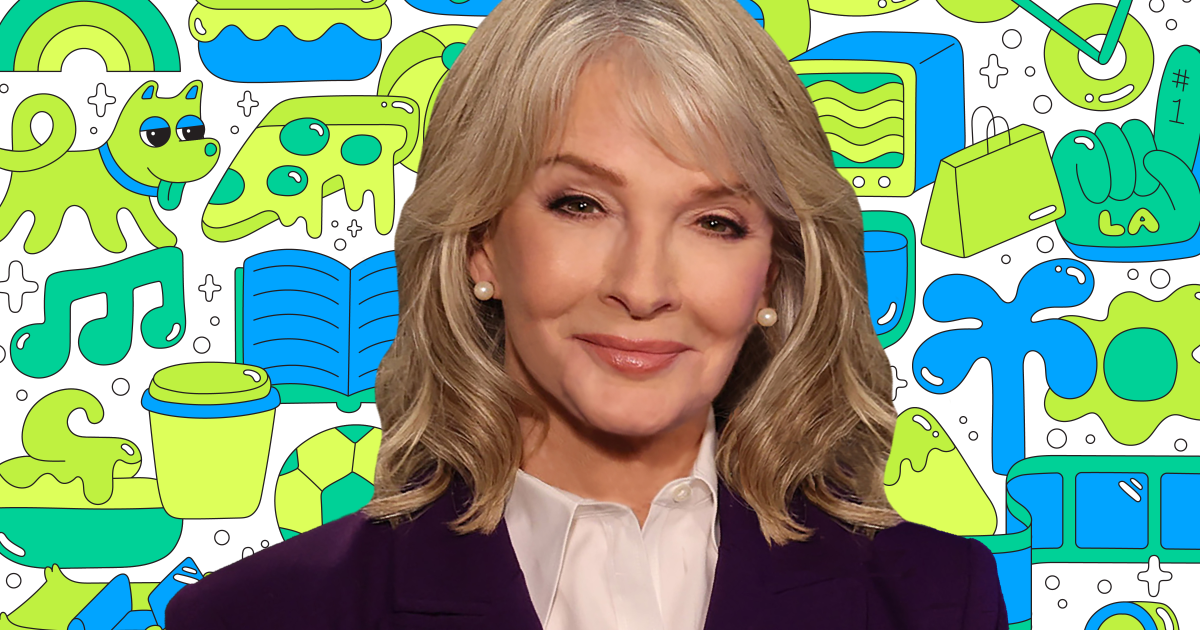
For half a century, Deidre Hall has taken on every kind of disaster in the drama-packed town of Salem, Ill., as a star of “Days of Our Lives.”
There was the time — actually, it happened twice — when her character, Dr. Marlena Evans, was famously possessed by the devil and even levitated.
In Sunday Funday, L.A. people give us a play-by-play of their ideal Sunday around town. Find ideas and inspiration on where to go, what to eat and how to enjoy life on the weekends.
Or the time a serial killer, who was actually Marlena under hypnosis, seemed to kill several beloved characters. The long-running show’s storylines have become legendary, and in March, while promoting “Hail Mary,” actor Ryan Gosling even gave Hall a shout-out, admitting he was a fan, praising the hard work of soap opera actors and calling her an “OG acting inspiration.”
But Hall’s real life in Santa Monica is much quieter than her character’s, and she likes it that way.
“When I bought my house in Santa Monica, I didn’t realize how great it would be to live near Montana Avenue,” says Hall, 78, about the popular shopping spot. Every day, she walks to the main street with her golden retriever, Riley, and enjoys Pilates, art and good food along the way. “The owners of the Farms Market even keep dog biscuits, so guess where the dog wants to go every time we walk — the Farms, of course,” she says, laughing.
When she isn’t filming the daily soap opera, which airs on Peacock, Hall enjoys raising monarch butterflies, exploring the shops and restaurants on Montana, and hosting movie nights at home with her two sons.
Here’s what a perfect day in L.A. looks like for her.
This interview has been lightly edited and condensed for length and clarity.

7 a.m.: Breakfast and dog walk
I usually kick off my day with a protein shake, feed our golden retriever and take her out for a walk. She’s a phenomenal girl. When we adopted her, her name was Riley, but I did think about naming her after Mrs. Hughes from “Downton Abbey.”

10 a.m.: Church and garden time
After I walk the dog and go to church, I like to spend some time in my yard. I’m not a natural gardener, but I really enjoy it. I started raising monarch butterflies because my identical twin sister, who played my twin on the show, planted a butterfly garden. Monarchs are amazing because they are transitional. Every year, they travel from Mexico to southern New England, but it’s getting harder for them. Their numbers have dropped by about 80%. To help, I plant milkweed, which is what they need to survive. I buy my milkweed from the Staghorn Garden on Wilshire Boulevard in Santa Monica. Julie, who owns the nursery, is delightful and has a wide variety of milkweed. The monarchs always seem to find my garden. Julie was raising some caterpillars too, and she cared a lot about them. We talked about how important it is to help the butterflies. That’s why I do this. Sometimes I get milkweed with eggs already on it, and Julie knows her butterflies are going to a good home.

1 p.m.: Walk to Montana Avenue for some lunch
I live near Montana and love taking long walks, going to Pilates and trying out the great restaurants nearby, like R+D Kitchen and La La Land. I’m a big fan of the waffles at the Courtyard Kitchen. Just a few days ago, I had a chicken salad on raisin bread with an Arnold Palmer, and it was delicious. It is right on Montana and has a nice outdoor seating area. It’s one of my favorite spots. La La Land always has a long line in the morning, which is perfect if you want coffee. They serve coffee, doughnuts, croissants and avocado toast. There’s plenty of outdoor seating, and you can even bring your dog.

2 p.m.: Peek inside a clock shop
There’s a small clock shop on Montana Avenue that’s closed on Sundays, but if you walk by, you’ll see all kinds of clocks — standing, table and wall clocks. The owner is great at fixing them. Once, I bought a wall clock from MacKenzie-Childs, but it didn’t work. And I was really upset because it matched everything else on my countertop. I brought it to the owner and said, “I love this, but I can’t make it work.” He fixed it right away. His name is John, but I call him Geppetto. And we all know why. He really does have a magic touch.

2:30 p.m.: Visit a neighborhood art gallery
Ten Women Gallery is run by 10 artists, all of whom show their work there. I was drawn to some watercolors there, bought a few cards and spoke with one of the artists. She told me, “You seem to love watercolors,” and mentioned that the artist who painted them, Pamela Harnois, lives in Los Angeles and teaches nearby. I got Pamela’s name and found out she taught at the Brentwood Art School. I was so inspired by her gift that I started taking private lessons with her on Saturdays. That gallery is where I discovered my love for watercolor painting.

3 p.m.: Grab some ice cream at Rori’s
The other day, my longtime girlfriend wanted to get ice cream and told me, “We are walking to Rori’s Artisanal Creamery.” It’s a small shop on Montana near Lincoln. They make everything themselves, using local ingredients from grass-fed cows with no added hormones. The place is family-owned and probably has the healthiest ice cream you’ll find. They switch up their flavors often, but my favorite is the salted caramel.

6 p.m.: Family dinner and movie night at home
R+D Kitchen is always packed, so my sons, who are 31 and 33, do the cooking. They come over, and together we make salads and cook dinner. There’s a neighborhood grocery store called the Farms, off Montana, a small family-run place that has everything we need. Everyone knows each other there, and people bring their dogs. We try to have movie night every Sunday. Sometimes the day changes, but we always make sure to have one night a week where we cook a meal and sit down as a family. Keeping that tradition has become really important to us. My sons are great cooks, which is funny because they definitely didn’t get that from me. [Laughs]
9 p.m.: Take Riley for one last walk and visit neighbors
After dinner, I take my dog for a walk. It’s a great way to meet neighbors. We always go around the same block. We’ve met so many people, and since she’s a golden retriever, she loves meeting everyone.

10 p.m.: News, knitting and bedtime
I am a news junkie, so I usually watch whatever is on the news before I go to bed. I have a long-standing passion for knitting. Lately, though, the news would make me drop a stitch.
For Iris van Herpen, couture is a laboratory as much as a runway. Our chief fashion critic, Vanessa Friedman, takes us inside this Dutch designer’s latest Paris show — from sci-fi-inspired gowns to an audacious attempt at a dress made of charged plasma.
Lifestyle
The BoF Podcast | Decoding Paris Haute Couture: Wonder, Restraint and the Call of the Void

-

 Technology11 minutes ago
Are you filthy enough for a $700 portable shower?
-

 World13 minutes ago
Former British MP and reality TV star Ann Widdecombe found dead; man arrested for murder
-

 Politics19 minutes ago
Trump takes unusual step, lets bipartisan housing bill become law unsigned amid SAVE pressure campaign
-

 Health26 minutes ago
Eating common dairy food every day may slow biological aging, study suggests
-

 Sports29 minutes ago
CM Punk to defend Undisputed WWE Championship against Cody Rhodes at SummerSlam
-

 Technology34 minutes ago
Would you pay $8,000 for a robot to fold laundry?
-
 Business41 minutes ago
Legendary Television City may be be sold in further blow to Hollywood
-
 Entertainment44 minutes ago
‘Foreign Tongues’ is the funniest Rolling Stones album in decades

