Lifestyle
The Surgeon General's parting prescription? Community. Amid the fires, L.A. is filling it


My first news of the Palisades fire came from a message in my neighborhood WhatsApp group. I learned from my neighbors in Del Rey that a blaze had broken out in the hills — above the neighborhood I grew up in, where my parents still live in our family home on the edge of the Palisades.
My own neighborhood of Del Rey was likely out of harm’s way. Yet as we all learned how quickly the fire was spreading, the neighborhood WhatsApp transformed into a mini resource center, sharing tips for staying safe and volunteering spare bedrooms and ADUs. A call for available deep freezer storage for an evacuee’s breast milk was met with offer upon offer. Everyone made space.
Meanwhile, I commiserated with preschool-era friends as our parents fled the Palisades and the institutions that raised us lit up in flames. The library, the grocery store, the coffee shop where I’ll always remember parking on the couch with my best friend discussing “1984” for hours — all gone. Was our synagogue OK? Nobody knew.
My parents evacuated to my mother-in-law’s house, friends scattered around Los Angeles. We all woke up to learn that so many families, dear friends, had lost their homes — each piece of news a gut punch. Even the famous village shopping district at the center of town was ash.
The devastation my community experienced was also being felt across L.A. County. The Eaton fire in Altadena burned tens of thousands of acres, including artist studios, musical havens and important sites of Black Angeleno heritage. The Hurst fire threatening Sylmar. Other fires dotted the L.A. map throughout the week, spurring evacuations and fear for West Hollywood and the West Valley.
Fire had reached into and across the city, taking, at this time of publishing, 28 lives and more than 16,000 structures. Meanwhile, despite heroic firefighting efforts, other government bodies sowed confusion. Our leaders have been playing a political blame-game. Past decisions to deprioritize fire prevention are coming to light. Even our emergency alert system failed, frightening every resident with a smartphone who received an evacuation notification sent in error.
The same day that the fires broke out, outgoing United States Surgeon General Vivek Murthy released a parting statement. The nation’s top doctor had spent his two terms interviewing citizens across the country learning about what contributed to and detracted from their mental and physical health. From his research came a prescription: A nation plagued with heart disease, diabetes, depression and an addiction crisis was — more than anything else — in need of community.
“The fracturing of community in America is driving a deeper spiritual crisis that threatens our fundamental well-being,” Murthy wrote, calling for a radical shift “in how we build and prioritize community.”
Witnessing how Los Angeles’ community networks picked up the slack of institutions that failed us illustrated the urgency of Murthy’s message. This prescription needs to be filled.
Disaster throws the need of community into sharp relief, but it is crucial for everyday and lifelong health and well-being too. Murthy explains that the “three pillars” of community — relationships, service and purpose — are scientifically proven to positively impact both life expectancy and life satisfaction.
These pillars, Murthy says, can “significantly influence health outcomes, including premature mortality, heart disease, depression, and anxiety. Community also gives us strength and resilience when facing the big challenges and countless paper cuts that come with moving through the world.”
But, as he sees it, these pillars have crumbled in recent years. An increase in the amount of time people need to spend at work has meant less civic participation and social interaction. The pandemic and social media both led to isolation, with the latter sowing division as discussions moved from in-person to online. Just 30% of people do volunteer work, and over 60% of young people say they feel directionless.
Community is a cornerstone of both individual wellness and collective well-being in the best of times. Now, friends, neighbors and an army of Los Angeles volunteers are proving that community is a powerful tonic in the worst of them.
The path to building community through these three pillars will take both individual effort and government investment, explains Murthy. Deepening relationships requires interactions that go beyond the group-chat, and fostering empathetic schools and workplaces. Providing service means the willingness to lend (and ask) a neighbor for help. Finding purpose means access to education and resources that unlock meaning in addition to a paycheck. The foundation for it all is reinvestment in (gutted) community infrastructure and social services that enable people to do more than simply survive.
Community is a cornerstone of both individual wellness and collective well-being in the best of times. Now, friends, neighbors and an army of Los Angeles volunteers are proving community is a powerful tonic in the worst of them.
After the fires swept through the Palisades we learned that, in some Hanukkah-esque miracle, my family’s Pacific Palisades synagogue, Kehillat Israel, did not burn, even as homes on its block did. In the coming days, KI became a locus of support, both practically and emotionally. It held both in-person services in a space lent by a temple across town, and a Zoom webinar. Local officials and disaster recovery experts gave concrete advice and information, and clergy and congregants gave each other time and space to hold each other’s pain. Even the Early Childhood Center found a temporary space for its toddler Shabbat group, Tot Shabbat, so that the temple’s youngest members could still see and sing with their class while evacuated from their homes. It’s been clear that bearing the grief with lifelong friends and strangers alike is the only real thing we can hold onto for the “strength and resilience” Murthy speaks of at a time like this.
Angelenos throughout the city have leaned on one another for support too. The essential workers who have lost steady employment in Palisades and Altadena homes are finding new opportunities in neighborhoods where residents share the names of those looking for work, like in my neighborhood group chat. A GoFundMe for organizations advocating for essential workers has raised over $90,000. For people seeking ways to help in person, every day, Mutual Aid Los Angeles Network updates a Google spreadsheet of volunteer opportunities that has dozens if not hundreds of viewers at all hours of the day and night; volunteer centers are so busy that they are turning people away. Teenage organizers are full up on beauty supply donations for other teenagers affected by the fires. Real estate agents are providing free house-hunt services, salon workers free haircuts, restaurants free meals and so much more. Celebrities like Beyoncé have given millions toward relief and recovery efforts; the general public has raised $50 million for those affected by fires on GoFundMe alone.
All of these efforts are only possible because Angelenos decided to care about one another. The fires have shown that our city, a patchwork of neighborhoods, is also a collection of neighbors.
This overwhelming community response to a crisis may be helping to cushion the blow for some, to the extent that that’s possible in the face of catastrophic loss. But community cannot only be a reactive value. On a national level, enshrining community as a civic value and way of life must serve as a local bulwark against natural disaster and larger political forces. On an individual level, seeking out community, and inviting others in, can ensure support in the face of both big challenges and “paper cuts.” Whether that’s being part of a faith institution, or participating in or creating a communication hub like a neighborhood chat. Local clubs and volunteer opportunities can help you bond with your neighbors over common interests. In all these cases, community is quite literally a lifeline.
That’s why the fires have made clear that building, investing in and nurturing community is important not just now, but always.
On Wednesday Jan. 8, one of KI’s rabbis, Rabbi Daniel Sher, recorded and posted a video on Instagram after finding out that he had just lost his own Palisades home:
“Our community that we love so dearly is in disarray,” he said. “But I do know that we will care for one another, reach out for one another, and we will rebuild. So many of us are experiencing heartbreak. But when a community experiences heartbreak together, it means that we can mend our hearts together as a community as well.”
As Murthy says, “a community grounded in love is a community that will stand.” It’s that human-to-human connection and compassion that will help us weather the storm. Every text I sent and received to impacted friends I’ve known since our KI preschool days — some of whom I haven’t even talked to in years — contained those words: I love you. Those bonds, and the ones we’ve seen form and tighten throughout the city, give me hope that when it comes to healing from these fires, Los Angeles is poised to administer our former surgeon general’s cure.


Lifestyle
L.A. Affairs: It’s hot when a man drives to me. But would this new guy make the trek from the Valley?
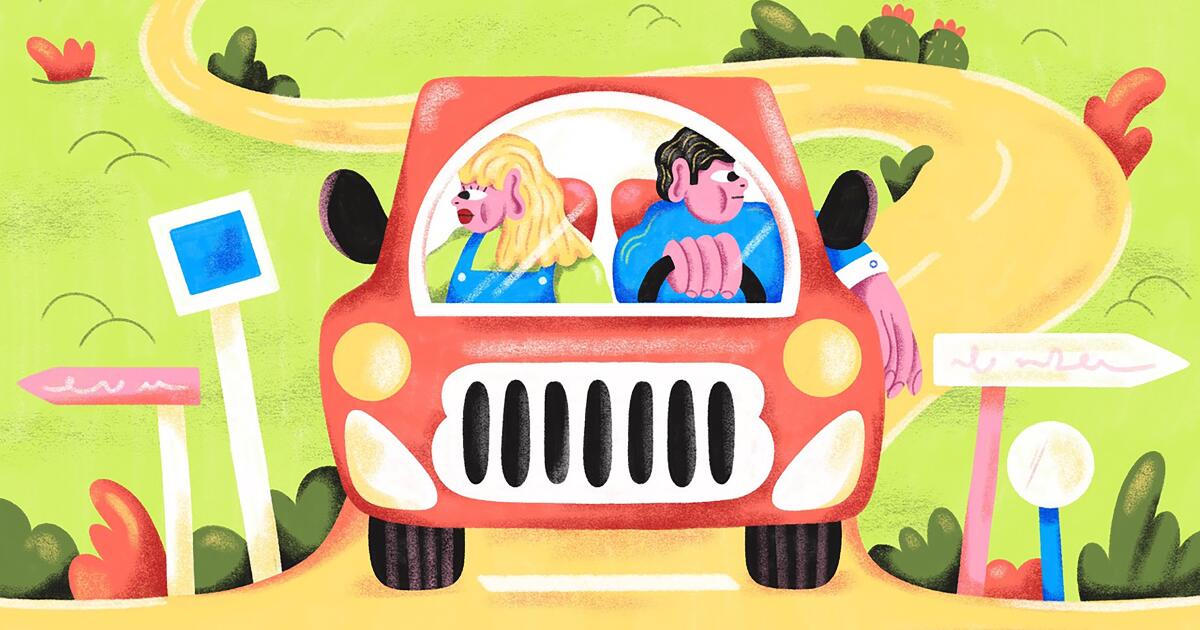
I met Dan on Hinge.
He lives in Woodland Hills, and I live in Venice. In Los Angeles, this is considered a long-distance relationship. In another city it might be nothing. Here, it’s a factor.
But I believe that with the right person, you can make anything work, so I stay open. I’m a native New Yorker, and if I were living in Brooklyn and a guy lived on the Upper West Side, that would be a 45-minute subway ride, which is truly nothing in New York. So with that same logic, I try to have flexibility with men in L.A.
When we started planning our first date, Dan suggested three options: a hike on mushrooms, a wine tasting or a walk on the beach.
A hike on mushrooms is something I’d only do with someone I already trust, not someone I just met online. I don’t do first-date hikes because I don’t like feeling trapped if the guy’s a dud. So I chose the wine tasting.
Then I learned the wine tasting was in West Hills.
On a Friday night, driving there from Venice would be insane. So I said I didn’t want to meet there because of the traffic. He suggested Malibu. That was also not ideal on a Friday.
I was getting annoyed — this was a pink flag because in my dating world, the guy is supposed to come to the woman’s neighborhood in the early days. I’ve gone out with plenty of men from the Valley who effortlessly suggested they come to me. It’s not rare or impossible.
I suggested he come to the Westside. I didn’t specifically say Venice, and in hindsight, I probably should have. He landed on Brentwood, which was manageable for both of us. On our first date, we met at an Irish pub on Wilshire Boulevard. He was cuter and more interesting than I had expected, and with the Guinness flowing, we had fun.
When I got home, he texted me: “Well, I like you 🙂 Less the tik tok and the lack of rock music in your life, but it’s not a deal breaker — there are other qualities 🙂 What are your thoughts?”
I noticed the slight negativity but was mostly dazzled that a man texted immediately after the date to say he liked me. In the modern dating economy, this felt rare.
The next day, both of our evening plans fell through, so we made a last-minute date. The wine tasting he originally suggested still sounded like fun, and although it meant me driving to the Valley, I was up for it now that we’d met.
We sipped flights at Malibu Wines & Beer Garden in its airy, romantic courtyard and played a flirty version of Truth or Dare. Halfway through, he dared me to kiss him.
We ended with sushi on Ventura Boulevard and a short make-out session in his car. He invited me to Thanksgiving at his uncle’s, which felt too soon, but also sweet.
After the second date, he texted and said he had his kids that week and was also hosting an event on Thursday, so his only day to meet was Wednesday. I said great.
On Tuesday night, he checked if we were still on, and I said yes.
Then he texted: “I’m flexible on time but not on location. I have a big event on Thursday, hopefully you can come to me again.”
My stomach tightened. This again?
So I texted back: “I drove to you last time, which was a bit of an exception for me especially in the early days, but the wine tasting location sounded special. Usually guys come to my area. How about we switch it up this time?”
He replied: “I appreciate the effort! Because of my event, I’d rather be close to a computer just if needed … Here is what i offer:
— I’ll come to your area anytime next week/end
— Lunch/dinner on me
I want to continue where we stopped last time 😉 No pressure of course, but let’s snuggle”
I responded: “Ok let’s meet next week. Snuggles sound nice … let’s see what happens …”
Then he wrote: “So I won’t see you tomorrow?”
I replied: “Unless you wanna come to me and bring your laptop along, let’s rain check until you have more flexibility.”
He said: “Dang, you are hard. I’ll let you know tomorrow around midday if it’s ok.”
And then — surprise — he decided to come.
He drove to Venice for a 5 p.m. date. He said his ETA was 5 p.m., and it ended up being 5:25 p.m., typical 405 Freeway.
When he showed up, he was in a cranky mood. On our way to KazuNori in Marina del Rey, I thanked him for picking me up and told him I think it’s hot when the guy comes to the girl.
“You’re just saying that because you want me to come to you more,” he said, not playfully, but aggressively.
That was basically the end for me. But there I was, in his car, heading to dinner. So I stayed pleasant and tried to make the best of it.
I shared that in the early stages of dating, I find it’s good etiquette for the guy to come to the woman’s neighborhood. He immediately disagreed and started ranting about how dating rules are ridiculous and how they swing in women’s favor. He resented paying for dates and declared he wasn’t looking to “sponsor a woman’s life.”
“If women want equality and equal rights,” he said, “then it should apply all across the board, including dating, and the man shouldn’t have to pay.”
I said women don’t actually have equal rights because we get paid less than men and often receive lower salaries than men in the same position.
I tried to change the subject and reset the mood, but he insisted we keep hashing it out.
I tried to explain masculine/feminine dynamics: providing and protecting, giving and receiving.
“What does the man get out of this arrangement?” he asked.
It was like watching someone’s personality warp into Mr. Hyde. Then he brought up another point: He’s a single dad of two kids, so he gets tired; and because I don’t have kids, that should factor into who drives where.
At this point, I was barely engaging and focused on eating my hand rolls, and I couldn’t wait to get home.
The check came, and I happily split it, wanting nothing further from him.
In the car back to my place, he remarked: “It’s obvious we’re never gonna see each other again.”
Obvious, but did it need to be stated?
Then he showed me a Spotify playlist he’d made for me of his favorite electronic music, because he knows I like EDM.
“Oh, that’s sweet,” I said.
“Yeah, that’s how I show interest. Through things like this, not who drives to who,” he replied.
When I got out of the car, we wished each other luck, and I headed inside and shut the door.
Two hours later, he sent me the playlist. I’ve yet to listen to it.
It wasn’t the distance that ruined it. It was the resentment. I’m not looking for a man who feels burdened by the effort. I’m looking for a man who sees the value of courting a woman in the first place.
The author is a writer, comedian and former psychologist who lives in Venice. She is the creator of the new vertical series “Manfari.” She’s on Instagram: @solange_neue and @manfari.show.
L.A. Affairs chronicles the search for romantic love in all its glorious expressions in the L.A. area, and we want to hear your true story. We pay $400 for a published essay. Email LAAffairs@latimes.com. You can find submission guidelines here. You can find past columns here.

Lonnie Bunch III is the 14th Secretary of the Smithsonian. He’s pictured above in September 2017.
J. Scott Applewhite/AP
hide caption
toggle caption
J. Scott Applewhite/AP
In a memo addressed to staffers sent Tuesday, the secretary of the Smithsonian, Lonnie G. Bunch III, defended the institution after the White House issued a 162-page report that characterizes the National Museum of American History as a place which has become “subject to institutional capture by a radical, activist ideology that is fundamentally opposed to telling the noble, honest story of the great country we know and love.”
In his email, which NPR has obtained, Bunch wrote in part: “While there will always be room for improvement, this report is not a fair characterization of the work and totality of the National Museum of American History. At the Smithsonian, our work is driven by scholarship, accuracy and an uncompromising commitment to tell the fullness of America’s story. As public servants and the keepers of this institution, we are charged with helping a nation find understanding, hope and clarity and as part of that duty, we are dedicated to excellence, reflection and growth.”

He continued: “We remain focused on what grounds us: a steadfast commitment to scholarship, nonpartisanship, independence, accuracy and integrity. For nearly 180 years, the Smithsonian has worked alongside partners across government — from the White House to Congress to our governing Board of Regents — guided by our enduring mission to increase and diffuse knowledge. That purpose remains: to pursue knowledge with rigor and to serve the American public with clarity and care.”
The White House report was issued on July 4 by the Domestic Policy Council under the title “Saving America’s Story: How Ideological Capture at the Smithsonian Institution’s National Museum of American History Erases Our Heritage.”

The council faults the National Museum of American History on a multitude of fronts, saying it underemphasized the Founding Fathers and early colonial and Revolutionary history; was not sufficiently celebratory of the country’s 250th anniversary; and that it engaged in “anti-white,” “illegal alien” and transgender activism.
It also accuses the museum of trying to “indoctrinate” teachers and students through its exhibitions, programming and teaching resources.
In the report, the council also specifically criticizes museum director Anthea Hartig, who has led the National Museum of American History since 2019 and is concurrently the president of the Organization of American Historians, calling her “an activist advancing an ideological agenda contradictory to the museum’s founding purpose of fostering patriotism.”

The Trump administration has made the Smithsonian museums one of its primary targets in its efforts to reshape cultural narratives to align with its viewpoints. In August 2025, the White House requested a “comprehensive internal review” of eight Smithsonian museums, including the National Museum of American History, following an executive order issued by President Trump in March 2025 in which he called for the removal of “improper ideology” from the Smithsonian’s offerings.
According to the Smithsonian’s charter, all of its 21 museums, 14 education and research centers, and the National Zoo are meant to be run independently of the federal government. The Smithsonian is overseen by Bunch and a board of regents, which includes Vice President Vance, Supreme Court Chief Justice John Roberts and other members appointed by Congress.
In an interview with NBC’s Meet the Press on Sunday, Bunch spoke about the Smithsonian’s 250th anniversary special exhibition at the Smithsonian Castle, which is called “American Aspirations.”
He told NBC: “It’s really important for people to understand that America is much an ideal as it is a place, that it’s a series of aspirations that have really shaped who this country is. And so for me, what is so powerful is to say, ‘Let us honor the words of Thomas Jefferson and the founders, but let us use those to challenge us to be better.’”
Jennifer Vanasco edited this story.

-

 Wisconsin39 seconds ago
Shipwreck Coast sanctuary council to meet July 16 in Sheboygan
-

 West Virginia8 minutes ago
Helicopter crashes in Pocahontas County
-

 Wyoming11 minutes ago
Wyoming officials say Meta’s 715,000-square-foot data center is responsible for contaminating its water system with a rare bacterium | Fortune
-

 Crypto16 minutes ago
What Are KOLs Discussing About the Cryptocurrency Market Today?
-

 Finance23 minutes ago
From Love Island to Precious Metals, Prediction Markets Are Changing Finance | PYMNTS.com
-

 Fitness25 minutes ago
80-year-old fitness icon Joan MacDonald reveals her simple exercise for a stronger, more stable core
-

 Movie Reviews38 minutes ago
‘Gail Daughtry and the Celebrity Sex Pass’ Review: We’re Off to Hump the Wizard
-

 World45 minutes ago
Backlash on ethanol-blend fuel intensifies in India, puts carmakers in the dock

