Lifestyle
The pioneering women behind the invisible art of film editing


Thelma Schoonmaker accepts the Oscar for achievement in film editing in 2007 for her work on The Departed.
Mark J. Terrill/AP
hide caption
toggle caption
Mark J. Terrill/AP

Thelma Schoonmaker accepts the Oscar for achievement in film editing in 2007 for her work on The Departed.
Mark J. Terrill/AP
When it comes to some of cinema’s most iconic films, Steven Spielberg’s Jaws is about as different from, say, The Wizard of Oz as that technicolor fantasy is from Quentin Tarantino’s genre pastiche Pulp Fiction. But one crucial component links them: they were all edited by women.
If you think about it, you can trace other craft elements of filmmaking to previous mediums – cinematography derived from photography, production design coming out of the theater. But film editing could not have been invented without the invention of film itself. There would be no film without film editing. And yet, its practitioners don’t often grace the cover of magazines.
“The fact that editing is supposed to be invisible, which has contributed to editors not being visible, is what makes it such a great craft,” said Su Friedrich, a filmmaker and former professor at Princeton University. While there, she created a database cataloging films edited by women called “Edited By.”
But just what is film editing?
“Basically, you take thousands of feet of film — you know, hundreds of shots of different scenes, whatever — figure out what the best take is, what’s the best performance, what’s the best moment in that performance, and make it all flow in a way so that when we’re watching something, we stay completely in the story,” Friedrich said. “When you do it really well, nobody’s noticing what you’ve done.”
Friedrich created the database after noticing just how many of the invisible editors for so many iconic moves had been women, going all the way back to the very beginning of Hollywood.
“Women were hired for that, I think, in many ways because it seemed like a job that women did the way women did sewing,” she said. “You know, they’re good with their hands, this sort of ridiculous idea.”
Friedrich said this notion pushed women out of other jobs in the industry, like directing and cinematography. But because many people saw film editing – or cutting, as it was called then – as unglamorous, secretarial work, it proved to be an easier entry point for women in the industry. And it gave them a lot of creative control.
Margaret Booth Receives an Honorary Award at the 1978 Oscars.
YouTube
One of the famed editors of Old Hollywood was Margaret Booth, who began her career with D.W. Griffith pioneering revolutionary film editing techniques.
“She’s one of the people that really helps to create this kind of invisible style of classical Hollywood, believing that editing or cuts should be invisible so they aren’t obstructing the action,” said Erin Hill, an assistant professor of media and popular culture at UC San Diego.
Booth became supervising editor for MGM studios for more than 30 years. Legendary studio head Irving Thalberg actually coined the term “film editor” because of Booth. Another major figure was Anne Bauchens, who worked for more than 40 years with Cecil B. DeMille. She was the first woman to win Best Film Editing at the Academy Awards, six years after the creation of the category.
To compare, when Kathryn Bigelow became the first woman to win best director, it came 81 years after the first directing award was given.
Kathryn Bigelow accepts Best Director Oscar for The Hurt Locker in 2010.
Kevin Winter/Getty Images
hide caption
toggle caption
Kevin Winter/Getty Images
Kathryn Bigelow accepts Best Director Oscar for The Hurt Locker in 2010.
Kevin Winter/Getty Images
“I mean, there are so many amazing examples of women who worked hand in hand with the director. And most of these women, I mean, their credits — they edited 50 films, 75 films, 100 films,” Friedrich said.
Friedrich says a lot of that work went uncredited, and as the craft became more popular, more men entered its ranks. But female film editors have remained a prominent force in movies.
Anne V. Coates won an Oscar for her work on the 1962 epic Lawrence of Arabia, perhaps most famous for the scene when Peter O’Toole blows out a match, and the scene suddenly shifts to the sun rising over the desert horizon. That “match cut” is considered one of the most iconic in movie history.
The “match cut” scene in Lawrence of Arabia.
YouTube
At this year’s Oscars, Thelma Schoonmaker received a record ninth nomination for Martin Scorsese’s Killers of the Flower Moon, marking her 22nd collaboration with the celebrated filmmaker. While the frontrunner for the Oscar looks to be Jennifer Lame, who edited Christopher Nolan’s Oppenheimer. Speaking to NPR, Lame said she was drawn to the challenge of making all those dialogue heavy scenes move like action scenes.
“I really wanted to make sure that those scenes that are with [Lewis] Strauss and the Senate aide — and it gets into the weeds of stuff — that certain lines popped,” she said.
Another part of her job — of any editor’s job — was to help shape the performances, to know which take best serves a scene. She singled out the scene when Cillian Murphy’s Oppenheimer reveals the tragic fate of his lover to his wife Kitty, played by Emily Blunt.
“Ten versions of that performance are amazing, and for the longest time we had one version where he’s, like, staring at her and he’s looking at her. And then we realized, ‘You know what? I think it’d be better if he wasn’t looking at her, and, you know, he had more shame.’ And it was. So it’s just this just constant tweaking,” Lame said.
Hilda Rasula, who edited best picture nominee American Fiction, says her job is about realizing the director’s vision.
“You’re kind of a midwife to the film, you know? You’re helping them realize that vision in the best way you can and seeing it through to the very end until it gets born,” Rasula said.
Considering the gender connotations of “midwife,” Rasula doesn’t see anything inherently gendered about being a film editor, but she isn’t surprised that so many of the trailblazing editors in movie history have been women.
“I think it’s not a coincidence that it is a role that requires an enormous amount of empathy, feeling the chemistry of what happens between two people, three people on screen and understanding human nature,” she said. “Women are raised to be fairly social creatures. So I think this is a skill that maybe is inherent not to all women, but to the way women are raised in our culture.”
Men still make up the majority of the Editors Guild. According to a 2023 USC Annenberg study, 14% of best editing nominees across Oscar history have been women. Though that’s compared to less than 2% of the best director nominees being women. Erin Hill puts the onus on the industry to provide more opportunities for female editors.
“They would be greatly helped if we did more to recognize the structural and the kind of cultural barriers to advancement, and that takes a lot of inward looking,” she said.



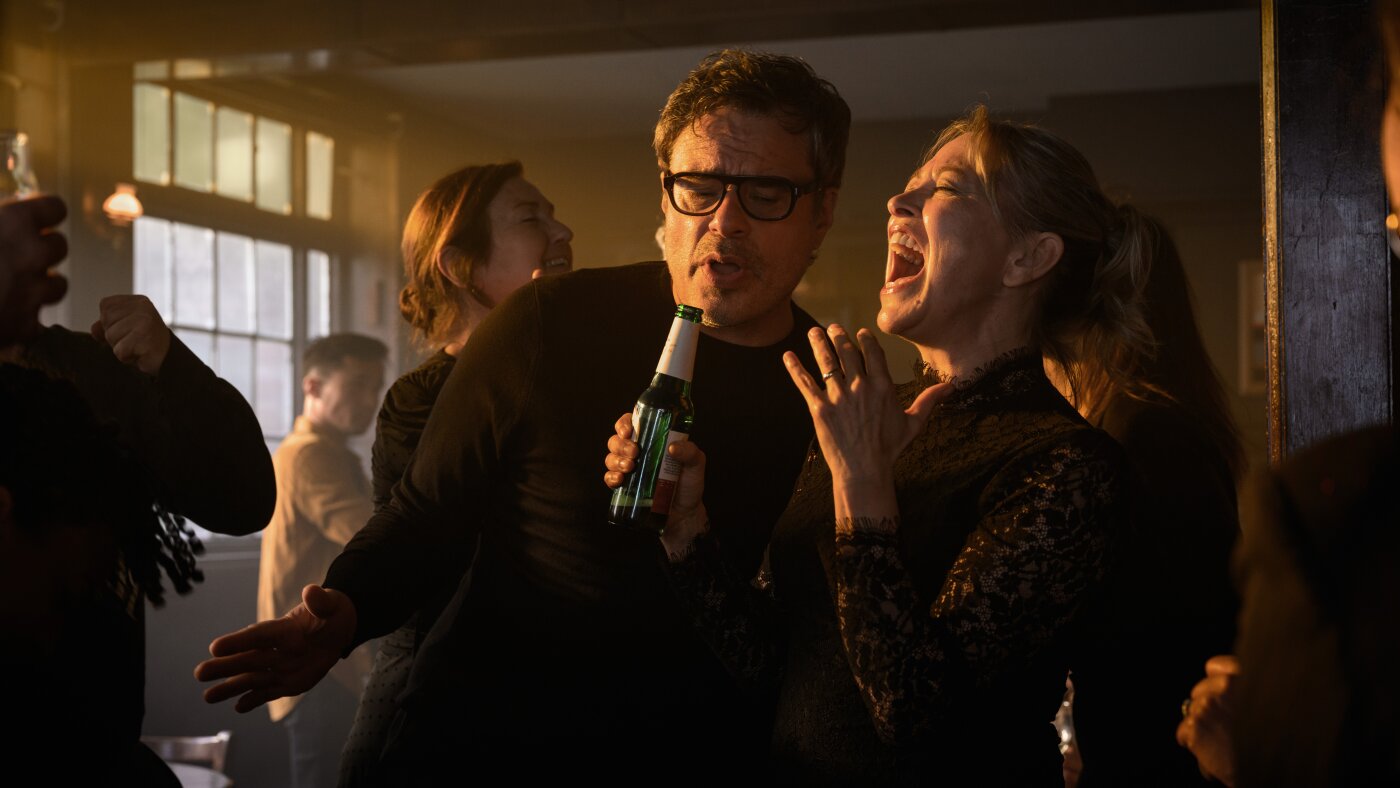
In Alice and Steve, Jemaine Clement and Nicola Walker play long-time friends who turn on each other after he gets involved with her 26-year-old daughter.
Lara Cornell/Disney+
hide caption
toggle caption
Lara Cornell/Disney+
I grew up watching episodic shows on network TV, nearly all of them formulaic but some indelibly great. Then, like everyone else, I moved into the days of what my colleague David Bianculli dubbed Platinum TV, where series like The Sopranos and The Wire and Fleabag aspired to something higher. What both these eras had in common was that their shows were carefully crafted — they had an internal logic, and a tone, that held them together.
In recent years, though, there’s been a proliferation of shows that, possibly obeying some algorithm, care less for coherence than sensation. They lurch among tones, from cuteness to sentimentality to meanness, stirring in random plot twists along the way. Bouncing all over the emotional map, these shows depend on compelling actors and a few memorable scenes to make us overlook their loose construction.
A great example is Alice and Steve, an entertaining but sometimes exasperating six-part British comedy on Hulu about two 50-something best friends who turn on each other after he gets involved with her 26-year-old daughter.


While the premise is juicy, it’s also a tad yucky, and I mainly tuned in because its title characters are played by performers Jemaine Clement from Flight of the Conchords and Nicola Walker, whom I’ve raved up on this show more than once.
The series starts poorly with Steve and Alice going on a cutesy bender after a friend’s funeral. Now, I always hate drunk scenes, which are an invitation to overact. As Clement and Walker bray their lines, we learn that Steve’s a divorced celebrity hair stylist who can’t find a girlfriend while Alice is a clothes designer with a doting younger husband, nicely played by Joel Fry, a sweetie-pie of a teenage son — that’s Tyrese Eaton-Dyce — and, of course, that 26-year-old daughter, Izzy, who has inherited her mother’s willfulness. Played by Yali Topol Margalith, Izzy kickstarts the plot by flirting with Steve. Predictably, he succumbs.

Almost immediately, they think they’re in love. While the weak-willed Steve wants to hide their romance — he knows it’s inappropriate — Izzy just blurts out the facts to her mom. Alice flips. And from hereon out in this series where the women are as alpha as the men are hangdog, Alice drives the action. Betrayed and violently angry, she’ll do whatever it takes to break them up — no matter who gets hurt. Her antics unleash Steve’s own malice. We’re in Beef territory.
At its core, Alice and Steve hinges on the way that platonic friendships are often richer and more powerful than romantic ones. It’s a fascinating subject, which may be why I found the script by Sophie Goodhart so frustrating. I wanted her to dig deeper. While the show’s got some very funny bits — Alice’s sharp-tongued mother is a blast — it’s often annoyingly lax.

If Steve really does the hair of Charli XCX, how come he’s a clueless older guy whose pop culture references are Willie Nelson and Woody Allen? If Izzy truly adores her mother as she claims, why does she keep rubbing her relationship with Steve in her mom’s face? Halfway through, one character nukes the other’s career, but this life-shattering event has no real weight: It’s barely even mentioned for the rest of the series.
That said, Alice and Steve is worth seeing for scenes like the one in which Steve spinelessly sells Izzy out or the lacerating discussion between Alice and her husband when he fully grasps that he adores a woman who views him as a reliable but dull concierge, not a man she likes hanging with. Most touching of all may be the lovely sequence when Alice, wise for once, smooths a romantic crisis between her son and his would-be girlfriend, a pair who are the show’s emblem of hope. For once, we understand why people love her.

While most viewers will find Steve more likable than Alice — the show takes pains not to make him appear predatory or creepy — the role doesn’t give Clement a whole lot to do except play variations on shambolic dread and discomfort. The show gets its galvanizing zing from Walker, a beloved star in England with amazing, luminous eyes. Her Alice is the kind of complicated, volcanic heroine that you don’t see in movies and rarely see on TV, one who shows her apocalyptic rage freely and in many different forms.
At least once in every episode, something would lead me to say, “Man, is this show a mess.” But that wasn’t a deal breaker. I kept watching. After all, life is messy, too.


How to enter your Sporty Spice era.
Getty Images/quantic69/Olga Kurbatova/Anastasiia Zvonary/Photo Illustration by NPR
hide caption
toggle caption
Getty Images/quantic69/Olga Kurbatova/Anastasiia Zvonary/Photo Illustration by NPR
Reality dating and professional sports are not as different as you’d think.
Brittany is in her Sporty Spice era – she watched the NBA playoffs, she’s following World Cup games, and she’s watching the New York Liberty play their WNBA season. These games are daily – and so is the reality dating show Love Island. And she noticed that the two formats are not very different at all. Defector.com staff writer and co-owner Kelsey McKinney came to the same conclusion – so the two of them discuss why these games of athleticism and love can bring us together… and why they get valued differently in our culture.
For more episodes on sports and reality TV, check out:
Get rich or die trying: how sports betting is changing our love of the game
Is this the end of reality TV?
The ugly truth of America’s expensive homes
Support Public Media. Join NPR Plus.
Follow Brittany on Instagram: @bmluse
This episode was produced by Liam McBain. It was edited by Neena Pathak. Our Supervising Producer is Cher Vincent. Our Executive Producer is Barton Girdwood. Our VP of Programming is Yolanda Sangweni.

-

 Vermont4 minutes ago
Authorities ID girl who died in Vt. river, older brother who died trying to save her
-

 Virginia11 minutes ago
How Virginia became the world’s data center capital and how it’s going – WTOP News
-
Washington14 minutes ago
Question of the week: What does Santana Moss think of Washington’s WR depth?
-

 Wisconsin19 minutes ago
Wisconsin Supreme Court puts ICE detainers suit on hold pending appeal
-

 West Virginia26 minutes ago
DEP Report: Parkersburg plant had prior fire containment issues
-

 Wyoming29 minutes ago
History of Laramie Jubilee Days: It Started As A One-day Fiddlers Contest And Chariot Race
-

 Crypto33 minutes ago
U.K.’s sanctions on cryptocurrency exchanges signal new focus on illicit digital financing – Compliance Week
-

 Finance41 minutes ago
UK Watchdog Urged to Consider Broader Oversight of AI Financial Firms | PYMNTS.com

