Lifestyle
The found family making history out of a K-town strip mall


The Korean diaspora has a complex relationship with the word “gyopo.” In the most literal sense, it refers to Koreans living in another country as immigrants. David Kang, former USC Korean studies director, once told The Times that the word carries this ancestral view of “Koreans as our blood overseas, almost.”
In a cultural sense, gyopo is an insult.
Think of it as the Korean “no sabo”: a derogatory term for a person living outside of the motherland and thus disconnected from their culture.
Despite and because of these definitions, in 2017, a group of L.A. Koreans lovingly named their new organization Gyopo.
“We started Gyopo because we all knew that this way of convening was missing from our lives,” says co-founding member Yoon Ju Ellie Lee.
At its heart, Gyopo is exactly that — a convening. It’s getting together to talk about historic Korean protest movements, the cultural significance of the chili pepper in Korean food, the meteoric rise of K-pop, anti-Asian racism in 2020, representation of transgender Koreans in film and anything and everything that affects L.A.’s Korean American community.
Following the 2016 presidential election, Lee was searching for this community. As a Korean American growing up in L.A., she felt most understood when surrounded by fellow first- or second-generation Koreans, who knew the “not-quite-fitting-in” and the desire to reconnect with their roots. Soon, she and a group of friends found themselves organizing impromptu events.
Koreans began immigrating to Los Angeles in the early 1900s as Korea lost independence to Japan, with a formal subjugation in 1910. In search of freedom, Koreans left for farming communities in the Imperial Valley, city life in San Francisco and eventually, Los Angeles. Koreatown came to life and blossomed in the late ’60s as a new immigration act permitted thousands of Koreans to immigrate and join their families in L.A.

In this history of pursuing independence and building up community from scratch, Gyopo is following a long legacy of diasporic Koreans gathering and restoring their relationships to identity.
“Using [Gyopo] as our organization’s name is definitely a reclamation of the term,” Lee says. “The reason why ‘Gyopo’ was a derogatory word is because there’s an overall kind of weight, complexity and even grief around the diaspora because of things like Japanese occupation and the Korean War. Just a decade ago, it was hard to find Korean things, so we had to define our own relationship to Korean culture.”
Today, Gyopo organizes and invites Korean Americans, and anyone curious, to panels, screenings, art galleries and other cross-cultural programs that highlight the diverse art of the Korean diasporic community. Some call it a “found family.”
In the style of traditional family photos, Gyopo’s board of directors and community members gathered one recent weekend morning in the parking lot of their historic Koreatown strip mall headquarters. Strip malls have played a nostalgic role in the Korean community, serving as places of communion, feast, work and dialogue. For the photo, the members joyously held up pieces of cloth from their charye table, a customary shrine that Gyopo and partner program Ssi Ya Gi set up at their most recent Chuseok benefit to remember ancestors.
Chuseok is one of Gyopo’s consistent annual gatherings in celebration of the traditional Korean autumn harvest holiday. On this year’s Chuseok, Gyopo honored “Beef” and “The Walking Dead” actor and producer Steven Yeun. As he stepped onstage, Yeun recognized Gyopo’s contributions to L.A.’s Korean arts scene.
“I feel like our community has come a long way,” Yeun said. “I thought about that a lot over the course of my personal career, over the course of the past decade, and as wonderful organizations like Gyopo have been made. I see, and I wish for, and I’m hopeful for and I’m emboldened to see everyone here and the way that we show up for the next generation.”
As Gyopo continues to bring the best of Angeleno Korean art and scholarship together, the people who make it possible reflect on the history of Gyopo. Their memories document Gyopo’s growth from backyard sketch to cultural mover.
2016–2017: ‘It felt like there was an opportunity’
Ann Soh Woods, Gyopo board of directors: “It was after the 2016 election that we first started talking about coming together in this way. It was a tough time. We were internalizing a lot of the negativity in the world and we wanted a place to open up and share. There wasn’t an organization like Gyopo. I’ve never been part of something like that, so shaped by the community with arts and enthusiasm and need. That’s what I always liked — it wasn’t hierarchical but about finding space to belong.”
Yoon Ju Ellie Lee, founding member of Gyopo: “During the earlier years, we were just a bunch of volunteers with a vision for a place for our diaspora to gather. (Former steering committee member) Nancy Lee and I sat in my backyard and sketched out the Gyopo logo. We sent it to our friend Jeanha Park, who was working at the Hammer Museum, and asked if she could make it into a vector. It’s our same logo today. That’s just an example of how scrappy and interdependent we were back then.”
Cat Yang, Gyopo steering committee member: “There is this moment in time, in the 2016 era, when Asian Americans had [greater visibility] in the wider art landscape in Los Angeles and nationally. It felt like there was an opportunity to galvanize our creative communities. It was in this that Gyopo was starting out, specifically made for Korean folks and diaspora in L.A., in a time when it felt like there weren’t many museum exhibitions or galleries that were considering Asian Americans as much.”
Ju Hui Judy Han, UCLA professor and Gyopo panelist: “I first met Gyopo, which was Ellie and a couple of other folks, right around the time they were deciding on the name. Gyopo, as you know, means a Korean American or a member of the Korean diaspora, and it’s a word that has some negative connotations. So I remember being a little bit hesitant about it and talking to them about the group. I knew that they were artists and curators and people in the art world, but I really wasn’t sure what to expect.”
Lee: “We always worked with the intention that this would grow. I think that everyone always knew and believed that Gyopo would go somewhere. The only reason we exist now is because of the goodwill of the community back then. Everyone just chipped in for art galleries, aquarium trips and fried chicken.”
2018: ‘We laid the groundwork and expectations that we wouldn’t shy away’
Woods: “I first heard about Gyopo before I even knew their name. My friend said, come to this New Year’s event, be part of this group, we’re gonna eat Korean food and watch K-dramas and make kimchi and practice Korean. It has certainly evolved from there, but at its core I think it’s still just a group of like-minded people trying to connect.”
Lee: “At our first Lunar New Year event, people talked about issues they wanted to deal with in the future, sharing space with each other, and for me in 2018, I hadn’t previously paid much attention to the Lunar New Year. It was the first time that I spent it surrounded by friends.”
Anicka Yi, Gyopo board of directors and artist: “I remember thinking that it seemed totally natural and organic that L.A. would have an organization like this, especially at this time, because there’s such a high concentration of immigrant communities. It was just really positive to see something uplifting and galvanizing. It wasn’t always so positive among these communities in L.A., remembering the L.A. riots, there was a lot of strife and conflict with marginalized communities. This felt like a positive direction.”
Lee: “Looking back at these archived programs, like our first collaboration with LACMA on understanding K-pop’s crossover success, I feel like it is totally relevant now. Early on, we were interested in all forms of art and issues that we are still dealing with. We laid the groundwork and expectations that we wouldn’t shy away from difficult issues.”

UCLA professor and educator Judy Han, left, moderated a queer film screening of “Coming to You,” a documentary about mothers and their queer kids with director Byun Gyu-ri, second to right. At the screening, Han says the sense of connection was emotional.
(Ruthie Brownfield)
Han: “The lecture that I gave with Gyopo, ‘Resistance in Precarious Times,’ was on protest cultures in South Korea. I’m used to lecturing, like, I plug in my computer, I have some visuals and I mostly read and speak. But then in consultation with Gyopo, I threw a question out there, ‘What might constitute an immersive lecture, something that would actually give the people in the room a feeling of actually being in a protest?’ And Gyopo had all these crazy ideas; they’re like, ‘Oh, we can do three screens, give people candles, have them sit on the floor.’ I’m like, ‘What?’”
Kayla Tange, artist and Gyopo volunteer: “I loved this book “This Is Where I Learned of Love” by Jennifer Moon and she did a talk with Gyopo. I went and ran into so many Korean artists. I remember thinking, “Wow, there’s this whole community out there.” I was following the work they did right before the pandemic and loved the people they would highlight. Celine Song did a talk with them, this amazing LACMA curator walked us through a Korean calligraphy exhibit. It was really unique.”
Han: “We did a queer film screening with a Q&A at the end. I remember there was an audience member who kind of choked up as they spoke and said that they’ve felt like an oddity, a sort of unicorn in their life, being a trans person and in the Korean American community. And then in that space, they looked around, and it was like a roomful of unicorns. That just really struck me because that’s exactly the spirit of the community that Gyopo fosters. It’s not just a normative idea of Korean Americans, but we’re actually trying to come up with a different vision altogether.”
Woods: “Around this time we got 501(c)(3) nonprofit organization status. This was a big step in helping to legitimize us. We also hosted Chuseok at my house this year, which was such a full-circle moment because I remember at the first one, we had people from various generations in attendance, which is wonderful to see, and we had a musician who played the song ‘Arirang,’ which is a traditional Korean folk song. Anyone that grew up Korean would know the song. So the older generation were all singing along, and by the end we were in tears. I think that was just such a moving moment and made me want to keep going with what Gyopo had to offer.”
2020: ‘I think there was a lot of division, which made connection even more impactful’
Cat Yang, Gyopo steering committee member: “2020 was a big racial reckoning and a time that called for community. There was solidarity from Gyopo in seeing how anti-Asian and anti-Black racism has historically been intertwined. In our programs, which included Zoom panels and supporting demonstrations, we set out to discover how these historic struggles have shaped us and how in this moment we could respond with more togetherness.
We were thinking about a program series about the racism we were seeing and it was called ‘Racism is a Public Health Issue,’ and it was like a two-part program also co-presented with LACMA. That was a way of working across many different industries of health experts to artists, think about how this is kind of rippling across many different marginalized groups. I think there was a lot of division during that time because there was just so much pain, violence, disconnection and isolation, which made connection even more impactful.”
Lisa Kwon, Gyopo volunteer and journalist: “At the height of the pandemic, I was writing for local outlets and I was covering various groups across L.A. that were organizing around the intersection of what’s happening around the pandemic and public health issues. So the story on Gyopo that I was working on for LA Taco began when I heard that Gyopo was doing the ‘Racism Is a Public Health Issue’ series of virtual programming.

Gathered in their headquarter’s strip mall parking lot, members of Gyopo’s steering committee and executive board hold up fabrics from Charye shrines, a knot scupture by Gyopo artist Nancy Lee, and batons from volunteer self defense workshops.
They had great speakers, talking about something that was really hitting all of us at home. That was when I met Ellie. I really enjoyed my conversation with Ellie as I was interviewing her for the story. I told her after the story was published that I’d love to learn more about Gyopo because I was looking for a space to meet other ‘gyopos’ and it just seemed perfect.”
Yi: “As someone who’s an artist, I saw that this was a very specific demographic that they were trying to address through culture and conversation. They asked me to be part of their 2020 series on racism along with writer Cathy Park Hong, [San Francisco State chair of Asian American studies] Russell Jeung, and even actor-comedian Bowen Yang was there. It felt completely organic and needed at the time.”
Kibum Kim, Gyopo steering committee member and moderator of “Racism Is a Public Health Issue” series: “We had thousands of folks tuning in. It felt like a really exigent conversation to have at the time. And so I felt that the way we were able to build that bridge among different folks working across art and academia, and to be able to have a large platform like LACMA, it stuck out to me as an example of how a largely volunteer-led effort can also amplify our efforts and voices.”
2021: ‘Those lockdown years were really all about building bridges’
Merle Dandridge, Gyopo volunteer and Broadway and “The Last of Us” actor: “Right before the pandemic, I had gone to Korea with my mom, who had always told me, you really shouldn’t go to Korea, they’re not going to really embrace you because of the way you look [Dandridge is mixed-race]. When I really got to meet them, I found this connectivity that I never expected. It was tearful and beautiful.
We went to Bulguksa Temple, which is at the top of this mountain near the Air Force base where my parents met. My mom stayed the night there when she was pregnant and had a dream about my life and knew it would be a good one. Fast forward, I go to this Gyopo exhibit years later, and there is this massive negative ink work, the size of an entire wall, of Bulguksa Temple. I almost fell to my knees.”
Kim: “Those lockdown years were really all about building bridges. In the middle of COVID, a bunch of us in Gyopo came together and did a weekly Zoom. In many ways, it was a group therapy session, sharing stories and feelings and talking about Cathy Park Hong’s ‘Minor Feelings,’ for example, which really struck a chord with people because it discussed the racism Asian people were facing at this time. Things got heated sometimes too — we would disagree. But having this safe space to engage felt really special.”
Dandridge: “As an artist myself, what a lesson to be fully present in your work, and the authenticity of their programs really resonated with me. Being Black and Korean is a very interesting mix; it’s exoticized now, but back when I was growing up it was an abomination. Gyopo’s use of gathering around art and conversation has been a great help in helping me make that shift to accepting my representation and connection to being Korean.”
2022: ‘There was something magical about having created this’

Gyopo’s volunteer picnic is an annual family-friendly gathering in L.A. Historic Park that creates community among Gyopo’s expansive volunteer base through food and play.
(GYOPO)
Kwon: “I only really started attending in 2022, but I had always liked what Gyopo did since writing a story on them. I went to a picnic they hosted and a few of us who met there realized we’re all writing about different things, but we’re all doing it alone. We formed a writing group within Gyopo and I met so many friends through it who keep me honest in my work.”
Ginny Hwang, Gyopo volunteer: “In 2022, Gyopo collaborated with this organization I was part of called Si Ya Gi for a program basically about interviewing and collecting oral histories from Korean American elders. The oral histories revolved around food, recipes and nostalgic things.
At our first event, we visited an elder community and interviewed several who wanted to participate and collected stories about where they were born, their hometowns and what recipes reminded them of home. What we did at the end was create those dishes that they talked about and put on an event where we presented those dishes to the elders as a meal and had a story sharing session. There was something magical about having created this whole program and the elders were so gracious and grateful, and I couldn’t believe that my first community experience was so rewarding and nourishing in that way.”
Kwon: “Another cool moment was when Alex Paik [Gyopo steering committee member] started providing self-defense workshops for local volunteers and friends and family of volunteers. I had been wanting to try mixed martial arts with someone I trust for a while and wasn’t ready for how much I connected with it. He’s my martial arts teacher now and I go to him once a week to learn Filipino martial arts and Muay Thai and it’s the highlight of my week. I’ve learned so much history and gained confidence in a new hobby which I still love today.”
2023: ‘I had this moment looking around when I realized that Gyopo is so intergenerational’

The annual volunteer picnic is one that made Joann Ahn realize Gyopo’s “intergenerational” identity. Surrounded by Gyopo’s community of elders and adults while kids played with a parachute, Gyopo felt special.
(GYOPO)
Joann Ahn, Gyopo operations manager: “I was hired on to Gyopo that year, and I just remember coming in with the mindset to reflect the work that had been happening and keep an open mind. The way Gyopo ran was very different from other nonprofits I had worked with. I helped renovate the Gyopo space and once that was done, it was conversations about, “How do we get the community we want to serve in here, and how can we keep this work going past when Ellie and I are here?””
Yang: “Gyopo got really popular and was really resonating with so many people. So everyone was really excited to become a volunteer, but I think by having this space it’s all about the small moments of lingering and catching up with someone or meeting someone that you’ve never met before. I don’t think I would have met all these people if not through Gyopo.
The way that we operate guides people into underrepresented ways of being or thinking, especially as our programs dove into queerness or multiracial identity or adoptees in the Korean community.”
Ahn: “At our annual picnic in L.A. State Historic Park, I had this moment looking around where I realized that Gyopo is so intergenerational. It’s not just the audience, but the members and volunteers that make it gratifying. I was just hearing babies laughing and parents and family and all the volunteers gathering together. It made my work feel gratifying.”
2024: ‘Giving me context is like giving me a part of my culture and my heritage’

“The Pepper: Migration and Metaphor,” was a cross cultural examination of the pepper plant and its significance to Korean and Mexican heritage and history with colonization.
(GYOPO)
Hwang: “One program that really sticks out to me is this whole presentation we did on the chile pepper plant and how it has migrated through generations and through countries. We discussed what it means to the Korean community and what it means to the Latino community, especially in L.A., because we share a lot of that produce and we share similar stories of losing sight of native species and of colonization through agricultural history. It seems unusual, but so many people related to it and told stories.”
Dandridge: “Gyopo’s symposium on the chile took me back to these flavors of my upbringing, and giving me context is like giving me a part of my culture and my heritage.”
Yi: “Last Chuseok (2024), I was talking to friends about how when we were growing up, you were marginalized and there was a lot of pressure to assimilate and abandon your cultural roots, especially because your parents didn’t teach you their culture. My parents never celebrated Chuseok at home. I didn’t know what that was until Gyopo introduced it to me as an adult. I just thought, what is this wonderful holiday?
So many people I talked to in Gyopo had had the same experience, and had grown up detached from Chuseok and other traditions. When I started to have a relationship with Korea itself, the country, the people and the culture, I realized how much I was oblivious to that I reconnected with through friends here.”
2025: ‘I can’t think of a more important time’

For Gyopo’s Diasporic Refractions, Kayla Tange performed modern dance as protests and unrest continued nearby.
(Halline)
Hannah Joo, Gyopo instructor and volunteer: “This year has been an important moment for me as I started a movement workshop with Gyopo. I have been studying Korean traditional dance and music the past few years and wanted to also share some of my learnings from my teacher back to our cultural community. I wanted to call it Moim, which means ‘gathering,’ because I feel like it’s just a simple term but it’s one of the most powerful things we can do.
Ever since starting the movement workshops, it’s really been such a space where we can access our grief, where we can process together so much of the violence that is happening all around us, to us directly. For me as a dance artist, I always believe that our body is such a portal to things that are bigger than just ourselves.”
Kim: “In many ways, this current moment feels like a full-circle moment, like a callback to when we began after Trump’s first election. That election was what really catalyzed this need for this community to come together and create space for dialogue, for community, for solidarity, for activism. I think that’s so foundational to what Gyopo is.”
Joo: I co-curated Diasporic Refractions, our collaboration with the L.A. Philharmonic, which was a performance that blended music, talks and dance with themes of resistance. What was very poignant about the timing of this programming was that it was when the ICE raids really started to pick up. The day of our performances in the garden, because it’s an outdoor space, we could hear people protesting. The concert hall is not too far from City Hall so we could hear the helicopters surveying the area. A lot of folks kind of just walked over to the protest after our programming. It was a hard day to see our people and the people of L.A. under attack like that. We just very openly acknowledged the reality of it and we spoke a lot about how actually it’s so important that we were together at that specific time.”
Tange, performer at the program: “I can’t think of a more important time to have art than in a moment like that.”
Photography assistant Jeremy Aquino




Can you say no to a friend’s wedding?
Getty Images/Getty images
hide caption
toggle caption
Getty Images/Getty images
Are we spending too much on other people’s weddings?
Going to a friend’s weddings can be so fun and meaningful… but it can also really hurt your wallet. A survey by LendingTree found that 31% of people who had been to a wedding in the past five years had accrued debt to attend. So what’s driving up the cost of weddings for guests? And what makes it so hard to say no to these expenses?
Brittany breaks it down with Allyson Rees, senior analyst at trend forecasting firm WGSN, and Annie Joy Williams, assistant editor at The Atlantic.
This episode was produced by Liam McBain, with additional support from Corey Antonio Rose. It was edited by Neena Pathak. Our Supervising Producer is Cher Vincent. Our Executive Producer is Barton Girdwood. Our VP of Programming is Yolanda Sangweni.
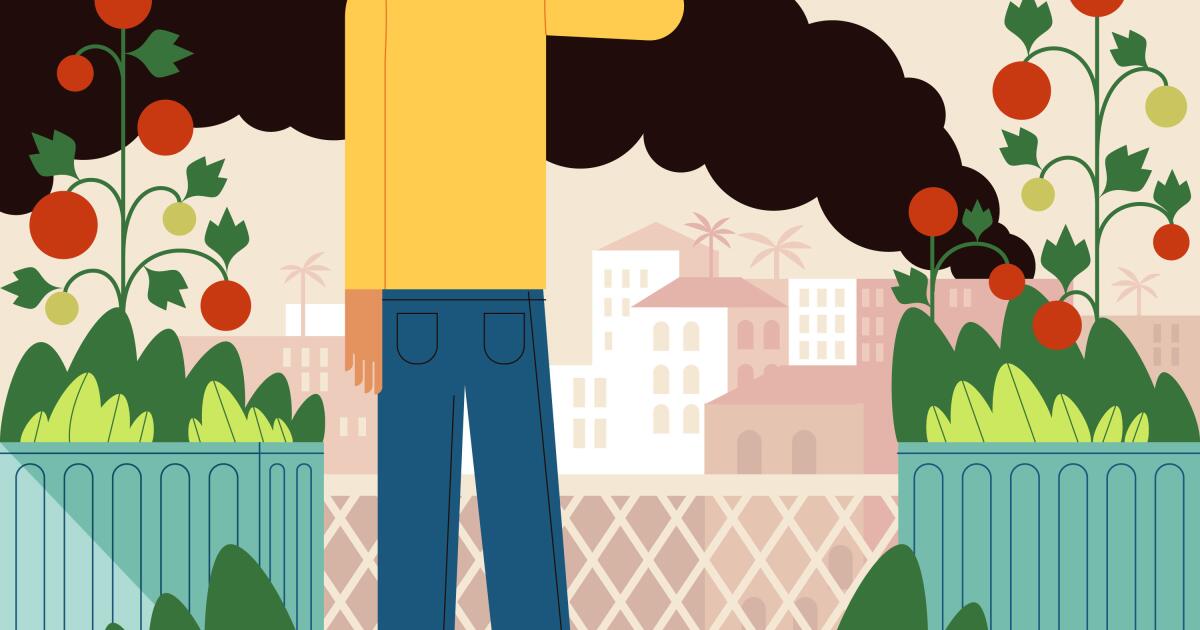
After the eight-day-long fire in a 500,000-square-foot Boyle Heights warehouse, eastern Los Angeles residents are contending with putrid smells, soot and potentially hazardous airborne chemicals after heavy plumes of smoke spread throughout the city. But those who grow food in nearby neighborhoods may also be wondering: How will the fires affect the plants and produce in my garden?
The Boyle Heights warehouse, owned by Lineage — a global temperature-controlled storage facility operator — housed 85 million pounds of frozen food and other products. In the days since the fire, local emergency visits for smoke inhalation and throat pain spiked while agencies still scramble to measure the amount of PM 2.5 — harmful fine particles — and heavy metals, like lead and arsenic, in the air.
According to researchers, any toxic airborne chemicals would likely stem from the charred foam insulation, metal exterior, burned solar panels and any lithium batteries that might have been present inside the warehouse.
After a fire, heavy metal particles can spread through ash and smoke over gardens and inhibit growth, said Olukayode Jegede, an agricultural toxicologist and assistant professor at UC Davis. Since the warehouse fire is so recent and cleanup has just begun, Jegede said the precise impact on gardens can’t be measured until comprehensive soil tests are conducted in the area.
While the L.A. city government hasn’t announced plans for soil testing, the Contaminant Level Evaluation and Analysis for Neighborhoods project at USC is offering free contaminant testing for Boyle Heights and East L.A. residents. Residents can collect soil samples and deliver them to Boyle Heights City Hall and other locations for an evaluation of lead, arsenic, chromium and mercury levels.
The good news is produce, plants and roots can still be preserved. According to Jegede, many of the soil tests conducted last year in the Altadena area after the Eaton fire showed that gardens and poultry were not as contaminated as one might expect.
“Quite a number of the soils we tested [in Altadena] were not really contaminated,” Jegede said. “We weren’t seeing many soils with concerning elevated levels of metal, so gardeners should not be too alarmed when these things happen.”
Nevertheless, there are several measures that gardeners can take to keep themselves, their children, plants and produce safe from potentially harmful contaminants stemming from the fire. Researchers, gardening experts and horticulturists offered some guidance on the handling, recultivation and cleanup that can keep you and your garden in good health.
How do I remove ash and contaminants from my garden?
Altadena horticulturist Leigh Adams said Boyle Heights plants and produce already live in a difficult environment, surrounded by industrial warehouses that spread contaminants daily.
“That area has been used industrially for 100 years, and the soil is impacted by many, many, many things,” Adams said. “Low-income neighborhoods and gardens usually don’t have a lot of resistance against dominant manufacturing.”
This means that the contamination of gardens in eastern L.A. won’t be as catastrophic as compared with those in Altadena, a more suburban environment, Adams said. But fallen ash still poses major health risks if ingested or inhaled.
An advisory from University of California Agricultural and Natural Resources last year recommended suiting up in an N95/KN95 mask, long sleeves, pants, close-toed shoes and gloves before attempting to deal with ash in the garden to limit exposure to potentially toxic contaminants. The advisory added that individuals should make sure all of this gear is cleaned thoroughly before bringing it back inside.
Once in the proper gear, Adams recommends removing the top two inches of topsoil from gardens, where the highest concentration of contaminants will settle after a fire. Using a plastic bag to collect the soil and disposing of it in the garbage — not green yard waste bins — will help to reduce the spread of airborne chemicals.
Gardeners with raised beds are advised to remove approximately six inches of soil, because excess ash can raise the pH level and prevent nutrients from soaking into the soil bed.
After this, watering the garden gently but plentifully will help to promote soil health and get rid of most of the ash present on plant leaves and stems. Adams said replacing the top two inches of soil with store-bought mulch or straw will help to contain any remaining ash and prevent it from spreading any further.
Experts say to avoid using leaf blowers if ash is present in the garden because they can send particles airborne. Doing so will increase the likelihood of heavy metal particles, which can carry lung irritants and carcinogens, being spread and inhaled.
A Boyle Heights resident keep a watchful eye on the fire at the 5,000-square-foot commercial building, which stores 85 million pounds of frozen food.
(Genaro Molina / Los Angeles Times)
Is it safe for me to eat produce from my garden?
Several studies, including one from the UC Cooperative Extension of Sonoma County, have shown that consuming produce in a fire-affected area poses minimal health risks.
Jegede said most root vegetables like potatoes and carrots, along with any fruit that has an outer layer, can be washed to remove potential contaminants, even if they were covered in ash. Peeling the outer layer of your produce can also help to reduce potential risks, he said.
Lettuce and other leafy foods with multiple layers pose a higher risk of contamination, but with a vigorous wash and peeling the outer layers, even the greens can be saved. The County of Los Angeles Department of Public Health recommends soaking leafy produce and fuzzy fruits like peaches in a 10% white vinegar and 90% water mixture.
Jegede said if the leaves or fruit are too delicate to wash or ash is still visible, it would be best to dispose of the produce.
How can I tell if my soil is contaminated?
After ridding your garden of visible ash, you might wonder how to tell if your plants will still thrive in the soil.
At-home soil tests that measure for alkaline, fertility and pH levels are widely available and can be purchased for $15 to $100 (for more detailed results) online. But Jegede said these tests can’t tell the full story of soil health.
Comprehensive soil testing is “something you can’t do properly at home,” Jegede said. “In labs, we are testing for metals like lithium and zinc, stuff that an at-home test will not show … If it comes to the point that you’re worried about your soil, I would just send it out to a lab.”
Wallace Laboratories in El Segundo, Babcock Laboratories in Riverside, Waypoint Analytical in Anaheim and other labs offer more detailed soil tests that measure heavy metal particles in addition to other fertility factors. Prices at Wallace Laboratories can range from $115 to $295 for a complete compost test.
The soil below two inches should be unharmed, Adams said, so long as new compost is set and plants are watered plentifully, which will promote natural biological cycles.
“What you’re doing is capping the soil, so that moisture stays in there, and instead of being dirt, it’s a living system called soil,” Adams said. “The more carbon we can get into our soil, the better.”
What can I do to help my soil recover?
For the last 12 years, Adams has been working with Metabolic Studio, a Los Angeles-based art and research hub focused on environmentalism, on methods for bioremediation, the practice of using additional fungi, plants and compost to decontaminate ash and break down contaminants.
Adams said straw, mushrooms, corn, rye and sunflowers are great bioremediators that can help to repair damage to soils. She said certain samples she’s worked on with Metabolic Studio have gone from testing at high heavy metal levels to nearly contaminant-free.
But for a more immediate fix, wash your produce, water your plants and have a little patience during ash cleanups. Your garden should look better in no time, Adams and Jegede said.

Inde Navarrette and Michael Johnston in Obsession.
Focus Features
hide caption
toggle caption
Focus Features
Two big horror films, Obsession and Backrooms, just smashed all box office expectations. So much of their success has been driven by Gen Z, which is now the biggest moviegoing demographic. But what makes a movie a Gen Z movie? Today we’re bringing you an episode of NPR’s It’s Been a Minute. Host Brittany Luse talks about this trend with Sam Adams and Reanna Cruz.
If you want to hear more about these movies, check out these episodes:
In ‘Obsession,’ love hurts. It really, really, really hurts.
‘Backrooms’ brings YouTube horror to the big screen
Zendaya brings ‘The Drama,’ we bring the spoilers
Connect with Pop Culture Happy Hour:
Letterboxd / Facebook
Our weekly newsletter
Support Pop Culture Happy Hour+
-
 News4 minutes ago
Supreme Court financial disclosures reveal how their books add to their income
-

 Los Angeles, Ca1 hour ago
Waymo video could determine charges after teens’ bizarre California ride
-
Detroit, MI2 hours ago
DPD investigating after human remains found in home on Detroit’s west side
-

 San Francisco, CA2 hours ago
Bay Area Teen Waymo Riders Nabbed For Allegedly Shooting Projectiles From Robotaxi
-
Dallas, TX2 hours ago
Role Call: Tyrus Wheat looking to make most of second stint with Cowboys
-

 Miami, FL2 hours ago
2026 Miami Football Early Opponent Preview, Game 8: North Carolina
-

 Boston, MA2 hours ago
Boston sues social media companies over ‘addictive’ features, joining nationwide litigation
-

 Denver, CO2 hours ago
Peyton Watson landing spots: Could Nuggets star actually leave Denver?

