Lifestyle
'Steamboat Willie' is now in the public domain. What does that mean for Mickey Mouse?


The original 1928 script for Disney’s Steamboat Willie, the first cartoon to star Mickey Mouse.
Robyn Beck/AFP via Getty Images
hide caption
toggle caption
Robyn Beck/AFP via Getty Images

The original 1928 script for Disney’s Steamboat Willie, the first cartoon to star Mickey Mouse.
Robyn Beck/AFP via Getty Images
An early Walt Disney movie featuring the first appearance of Mickey Mouse is among the copyrighted works from 1928 moving into the public domain on Jan. 1, 2024.
But the cartoon creature who stars in the animated short Steamboat Willie isn’t a lot like the Mickey we know today. He’s more rascally and rough. His roots in the blackface minstrel shows of the time are more apparent.
And he’s not exactly cuddly. For much of the movie, Mickey amuses himself by forcing barnyard animals into being unwilling musical instruments.
YouTube
“You know, he’s evolved so much and become more 3D and colorful,” observes Ryan Harmon, a former Disney Imagineer, of the character today. He remembers anxious talk, when he worked at the company in the 1990s, about the beloved icon eventually entering the public domain.
But that’s not happening, says Kembrew McLeod, a communications professor and intellectual property scholar at the University of Iowa.
“What is going into the public domain is this particular appearance in this particular film,” he says.
That means people can creatively reuse only the Mickey Mouse from Steamboat Willie. Not the Mickey Mouse in the 1940 movie Fantasia. Nor the one on Mickey Mouse Clubhouse, a kids’ show that aired on the Disney Channel for a decade starting in 2006.
New versions of Mickey Mouse remain under copyright. Copyright applies to creative characters, movies, books, plays, songs and more. And as it happens, Mickey Mouse is also trademarked.
“Trademark law is entirely about protecting brands, logos and names — like Mickey Mouse as a logo, or the name Mickey Mouse,” McLeod says.
“And of course, trademark law has no end,” adds Harvard Law School professor Ruth Okediji. Disney and other corporations, she says, use trademarks to extend control over intellectual property.” As long as the mark remains distinctive in the supply of goods and services, the owner of the trademark gets to protect that trademark.”
Jennifer Jenkins, director of the Duke Center for the Study of the Public Domain, made this conveniently mouse-shaped explanation of what you can and can’t do with the Steamboat Willie version of Mickey Mouse as of Jan. 1, 2024. Find out more here.
Jennifer Jenkins and Sean Dudley
hide caption
toggle caption
Jennifer Jenkins and Sean Dudley
Jennifer Jenkins, director of the Duke Center for the Study of the Public Domain, made this conveniently mouse-shaped explanation of what you can and can’t do with the Steamboat Willie version of Mickey Mouse as of Jan. 1, 2024. Find out more here.
Jennifer Jenkins and Sean Dudley
“It’s something copyright scholars like myself have been concerned about,” she continues. “This effective undermining of the public domain by allowing trademark law to effectively extend the life of a copyrighted work. And it’s my hope that either Congress or the courts will restore the full balance between the protection of creativity and the protection of the public domain, which is also the protection of creativity.”
Now, people should still be able to do things like incorporate clips of Steamboat Willie in an art project, or maybe sell a T-shirt reproducing a frame from the movie. But Okediji cautions if those things infringe on the trademark, or threaten to dilute the trademark because of the way it’s used, then Disney can use the law to assert its ownership.
This could keep people from making, for example, a Mickey Mouse slasher movie. Which someone actually did when Winnie the Pooh went into the public domain last year.
YouTube
“You also can’t just call your restaurant Mickey Mouse on January 1st,” Okediji chuckles. “You can’t say, ‘I’m the Mickey Mouse restaurant.’ That would be a clear trademark violation.”
The Walt Disney Company has earned a reputation for aggressive litigiousness over such matters. In 1989, it threatened to sue, for example three Florida daycares for painting Disney characters in a mural on its walls.
But more recently, McLeod says, the company has turned its focus from copyright and trademark related lawsuits to curbing online piracy. It’s possible, he says, an old cartoon from 1928 may not be all that valuable in 2024. The company even made Steamboat Willie available on YouTube for free back in 2009.
“Here is the irony,” McCleod says. “Steamboat Willie is based on a popular film at the time.”
Steamboat Bill, Jr. was a Buster Keaton hit that came out earlier that year. Steamboat Willie is a play on its name.
“Mickey Mouse made an appearance in a film for the first time that very much relied on another copyrighted work that helped propel its popularity,” McLeod continues. “When you’re referring to something that’s popular, most likely it’s going to create wider audiences and audiences who are recognizing that that particular reference.”
As enshrined in the Constitution, he says, copyright was originally intended to protect creators for fewer than 30 years. While copyright extensions may enrich corporations, they impoverish the cultural conversations that rely on relevancy, innovation and creativity to drive artistic and technological progress.






Stephen Colbert in Dec. 2025.
Angela Weiss/AFP via Getty Images
hide caption
toggle caption
Angela Weiss/AFP via Getty Images
Stephen Colbert is co-writing a new Lord of the Rings movie, Warner Bros. Pictures and New Line Cinema announced.
“We’ve got a very special partner that we’re working with,” said filmmaker Peter Jackson in a video shared across social media at midnight on Wednesday before introducing the comedian and Late Show host via video call.
Colbert is a Tolkien fan — he even had a cameo appearance in The Hobbit: The Desolation of Smaug in 2013. He will co-write a new movie with his son, screenwriter Peter McGee, and LOTR veteran screenwriter Philippa Boyens. Its working title is Lord of the Rings: Shadow of the Past.
YouTube
Colbert said in the video with Jackson that the film will adapt six early chapters — “Three is company” through “Fog on the Barrow-downs” — from The Fellowship of the Ring, the first book of J.R.R. Tolkien’s Lord of the Rings trilogy. These chapters were not part of the first film.
“I thought, ‘Oh wait, maybe that could be its own story that could fit into the larger story,’” Colbert said. “‘Could we make something that was completely faithful to the books while also being completely faithful to the movies that you guys had already made?’”
Colbert said he and his son, McGee, worked out what they thought might be a framing device for the story.

“It took me a few years for me to scrape my courage into a pile to give you a call,” joked Colbert to Jackson.
Warner Bros. sent the film’s synopsis in a release: “Fourteen years after the passing of Frodo – Sam, Merry, and Pippin set out to retrace the first steps of their adventure. Meanwhile, Sam’s daughter, Elanor, has discovered a long-buried secret and is determined to uncover why the War of the Ring was very nearly lost before it even began.”
Shadow of the Past is one of two upcoming films in the Lord of the Rings franchise. Andy Serkis, who plays Gollum in the films, is directing The Lord of the Rings: The Hunt for Gollum, which takes place in between the fictional timelines of The Hobbit and The Lord of the Rings.
Warner Bros. has not announced a release date for Shadow of the Past, but it will come after The Hunt for Gollum, which is expected in Dec. 2027.
“I did not think I’d have the time,” Colbert laughed in the video about finding the hours to work on the new movie. But, he said, “It turns out I’m gonna be free starting this summer.”
Last year, CBS announced that it was canceling The Late Show with Stephen Colbert, days after Colbert publicly criticized Paramount — CBS’s parent company — for paying $16 million to settle a lawsuit filed by President Trump over claims that CBS interfered in the 2024 election by airing edited segments of an interview with Kamala Harris. The Late Show will air its final episode on May 21, more than 30 years after David Letterman first hosted in 1993.
Paramount is also set to buy Warner Bros. Discovery in a massive nearly $111 billion merger deal.
“If you’ll excuse me, I’ve gotta finish a television show and I’ve gotta write a movie script, but I will see you all in the shire,” Colbert said in the video.


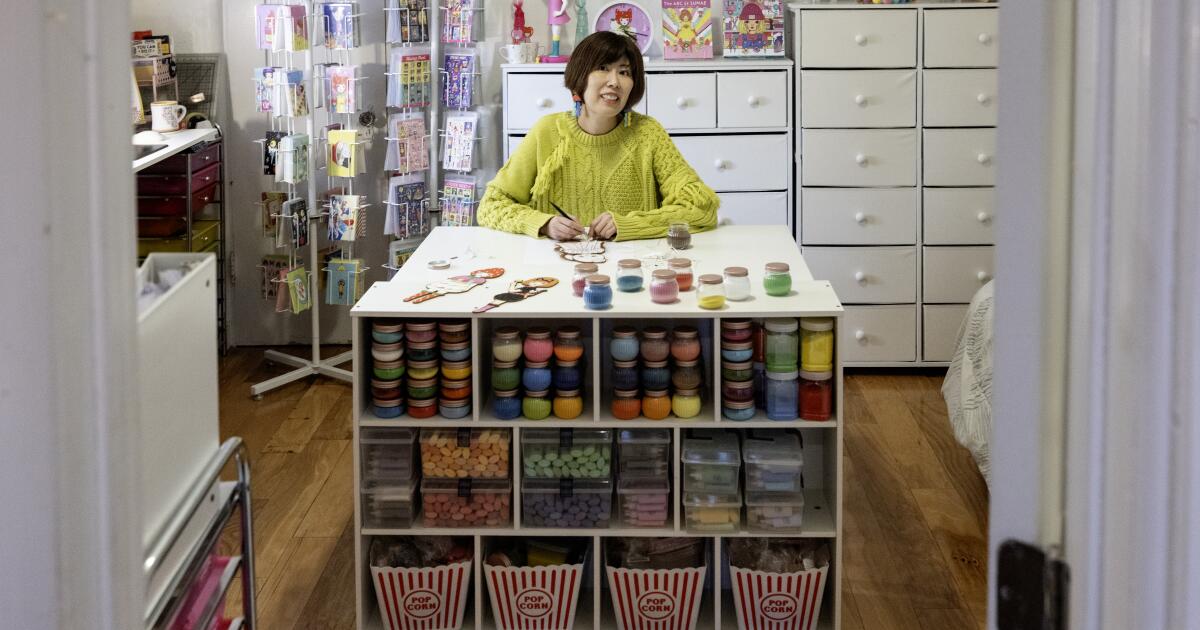
The artist who goes only by the mononym Naoshi is a master at spinning tiny grains of sand into something grand.
She specializes in sunae, the Japanese art of making images out of colored sand. In her tidy Alhambra home studio, she meticulously assembles out-of-this-world tableaux in saturated, punchy hues.
Naoshi’s pieces usually center around a chic ingenue sporting food-focused fashion — think bonnets made of bonbons and boba tea skirts. One of her earliest characters, Ice Cream Girl, is a go-getter with a scoop for a head, inspired by a character she drew as a child. Another of her stars is a fierce fast-food warrior clad in a cheeseburger skirt, wielding ketchup and mustard laser guns and flanked by a squad of fighters who happen to be anthropomorphic pizza and hot dogs.


In this series, we highlight independent makers and artists, from glassblowers to fiber artists, who are creating original products in and around Los Angeles.
But not all of the artist’s works have a gourmet bent — she also creates celestial goddesses and nature-inspired divas, and made a series devoted to the Major Arcana of tarot. Her “It” girls often keep company with a coterie of tiny monkeys, kittens or creatures with confections for heads. Their vibrant, jam-packed settings depict anything from an oceanic rave to a rainbow-hued big top performance to a joyride through the cosmos. And no matter the motif, she always makes sure her subjects are “playful, sweet and dreamy.”
“When I was a child, I had the experience of making sunae using a kit,” she recalled during a recent interview. “That memory stayed with me very strongly.”
Harnessing that nostalgia, she started creating and selling small DIY sunae kits of her own design in 2004.

Food-focused characters dominate Naoshi’s work, including picture books and sand art kits.
“I began making [them] with the hope that they could become a fun and memorable experience for someone else as well,” she said of the kits, which range from easy to challenging, accommodating budding artists of any age and skill set.
But whipping up one of her full-scale smorgasbords of sprinkled donuts, popcorn and nigiri for a gallery display isn’t mere child’s play. The technique involves attaching an original sketch to an adhesive backing, cutting it out, strategically sprinkling sand on the desired areas, then removing any misplaced grains one by one. Each piece takes her anywhere from a few days to a few weeks.
Originally from Japan (Yokohama by way of Iwate), Naoshi first visited Southern California in 2010, when she participated in a Sanrio anniversary exhibition in Santa Monica. There, she displayed her work and held a sand art workshop.
“It was such a really inspiring experience, I began to feel that I wanted to challenge myself as an artist in Los Angeles,” she said. “It’s always so sunny and the food is so good! In Japan, a lot of people wear black and white, but in L.A. everything’s so colorful. I get inspiration all the time.”
Since taking the leap to living in the L.A. area in 2014, she has exhibited her work at Gallery Nucleus, Corey Helford Gallery and La Luz de Jesus Gallery, to name a few. She has also conducted workshops and sold merchandise — from art prints to T-shirts to washi tape — at such spots as Leanna Lin’s Wonderland, Popkiller and Pygmy Hippo Shoppe.


Jars of colorful sand and sweet artwork fills Naoshi’s studio.
Establishing herself in a new country was not without its challenges. “The culture is totally different,” she explained. “I felt stress every day.”
Early obstacles included overcoming the language barrier, as well as learning how to navigate the city’s vastness, how to open a bank account, and where to find markets and restaurants where she could buy her favorite Japanese delicacies.
“I eventually started to enjoy the act of challenging myself,” she said of her transition phase. These days, she high-fives herself for successfully filing business taxes on her own and she has become a regular at Katsu-Jin, a Tonkatsu spot in South Pasadena.
Last year, Naoshi released “The ABC of Sunae,” a mini-encyclopedia of sorts that traces the global origins of sand art in its various forms, including the ceremonial sand paintings of the Navajo in the American Southwest and the spiritual sand mandalas of Tibetan Buddhists. She also takes readers behind the scenes of her approach to the craft, showing off her preferred tools and providing step-by-step photos of the process.
“The biggest challenge of working with sand is that there’s no room for mistakes,” she said while sitting at a worktable stocked with dozens of small sand-filled glass jars, all arranged by color. “Once the sand sticks, it’s almost impossible to make corrections. So if there’s even a small part I’m not satisfied with, I have to start over from the very first step.”

The intricate nature of sunae means that if Naoshi makes a mistake, she has to start all over.
A stark white workspace filled with natural light, her trusty craft knife, a steady hand and a keen pair of eyes are all essential for keeping her girls’ cheeks rosy and for making their backdrops sparkle. And she maintains sanity by working to a soundtrack of her favorite Japanese pop songs and the bouncing beats of Basement Jaxx.
“Sand may be the opposite of an efficient or convenient material,” she said, “but its soft texture and the time I spend deeply focusing on the process feels almost meditative to me.”

US troops brace for ‘hit-and-run’ guerilla attacks as 82nd Airborne deploys to Iran, military analyst warns

New Jersey Gov Sherrill signs law barring ICE agents from wearing face coverings to shield identities

Chronic back pain may have met its match with hormone treatment, scientists say

Rams star Puka Nacua sued for alleged assault and battery amid accusations he bit woman

Spring clean your digital footprint: Why retirees are scam targets

Florida High School Football Rankings: Top 25 teams – Oct. 21

How old is Bo Nix? What to know about Oregon quarterback ahead of 2024 NFL Draft

Cleary's 21 help Le Moyne down Central Connecticut State 69-64 in OT

99th annual Pony Swim held in Virginia

Indiana Members Credit Union announced as new anchor tenant at Bottleworks District
New Jersey Gov Sherrill signs law barring ICE agents from wearing face coverings to shield identities

Escalation in the Middle East – Not Europe’s war? MEPs in the Ring

War with Iran disrupts fertilizer exports as U.S. farmers prepare for planting season

White House unleashes on Raskin for clinging to ‘deranged’ Jack Smith ‘lies’ in latest Trump docs flare-up

‘Keffiyehs seized, left to die’: Inside the Palestine Action hunger strike
-

 Detroit, MI1 week ago
Drummer Brian Pastoria, longtime Detroit music advocate, dies at 68
-

 Georgia1 week ago
How ICE plans for a detention warehouse pushed a Georgia town to fight back | CNN Politics
-

 Movie Reviews1 week ago
‘Youth’ Twitter review: Ken Karunaas impresses audiences; Suraj Venjaramoodu adds charm; music wins praise | – The Times of India
-
 Science1 week ago
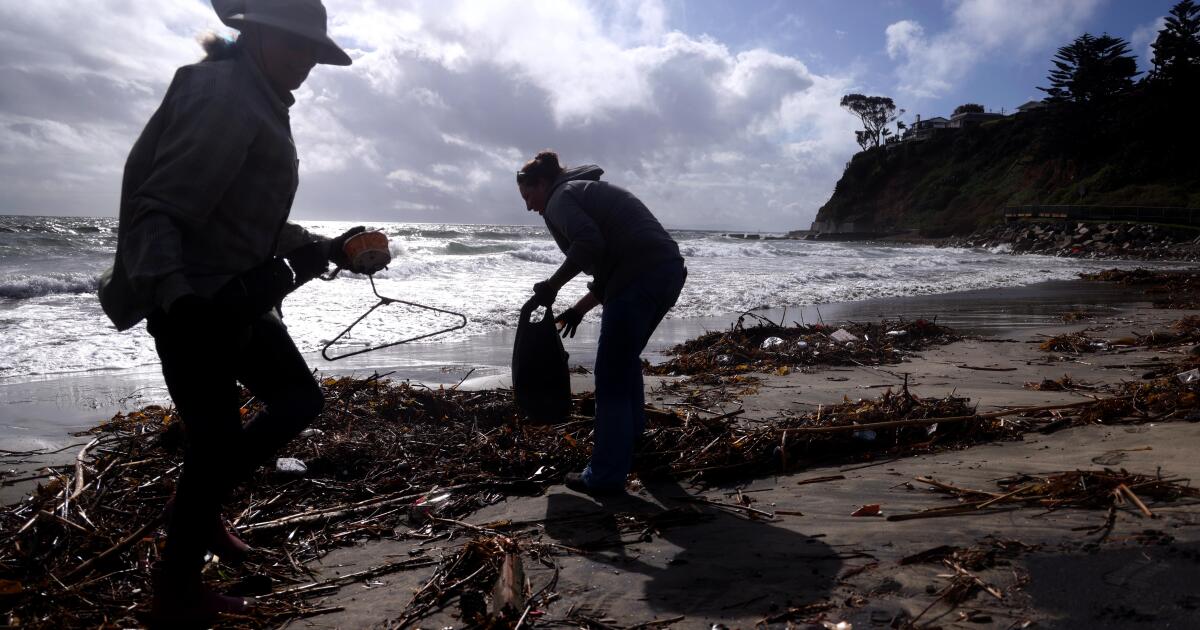
Industrial chemicals have reached the middle of the oceans, new study shows
-

 Science1 week ago
How a Melting Glacier in Antarctica Could Affect Tens of Millions Around the Globe
-

 Culture1 week ago
Test Your Memory of Great Lines From Classic Irish Poems
-

 Sports5 days ago
IOC addresses execution of 19-year-old Iranian wrestler Saleh Mohammadi
-

 New Mexico3 days ago
Clovis shooting leaves one dead, four injured