Lifestyle
Smell that? A rare corpse flower is about to bloom at the Huntington

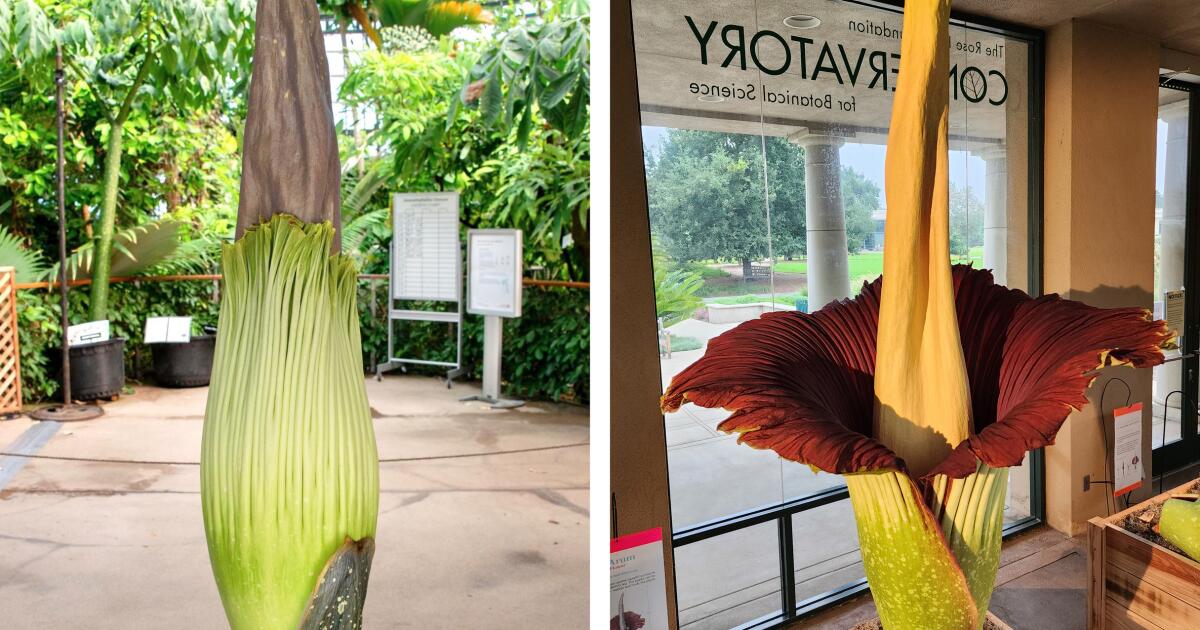
It’s sweaty stinky time again at the Huntington Library, Art Gallery, and Botanic Gardens. One of its rare corpse flowers is about to bloom, in all its putrescence. In the next 10 to 12 days, expect visitors to be lined up to enter the Huntington’s sauna-like viewing area in San Marino to give this giant, fantastically weird tropical plant a sniff.
Corpse flowers (Amorphophallus titanum) are native to the rain forests of Sumatra in Indonesia, so they like it hot and steamy. They also bloom once every four to six years in the wild for only 24 hours before they start closing again, so viewing windows are short and rare.
If you miss seeing this one in person, you’re in luck. The Huntington has 43 corpse flowers in its collection, which spend most of their time in a greenhouse removed from public view. Over time, the staff has developed ways to coax the plants into blooming every two to three years, said Brandon Tam, associate curator of the Huntington’s orchid (and corpse flower) collection. With so many plants, there are usually a few primed to bloom every year.
In 2023, for instance, the Huntington had four plants bloom between July and October, Tam said. And one of last year’s bloomers, named Stankosaurus Rex for its massive 8-foot height, is now fruiting, so it looks like a tall upright club covered with plump crimson orbs.
The Huntington has had many corpse flowers fruit since its first display in 1999, and it’s used the seeds from those fruits to grow new plants for its collection and for other botanic gardens that want their own corpse flowers. But this is the first time the Huntington has been able to show off a blooming plant next to one that is fruiting, Tam said.
Curator Brandon Tam stands next to a blooming corpse flower in 2023 that was named Allan after Ken’s best friend from last year’s wildly popular “Barbie” movie.
(The Huntington Library, Art Museum, and Botanical Gardens)
The flower’s fruit is the favored food of the rhinocerus hornbill but is toxic to humans, Tam said, so don’t try to sample it. Also, the flower gets pollinated by the insects attracted to its rotten smell, “typically sweat bees, flesh flies and carrion beetles who enjoy the pungent odor,” he said.
The pollinators are usually insects looking for the decaying carcasses of animals to lay eggs on, Tam said, “which is why they’re looking for stinky things. The flower is trying to mimic that odor of a dead carcass, and its entire base is a dark maroon red to mimic bloody carcasses of dead animals. Plants are just so fascinating, especially this one.”
As for the flower’s stench, uh, “fragrance,” some people equate it to rotting meat or stinky gym socks, but it seems to change depending on the sniffer, said Keisha Raines, the Huntington’s communications associate. “To me, it smells like a really bad trash can with heavy cabbage smells,” she said. “I used to work at a vegetarian restaurant in high school, and that flower smells like the trash there the day before it was collected.”
Tam believes the flower will bloom in the next 10 to 12 days. It’s hard to precisely predict when, he said, because its bloom is affected by the weather. “The hotter it is, the faster it blooms.” (If you want to see one bloom now, the Huntington’s website features a time lapse of the 2022 bloom.)
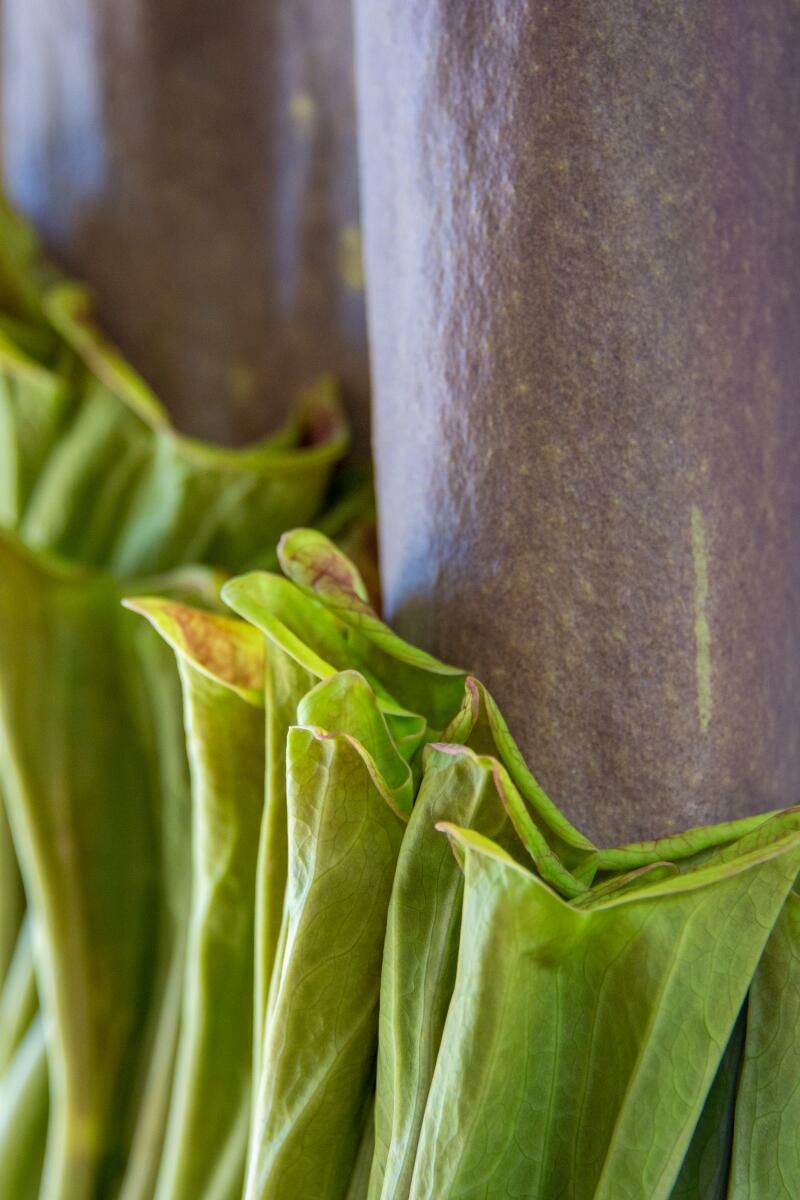
A closeup detail of a closed corpse flower before it blooms. (The Huntington Library, Art Museum, and Botanical Gardens)
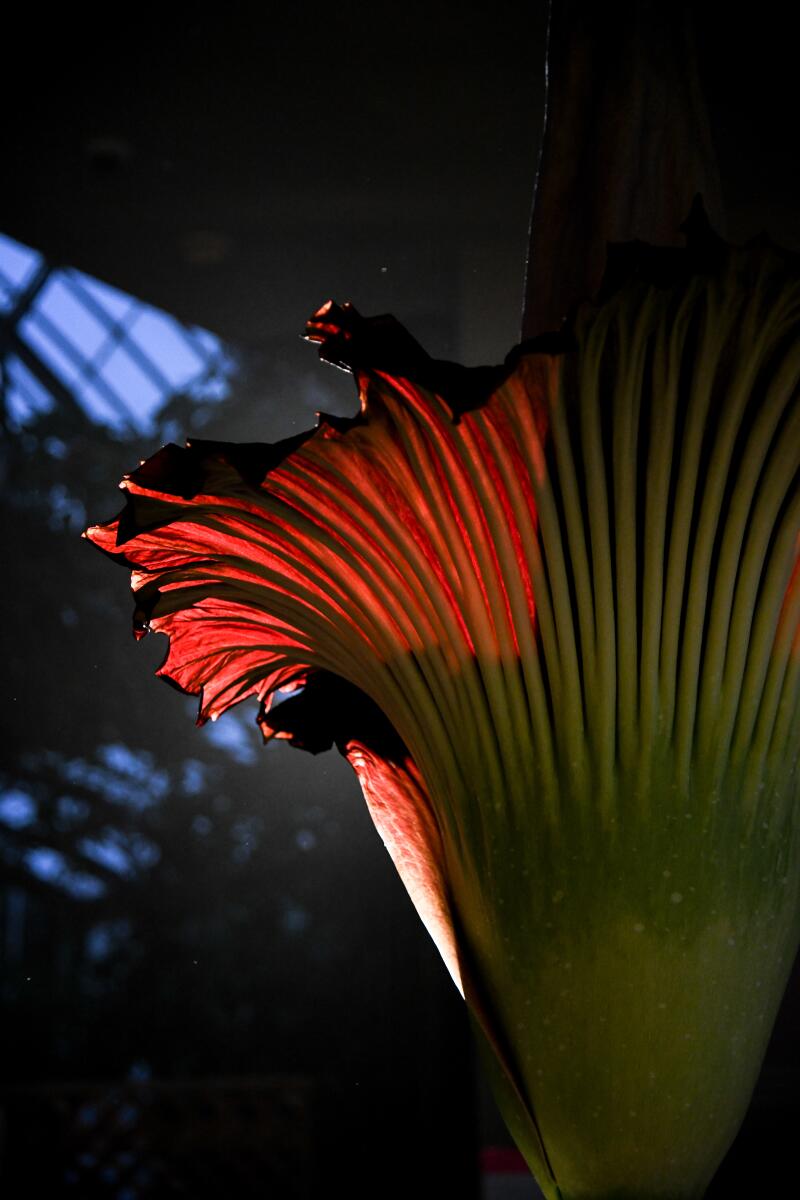
The deep maroon skirt of a blooming corpse flower mimics the color of rotting flesh, part of its ploy, along with its putrid “fragrance,” to attract carrion-loving pollinators. (Linnea Stephan / The Huntington Library, Art Museum, and Botanical Gardens)
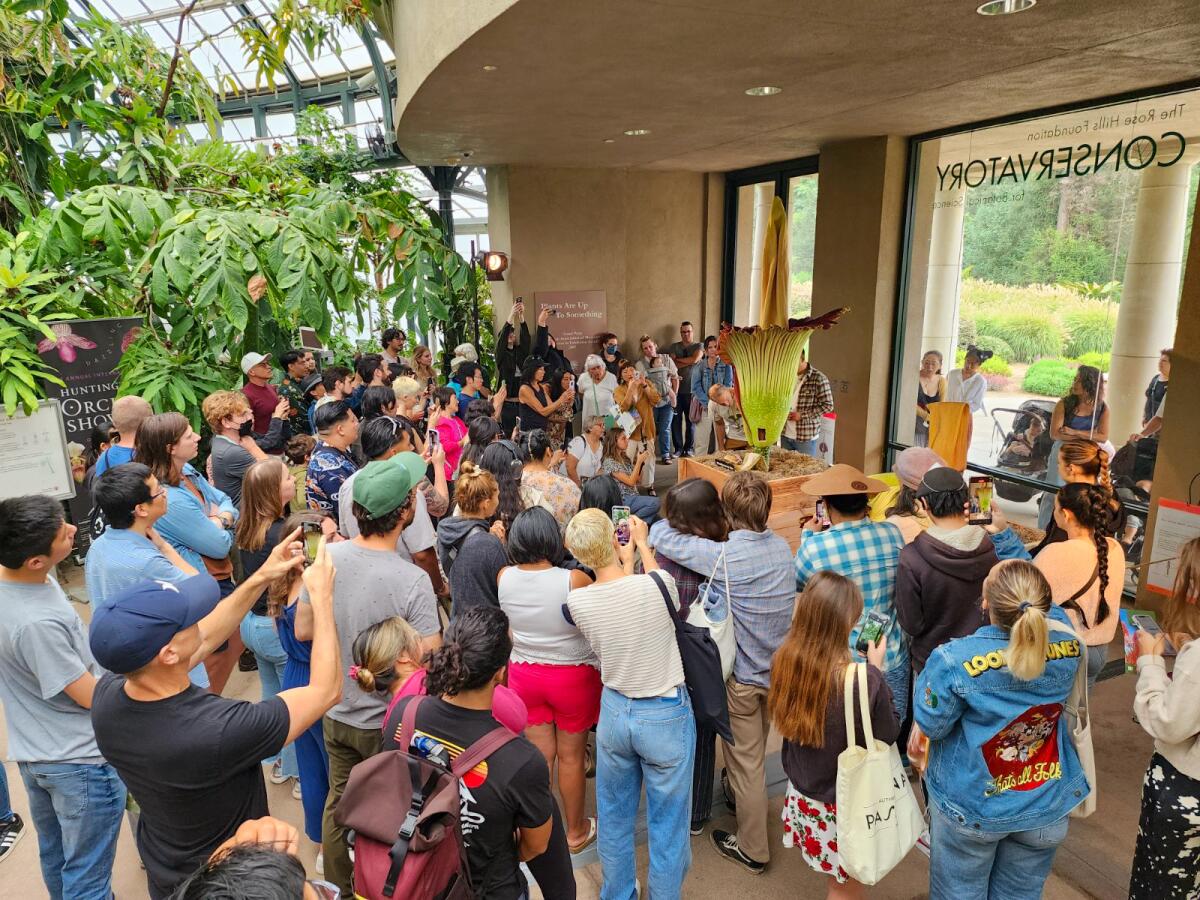
Corpse flowers bloom for just 24 hours, so their blooms always attract a crowd like this one at the Huntington in 2023.
(The Huntington Library, Art Museum, and Botanical Gardens)
Typically, corpse plants bloom at night, but the Huntington’s social media team will send out updates and alerts as the time gets nearer, Tam said. You can also watch the flower’s progress on a live webcam and daily growth chart. When the bloom looks imminent, go online to get your ticket and arrive as early as you can in the morning.
The Huntington is open from 10 a.m. to 5 p.m. Wednesday through Monday and closed on Tuesday. (Tam said he feels fairly certain this flower won’t bloom on a Tuesday.)
If that suspense is not enough, the Huntington is also asking the public to help name this year’s first blooming corpse plant. One of last year’s plants was dubbed “Allan the Amorphophallus,” in honor of Allan from the popular “Barbie” movie, said Raines. (Allan is Ken’s awkward best friend, which seemed fitting for a lovable stinky plant, “and we were in a very Barbie state of mind last year,” she said.)
People should post name ideas on the Huntington’s Instagram page, watch their social media and bring a fan for visiting the corpse flower in person. That’s because it gets steamy and hot inside the conservatory, Tam said, to the point that people actually walk outside for a little relief. With highs around the Huntington forecast to cool to the high 80s from the mid-90s next week, that could be a blessing for visitors.




An underwater view shows US’ Lilly King competing in a heat of the women’s 200m breaststroke swimming event during the Paris 2024 Olympic Games at the Paris La Defense Arena in Nanterre, west of Paris, on July 31, 2024. (Photo by François-Xavier MARIT / AFP) (Photo by FRANCOIS-XAVIER MARIT/AFP via Getty Images)
François-Xavier Marit/Getty Images
hide caption
toggle caption
François-Xavier Marit/Getty Images
This week’s show was recorded in Bloomington, Indiana with host Peter Sagal, judge and scorekeeper Bill Kurtis, Not My Job guest Lilly King and panelists Alonzo Bodden, Josh Gondelman, and Faith Salie. Click the audio link above to hear the whole show.
Who’s Bill This Time
State of the Union is Hot; The Tribal Council Convenes Again; A Glow Up In the Doll Aisle
Panel Questions
The Toot Tracker
Bluff The Listener
Our panelists tell three stories about a travel hack in the news, only one of which is true.
Not My Job: Olympic Swimmer Lilly King answers our questions about Lil’ Kings
Olympic Swimmer Lilly King plays our game called, “Lilly King meet these Lil’ Kings” Three questions about short kings.
Panel Questions
Cleaning Out The Cabinet; Bedtime Stacking
Limericks
Bill Kurtis reads three news-related limericks: Getting Cozy With Cross Country Skiing; Pickleball’s New Competition; Bees Get Freaky
Lightning Fill In The Blank
All the news we couldn’t fit anywhere else
Predictions
Our panelists predict, after American Girls, what’ll be the next toy to get an update.

Law Roach
Zendaya and Tom’s Wedding Already Happened …
Y’all Missed It!!!
Published
Zendaya and Tom Holland are married … so claims her longtime stylist, Law Roach.
Here’s the deal … the celebrity stylist — who started styling Zendaya way back in 2011 — spoke to Access Hollywood on the Actors Awards red carpet where he sang out “The wedding has already happened, you missed it.”
Waiting for your permission to load the Instagram Media.
The AH reporter asks in shock if that’s true … and, Law responds by saying it’s “very true” before walking off.
This isn’t the first time Tom and Zendaya’s relationship status has made headlines on a red carpet … remember at the Golden Globes in 2025, Zendaya had a ring on that finger — and, the next day, we found out the two were engaged.

TMZ.com
Zendaya and Tom met on the set of “Spider-Man: Homecoming” in 2016, started dating a couple years later and went public with their relationship in 2021.
We’ve reached out to Tom and Zendaya’s teams … so far, no word back.

Online prediction market platforms allow people to place bets on wide-ranging subjects such as sports, finance, politics and currents events.
Photo Illustration by Scott Olson/Getty Images
hide caption
toggle caption
Photo Illustration by Scott Olson/Getty Images
The rise of prediction markets means you can now bet on just about anything, right from your phone. Apps like Kalshi and Polymarket have grown exponentially in President Trump’s second term, as his administration has rolled back regulations designed to keep the industry in check. Billions of dollars have flooded in, and users are placing bets on everything from whether it will rain in Seattle today to whether the US will take over control of Greenland. Who’s winning big on these apps? And who is losing? NPR correspondent Bobby Allyn joins The Sunday Story to explain how these markets came to be and where they are going.
This episode was produced by Andrew Mambo. It was edited by Liana Simstrom and Brett Neely. Fact-checking by Barclay Walsh and Susie Cummings. It was engineered by Robert Rodriguez.
We’d love to hear from you. Send us an email at TheSundayStory@npr.org.
Listen to Up First on Apple Podcasts and Spotify.

Setting sail on iceboats across a frozen lake in Wisconsin

West Virginia Surrenders Six-Run Lead, Falls in Series Finale to Kennesaw State

Meyer’s Late Score Lifts Wyoming past Air Force – SweetwaterNOW

Crypto Sector Suffers Exodus of Reliable Retail Investors | PYMNTS.com

Canton High School students find success in personal finance

Florida High School Football Rankings: Top 25 teams – Oct. 21

Cleary's 21 help Le Moyne down Central Connecticut State 69-64 in OT

How old is Bo Nix? What to know about Oregon quarterback ahead of 2024 NFL Draft

99th annual Pony Swim held in Virginia

Indiana Members Credit Union announced as new anchor tenant at Bottleworks District

House Republicans push Johnson to go to war with Senate over SAVE Act

Israel FM says Europe too divided, slams Spanish PM

Satellite images provide view inside Iran at war

Video: What the Texas Primary Battle Means for the Midterms

Dems’ potential 2028 hopefuls come out against US strikes on Iran
-

 World4 days ago
Exclusive: DeepSeek withholds latest AI model from US chipmakers including Nvidia, sources say
-

 Massachusetts4 days ago
Mother and daughter injured in Taunton house explosion
-

 Montana1 week ago
2026 MHSA Montana Wrestling State Championship Brackets And Results – FloWrestling
-

 Denver, CO4 days ago
10 acres charred, 5 injured in Thornton grass fire, evacuation orders lifted
-

 Louisiana7 days ago
Wildfire near Gum Swamp Road in Livingston Parish now under control; more than 200 acres burned
-

 Technology1 week ago
YouTube TV billing scam emails are hitting inboxes
-

 Politics1 week ago
OpenAI didn’t contact police despite employees flagging mass shooter’s concerning chatbot interactions: REPORT
-

 Technology1 week ago
Stellantis is in a crisis of its own making