Lifestyle
Should the Army bring back the Pentomic Division?


In the late 1950s, when everyone expected World War III to go nuclear, the U.S. Army had to contemplate operating on a battlefield sprouting atomic fireballs.
This put Army planners in a dilemma. Military theory said that forces had to be concentrated to overwhelm the enemy and achieve decisive results. Common sense said that massing troops would only present a juicy target for nuclear weapons. The Army ultimately settled on the Pentomic Division, which consisted of self-contained battalions that would assemble for operations and then disperse. Yet the idea proved so unwieldy that the Army soon discarded it.
But 70 years later, the Army faces a similar dilemma. Instead of atomic bombs, the threat now comes from drones, as vividly demonstrated in the Ukraine war. To survive, Ukrainian and Russian forces have learned to operate in dispersed groups — sometimes as small as four to six soldiers — for fear of attracting the attention of a drone swarm. But lack of mass foregoes the possibility of decisive maneuver — and victory — and the conflict has degenerated into a grinding war of attrition.
A British expert has a solution: Resurrect the Pentomic concept.
“Something similar to the Pentomic structure may have something to teach in terms an answering the battlefield problems of today,” wrote John Moore, a former British Ministry of Defense official, in a recent essay for the U.S. Army’s Armor Magazine.
The original Pentomic divisions were a response to the “quantitative leap in firepower” from nuclear weapons, Moore told Defense News. With modern armies facing drones, long-range missiles and sensors, the new Pentomic “is posited on a similar response to firepower that in this case is in-depth, ubiquitous, pinpoint in accuracy and available day or night.”
“Massing a larger number of men and materiel takes time,” he said. “You will be spotted and attacked before you even reach the departure or jump-off point.”
The Pentomic concept, which governed U.S. Army infantry and airborne divisions from 1957 to 1963, replaced the triangular divisional structure of three regiments, with a five-sized organization. Pentomic divisions consisted of five battlegroups — equivalent to oversized battalions — with five rifle companies, a headquarters and support company and a mortar battery. But to create self-contained all-arms battlegroups, a plethora of support units were usually attached, including armor, artillery, engineers and air defense.
Given 1950s technology, command and logistics proved overwhelming.
“On the Pentomic battlefield, a CO could easily find himself with at least nine maneuver elements, well beyond the effective span of control for most colonels of the day,” recalled the late U.S. Army Col. David Hackworth in his memoir “About Face.”
Moore envisions the New Pentomic — which he also calls “Pentomic v5″ — as a company-level approach.
“That formation size has enough combat power to achieve local success while having enough resilience to sustain combat for a useful length of time,” he wrote. Battlegroups would be composed of companies that would assemble as needed.
Dispersed, flexible companies would be less likely to be detected and attacked by drones, and could concentrate for attacks.
On the defense, “such a Pentomic structure has sufficient reserve potential to meet a range of attacks and will require increased effort by an attacker to neutralize a defense in depth and use that most precious of assets — time,” Moore wrote. “A dispersed Pentomic defense based on areas of concealment such as villages, towns, wooded and rough terrain can allow for gaps as these can be covered by precision fire at every level and improve unit survivability.”
Moore believes that technology has improved enough since the 1950s that command and control of dispersed maneuver units is feasible.
“Even the smallest unit has, through FPV [first-person-view] drone technology, the means of battlefield reconnaissance and precision strike,” he wrote. “While distributed command systems have great resilience and an ability to jump echelons in terms of targeting.”
Moore also sees the New Pentomic as a relatively inexpensive way that the U.S. — and NATO — can adapt to a changing battlefield.
“It can be done cheaply as it is about structure, training and an attitude of mind,” he told Defense News.
Yet history suggests that a Pentomic 2.0 would face many of the same challenges that doomed its predecessor. In the early years of World War II, the German blitzkrieg achieved remarkable victories, largely due to a doctrine that emphasized flexibility and expected commanders and soldiers to use their initiative. By 1944, heavy losses in experienced officers and NCOs led to increasingly rigid tactics. Similarly, in the early days of the 2022 Russian invasion, outnumbered but agile Ukrainian forces defeated clumsy Russian offensives. But heavy casualties have resulted in Ukrainian commanders reverting to the rigid Soviet-style tactics they were trained in before the war.
“Ultimately, any success will depend on a high level of initiative and a willingness to gamble on success,” Moore wrote. “This will have implications for training and leadership at every level.”



In her long-awaited memoir, Phases, entertainment icon Brandy is opening up about her storied journey from singing in church in rural Mississippi to building a decades-long career in Hollywood as a music artist, songwriter, producer and actress.
Kevin Winter/Getty Images/Kevin Winter/Getty Images
hide caption
toggle caption
Kevin Winter/Getty Images/Kevin Winter/Getty Images
It was in the late summer of 1993 when Brandy first captured viewers nationwide with the premiere season of the sitcom Thea. Playing the vibrant and savvy Danesha Turrell, Brandy stepped into a role that, though short-lived, would become the prelude to her now decades-long entertainment career.
In an interview with Morning Edition ahead of the release of her new memoir, Phases, Brandy recounted that these early achievements affirmed the childhood dreams she held so close growing up in McComb, Mississippi, and Carson, California. While working to reach her visions for herself, Brandy honed her singing and acting skills with the support of her singer and musican father, William “Willie” Norwood Sr., her mother and eventual manager, Sonja Norwood, and her younger brother, Ray J, whose full name is William Norwood Jr.
“All I wanted to do was be a singer, touch people with my voice and meet Whitney Houston. That was my dream. But God had other plans for me. I was able to expand into acting and all sorts of things that I never saw myself doing,” Brandy told NPR’s A Martinez.

Brandy at the ninth annual Soul Train Music Awards in 1995, where she won the award for R&B new artist following the release of her self-titled debut album, which went platinum and featured her chart-topping singles “I Wanna Be Down” and “Baby.”
Jeff Haynes/AFP via Getty/AFP
hide caption
toggle caption
Jeff Haynes/AFP via Getty/AFP
Brandy’s debut acting role came the same year that she secured her first record deal — with her signing to Atlantic Records. Just one year later in 1994, several months after Thea filmed its final episode, Brandy dropped her self-titled debut album. The platinum-selling album stormed the charts, producing two No. 1 singles on the Hot R&B/Hip-Hop Songs chart, three top 10 hits on the Billboard Hot 100 chart and securing Brandy’s title as an artist to watch.
“I just remember being fearless at 14, excited for everything, ready for all of the things that I saw myself doing. I just was so full of spirit,” said Brandy, whose full name is Brandy Norwood, though she’s gone by the mononym Brandy throughout her career.
From a rising star to a pop culture force
Less than a year after releasing her first album, Brandy had already accomplished one of her most coveted goals — meeting her idol Whitney Houston. The pair crossed paths at the Nickelodeon Kids’ Choice Awards in 1995, where Brandy was performing and Houston was hosting the show. Brandy said that encounter was the beginning of a “beautiful friendship” between her and Houston.
YouTube
Brandy and Houston soon worked together again when Houston asked Brandy to be on the soundtrack for Houston’s 1995 film Waiting to Exhale, a music project that Houston curated to feature a roster of all-women music artists and housed Brandy’s No. 1 single “Sittin’ Up in My Room.”
The following year, Brandy took on a new role on the UPN series Moesha, where she starred as the show’s title character, Moesha Mitchell. The show aired for six seasons until its end in 2001, a series run Brandy said she “couldn’t predict” would have lasted so long.

Brandy celebrates the 100th episode of Moesha with her castmates William Allen Young, Yvette Wilson, Shar Jackson, Marcus T. Paulk, Lamont Bentley, Sheryl Lee Ralph and Brandy’s real-life brother, Ray J.
Getty Images/Getty Images/Hulton Archive
hide caption
toggle caption
Getty Images/Getty Images/Hulton Archive
“It was nothing like Moesha on television. It wasn’t a young Black girl with braids on television, just tackling so many topics about life and what teenagers go through. It was different. It was family oriented. It just seemed really grounded,” Brandy said.
“I loved that it was set in Leimert Park. It was just the culture there. It was just so beautiful,” Brandy added, referencing the real-life historic Black neighborhood in Los Angeles where Moesha and her family lived on the show. “I was so happy that we tapped into it. It was such a fun time.”

Brandy and her real-life brother, Ray J, both appeared in the the television series Moesha. Brandy played the series’ title charachter, Moesha Mitchell. While Ray J memorably played several charachters on the show, with his best-known rolebeing Dorian Long.
Getty Images
hide caption
toggle caption
Getty Images
But it was in 1997 that Brandy played one of her most treasured roles — Cinderella in the Disney television film adaption of the musical Rodgers & Hammerstein’s Cinderella. Brandy was cast in the lead role by her own fairy godmother Houston — with Brandy making history as the first Black actress to play a Disney princess on screen.
While working on the film, Brandy says that Whitney centered her with “encouraging energy” and urged Brandy to be herself.
“She just made me feel safe to be myself and I just wanted to impress her,” Brandy said. “Anything I could think of to impress her, I would do it … to make her laugh, to do a run or something to just make her smile. Just because I loved her so much. And I still love her.”

Brandy and Monica arrive at the 41st annual Grammy Awards in February 1999 in Los Angeles, California. That night they won the Grammy Award for best pop duo/group peformance for their chart-topping single “The Boy Is Mine.”
Dan Callister
hide caption
toggle caption
Dan Callister
On the glass heels of the Cinderella film’s international success, Brandy released her 1998 sophomore album Never Say Never. The album included the track “The Boy Is Mine,” her record-breaking duet with her fellow teen sensation Monica. Brandy then closed out the decade with a Grammy win for “The Boy Is Mine,” her becoming the first Black singer to land a CoverGirl contract, Mattel’s release of a Brandy Barbie doll, and her recognition as a beauty and style muse — who’d become known for her trademark braided hairstyles and her fashion on and off the screen.
Balancing the dream
The bustle following Brandy’s debut album in 1994 had surged to a thundering confirmation by the end of the 1990s, with the multiphenate amassing a pop culture significance unrivaled by most of her teen-star contemporaries. But Brandy says navigating her preteen and teenage years as a public figure came with a crushing cost — the mounting expectations of perfection she often felt placed upon her professional and personal life.

Brandy performs during the 50th annual Primetime Emmy Awards on September 13, 1998.
Gerard Burkhart/AFP via Getty Images/AFP
hide caption
toggle caption
Gerard Burkhart/AFP via Getty Images/AFP
“You’re a teenager. That’s when you’re making mistakes, and falling down and trying to get back up — all of these things. And I wasn’t able to do that because I was an example. I was put in a position to be like a role model,” Brandy said.
“The pressures of staying on point and not making mistakes — it was hard to live up to for a long period of time,” Brandy continued. “Because life kicks in. And you do start to learn about yourself. And you do start to make mistakes. And you learn from those mistakes. But when you’re a child star, everything is on blast.”
An expansion of career and honoring of self
Brandy entered the new millennium with artistic fervor, exclaiming her coming of age as a young adult with her 2002 third studio album Full Moon and its acclaimed title track. Her Full Moon era also included the birth of her now 23-year-old daughter Sy’rai Smith, who Brandy says has pulled her own creative inspiration from the beloved project.
“[Sy’rai]’s an artist. She loves music. She can sing her little tail off. So I’m supporting her on her journey, becoming and blossoming into a beautiful artist,” Brandy said, adding that “Full Moon” is Sy’rai’s favorite song out of her mom’s catalog. “Her and her crew, every time that song comes on, they want me to know that they know every lyric. They know every word.”

Brandy visits BET’s 106 & Park and chats with the shows co-host Free in 2002 while promoting her third studio album Full Moon.
Scott Gries/Getty Images/Getty Images North America
hide caption
toggle caption
Scott Gries/Getty Images/Getty Images North America
In the decades following Full Moon, Brandy expanded her career through a melding of film, TV, theater and music projects.
As an actress, she’s taken on feature films like The Perfect Match, her lead role in the sitcom Zoe Ever After, her televsion movie with Sy’rai Christmas Everyday and starring on Broadway as Roxie Hart in the musical Chicago. She’s also continued to foster her musical evolution through studio albums that have found her exploring a range of sonic spaces — including her critically lauded Afrodisiac in 2004, her pop and R&B fusion Human in 2008, Two Eleven in 2012 and her musing experimental album B7 in 2020, which she co-wrote and co-produced.

Brandy’s daughter, Sy’rai Smith, pictured above on the left, is building her own career as a singer and actress. Sy’rai released her debut single “On My Own” in 2023, has been featured on several songs on her mother’s albums and Sy’rai appeared alongside Brandy in the Lifetime holiday movie Christmas Everyday, which premiered in November 2025.
Paras Griffin
hide caption
toggle caption
Paras Griffin
Despite her exhaustive list of creative pursuits, the past three decades have seen Brandy employ moments of dormancy from the spotlight — with her often going inactive on social media and generally retreating from the public eye between projects. It was during one such break that Brandy says she was able to fully address the emotional complexities of her life as a child star.
“Once I was able to step away from the limelight and really work on myself, and work on my self-worth, and heal, I was able to grow and become an amazing person, and mom and a role model for my daughter in the best way possible,” Brandy said. “So I’m grateful for what I’ve been through because I wouldn’t be the person that I am today.”
A timeless icon reinspired
Now putting shape to her fourth decade in the entertainment industry, Brandy says she’s building on the artistic energy she rediscovered during her record-setting joint tour with Monica last fall — which was named after their hit song “The Boy Is Mine.” The 32-date The Boy Is Mine Tour sold out arenas around the nation and dominated social media feeds with performance clips, photos and behind-the-scenes footage.

Brandy attends her Hollywood Walk of Fame induction ceremony on March 30, 2026, in Hollywood, California.
Kevin Winter/Getty Images/Getty Images North America
hide caption
toggle caption
Kevin Winter/Getty Images/Getty Images North America
“When I was creating [The Boy Is Mine] with Rodney Jerkins and LaShawn Daniels, I was watching a lot of [the Jerry Springer Show]. And I saw this [episode] where the show was called pretty much ‘The Boy Is Mine.’ And I was like we should do a song with another artist like Monica,” Brandy said. “I thought my idea for it was amazing. When I heard the song, I just had this idea of our voices going back and forth, and us going back and forth in the song, and producing it like that and. And nobody could see it but me. And I was right.”
“[‘The Boy Is Mine’] is the biggest song of our careers. It won us a Grammy. It put us back on tour 27 years later in 2025 in front of these amazing fans — and reinspired me and reignited me to do more performing and entertainment now. I’m so inspired because of ‘The Boy Is Mine’ and the tour,” Brandy said.

Brandy performs the national anthem ahead of the NFC Championship Game between the Los Angeles Rams and the San Francisco 49ers at SoFi Stadium on January 30, 2022 in Inglewood, California. Brandy’s white tracksuit paid homage to the white windsuit her idol Whitney Houston wore during her iconic performance of the national anthem at the Super Bowl in 1991.
Christian Petersen/Getty Images/Getty Images North America
hide caption
toggle caption
Christian Petersen/Getty Images/Getty Images North America
As Brandy waxes into a new phase of galvanized creativity and self-discovery, she’s reassured that she won’t be overshadowed by weighty expectations and misconceptions. Instead, this era of her life will be fully illuminated by the personal truths she assuredly proclaims in her long-awaited memoir, which she penned in collaboration with journalist Gerrick Kennedy.
“For so long my story was told for me. So given the opportunity to have a chance to speak myself and tell my own story, I just felt like it was divine,” Brandy said. “I wanted to give my younger self a voice and heal my inner child. Some of the things that I went through was super difficult, and I wanted to speak about that and inspire others.”
“[Gerrick Kennedy] helped me to recall some of the things that I didn’t remember and was able to put together a beautiful, compelling story to help other people feel like they can survive whatever they’re going through,” Brandy added.
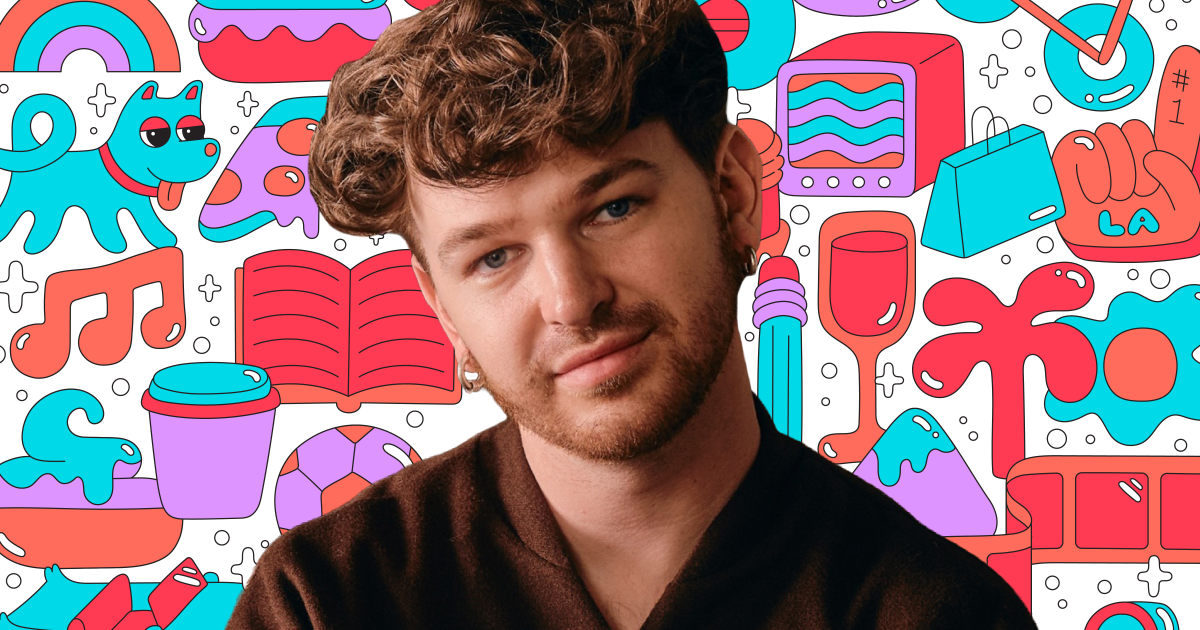
To his millions of YouTube, Instagram and TikTok followers, 30-year-old designer and content creator Drew Michael Scott (a.k.a Lone Fox) is best known for his easy-to-follow DIY transformations, from updating his 1929 Spanish duplex and offering rental tips to surprising his mom with a living room makeover.
Now, Scott has taken on a new project that isn’t online. This week, he opened Lone Fox Los Angeles, a 7,000-square-foot bricks-and-mortar home store on La Brea Avenue in Mid-City that will have about 2,500 square feet of retail space across two floors.

In Sunday Funday, L.A. people give us a play-by-play of their ideal Sunday around town. Find ideas and inspiration on where to go, what to eat and how to enjoy life on the weekends.
“I source every single item,” Scott said, as he gave a tour of the elegant showroom filled with vintage furniture and modern accessories including glassware, pillows, lighting and small gifts.
Scott started selling vintage furniture online about 2½ years ago after his viewers kept asking him about the pieces he used. “I would always use thrifted finds and flea market things in my makeovers, and people would always ask me, ‘Can you sell what you’re using?’” he said.
Fans can now get a taste of his impeccable style in person. Curious about where he finds his vintage pieces? On a typical Sunday in L.A., Scott visits one or two flea markets. Want to know which ones? Keep reading.
This interview has been lightly edited and condensed for length and clarity.

8 a.m.: Avoid anxiety by posting content
I am a workaholic. But I do that to myself. In the past, I was an anxious person, and that stemmed from having too much free time. So I like filling my day. I have been doing social media for 15 years, and Sundays are my primary day for posting content. I wake up around 8 or 9 a.m. and am excited to post my content, which I always have ready to go. Over time, I noticed it felt like a nice day for people to look at social media because they had more free time, and I found that my views did better on Sunday.
9 a.m.: Coffee and croissants at a minimalist coffee shop
I love the coffee shop Laveta Coffee near downtown [L.A.] on Glendale Boulevard, which is only 16 minutes from my house. It’s a chill coffee shop where croissants are made to order. They also have cinnamon-sugar croissant doughnuts that are really good. I always get the Andante, a cold brew with maple syrup, salted sweet cream foam, cacao powder and pink salt. It is the best coffee I’ve ever had in my life. It’s my go-to, and I love that place.

10 a.m.: Flea market shopping in Long Beach or Pasadena
Sundays are for flea markets, and I take advantage of that. I personally source all my vintage pieces, so I try to visit flea markets every week. I bring a wagon to carry all my finds and really enjoy hunting for treasures. I try to go early and can always find art or furniture to rework and give new life. My favorite spot is the Long Beach Flea Market.
Another great option is the Pasadena City College Flea Market. It’s especially nice on hot days because about 70% of it is in a shaded parking garage. Sometimes I’ll find a large piece of furniture. When that happens, I use Lugg, which works like Uber. It’s perfect for things like sideboards and usually costs about $100.
Noon: Hunt for treasures at a sprawling antique mart
I also spend a lot of time at the Mart Collective in Venice, where I have a booth. I love finding new pieces there and checking out the different vendors. The selection is so interesting. It feels more like a museum than a typical antique mall, and I always discover something new. Two booths I really like are West End Vintage, which has unique furniture that looks like it’s from a mountain home, and a French booth near the checkout stand that has amazing French oil paintings.

1:30 p.m.: Stop by Lone Fox Los Angeles
After shopping, I’ll drop off my vintage finds from the flea market and check in at Lone Fox Los Angeles. I don’t plan to be there all the time, but I want to be around the first few weeks it’s open to spot any issues.

2 p.m.: Walk the dog over to Thai lunch
After visiting the shop, I’ll walk my dog over to Her Thai in Mid-City to pick up lunch. I love their pad Thai and Thai iced tea, and I usually get my order to go and bring it home. The Thai tea is especially good. Her Thai is run by the same people who own Met Her at a Bar and Met Him at a Bar, and they are all great.

4 p.m.: Indulge in an afternoon bath
I love taking a bath during the day, even though it feels a bit unusual. I only get the chance on Sundays. I don’t really use bath time to relax, but I do find it sparks my creativity. When I’m in the bath, I come up with ideas for scripts or plan out my work for the week. It might not be the typical way people use their bath time, but it’s something I’ve always enjoyed. My mind is usually focused on work, so that’s where my thoughts go. While I’m in the tub, I like using Cyklar products. Their vitamin C body oils smell great, and adding them to my bath makes me feel productive.
7 p.m.: Enjoy some homemade pasta at a cozy neighborhood cafe
Then I’d have dinner at Met Him at a Bar, my favorite spot. I really like the restaurant’s vibe. They offer both indoor and outdoor seating, and it reminds me of a New York street corner. The restaurant serves Italian food and makes its pasta from scratch. Their Brussels sprout appetizer with balsamic glaze is amazing. The cocktails are great too. Since it’s just a few blocks from my house, I can walk there if I want to have a drink.

10 p.m.: Content planning while watching true crime documentaries
I love watching TV from bed. On Sunday nights, I usually plan content for the week and check what’s trending. I try to relax and come up with new ideas. I’m really into crime documentaries, which are very different from the content I make at home. I like how real they are, even if they aren’t uplifting. I can work on my phone and look up when something interesting happens. I also enjoy YouTube videos about home content, Mr. Kate, how things are made and soothing ASMR reels. It’s my guilty pleasure and helps me unwind.

A note from Wild Card host Rachel Martin: George Saunders is considered one of the master storytellers of our time. He uses humor and empathy to draw readers into characters and situations that stick deeply in the imagination.
He also seems like a guy totally preoccupied with the liminal space between the living and the dead. And I dig this because I am also preoccupied with this in-between-space. It was the setting for his best selling book “Lincoln in the Bardo” and of his newest novel, “Vigil.”

Justin Verlander placed on injured list for Tigers with hip issue

San Francisco’s Art on Market poster series features local artists; 2027 submissions open

Preview: It’s Time to D-D-D-Duel in D-D-D-Dallas

Driver detained after striking deputy’s cruiser during fatal crash investigation in NW Miami-Dade

Team Hoyt Taper kicking off weeks leading up to the Boston Marathon

Florida High School Football Rankings: Top 25 teams – Oct. 21

How old is Bo Nix? What to know about Oregon quarterback ahead of 2024 NFL Draft

Cleary's 21 help Le Moyne down Central Connecticut State 69-64 in OT

99th annual Pony Swim held in Virginia

Indiana Members Credit Union announced as new anchor tenant at Bottleworks District

Trump says ‘America needs God’ in Good Friday message touting ‘resurgence of religion’
Fact check: How can a country actually withdraw from NATO?

65, single, seeking a roommate: More seniors are being priced out of living alone

Video: Search and Rescue Underway After Iran Downs U.S. Fighter Jet

Nebraska Senate candidate restructures campaign after complaint over payments to family: report
-

 Culture1 week ago
What Happens When We Die? This Wallace Stevens Poem Has Thoughts.
-

 South-Carolina6 days ago
South Carolina vs TCU predictions for Elite Eight game in March Madness
-

 Miami, FL1 week ago
Jannik Sinner’s Girlfriend Laila Hasanovic Stuns in Ab-Revealing Post Amid Miami Open
-

 Education1 week ago
Video: Transgender Athletes Barred From Women’s Olympic Events
-

 Minneapolis, MN1 week ago
Boy who shielded classmate during school shooting receives Medal of Honor
-

 Vermont6 days ago
Skier dies after fall at Sugarbush Resort
-

 Politics6 days ago
Trump’s Ballroom Design Has Barely Been Scrutinized
-

 Atlanta, GA6 days ago
Fetishist ‘No Kings’ protester in mask drags ‘Trump’ and ‘JD Vance’ behind her wheelchair