Lifestyle
Retired, they moved from 6 bedrooms to a tiny L.A. ADU built in 3.5 months


Ever wondered how long it would take to build an accessory dwelling unit, or ADU, in your backyard?
In the case of Alvaro “Al” and Nenette Alcazar, a retired couple, who downsized from a six-bedroom home in New Orleans to a one-bedroom ADU in Los Angeles, it took just 3½ months.
“We went on vacation to the Philippines in November, right as they were getting started on construction,” Al says of the ADU his son Jay Alcaraz and his partner Andy Campbell added behind their home in Harbor Gateway. “When we returned in March of this year, the house was ready for us.”
The Alcazars were surprised by the rapid completion of their new 570-square-foot modular home by Gardena-based Cover. By the time construction was finished, they hadn’t yet listed their New Orleans home, where they lived for 54 years while raising their two sons.
Andy Campbell, seated left, and his partner Jay Alcazar’s home is reflected in the windows of the ADU where Alcazar’s parents Al and Nenette Alcazar, standing, now reside.

Jay Alcazar and Andy Campbell’s backyard in Harbor Gateway before they added an ADU.
(Jay Alcazar)
Alexis Rivas, co-founder and CEO of Cover, was also surprised by how quickly the ADU was permitted, taking just 45 days. “The total time from permit submittal to certificate of occupancy was 104 days,” he says, crediting the city’s Standard Plan and the ADU’s integrated panelized system for making it the fastest Clover has ever permitted.
For Al, a longtime religious studies professor at Loyola University New Orleans and community organizer, the construction process was more than just demolition and site prep. Seeing the Cover workers collaborate on their home reminded him of “bayanihan,” a Filipino core value emphasizing community unity and collective action.
“Both of my parents were public school teachers,” says Al, who was exiled from the Philippines in 1972. “When they moved to a village where there were no schools, the parents were so happy their children wouldn’t have to walk to another village to go to school that they built them a home.”


“It’s only one bedroom but we love it,” says Nenette Alcazar. “It’s the right size for two people.”
Like his childhood home in the village of Cag-abaca, Al says his and Nenette’s ADU “felt like a community built it somewhere and carried it into the garden for us to live in.” Only in this instance, the home was not a Nipa hut made of bamboo but a home made of steel panels manufactured in a factory in Gardena and installed on-site.
Jay Alcaraz, 40, and Campbell, 43, had been renting a house in Long Beach for three years when they started looking for a home to buy in 2022. Initially, they had hoped to stay in Long Beach, but when they realized they couldn’t afford it, they broadened their search to include Harbor Gateway. “It was equidistant to my job as a professor of critical studies at USC, and Jay’s job as a senior product manager at Stamps.com near LAX,” Campbell says.
When they eventually purchased a three-bedroom Midcentury home that needed some work, they were delighted to find themselves in a neighborhood filled with multigenerational households within walking distance of Asian supermarkets and restaurants.


The ADU does not overwhelm the backyard. “It looks like a house in a garden,” says Al Alcazar.
“We can walk to everything,” says Jay. “The post office. The deli. The grocery store. We love Asian food, and can eat at a different Asian restaurant every day.”
Adds Campbell: “We got the same thing we had in Long Beach here, plus space for an ADU.”
At a time when multigenerational living is growing among older men and women in the United States, according to the Pew Research Center, it’s not surprising that the couple began considering an ADU for Jay’s parents soon after purchasing their home, knowing that Al and Nenette, who no longer drives, would feel comfortable in the neighborhood.
They started by reviewing ADUs that the city has pre-approved for construction as part of the ADU Standard Plan Program on the city’s Building and Safety Department website. The initiative, organized by former L.A. Mayor Eric Garcetti’s office in collaboration with Building and Safety in 2021, was designed to simplify the lengthy permitting process and help create more housing.


The 570-square-foot house has a single bedroom and bathroom.

Jay and Al Alcazar have coffee in the kitchen of the ADU.
They reached out to several potential architects and secured a line of credit for $300,000. They decided to go with Cover after touring its facility and one of its completed ADUs. “We liked that they were local and their facility was five minutes away from us,” Campbell says.
The couple originally envisioned removing their backyard pergola and lawn and adding an L-shaped ADU. But after consulting with Rivas, they decided on a rectangular unit with large-format glass sliders and warm wood cladding to preserve the yard.
The configuration was the right choice, as the green space between the two homes, which includes a deck and drought-tolerant landscaping, serves as a social hub for both couples, who enjoy grilling, sharing meals at the outdoor dining table and gardening. Just a few weeks ago, the family celebrated Al’s 77th birthday in the garden along with their extended family.
Nenette, a self-described “green thumb,” is delighted by the California garden’s bounty, including oranges, lemons, guava trees and camellias. “I can see the palm trees moving back and forth and the hummingbirds in the morning,” she says.

“They’re a lot of fun,” Jay Alcazar says of his parents. “They are great dinner companions.”
Although some young couples might hesitate to live close to their parents and in-laws, Jay and Campbell see their ADU as a convenient way to stay close and support Jay’s parents as they age in place.
Besides, Jay says, they’re a lot of fun. “They are great dinner companions,” he says.
Campbell, who enjoys having coffee on the outdoor patio with Al, agrees. “When I met them for the first time 12 years ago, they had a group over for dinner and hosted a karaoke party until 3 a.m.,” he said. “I was like, ‘Is this a regular thing?’”


A teak bed from the Philippines and family mementos help to make the new ADU feel like home.
Unlike the Alcazars’ spacious 1966 home in New Orleans, their new ADU’s interiors are modern and simple, with white oak floors and cabinets and Bosch appliances, including a stackable washer and dryer. Despite downsizing a lifetime of belongings, Al and Nenette were able to keep a few things that help make the ADU feel like home. In the living room, mother of pearl lamps and wood-carved side tables serve as a reminder of their old house. In their bedroom, a hand-carved teak bed from the Philippines, still showing signs of water damage from Hurricane Katrina, was built by artisans in Nenette’s family.
“Madonna and Jack Nicholson both ordered this bed,” Nenette says proudly.

The couple chose a thermally processed wood cladding for its warmth. “It will develop a silver hue over time,” says Alexis Rivas of Cover. “It’s zero maintenance.”
But one thing didn’t work out in their move West. When they realized their sofa would take up too much room in the 8-foot portable storage pod they rented in New Orleans, they decided to purchase an IKEA sleeper sofa in L.A. It’s now in the mix along with their personal artifacts and family photos that further add memories to the interiors, including a reproduction of the Last Supper, a common tradition in many Filipino homes symbolizing the importance of coming together to share meals. With limited storage, the families share the two-car garage, where Al stores his tools.
“It’s only one bedroom, but we love it,” says Nenette, 79, of the ADU, which cost $380,000. “It’s just the right size for two people.”
The ADU feels private, both couples say, thanks to the 9-foot-long custom curtains they ordered online from Two Pages Curtains. “When the curtains are open, we know they are awake, and when their curtains are down, we know to leave them alone,” Jay says, laughing at their ritual.
In terms of aging in place, the ADU can accommodate a wheelchair or walker if necessary, and Rivas says a custom wheelchair ramp can be added later if necessary.
Now, if only Jay could mount the flat-screen television on the wall, Al says, teasing his son. It’s hard to escape dad jokes when he’s living in your backyard — and that’s the point.
“It’s really nice having them here,” Andy says.


Jay Alcazar and Andy Campbell enjoy having Al and Nenette Alcazar close. “They feel like neighbors,” Jay says.
After losing his family and home in the Philippines when Ferdinand Marcos declared martial law in the country, Al, who once studied to be a priest, says he’s deeply moved to be the recipient of the bayanihan spirit once again.
“I was tortured in the Philippines, and it didn’t break me,” he says. “So having a home built by a friendly community really points to a shorter but more spiritual meaning of bayanihan, which is, ‘when a group of friends,’ as my grandma Marta used to say, ‘turns your station of the cross into a garden with a rose.’ Now, we have Eden here in my son’s backyard.”



NASCAR’s Gregg Biffle
Jet Turns Into Ball Of Flames …
Shocking Video Shows
Published
Brevin Renwick
Horrifying new video shows the precise moment a plane carrying NASCAR driver Greg Biffle and his family crashed and exploded in flames Thursday, killing everyone on board.
Security footage captured the corporate jet turning into a ball of fire as it crash-landed near a runway at Statesville Regional Airport in North Carolina. The aircraft was scheduled to fly to Florida, but not long after takeoff, it turned back to the airport before crashing.
As you can see from the clip, the plane was reduced to what looks like a burning oil slick with black smoke rising into the sky. All seven people on the plane died, including Biffle, his wife, Cristina and two children — Emma, 14, and Ryder, 5.
PEOPLE reported minutes before impact, Cristina sent her mom a chilling text, stating, “We’re in trouble.”
The Federal Aviation Administration is investigating the cause of the crash.

President Donald Trump stands in the presidential box as he visits the John F. Kennedy Center for the Performing Arts in Washington, D.C, on March 17, 2025.
Jim Watson/AFP via Getty Images
hide caption
toggle caption
Jim Watson/AFP via Getty Images
The John F. Kennedy Center for the Performing Arts will now have a new name — the “Trump-Kennedy Center.” White House press secretary Karoline Leavitt announced the news on social media Thursday, saying that the board of the center voted unanimously for the change, “Because of the unbelievable work President Trump has done over the last year in saving the building.”
Shortly after the announcement, Ohio Democrat Rep. Joyce Beatty, an ex-officio member of the board, refuted the claim that it was a unanimous vote. “Each time I tried to speak, I was muted,” she said in a video posted to social media. “Participants were not allowed to voice their concern.”
When asked about the call, Roma Daravi, vice president of public relations at the Kennedy Center, sent a statement reiterating the vote was unanimous: “The new Trump Kennedy Center reflects the unequivocal bipartisan support for America’s cultural center for generations to come.”
Other Democrats in Congress who are ex-officio members of the Kennedy Center Board, including Sen. Chuck Schumer and Rep. Hakeem Jeffries issued a statement stating that the president is renaming the institution “without legal authority.”
“Federal law established the Center as a memorial to President Kennedy and prohibits changing its name without Congressional action,” the statement reads.


Earlier this year, Trump installed himself as the chairman of the center, firing former president Deborah Rutter and ousting the previous board chair David Rubenstein, along with board members appointed by President Biden. He then appointed a new board, including second lady Usha Vance, White House Chief of Staff Susie Wiles, Fox News host Laura Ingraham and more.

Trump hinted at the name change earlier this month, when he took questions before becoming the first president to host the Kennedy Center Honors. He deferred to the board when asked directly about changing the name but said “we are saving the Kennedy Center.”

The president was mostly hands off with the Kennedy Center during his first term, as most presidents have been. But he’s taking a special interest in it in his second term, touring the center and promising to weed out programming he doesn’t approve of. His “One Big Beautiful Bill” included $257 million for the building’s repairs and maintenance.
Originally, it was called The National Cultural Center. In 1964, two months after President Kennedy was assassinated, President Lyndon Johnson signed legislation authorizing funds to build what would become the John F. Kennedy Center for the Performing Arts.
It’s mid-November, a full week before Thanksgiving, and the progeny of Francisco Robles, a Mexican immigrant who peddled watermelons in East L.A., have converged in West Covina to commemorate the 76th year of the family’s seasonal business: selling fresh Christmas trees around L.A. from the forests of the Pacific Northwest.
Francisco and his wife, Lucia, left Mexico for a better life in the early 1900s, so it’s hard to imagine what they would make of their thoroughly Americanized descendants today. One of them is looking for a place to plug in her electric car; another is zipping around the large lot on a motorized scooter; and a third is carrying a large, elaborately framed photo of their mother, “the Queen of our hearts,” who died on Mother’s Day, so she can be part of the family photo commemorating the 2025 tree season.
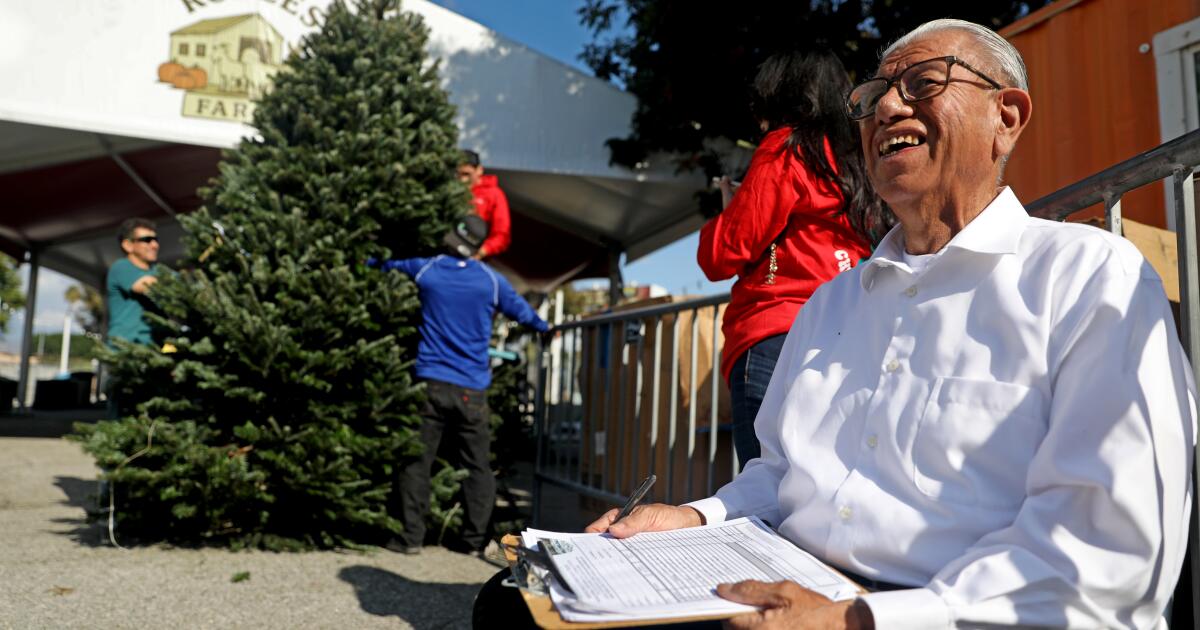
The Robles’ 76-year-old grandson, Louis Jr., is keeping track of today’s Christmas tree delivery from a folding chair, wearing horn-rim glasses, slacks and a white, open-neck dress shirt. But most of his family — his three adult children, their spouses and a few of his grandchildren — are casually dressed in red “Robles Christmas Trees”-themed sweatshirts or holiday leggings, laughing and posing for cellphone photos under a huge red-and-white striped tent in the parking lot of the bustling Plaza West Covina mall.
Louis Robles Jr., 76, right, listens as his children go over an inventory list of Christmas trees delivered to his son Gabriel Robles’ lot at Plaza West Covina on Nov. 19. Gabriel stands at his father’s left, beside his wife Kathy Robles. His sister, Lorraine Robles-Acosta, far left, looks over paperwork about the trees that will next be delivered to her lot in Montebello.
All the pumpkin patch trimmings from October have been put away — the petting zoo, towering inflatable slides, Cyglos and other rides — and now the family is setting up Christmas decor and stands for the trees that will soon be delivered.
It’s a far cry from the dusty streets where Francisco Robles sold his watermelons from a truck more than a century ago. By the end of this day, the massive 53-foot-truck will have delivered its icy bundles of Nordmann, noble and silvertip firs — what Louis Jr. calls “the Cadillac of Christmas trees” — to all three of their lots in Eagle Rock, Plaza West Covina and the Montebello mall.
The Robles family is eager to get the Christmas tree lots going. Sales were slower than usual at their pumpkin patches this year, a slump they blame on Immigration and Customs Enforcement raid concerns among their large Latino customer base.

Antonio Villatoro, left, closes a hatch after moving trees, while Javier Vasquez, looks on at Robles Christmas Trees run by Gabriel Robles at Plaza West Covina.

The Robles family adds festive decor and places for photos to their Christmas tree lots such as this wall at Gabriel Robles’ business at Plaza West Covina.
Members of the Robles family talk carefully about ICE and immigration. They are business people and deeply religious — Louis Jr. is an assistant pastor at the Living Word Apostalic Church in El Monte, where they attended as a family for years — and they want to keep their politics private.
“But we are not fearful,” said Gabriel Robles. “We’ve lived here all our lives, born and raised here, and we’ve been through so much. I believe this ICE issue is another moment in time. It will pass like COVID happened and passed, and we can stand whatever they throw at us. Los Angeles is a melting pot of immigrants. We’re all unified together, no matter who is in office, and you can’t get rid of us. We are the fabric of L.A.”
Getting the family together in mid-November is unusual because, from October through December, the Robleses are juggling the family business with their other jobs: Gabriel Robles, operator of the Robles Pumpkin Festival and Christmas Trees in West Covina, is an insurance broker; his wife, Kathy, is a homemaker who manages their books. Gabriel’s older sister, Lisa Nassar, operator of Cougar Mountain Pumpkin and Christmas Trees in Eagle Rock, does security screenings at Disneyland (“I keep Tinker Bell safe,” she says, laughing). Her husband, Sam Nassar, is a counselor at Mt. San Antonio College. Lorraine Robles-Acosta is a massage therapist who does lots of work for her church; her husband, Joseph Acosta, is a drug and alcohol counselor. Together, they run the Robles Pumpkin Patch and Christmas Tree Farm in Montebello.
It’s a grueling schedule, but they cling to Louis Jr.’s motto — “We’ll sleep in January” — because this business is in their blood. Not all of the younger generation of Robleses is as gung-ho about the family business as their parents are. But Gabriel and Kathy’s sons, Roman, 21, and Mason, 19, are already devising plans to improve the family’s presence on social media, and the couple’s art-loving daughter Loren, 15, set up the acrylic paints for pumpkin painting.

The Robles family’s late matriarch, Madalene Robles, smiles from a portrait held by her husband, Louis Jr., so she can be part of the family photos commemorating the start of the 2025 Christmas tree season on Nov. 19 at their son, Gabriel Robles’ lot in West Covina. Madalene Robles died on her birthday, May 11, which also happened to be Mother’s Day, her favorite holiday.
Louis Jr.’s children, Lisa, Stephen, Gabriel and Lorraine, played among the trees in their father’s tree lots, first in Monrovia in 1973, Louis Jr. says, then in Rosemead and Pico Rivera. Louis Jr. purchased a small trailer with a tiny space heater to sit on the lot so the kids could eat and rest there while he and his wife sold trees.
“That trailer was so cold at night,” said Lisa, shivering with the memory.
In those early years, when Louis Jr. worked all day at a produce warehouse with his dad before spending his evenings at his Christmas tree lot, he and Madalene used the tree money to create magical Christmases for their children.
“I remember waking up to mountains of presents under the Robles’ tree,” Lorraine said dreamily, “and Mom wrapped every single gift.”
When they were older, Lorraine and her siblings helped set up and sell the trees. They’d chase after the few scalawags who tried to steal them, and ultimately they lobbied Louis Jr. to let them have their own lots, which over time expanded from selling a few pumpkins on straw before Halloween to big pumpkin patch extravaganzas with petting zoos, art activities, inflatables and rides. (Stephen, who lives in San Diego, stepped away from the seasonal business.)

The Robles family considers silvertip firs, with their sturdy open branches and graceful form, to be the Cadillac of Christmas trees, said Gabriel Robles. They used to be plentiful, but they’re harder to find these days, he said, because they require altitude and cold to thrive.
Inflatables like bounce houses and giant slides were Gabriel’s innovation, and so popular he insisted on adding them to his Christmas tree lot too. His dad warned against the idea, but Gabriel said he was determined. He set them up at his lot and they did well for a few days. But then it rained, and his father’s logic became apparent. The inflatables never dried, Gabriel said, and the cold and mud made them even less appealing to visitors. “I still have customers to this day who say, ‘Please put the inflatables out again,’ but they don’t understand they take forever to dry.”
The Robles family is dismissive about big-box competitors (“They’ll never replace the tradition and environment you get at our lots,” said Lisa), and they collectively hiss at the mention of artificial trees.
“My dad has been worried that artificial trees get nicer and nicer, but it hasn’t really changed our sales,” Gabriel said. “The No. 1 reason people come to our lots is the fragrance. They want that fresh pine smell throughout their home, and fake sprays don’t cut it.”

Worker Jonathan Tovar, foreground, who helps with general operations, and Roman Robles, 21, background, whose father Gabriel Robles runs the lot, arrange trees while inventory is being unloaded.
The Robles family hand-select their trees every year from the farms in the Pacific Northwest. (The names of the farms are secret to keep competitors away, Gabriel said.) After the trees are delivered, the family sprays them with water every night and keeps them shaded from the sun so they don’t dry out. “That’s the secret of our success,” Gabriel said.
Louis Jr. said the biggest part of his family’s success has been adding fresh ideas to expand the business that come from each passing generation, starting with his dad, Louis.
Francisco and Lucia Robles and their five L.A.-born children lived on Brooklyn Avenue in East L.A. All three of their sons went to war for the United States, and two never came home, one lost in World War II and the other in the Korean War. Their third son, Louis Robles, served in WWII, right out of high school. He entered the Army’s 101st Airborne Division and earned a Purple Heart as one of the paratroopers who, at age 20, dropped into German-occupied France on D-day, June 6, 1944.

Paratrooper and produce wholesaler Louis Robles Sr. supplemented his income in 1949 by selling Christmas trees in L.A. In this family photo from 1955, Robles, then 31, pauses by his Robles Produce truck preparing to drive a load of fir trees from snowy Washington to his lot in Lincoln Heights. The boy at left is unindentified.
When he returned from the war, Louis joined his father selling produce, but he had bigger ideas, Louis Jr. said of his dad. He didn’t want to sell from a truck; instead, he went into the wholesale business, selling watermelons and oranges from a stall at the old Central Wholesale Produce Market at 8th Street and Central Avenue in downtown L.A. He married Elena Ramirez, who helped at the warehouse, keeping the books, and they had four children: three girls — Gail, Priscilla, Denise — and a boy, Louis Jr.
Then, in 1949, the same year his son was born, Louis Robles had another idea: Watermelon sales slowed in the winter. Oranges were plentiful year-round, but he needed another crop that could fill the income gap. He noticed how people went to the railyard in December and bought Christmas trees off boxcars, so fresh they still had ice clinging to their branches. Packing them in snow was how trees were kept fresh during transport from the Pacific Northwest.
Inspired by this, Louis Sr. found a vacant lot in Lincoln Heights and started selling Christmas trees. Being the innovator he was, he didn’t want to rely on other people’s choices for his trees. So he researched tree farms in the Pacific Northwest and visited them himself, selecting his own trees and, for a while, even driving his warehouse’s Robles Produce truck up north to transport them himself.

Lisa Nassar helps unload small Christmas trees at her brother Gabriel Robles’ Christmas tree lot at Plaza West Covina on Nov. 19. The 53-foot-long truck filled with trees from the Pacific Northwest stopped at Nassar’s lot first in Eagle Rock that morning, and would continue on to their sister Lorraine Robles-Acosta’s lot in Montebello.
Eventually, Louis Sr. bought his own produce warehouse, and Louis Jr., always a helper after school and on weekends, joined the business right after graduation. The younger Robles married his high school sweetheart, Madalene Maldonado on Jan. 4, 1969 — after the busy holiday season, of course — and they immediately started a family. Although she helped at the warehouse, Madalene’s main interest “was being a homemaker; raising her children and being a good wife,” Louis Jr. said.
Louis Sr. was considered by his family to be a taskmaster. He was generous about giving out jobs, but he didn’t tolerate people standing around at work. Laughing, Lisa said anytime you saw him coming, you grabbed a broom and started sweeping. “I still carry that mentality — there’s always something to do, even if it’s just pushing a broom,” she said.
Louis Sr. instilled that work ethic in all of his family growing up. “Grandfather was the first one out on the floor, always working and moving, and he took people up with him,” Gabriel said. “He really believed if he succeeded, you were going to succeed. It wasn’t about a handout, it was a hand up.”

Workers unloaded trees at Robles Christmas Trees run by Gabriel Robles.
Louis Sr. was well-respected by his creditors and so beloved by his employees that they insisted on filling his grave themselves after his sudden death in 1984. But the senior Robles never attended any of his son’s games in high school, Louis Jr. said, and he missed many family activities because of work.
“That was his blind spot. He always put business first,” Louis Jr. said. “I decided I wanted a balance — I would take care of business but I would also take time to go to my children’s games.”
Louis Sr. was such a force of nature, no one was prepared when he fell in December 1984. Because this was the family’s busy season, he insisted on working despite a bad cold that turned into walking pneumonia, Louis Jr. said. He told his family he would rest in January.
He almost made it. Shortly before Christmas Louis Robles had a stroke, then a heart attack and, on Dec. 27, at age 60, he died.

Gabriel Robles, right, consults with his father, Louis Robles Jr., while Gabriel’s son Mason, left, checks his phone during the first delivery of this year’s Christmas trees at his West Covina lot.
Louis Sr.’s death, so unexpected, required Louis Jr. to take over the business himself, but it also cemented his vow to put God and family first. “I remember playing in the all-stars game in baseball and looking for my dad, and he wasn’t there, and I thought, ‘I’m not going to do that to my kids,’” he said.
Gabriel laughed, saying: “My dad was so much into my basketball games, I got kind of embarrassed.”
Eventually, the watermelon and produce business became too competitive, and Louis Jr. sold the warehouse around 2012. By then, Robles Produce was debt-free, he said. His children were working, getting married and established in their own homes, and he’d been ordained as a pastor in 1999 and was deeply involved in his church. But the family pumpkin patch and Christmas tree business remained a constant.
“It does get in your blood,” said Lorraine’s husband, Joseph, with a laugh. “I got my blood transfusion when I married my wife.”
Today, Louis Jr. acts as an advisor and consultant to his children’s three pumpkin patches and Christmas tree lots. They meet to discuss pricing and inventory, but the siblings run their own lots with each a little different from the other. There are disagreements, of course, Gabriel said, “but in the end, the thing that makes us so successful is we’re united — if someone goes against us, we’re a united front.”

Louis Robles, 76, center, of El Monte, poses with three generations of his family: son Gabriel Robles, of Fontana, far left, with his daughter Loren, 15, wife Kathy, and two sons sitting up top, Mason 19, left, and Roman, 21, Louis’ daughters Lisa Nassar, of Upland, right, Lorraine Robles-Acosta, of Pomona, and Lorraine’s husband Joseph Acosta, far right, at Robles Christmas Trees in West Covina. Gabriel’s sons say they are eager to continue the family business. “I’ve been bitten by the bug,” said Mason.
It’s not clear how many of Louis Sr.’s seven great-grandchildren will continue the family business, but Gabriel’s sons, Roman and Mason, say they’re on board. Both have opted to skip college for a hands-on business course, soaking up whatever they can from their father and grandfather.
“Our great-great-grandfather started with nothing, and now we have this. And every generation we’ve built it higher,” Mason said.
“Not many kids my age are blessed to have a family business to learn from,” said Roman. “I want to do something more with my life than just showing up.”

Judge tosses Trump-linked lawsuit targeting Chief Justice Roberts, dealing setback to Trump allies

New study questions whether annual mammograms are necessary for most women

Ed Orgeron on who should be out of College Football Playoff, Lane Kiffin’s move to LSU and his coaching plans

AI photo match reunites Texas woman with lost cat after 103 days

They graduated from Stanford. Due to AI, they can’t find a job

Florida High School Football Rankings: Top 25 teams – Oct. 21

Cleary's 21 help Le Moyne down Central Connecticut State 69-64 in OT

How old is Bo Nix? What to know about Oregon quarterback ahead of 2024 NFL Draft

99th annual Pony Swim held in Virginia

Video: ‘It Didn’t Have to Happen This Way:’ U.Va. Faculty Call for Review of Police Response to Protests
Judge tosses Trump-linked lawsuit targeting Chief Justice Roberts, dealing setback to Trump allies

Who was Osman Hadi; why is Bangladesh on fire over his death?

Putin tells news conference that Kremlin’s military goals will be achieved in Ukraine

Video: Trump Mocks Obama, Biden in His Presidential ‘Walk of Fame’

Trump quietly signs sweeping $901B defense bill after bipartisan Senate passage
-

 Iowa4 days ago
Addy Brown motivated to step up in Audi Crooks’ absence vs. UNI
-

 Washington1 week ago
LIVE UPDATES: Mudslide, road closures across Western Washington
-

 Iowa6 days ago
How much snow did Iowa get? See Iowa’s latest snowfall totals
-

 Maine3 days ago
Elementary-aged student killed in school bus crash in southern Maine
-

 Maryland4 days ago
Frigid temperatures to start the week in Maryland
-

 Technology1 week ago
The Game Awards are losing their luster
-

 South Dakota5 days ago
Nature: Snow in South Dakota
-

 Nebraska1 week ago
Nebraska lands commitment from DL Jayden Travers adding to early Top 5 recruiting class