Lifestyle
Recess for grown-ups: Join these L.A. groups for double Dutch, dodgeball and more


As a Black woman who grew up in New York City in the late ’90s and early aughts, double Dutch has always been near and dear to my heart.
In the summertime, the balmy Bronx streets would be filled with kids hanging out on their blocks with time to kill and limited means. We’d fashion an XL double Dutch rope out of landline cords and spend hours taking turns, inviting in anyone who passed by — usually neighborhood aunties, including my auntie Thelma, who would join us for a turn or two on her way home from work.
Now I am the auntie, and I’ve been feeling called to jump again.
A lot of people like me have been returning to their beloved childhood activities as a way to reconnect with their inner child — and perhaps to cope with the fact that adulthood looks nothing like what we had imagined.
Around L.A., there are groups you can join to play the games you loved as a kid and connect with like-minded people (and perhaps awaken some physical skills that have been dormant since high school gym class). Here are six organizations to join for “adult recess”-style activities.
Relive your high school glory days with WeHo Dodgeball
What calls to mind phys ed and school gymnasiums more palpably than dodgeball? The game is nightmare fodder for countless nerds across the country. In case you’ve blocked it out of your memory, the game is as it sounds: a mad rush to dodge a rubber ball being hurled at you by a member of the opposing team. If you get hit, you’re out, and the game continues until there’s one person left standing.
WeHo Dodgeball players celebrate.
(Grant Terzakis)
For adults with a taste for nostalgia, WeHo Dodgeball offers league games on Tuesday and Thursday evenings at the West Hollywood Aquatic and Recreation Center, followed by a celebration at the nearby Gym Bar WeHo. The league uses soft rubber “no sting” balls and welcomes everyone “from prom queens to drag queens” who might be looking for something different in the WeHo social scene.
The co-ed league has begun accepting new people into its rotating membership base. Registration is $80 for a 12-week series.
Master the rhythm of two ropes with 40 Plus Double Dutch Club in Inglewood
40 Plus Double Dutch Club is a national organization created for women of a certain age who love jumping rope. The group, whose oldest member is 90, takes its age restriction seriously. “You have to be 40 [plus],” said Pamela Brown, 63. “We tell [younger people] to come on back when they’re 40.”
The Inglewood branch (or “subclub” as they call it) gathers for 90 minutes on Saturdays, beginning at 9 a.m., at Rogers Park, followed by after-parties. Since the first meet-up, when just a handful showed up, weekly attendance has swelled to more than 50. “It’s been fun,” said Brown, who described it as “a sisterhood, a fellowship.” “I may have on some knee braces but I’m here.”
The group has been known to break out into hopscotch, Hula-Hoop, line dancing, jump rope and patty-cake, among other games. Melinda Jackson, 50, serves as the group’s unofficial choreographer for line dances.
“It started off as women coming together because of the [shared] passion and pastime of double Dutching,” she said. “But once we got together, we found out that we have so much more in common than just that. And it has provided us a place of socialization where we can support one another through our ups and downs of life. We are mothers, grandmothers but we get to see each other as individuals when we’re here.”
Find your next crush on the kickball field with Zog Sports
A near-death experience led Robert Herzog to start ZogSports, a social sports community that serves thousands of players annually in the U.S.
On Sept. 11, 2001, Herzog got an uncharacteristically late start to his day, which led him to be five minutes late to his job at Marsh & McLennan, on the 96th floor of the World Trade Center in New York City. He stepped off the subway just in time to see the first tower get hit in a terrorist attack.
Three months later, while reflecting on his life and trying to chart a course forward, he resolved to create a well-organized sports league that could help people forge connections outside the office, to “create community and help people heal,” said ZogSports’ chief of staff, Jody Zellman. “Today, we help thousands of athletes across the country create community and connections through the sports they love.”
Today, more than 1,000 teams play every year across six regions of the U.S., and there are 37 programs in L.A. Co-ed kickball games are on the schedule for late October, with games being held in Hollywood, West Hollywood and Venice. Among the other offerings are volleyball, basketball, soccer, softball, bowling, flag football and pickleball, which has been having a resurgence lately.
Herzog, who met his wife at a co-ed softball game before founding his company, credits the organization for “sooo many off-the-field romances,” according to the website. Prices for eight regular season games plus playoffs range from $95 for an individual to $625 for a team of up to seven.
Become a team player with Club Waka
Soccer in Glendale. Bowling in Torrance. Volleyball in Santa Monica. Kickball in Venice, Hollywood, Pasadena and Long Beach. These are some of the offerings and areas served by Club Waka, a national organization that offers social sports for players of all skill levels.
Players meet weekly for eight weeks to play games that run 45 minutes to an hour. Newcomers can join individually, in a small group to be placed in a larger group or as a fully formed team. Postgame, there’s an after-party at a local bar.
Registration fees vary and include weekly games (plus playoffs), a team shirt and specials at the sponsor bar.
You don’t have to be a member of the LGBTQ+ community to join a team at OutLoud Sports, an organization dedicated to creating inclusive spaces for members and allies of the queer community.
“Our players are extremely diverse with a focus on the queer+ community but inclusive of everyone, including our straight allies,” said founder Will Hackner. “Our policy since Day 1 has been that everyone is welcome.”
Founded in 2007 (originally under the name Varsity Gay League) with a game of capture the flag at Pan Pacific Park, OutLoud is now the largest LGBTQ+ recreational sports organization in the nation with more than 70,000 registered players. There are leagues in L.A. and Long Beach.
Each eight-week season offers regular season games as well as playoff games for such sports as beach and indoor volleyball, bowling, dodgeball, flag football, kickball, tennis, pickleball and soccer. Prices range from $20 for bowling to $72 for beach volleyball.
“We want to everyone to understand that whatever age, size, sex, shape or skill you carry should not be a detriment to participating in a sport,” said Hackner. “So many adults, both queer and straight, harbor fears and anxieties that come from toxic locker room culture. This is not that space. This is about playing, being silly and trying something new, successful or not. This space is for everyone to have fun.”


Can you say no to a friend’s wedding?
Getty Images/Getty images
hide caption
toggle caption
Getty Images/Getty images
Are we spending too much on other people’s weddings?
Going to a friend’s weddings can be so fun and meaningful… but it can also really hurt your wallet. A survey by LendingTree found that 31% of people who had been to a wedding in the past five years had accrued debt to attend. So what’s driving up the cost of weddings for guests? And what makes it so hard to say no to these expenses?
Brittany breaks it down with Allyson Rees, senior analyst at trend forecasting firm WGSN, and Annie Joy Williams, assistant editor at The Atlantic.
This episode was produced by Liam McBain, with additional support from Corey Antonio Rose. It was edited by Neena Pathak. Our Supervising Producer is Cher Vincent. Our Executive Producer is Barton Girdwood. Our VP of Programming is Yolanda Sangweni.
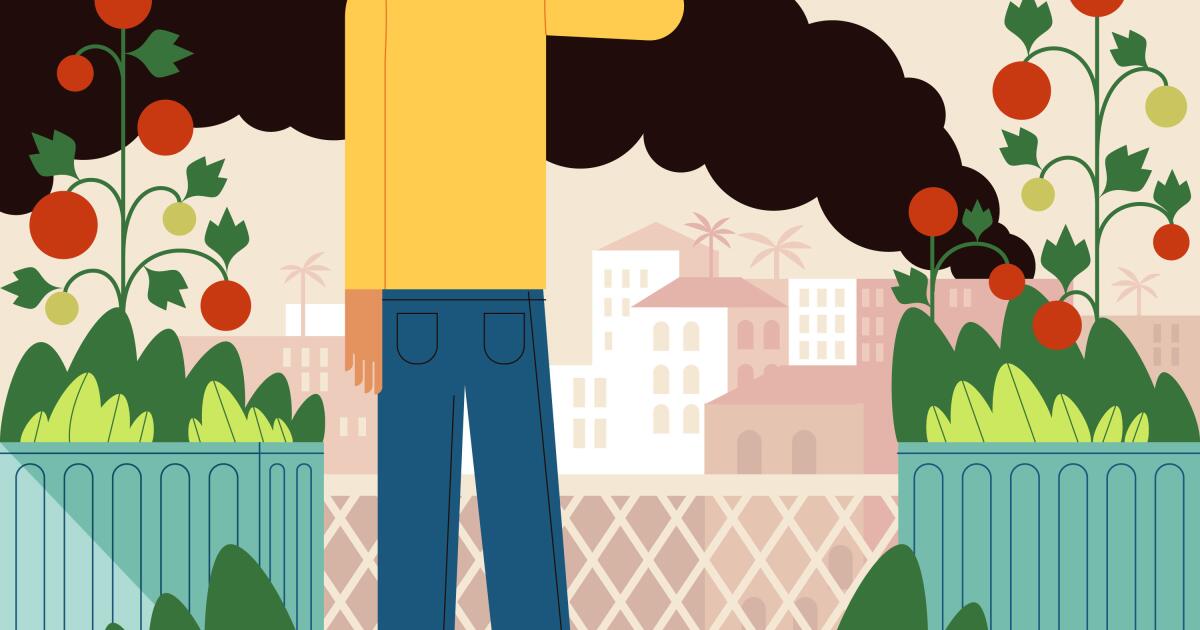
After the eight-day-long fire in a 500,000-square-foot Boyle Heights warehouse, eastern Los Angeles residents are contending with putrid smells, soot and potentially hazardous airborne chemicals after heavy plumes of smoke spread throughout the city. But those who grow food in nearby neighborhoods may also be wondering: How will the fires affect the plants and produce in my garden?
The Boyle Heights warehouse, owned by Lineage — a global temperature-controlled storage facility operator — housed 85 million pounds of frozen food and other products. In the days since the fire, local emergency visits for smoke inhalation and throat pain spiked while agencies still scramble to measure the amount of PM 2.5 — harmful fine particles — and heavy metals, like lead and arsenic, in the air.
According to researchers, any toxic airborne chemicals would likely stem from the charred foam insulation, metal exterior, burned solar panels and any lithium batteries that might have been present inside the warehouse.
After a fire, heavy metal particles can spread through ash and smoke over gardens and inhibit growth, said Olukayode Jegede, an agricultural toxicologist and assistant professor at UC Davis. Since the warehouse fire is so recent and cleanup has just begun, Jegede said the precise impact on gardens can’t be measured until comprehensive soil tests are conducted in the area.
While the L.A. city government hasn’t announced plans for soil testing, the Contaminant Level Evaluation and Analysis for Neighborhoods project at USC is offering free contaminant testing for Boyle Heights and East L.A. residents. Residents can collect soil samples and deliver them to Boyle Heights City Hall and other locations for an evaluation of lead, arsenic, chromium and mercury levels.
The good news is produce, plants and roots can still be preserved. According to Jegede, many of the soil tests conducted last year in the Altadena area after the Eaton fire showed that gardens and poultry were not as contaminated as one might expect.
“Quite a number of the soils we tested [in Altadena] were not really contaminated,” Jegede said. “We weren’t seeing many soils with concerning elevated levels of metal, so gardeners should not be too alarmed when these things happen.”
Nevertheless, there are several measures that gardeners can take to keep themselves, their children, plants and produce safe from potentially harmful contaminants stemming from the fire. Researchers, gardening experts and horticulturists offered some guidance on the handling, recultivation and cleanup that can keep you and your garden in good health.
How do I remove ash and contaminants from my garden?
Altadena horticulturist Leigh Adams said Boyle Heights plants and produce already live in a difficult environment, surrounded by industrial warehouses that spread contaminants daily.
“That area has been used industrially for 100 years, and the soil is impacted by many, many, many things,” Adams said. “Low-income neighborhoods and gardens usually don’t have a lot of resistance against dominant manufacturing.”
This means that the contamination of gardens in eastern L.A. won’t be as catastrophic as compared with those in Altadena, a more suburban environment, Adams said. But fallen ash still poses major health risks if ingested or inhaled.
An advisory from University of California Agricultural and Natural Resources last year recommended suiting up in an N95/KN95 mask, long sleeves, pants, close-toed shoes and gloves before attempting to deal with ash in the garden to limit exposure to potentially toxic contaminants. The advisory added that individuals should make sure all of this gear is cleaned thoroughly before bringing it back inside.
Once in the proper gear, Adams recommends removing the top two inches of topsoil from gardens, where the highest concentration of contaminants will settle after a fire. Using a plastic bag to collect the soil and disposing of it in the garbage — not green yard waste bins — will help to reduce the spread of airborne chemicals.
Gardeners with raised beds are advised to remove approximately six inches of soil, because excess ash can raise the pH level and prevent nutrients from soaking into the soil bed.
After this, watering the garden gently but plentifully will help to promote soil health and get rid of most of the ash present on plant leaves and stems. Adams said replacing the top two inches of soil with store-bought mulch or straw will help to contain any remaining ash and prevent it from spreading any further.
Experts say to avoid using leaf blowers if ash is present in the garden because they can send particles airborne. Doing so will increase the likelihood of heavy metal particles, which can carry lung irritants and carcinogens, being spread and inhaled.
A Boyle Heights resident keep a watchful eye on the fire at the 5,000-square-foot commercial building, which stores 85 million pounds of frozen food.
(Genaro Molina / Los Angeles Times)
Is it safe for me to eat produce from my garden?
Several studies, including one from the UC Cooperative Extension of Sonoma County, have shown that consuming produce in a fire-affected area poses minimal health risks.
Jegede said most root vegetables like potatoes and carrots, along with any fruit that has an outer layer, can be washed to remove potential contaminants, even if they were covered in ash. Peeling the outer layer of your produce can also help to reduce potential risks, he said.
Lettuce and other leafy foods with multiple layers pose a higher risk of contamination, but with a vigorous wash and peeling the outer layers, even the greens can be saved. The County of Los Angeles Department of Public Health recommends soaking leafy produce and fuzzy fruits like peaches in a 10% white vinegar and 90% water mixture.
Jegede said if the leaves or fruit are too delicate to wash or ash is still visible, it would be best to dispose of the produce.
How can I tell if my soil is contaminated?
After ridding your garden of visible ash, you might wonder how to tell if your plants will still thrive in the soil.
At-home soil tests that measure for alkaline, fertility and pH levels are widely available and can be purchased for $15 to $100 (for more detailed results) online. But Jegede said these tests can’t tell the full story of soil health.
Comprehensive soil testing is “something you can’t do properly at home,” Jegede said. “In labs, we are testing for metals like lithium and zinc, stuff that an at-home test will not show … If it comes to the point that you’re worried about your soil, I would just send it out to a lab.”
Wallace Laboratories in El Segundo, Babcock Laboratories in Riverside, Waypoint Analytical in Anaheim and other labs offer more detailed soil tests that measure heavy metal particles in addition to other fertility factors. Prices at Wallace Laboratories can range from $115 to $295 for a complete compost test.
The soil below two inches should be unharmed, Adams said, so long as new compost is set and plants are watered plentifully, which will promote natural biological cycles.
“What you’re doing is capping the soil, so that moisture stays in there, and instead of being dirt, it’s a living system called soil,” Adams said. “The more carbon we can get into our soil, the better.”
What can I do to help my soil recover?
For the last 12 years, Adams has been working with Metabolic Studio, a Los Angeles-based art and research hub focused on environmentalism, on methods for bioremediation, the practice of using additional fungi, plants and compost to decontaminate ash and break down contaminants.
Adams said straw, mushrooms, corn, rye and sunflowers are great bioremediators that can help to repair damage to soils. She said certain samples she’s worked on with Metabolic Studio have gone from testing at high heavy metal levels to nearly contaminant-free.
But for a more immediate fix, wash your produce, water your plants and have a little patience during ash cleanups. Your garden should look better in no time, Adams and Jegede said.

Inde Navarrette and Michael Johnston in Obsession.
Focus Features
hide caption
toggle caption
Focus Features
Two big horror films, Obsession and Backrooms, just smashed all box office expectations. So much of their success has been driven by Gen Z, which is now the biggest moviegoing demographic. But what makes a movie a Gen Z movie? Today we’re bringing you an episode of NPR’s It’s Been a Minute. Host Brittany Luse talks about this trend with Sam Adams and Reanna Cruz.
If you want to hear more about these movies, check out these episodes:
In ‘Obsession,’ love hurts. It really, really, really hurts.
‘Backrooms’ brings YouTube horror to the big screen
Zendaya brings ‘The Drama,’ we bring the spoilers
Connect with Pop Culture Happy Hour:
Letterboxd / Facebook
Our weekly newsletter
Support Pop Culture Happy Hour+
-

 Pennsylvania2 minutes ago
Pennsylvania state trooper to be laid to rest after being fatally struck in Schuylkill County
-

 Rhode Island9 minutes ago
Man critically hurt in Providence stabbing
-

 South-Carolina12 minutes ago
Federal court revives NAACP lawsuit challenging SC education law limiting how schools can teach race
-

 South Dakota17 minutes ago
As travel costs rise, many families find summer adventures closer to home
-

 Tennessee24 minutes ago
In-N-Out’s fifth Tennessee location is opening soon. Here’s how many stores are planned
-

 Texas27 minutes ago
Triple-digit heat returns to North Texas before weekend storms bring relief
-

 Utah32 minutes ago
Planned 60-foot long Liberty Arch in Utah sparks patriotism, but also concerns
-

 Vermont39 minutes ago
Vermont offers money to replace diesel vehicles with electric

