Connect with us

Lifestyle

Photos: See what Election Day looked like across the country

Published

on

Photos: See what Election Day looked like across the country

Iris and Burt Foster take a selfie after voting Dr. Henry A. Wise, Jr., High School in Upper Marlboro, Md.

Beth LaBerge/KQED


hide caption

toggle caption

Advertisement

Beth LaBerge/KQED

The final day of election season is coming to an end as polling stations around the U.S. close. The race between Republican Donald Trump and Democrat Kamala Harris remains statistically close.

NPR’s final national NPR/PBS News/Marist poll found that Vice President Kamala Harris narrowly leads former President Donald Trump among likely voters, fueled by white, college-educated voters, Black voters and Latinos.

Some of NPR’s member station photographers spent the day documenting Americans casting their votes in what could be a historic election.

Advertisement
Members of the Staten Island Republican Party hold signage in support of Republican Presidential candidate Donald J. Trump for drivers passing by in Staten Island, NY.

Members of the Staten Island Republican Party hold signage in support of Republican Presidential candidate Donald J. Trump for drivers passing by in Staten Island, NY.

José A. Alvarado Jr./José A. Alvarado Jr. for NPR


hide caption

toggle caption

José A. Alvarado Jr./José A. Alvarado Jr. for NPR

Advertisement

A line forms outside of the Ruiz Branch of the Austin Public Library to vote in Austin, Texas.

A line forms outside of the Ruiz Branch of the Austin Public Library to vote in Austin, Texas.

Michael Minasi/KUT News


hide caption

toggle caption

Advertisement

Michael Minasi/KUT News

Voters drop off their ballots on Election Day at City Hall in San Francisco, Calif.

Voters drop off their ballots on Election Day at City Hall in San Francisco, Calif.

Beth LaBerge/KQED


hide caption

Advertisement

toggle caption

Beth LaBerge/KQED

Carmen Lopez prepares to fill out her ballot on Election Day at City Hall in San Francisco, Calif.

Carmen Lopez prepares to fill out her ballot on Election Day at City Hall in San Francisco, Calif.

Beth LaBerge/KQED


hide caption

Advertisement

toggle caption

Beth LaBerge/KQED

Voters cast their ballot at VFW Post 738 with the state Capitol building in view in Des Moines, Iowa.

Voters cast their ballot at VFW Post 738 with the state Capitol building in view in Des Moines, Iowa.

Madeleine Charis King/IPR

Advertisement


hide caption

toggle caption

Madeleine Charis King/IPR

Advertisement
St. Louis County voting stickers are laid out for voters at Holy Name Community Center in Bellefontaine Neighbors, Mo.

St. Louis County voting stickers are laid out for voters at Holy Name Community Center in Bellefontaine Neighbors, Mo.

Brian Munoz/St. Louis Public Radio


hide caption

toggle caption

Brian Munoz/St. Louis Public Radio

Advertisement

At Waterbury City Hall, Joanna Dvorchak (left) and Rosemary Delano (right) hand count ballots that didn’t read in the tabulator machine the evening of Election Day in Waterbury, Conn.

At Waterbury City Hall, Joanna Dvorchak (left) and Rosemary Delano (right) hand count ballots that didn’t read in the tabulator machine the evening of Election Day in Waterbury, Conn.

Dave Wurtzel/Connecticut Public


hide caption

toggle caption

Advertisement

Dave Wurtzel/Connecticut Public

Voters arrive at Calhoun Community Center on Election Day morning to cast their ballots, with poll workers assisting with check-in and directions in Richmond, Va.

Voters arrive at Calhoun Community Center on Election Day morning to cast their ballots, with poll workers assisting with check-in and directions in Richmond, Va.

Carlos Bernate for VPM News


hide caption

Advertisement

toggle caption

Carlos Bernate for VPM News

Patti Gorman, dressed as lady liberty, talks with her former Seattle Central student, Afrikaan Sahra, right, as voters cast their ballots outside of Seattle Central College in Capitol Hill. Sahra is voting for the first time after receiving U.S. citizenship.

Patti Gorman, dressed as lady liberty, talks with her former Seattle Central student, Afrikaan Sahra, right, as voters cast their ballots outside of Seattle Central College in Capitol Hill. Sahra is voting for the first time after receiving U.S. citizenship.

Megan Farmer/KUOW


hide caption

Advertisement

toggle caption

Megan Farmer/KUOW

Voters check in and head to voting booths at the Charlestown Boys and Girls Club in Charlestown, Mass.

Voters check in and head to voting booths at the Charlestown Boys and Girls Club in Charlestown, Mass.

Jesse Costa/WBUR

Advertisement


hide caption

toggle caption

Jesse Costa/WBUR

Advertisement
Iris and Burt Foster take a selfie after voting Dr. Henry A. Wise, Jr., High School in Upper Marlboro, Md.

Iris and Burt Foster take a selfie after voting Dr. Henry A. Wise, Jr., High School in Upper Marlboro, Md.

Tyrone Turner/WAMU


hide caption

toggle caption

Tyrone Turner/WAMU

Advertisement

Adam Powell, 45, casts his ballot during the General Election at Holy Name Community Center in Bellefontaine Neighbors, Mo. A power outage at the polling site caused staff to run off of lanterns and generators.

Adam Powell, 45, casts his ballot during the General Election at Holy Name Community Center in Bellefontaine Neighbors, Mo. A power outage at the polling site caused staff to run off of lanterns and generators.

Brian Munoz/St. Louis Public Radio


hide caption

toggle caption

Advertisement

Brian Munoz/St. Louis Public Radio

Voters wait in a long line down a spiral staircase before the polls open at 7 a.m. at the Charlestown Boys and Girls Club in Boston, Mass.

Voters wait in a long line down a spiral staircase before the polls open at 7 a.m. at the Charlestown Boys and Girls Club in Boston, Mass.

Jesse Costa/WBUR


hide caption

Advertisement

toggle caption

Jesse Costa/WBUR

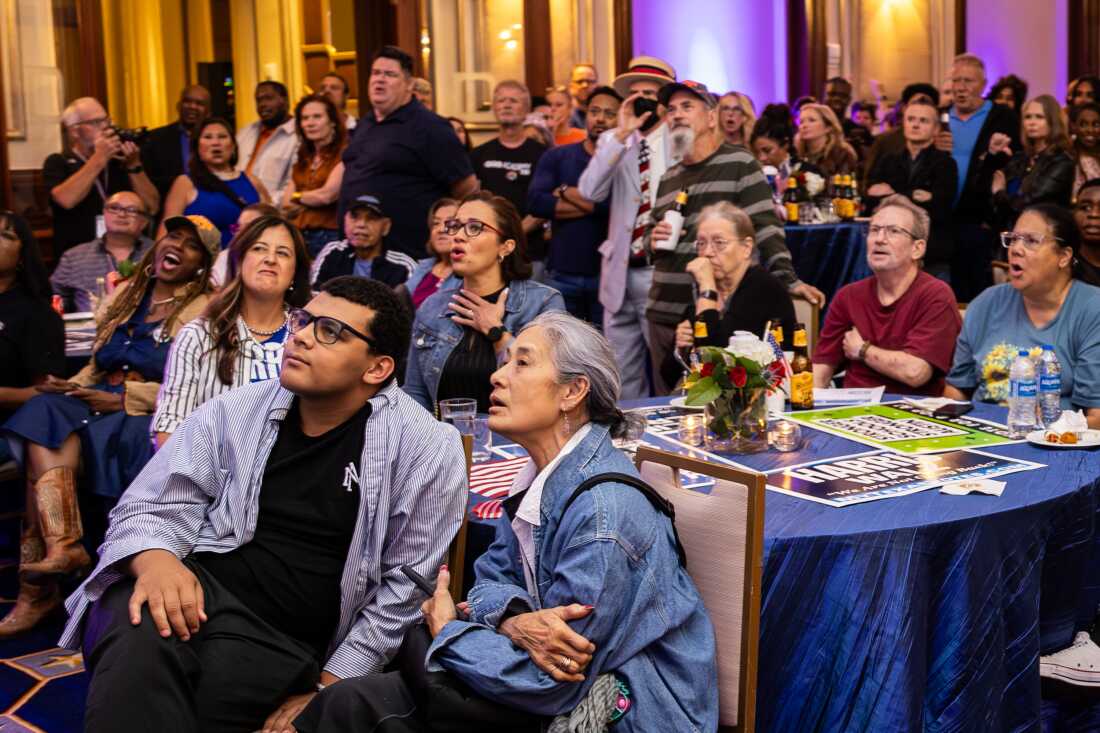
Attendees react as a race is predicted for Trump during the Travis County Democratic Party’s Election Night watch party in Austin, Texas.

Attendees react as a race is predicted for Trump during the Travis County Democratic Party’s Election Night watch party in Austin, Texas.

Michael Minasi/KUT News


hide caption

Advertisement

toggle caption

Michael Minasi/KUT News

Ballots move through a signature verification system at the Multnomah County Elections Division office in Portland, Ore.

Ballots move through a signature verification system at the Multnomah County Elections Division office in Portland, Ore.

Kristyna Wentz-Graff/OPB

Advertisement


hide caption

toggle caption

Kristyna Wentz-Graff/OPB

Advertisement
Scanner printouts from every ballot scanner in every precinct in Fulton County are displayed at the election hub in Atlanta, Ga.

Scanner printouts from every ballot scanner in every precinct in Fulton County are displayed at the election hub in Atlanta, Ga.

Matthew Pearson/WABE


hide caption

toggle caption

Matthew Pearson/WABE

Advertisement

Voters cast their ballots at Robious Elementary School in Chesterfield County, Va.

Voters cast their ballots at Robious Elementary School in Chesterfield County, Va.

Ryan M. Kelly/VPM News


hide caption

toggle caption

Advertisement

Ryan M. Kelly/VPM News

Richmond residents cast their votes at Fire Station #15 during the morning hours on Tuesday in Richmond, Va.

Richmond residents cast their votes at Fire Station #15 during the morning hours on Tuesday in Richmond, Va.

Carlos Bernate for VPM News/For VPM News


hide caption

Advertisement

toggle caption

Carlos Bernate for VPM News/For VPM News

Residents of the Jackson Heights neighborhood anxiously look on for the evening’s election results during an election night watch party in Terraza 7 in Queens in New York City.

Residents of the Jackson Heights neighborhood anxiously look on for the evening’s election results during an election night watch party in Terraza 7 in Queens in New York City.

José A. Alvarado Jr. for NPR


hide caption

Advertisement

toggle caption

José A. Alvarado Jr. for NPR

Advertisement

Lifestyle

‘How to Rule the World’ explores education and power at Stanford University

Published

on

‘How to Rule the World’ explores education and power at Stanford University

Students walk on the Stanford University campus on March 14, 2019, in Stanford, Calif.

Ben Margot/AP


hide caption

toggle caption

Advertisement

Ben Margot/AP

When Theo Baker arrived at Stanford University a few years ago, he joined the student newspaper, following the path of his journalist parents, Peter Baker, a White House correspondent for The New York Times, and Susan Glasser, a writer for The New Yorker.

Through his reporting as a student journalist, he eventually broke a story about manipulated data in Stanford President Marc Tessier-Lavigne’s neuroscience research that helped lead to the university president’s resignation.

Theo Baker’s book, How to Rule the World: An Education in Power at Stanford University was released May 19. In it, Baker describes Stanford as a place where proximity to Silicon Valley gives rise to a parallel system of influence, recruitment and money, with investors looking to identify promising students almost as soon as they arrive on campus.

Advertisement

He told Morning Edition host Steve Inskeep there was “a sort of Stanford inside Stanford,” where elite students are drawn into an “alternate reality” of excess and access to cut corners.

In the interview, he discusses how Stanford is not just a university but also a pipeline where status and power can matter as much as ideas.

We reached out to Stanford University for comment and have not heard back.

Listen to the interview by clicking play on the blue box above.

Advertisement
Continue Reading

Lifestyle

OTB Takes Full Control of Viktor & Rolf

Published

on

OTB Takes Full Control of Viktor & Rolf
The Italian fashion group behind Diesel and Maison Margiela is taking full ownership of the avant-garde haute couture house, acquiring the remaining 30 percent it didn’t already own. Founders Viktor Horsting and Rolf Snoeren remain creative directors.
Continue Reading

Lifestyle

How having zero points in tennis — or ‘love’ — came to sound so sweet

Published

on

How having zero points in tennis — or ‘love’ — came to sound so sweet

The scoreboard shows the results of the women’s singles final match between Iga Swiatek of Poland and Amanda Anisimova of the U.S. at the Wimbledon Tennis Championships in London, Saturday, July 12, 2025.

Kirsty Wigglesworth/AP


hide caption

toggle caption

Advertisement

Kirsty Wigglesworth/AP

Fifteen points in tennis? Nice. Thirty, 40 — even better. Advantage — that sounds good. “Love” — that also must be great, right? Well, not quite.

As the French Open rolls on and Serena Williams has announced her return to the sport, maybe you’ve been paying a little more attention to tennis. The sport’s scoring system is notably distinct, and can sometimes be hard to grasp for newcomers. But even tennis aficionados might not know why, or how, “love” became the unmistakable callout for zero points. For this installment of NPR’s Word of the Week, we’re exploring how a word that signifies trailing behind got such a sweet name.

“Love” comes from the heart — or an egg?

It’s hard to pinpoint when the first tennis ball went over the net. Tennis is a derivative of lots of other sports, such as “jeu de paume,” a handball game played in France, said JT Buzanga, the collections manager at the International Tennis Hall of Fame museum.

Advertisement

But tennis became a patented, official sport in 1874, said Steve Flink, a journalist whose tennis coverage got him inducted into the International Tennis Hall of Fame. It has retained its unique, mysterious scoring system ever since.

“By and large, the original system has held up almost entirely,” Flink said.

The use of “love” goes back to the late 18th century, said Jesse Sheidlower, a lexicographer. But it was used earlier than that in card games such as whist and bridge. Before the term made its way to tennis, the sport favored plain old “nothing,” or “nil,” he said.

Why love in the first place, though? Historians don’t really know for sure, but there are a few theories.

The French could have something to do with it. Some historians believe “love” derives from “l’oeuf,” which means “the egg” in French. Because eggs are shaped like zeros, terms such as “goose egg” and “duck’s egg” have been used in other contexts to mean zero, Sheidlower said.

Advertisement

It’s also possible English speakers mispronounced l’oeuf as “love.” But Sheidlower isn’t convinced that’s the answer.

“It’s the French equivalent of an English expression. But since that expression doesn’t appear in French, the French word wouldn’t have been used,” he said.

To be sure, France has had a lot of influence on tennis culture, Buzanga said. For example, “deuce” or a game tied at 40 points, comes from the French word for “two”: “deux.” But he prefers another prominent theory: that “love” comes from the idiom “for the love of the game.” Even if a player hasn’t scored, it doesn’t matter, because their heart is in it. It’s the theory Sheidlower said is the most plausible, because the idiom was used by the English before tennis was popularized.

Another variation of the “love of the game” theory is that the word could have come from the Dutch “lof,” or “honor” — or the Latin “amare,” meaning “to love,” Flink said.

But if tennis’ “love” doesn’t come from a French word, the theory at least has a French sensibility.

Advertisement

“I think the ‘for the love of the game’ is kind of romantic,” Buzanga said.

“Love” probably isn’t going anywhere

Tennis used to be a sport of leisure. The style of play has changed a lot over the years; players are more athletic and competitive, for instance, Flink said. But the rules of the sport are more steadfast, he said.

“There’s this incredible, enduring respect for tradition in tennis,” he said. “Changes are not made easily.”

There has been one major change in modern history: the tie-break. Matches can go on and on because players have to score two consecutive points to break a deuce, or by two games to break a tied set. But the onset of television meant matches would have to get shorter if the sport wanted to capture a larger audience, Flink said.

Change even came for “love.” An alternative sprouted up in the 1970s, and is still used today: “bagel,” named for its zero shape, Sheidlower said. Novices may say “zero,” and insiders will understand what they mean, but they “will needle them about it,” Flink said.

Advertisement

But “love” still prevails.

“People kind of like it,” Flink said. “It’s different. Why say zero when you can say love?”

Continue Reading
Advertisement

Trending