Lifestyle
One restaurant has a way to fight food waste: Making food out of 'trash'


Kayla Abe (pictured here) and her partner, chef David Murphy, co-founded Shuggie’s Trash Pie in 2022, in part to address the global problem of food waste. According to the food waste reduction nonprofit ReFED, 38% of the U.S. food supply goes uneaten.
Ryan Kellman/NPR
hide caption
toggle caption
Ryan Kellman/NPR
Climate change is affecting our food, and our food is affecting the climate. NPR is dedicating a week to stories and conversations about the search for solutions.
No one, except maybe Sesame Street’s Oscar the Grouch, wants to consume food that most people think of as garbage.
But if everyone ate fare that might otherwise be thrown out — say, weird animal parts or milk that’s close to its sell-by date — we’d significantly reduce the impacts of human-caused climate change.
“Addressing food waste turns out to be one of the biggest climate solutions of them all,” said climate scientist Jonathan Foley, who serves as executive director of the climate solutions think tank Project Drawdown.
According to the food waste reduction nonprofit ReFED, 38% of the U.S. food supply goes uneaten.
All of the processes involved in making food, from clearing land and raising cattle to packaging and cooking ingredients, contribute to one-third of the world’s planet-warming pollution. The food waste that ends up rotting in landfills is particularly problematic.
“It causes methane to go into the atmosphere as well, and that’s a really potent greenhouse gas,” Foley said.
Methane traps more heat than carbon dioxide, which causes global warming. An estimated 60% of methane emissions are human-caused and come largely from agriculture, fossil fuels and food waste decomposing in landfills.
Restaurants are in an optimal position to help solve this problem.
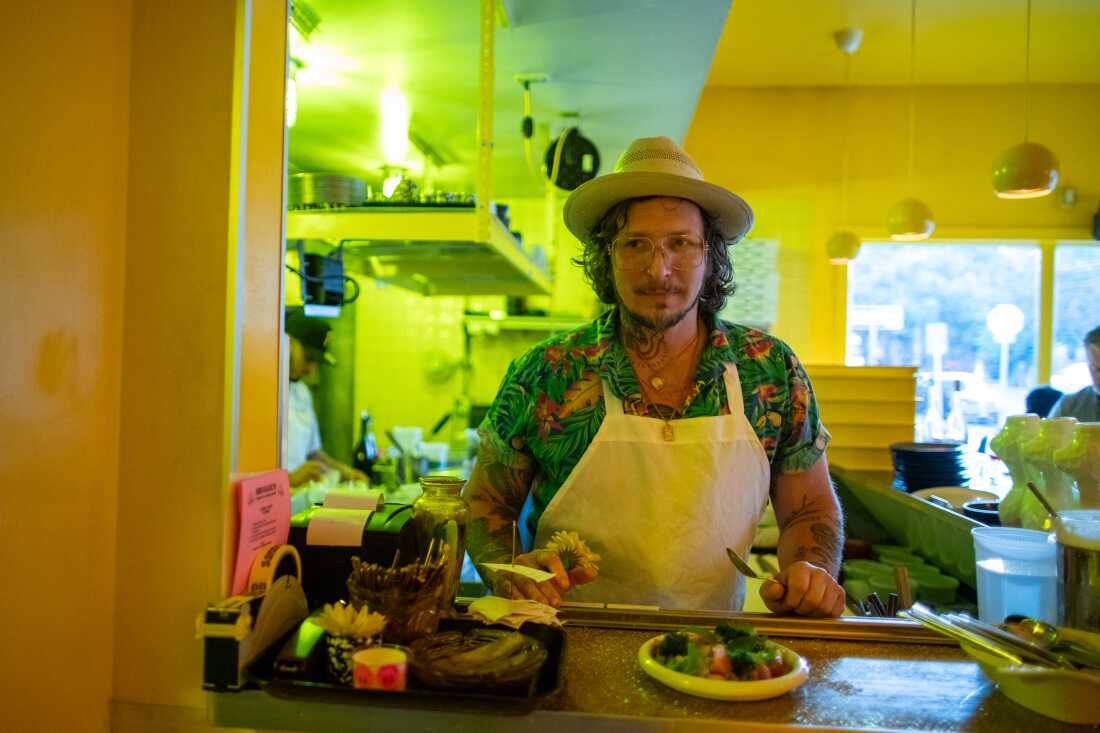
David Murphy, chef and co-owner of Shuggie’s Trash Pie in San Francisco, a restaurant that focuses on imperfect and up-cycled ingredients, previously worked in high-end restaurants. “We always demanded the best. The most perfect little Brussels sprout,” he says.
Ryan Kellman/NPR
hide caption
toggle caption
Ryan Kellman/NPR
According to research from the U.S. Department of Agriculture, people are spending more on eating out in this country than they are at home, and the restaurant industry was responsible for almost 10 million tons of leftover food in 2022, according to 2022 data from ReFED.
Restaurants can make practical tweaks, like reducing or customizing portion sizes. “That’s a big one,” said Roni Neff, an associate professor at the Johns Hopkins Bloomberg School of Public Health who studies food systems and waste. “Seventy percent of the food that’s wasted in restaurants is happening after it’s served to people — on their plates.”
Neff said restaurants can also streamline their ordering processes so surplus food isn’t sitting around. And then there are the chefs.
“They can help to shape people’s views, expand our ideas of what’s good food. And they can also shift behaviors in more subtle ways,” he said.

Shuggie’s co-owners David Murphy and Kayla Abe met at a farmers market in downtown San Francisco. They were united in their desire to help local farmers who were having trouble selling their extra produce. Pictured at right, Abe and Murphy’s dog, Beef.
Ryan Kellman/NPR
hide caption
toggle caption
Ryan Kellman/NPR
That’s where restaurants like Shuggie’s Trash Pie come in.
Founded by chef David Murphy and his partner, Kayla Abe, in 2022, the San Francisco “climate solutions restaurant” works to get diners comfortable with imperfect ingredients usually discarded by the food system. According to Abe, Shuggie’s has saved 41,000 pounds of food waste from the trash can in the roughly 2 1/2 years since it opened.
“Our big goal is to change the way America’s eating,” said Abe. “And bring the idea to the mainstream that eating trash is cool.”

Shuggie’s menu features dishes made from imperfect and surplus ingredients — often sourced from local farmers who have too much of a particular produce to sell, or a produce that is past its prime. “I was constantly talking to them about their issues,” says Abe of her conversations with farmers. “And food waste was a recurring one.”
Ryan Kellman/NPR
hide caption
toggle caption
Ryan Kellman/NPR
Like a few other sustainability-focused restaurants and chains in the U.S. (e.g. Emmer & Rye Hospitality Group in Austin and San Antonio, Texas, and Lighthouse in Brooklyn, New York) Shuggie’s sources food that local producers cannot sell because there’s a surplus, it looks irregular, or it’s past its prime.
“We do not dumpster dive,” said Murphy. “That is not something that we do.”
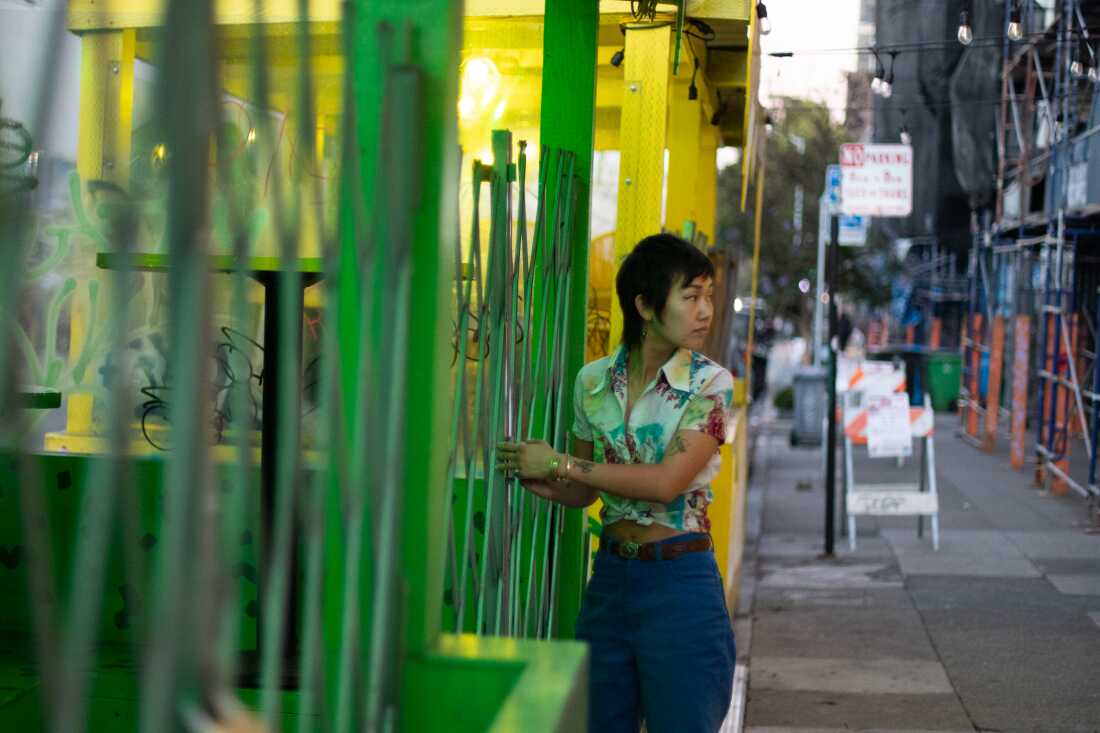
Shuggie’s co-owner Kayla Abe gets ready for closing time. Before co-founding Shuggie’s with partner David Murphy in 2022, Kayla Abe worked for the organization that runs the farmers market at San Francisco’s Ferry Building. “The more we can grow this movement, we can actually start to make bigger change,” she says of advocating for food waste reduction as a restaurateur.
Ryan Kellman/NPR
hide caption
toggle caption
Ryan Kellman/NPR
Instead, Murphy and Abe have built strong relationships with local produce farmers, as well as fish and meat distributors.
“To look at the ugly food or the imperfect food, that it doesn’t have to be the best of everything, is a relatively new way for people to look at their food,” said Jordan Bow, the founder of the distributor Royal Hawaiian Seafood, and Shuggie’s main seafood source for oft-discarded fish parts like halibut cheeks and various types of bycatch. “I’m counting on the chefs to be creative and not just do what everybody else does.”
It’s going to take many more restaurants doing this work, as well as a broader cultural change among customers, to really make a dent in the massive food waste problem. That’s true both for eating out and eating at home. And if that shift happens, it could mean less food waste in landfills and less planet-warming pollution, which makes reducing food waste a huge climate solution.
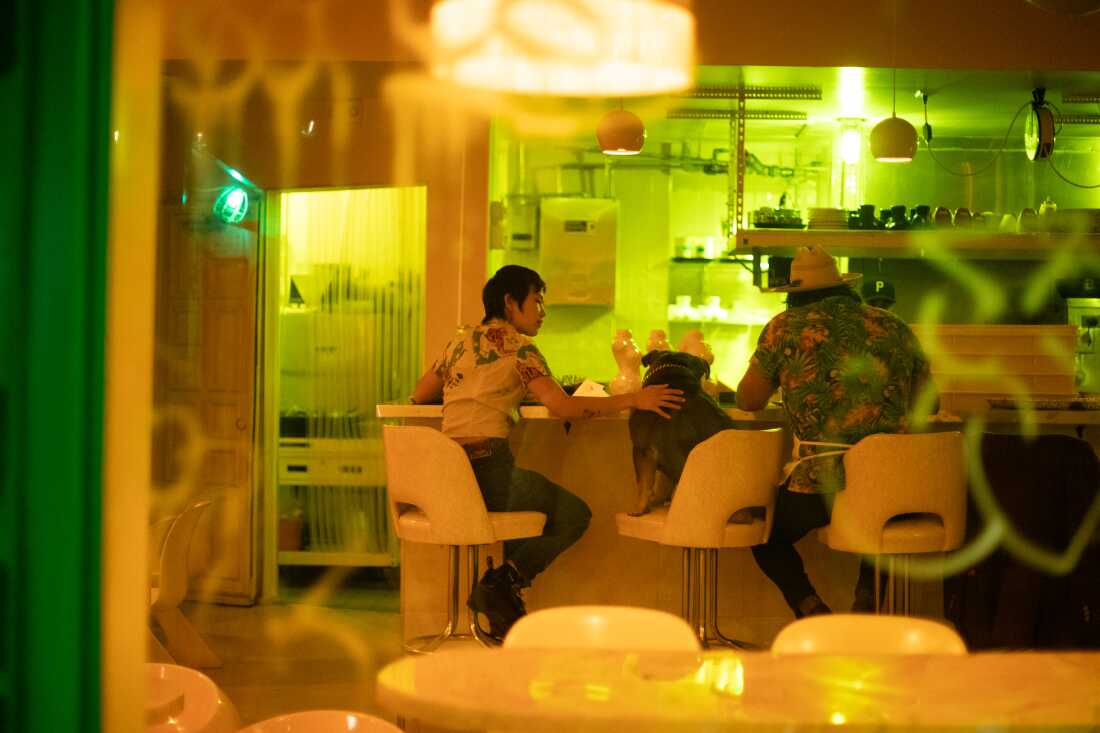
Abe and Murphy work long hours at Shuggie’s. Prepping imperfect ingredients to restaurant standards creates additional work, and margins are tight. It can be challenging to persuade consumers to pay restaurant prices for what they perceive as waste. After closing for the night, Abe and Murphy, along with their dog Beef, sit down for a meal.
Ryan Kellman/NPR
hide caption
toggle caption
Ryan Kellman/NPR
There are simple ways to use leftover food in your refrigerator. To help you get started, NPR asked Shuggie’s chef Murphy to share some ideas. Below you’ll find three of his creative yet simple recipes that make use of commonly leftover items.
Carrot Top Chimichurri
Chef’s note: “This sauce is the base for so many of our dishes. For example, it gets incorporated into a pesto after we add cheese and nuts to it.”
Ingredients
2 cups carrot tops or beet tops, or wilting fridge greens
3 cloves garlic, minced
2 tablespoons vinegar (apple cider preferably)
1 cup extra virgin olive oil or grapeseed oil
1½ tablespoons chili flakes
salt, to taste
Method
In a blender, mix all the ingredients together on high for 30 seconds or until all the leaves have been incorporated well.
Season with salt.
So good you’ll want to use this chimi on everything!

Chef David Murphy’s Carrot Top Chimichurri sauce, showcased here on Shuggie’s Pizza Puffs.
Kayla Abe
hide caption
toggle caption
Kayla Abe
Shuggie’s Dream Beans
Chef’s note: “Use this wholesome bean dish as a dumpster for all sorts of leftovers sitting in the fridge. I’ve added squid, octopus, numerous different veggies, tired greens, fennel … anything!”
Ingredients
3 cups great northern beans, soaked, cooked in a flavorful vegetable stock. (You can sub with cannellini, gigante, or your favorite soup bean.)
½ cup chopped garlic
½ cup sundried tomatoes in oil, chopped
1 tin Spanish anchovies in oil
1 cup herb stems, chopped
4 cups tired greens (kale, collards, arugula, or any other thing left in the crisper), chopped into 1-inch pieces
1 stick dry cured Spanish chorizo, chopped into ⅛-inch cubes
4 quarts flavorful vegetable or chicken stock
3 tablespoons smoked paprika
1 teaspoon cayenne pepper
2 tablespoons black pepper
1 large yellow onion, medium dice
Method
Cook beans until tender, strain.
In another pot with a bit of grapeseed oil in the pan, cook all veggies and chorizo, deglaze with stock, add dry spices, anchovy and sundried tomato.
Add salt to taste.
Ladle into bowls, top with croutons made from day old bread, and add carrot top chimi!

Shuggie’s Dream Beans
Kayla Abe
hide caption
toggle caption
Kayla Abe
Ricotta Fluff
Chef’s note: “Throw this creamy topping on waffles, or insert it in place of mozzarella on your favorite pizza … super sexy!”
Ingredients
1 gallon milk (close to or even past its expiration date!)
¼ cup white vinegar
2 cups heavy cream
Salt to taste
Honey or other sweetener of your choice
Method
Whip heavy cream to soft peaks.
Heat milk to a simmer over low heat.
Pour in vinegar, stir gently, then strain.
Let curds cool.
Fold in heavy cream and season with salt.
Slather the mixture on toasted bread with olive oil.
Sweeten to taste.
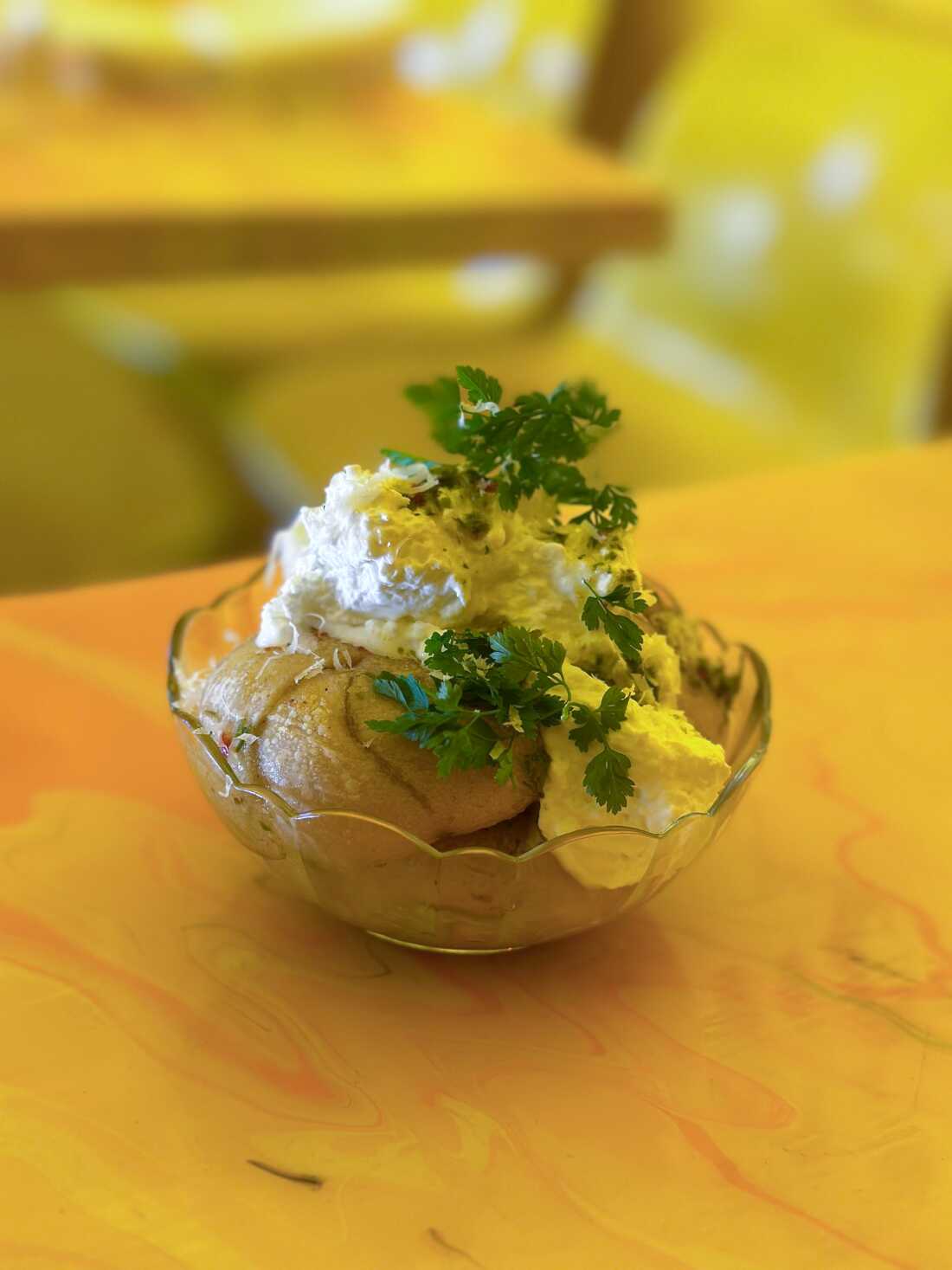
Ricotta Fluff sits atop Shuggie’s Garlic Knots, with a dash of Carrot Top Chimi. The fluff can also be used in desserts.
Kayla Abe
hide caption
toggle caption
Kayla Abe
Audio and digital stories edited by Jennifer Vanasco and Sadie Babits. Audio story mixed by Isabella Gomez-Sarmiento.


In Alice and Steve, Jemaine Clement and Nicola Walker play long-time friends who turn on each other after he gets involved with her 26-year-old daughter.
Lara Cornell/Disney+
hide caption
toggle caption
Lara Cornell/Disney+
I grew up watching episodic shows on network TV, nearly all of them formulaic but some indelibly great. Then, like everyone else, I moved into the days of what my colleague David Bianculli dubbed Platinum TV, where series like The Sopranos and The Wire and Fleabag aspired to something higher. What both these eras had in common was that their shows were carefully crafted — they had an internal logic, and a tone, that held them together.
In recent years, though, there’s been a proliferation of shows that, possibly obeying some algorithm, care less for coherence than sensation. They lurch among tones, from cuteness to sentimentality to meanness, stirring in random plot twists along the way. Bouncing all over the emotional map, these shows depend on compelling actors and a few memorable scenes to make us overlook their loose construction.
A great example is Alice and Steve, an entertaining but sometimes exasperating six-part British comedy on Hulu about two 50-something best friends who turn on each other after he gets involved with her 26-year-old daughter.


While the premise is juicy, it’s also a tad yucky, and I mainly tuned in because its title characters are played by performers Jemaine Clement from Flight of the Conchords and Nicola Walker, whom I’ve raved up on this show more than once.
The series starts poorly with Steve and Alice going on a cutesy bender after a friend’s funeral. Now, I always hate drunk scenes, which are an invitation to overact. As Clement and Walker bray their lines, we learn that Steve’s a divorced celebrity hair stylist who can’t find a girlfriend while Alice is a clothes designer with a doting younger husband, nicely played by Joel Fry, a sweetie-pie of a teenage son — that’s Tyrese Eaton-Dyce — and, of course, that 26-year-old daughter, Izzy, who has inherited her mother’s willfulness. Played by Yali Topol Margalith, Izzy kickstarts the plot by flirting with Steve. Predictably, he succumbs.

Almost immediately, they think they’re in love. While the weak-willed Steve wants to hide their romance — he knows it’s inappropriate — Izzy just blurts out the facts to her mom. Alice flips. And from hereon out in this series where the women are as alpha as the men are hangdog, Alice drives the action. Betrayed and violently angry, she’ll do whatever it takes to break them up — no matter who gets hurt. Her antics unleash Steve’s own malice. We’re in Beef territory.
At its core, Alice and Steve hinges on the way that platonic friendships are often richer and more powerful than romantic ones. It’s a fascinating subject, which may be why I found the script by Sophie Goodhart so frustrating. I wanted her to dig deeper. While the show’s got some very funny bits — Alice’s sharp-tongued mother is a blast — it’s often annoyingly lax.

If Steve really does the hair of Charli XCX, how come he’s a clueless older guy whose pop culture references are Willie Nelson and Woody Allen? If Izzy truly adores her mother as she claims, why does she keep rubbing her relationship with Steve in her mom’s face? Halfway through, one character nukes the other’s career, but this life-shattering event has no real weight: It’s barely even mentioned for the rest of the series.
That said, Alice and Steve is worth seeing for scenes like the one in which Steve spinelessly sells Izzy out or the lacerating discussion between Alice and her husband when he fully grasps that he adores a woman who views him as a reliable but dull concierge, not a man she likes hanging with. Most touching of all may be the lovely sequence when Alice, wise for once, smooths a romantic crisis between her son and his would-be girlfriend, a pair who are the show’s emblem of hope. For once, we understand why people love her.

While most viewers will find Steve more likable than Alice — the show takes pains not to make him appear predatory or creepy — the role doesn’t give Clement a whole lot to do except play variations on shambolic dread and discomfort. The show gets its galvanizing zing from Walker, a beloved star in England with amazing, luminous eyes. Her Alice is the kind of complicated, volcanic heroine that you don’t see in movies and rarely see on TV, one who shows her apocalyptic rage freely and in many different forms.
At least once in every episode, something would lead me to say, “Man, is this show a mess.” But that wasn’t a deal breaker. I kept watching. After all, life is messy, too.


How to enter your Sporty Spice era.
Getty Images/quantic69/Olga Kurbatova/Anastasiia Zvonary/Photo Illustration by NPR
hide caption
toggle caption
Getty Images/quantic69/Olga Kurbatova/Anastasiia Zvonary/Photo Illustration by NPR
Reality dating and professional sports are not as different as you’d think.
Brittany is in her Sporty Spice era – she watched the NBA playoffs, she’s following World Cup games, and she’s watching the New York Liberty play their WNBA season. These games are daily – and so is the reality dating show Love Island. And she noticed that the two formats are not very different at all. Defector.com staff writer and co-owner Kelsey McKinney came to the same conclusion – so the two of them discuss why these games of athleticism and love can bring us together… and why they get valued differently in our culture.
For more episodes on sports and reality TV, check out:
Get rich or die trying: how sports betting is changing our love of the game
Is this the end of reality TV?
The ugly truth of America’s expensive homes
Support Public Media. Join NPR Plus.
Follow Brittany on Instagram: @bmluse
This episode was produced by Liam McBain. It was edited by Neena Pathak. Our Supervising Producer is Cher Vincent. Our Executive Producer is Barton Girdwood. Our VP of Programming is Yolanda Sangweni.

-

 Pennsylvania22 seconds ago
Pennsylvania State Police on scene of ‘active incident’ in Marysville
-

 Rhode Island5 minutes ago
Rhode Island participates in ‘New England Drive to Save Lives’ campaign
-

 South-Carolina12 minutes ago
Georgetown County Sheriff Carter Weaver named South Carolina Sheriff of the Year: SCSA
-

 South Dakota15 minutes ago
South Dakota native lived near Iranian missile & drone attacks
-

 Tennessee20 minutes ago
The Recipient of Taylor Swift’s Bouquet Toss Has Strong Tennessee Football, Lady Vols Basketball Ties | Rocky Top Insider
-

 Texas27 minutes ago
Texas Rescuers Save Woman From Sewage-Filled Ravine
-

 Utah30 minutes ago
Fireworks ban expires as Utah weighs Pioneer Day restrictions
-

 Vermont35 minutes ago
Authorities ID girl who died in Vt. river, older brother who died trying to save her

