Lifestyle
Leigh Bowery Arrives at Tate Modern, Without Labels


“If you label me, you negate me,” the performance artist and fashion designer Leigh Bowery said in 1993, one year before his death at age 33.
Maybe it is this resistance to easy categorization that has meant Bowery never quite became a household name. His cultural influence, though, is beyond question: His provocative performances led him to work with artists including Lucian Freud and Marina Abramovic. His extreme fashions are still referenced on runways, by designers including Rick Owens and John Galliano. And his status as a queer culture icon is cemented by regular invocations at L.G.B.T.Q. club nights and on “RuPaul’s Drag Race.”
But during his short, colorful and often shocking life, nobody knew what box to put Bowery in. Three decades after his death, they still don’t.
A new exhibition called “Leigh Bowery!” at Tate Modern in London will bring his work to a much broader audience. The show, which opens Feb. 27 and runs through Aug. 31, charts Bowery’s journey from suburban Australia to the heart of London’s alternative gay club scene in the ’80s, and his transformation into a figure that Boy George once described as “modern art on legs.”
George later went on to play Bowery in the 2003 Broadway run of the biographical musical “Taboo,” for which George also wrote the lyrics. The musical is named after an infamous club night that Bowery hosted, which opened in 1985 on a dingy corner of London’s Leicester Square.
Every Thursday, the party attracted artists, models, designers and celebrities including George Michael, Sade and Bryan Ferry — but also drag queens and heroin users. Each week, Bowery arrived with a wild new outfit that challenged conventional notions of taste, gender and decorum. He described his role at the club as “a local cabaret act,” explaining: “If people see me behaving in such an outrageous manner, they won’t feel inhibited themselves.”
Fashion was the chief concern at Taboo, which operated by the mantra: “Dress as if your life depends on it, or don’t bother.” The doorman would flash a mirror in the face of aspiring entrants and ask, “Would you let yourself in?” The exclusivity was not just to generate mystique: It also created a space where people on society’s margins felt like they belonged.
“I remember Leigh in this insane Bart Simpson mask on roller skates, just bumping into everyone and screaming,” Boy George said in an email. “He brought such anarchy and energy to every club or party.”
Taboo closed after just one year when a tabloid newspaper ran an article about drug use in the club — but just like Bowery himself, the short run only served to cement the legend.
Epic Looks
Bowery grew up in Sunshine, a suburb of Melbourne, Australia, where he felt stifled by the conventions of his surroundings and would gaze longingly at magazine photos of Britain’s New Wave and punk scenes. When he turned 18, he moved to London, adopted a British accent and set about infiltrating the city’s gay party circuit.
Though he started out making clothes for others, Bowery soon realized that he preferred to design for himself alone.
“Directing his own performance and being the star was a better fit for what he wanted to do,” his sister, Bronwyn Bowery, said recently by phone. While he didn’t consider himself a drag queen, he was inspired by drag, combining high camp with high fashion. His huge figure — heavy set and a towering 6-foot-3 — only accentuated the impact of his outlandish looks.
One of his design collaborators was the sequin expert Nicola Rainbird, who was Bowery’s close friend and eventual wife. Though he was gay and, according to one biography, a lifelong devotee of anonymous public sex, Bowery married Rainbird a year before his death, in a ceremony he called “a little private art performance.”
For Bowery, makeup and clothing were not just cosmetic decoration, but tools for reinvention — and he reinvented himself often.
He made outfits from whatever he could lay his hands on, including bobby pins, tennis balls, tuna tins and even meringues. Some of his best-remembered looks include colored glue dribbled down his bald head like a splattered egg, and giant polka dots covering not only his clothes, but also his face.
Others on display in the Tate Modern show include a pink leather harness that secures flashing lightbulbs over the ears, and a sculptural white jacket that also obscures the wearer’s face with a puffball of orange tulle.
Fashion designers continue to reference Bowery today. In a 2015 show, Rick Owens sent models down the runway carrying other models in harnesses, which Owens admitted was “totally ripped off” from a Bowery concept. A 2009 Alexander McQueen show painted models with Bowery’s signature oversized lips. Gareth Pugh, Charles Jeffrey and Maison Margiela have all nodded to him in collections.
Bowery’s outré style has also influenced the high-concept looks of pop stars like Lady Gaga and a vast swath of contemporary drag queens — though George said something had been lost in the transition to the mainstream. “When you see drag queens referencing Leigh on ‘Drag Race,’ it’s gorgeous, but too polished,” George said. “Leigh was very rough around the edges and he had the build of a rugby player — and was not dainty or fey.”
That legacy also still plays out in many L.G.B.T.Q. clubs, which present the dance floor as not just a space for hedonism, but also for presenting elaborate looks, experimenting with gender and blurring the lines between performance and partying.
It was nightlife impresario Susanne Bartsch who introduced Bowery to New York, inviting him to contribute clothes to a fashion show displaying the latest London fashions in 1983. (She also took him to Tokyo, where she said that he startled the prime minister of Japan by baring his bottom on the runway.)
“When he came in his look, everything stopped,” Bartsch said. “You just wanted to see it again and again. His charisma, even when you couldn’t see his face, oozed through all the pieces that he made.”
Bowery would later return to New York as a performer, hosting Bartsch’s 1991 Love Ball, which raised money for AIDS research, and influencing New York club kids like Michael Alig, Amanda Lepore and James St James.
“Leigh had a very special relationship with New York,” said the choreographer Michael Clark, “he was particularly celebrated there. There was a whole gang of people ready for him there and he was embraced with open arms.”
Clark first met Bowery in 1984, when he was bewitched by one of Bowery’s outfits and followed him into a club bathroom to invite him to collaborate. Before long, Bowery was making provocative costumes, playing piano and dancing for Clark’s contemporary dance company, until he and Clark fell out in 1992.
By this time, Bowery was increasingly turning toward performance. In 1988, he presented himself as a living art installation at Anthony d’Offay Gallery in London for five days, posing behind a two-way mirror on a chaise longue in a series of his best-known looks. He also worked with the performance artist Marina Abramovic on a piece using 400 live rats titled “Delusional,” which she has called “the most insane work I have made to this day.”
The Tate will show a video of Bowery’s notorious “Birthing” act, which he performed many times, including at the 1993 Wigstock drag festival in New York. There, he wore a bulging costume from which Rainbird, his wife, burst out like a newborn, covered in red gunk and with links of sausages as an umbilical cord.
Bowery loved to provoke outrage, commenting after one particularly extreme show involving an onstage enema: “If I have to ask, ‘Is this idea too sick?’ I know I am on the right track.”
Bowery’s sister said that his desire to shock was partly a response to his conservative upbringing in Australia. “My parents encouraged us immensely to conform,” she said, “but at the same time, we were told to stand out, so we were pretty confused. When someone wants you to conform because they don’t accept who you are, you have a choice: You conform and you lose yourself, or you react.”
‘Disco Monster Terrorist’
“Flesh is the most fabulous fabric,” Bowery once said, and the body’s expressive potential is a through line in his work. Even for an artist strongly associated with clothing, some of Bowery’s most enduring images show him completely nude.
He began sitting for a series of portraits with the painter Lucian Freud in 1990, often posing for seven hours a day. When a show of Freud’s work prominently featuring these paintings opened at New York’s Metropolitan Museum of Art in 1993, it represented the beginnings of a legitimacy in the fine art world that Bowery had long been seeking.
Though Bowery was diagnosed with H.I.V. in 1988, he only told Rainbird and his friend Sue Tilley, instructing them to explain his absence once he was gone with a characteristic quip: “Tell them I’ve gone to Papua New Guinea.” He died on Dec. 31, 1994, of AIDS-related meningitis and pneumonia.
In a biography of Bowery that Tilley published in 1998, she describes his final moments lying in hospital under an oxygen mask, hooked up to a tangle of tubes. “It really was a fantastic look,” she writes, “and if he had seen someone else with it, we were sure that he would have soon been wearing it to nightclubs.”
Freud paid for Bowery’s body to be sent back to Australia, where he was buried next to his mother. At the funeral, the grave had to be widened to fit his plus-size coffin. As in life, there was no conventional space big enough to accommodate Bowery.
In a song about Bowery released the year after his death, Boy George lauded him as a “disco monster terrorist, hanging in the Tate with Turner and van Gogh.” Three decades later, the Tate Modern show is placing Bowery in the artistic canon.
In an interview, Rainbird reflected on how Bowery would feel about this moment: “He’d be absolutely over the moon,” she said. “He wanted to be famous and he knew he was a genius. He’d be very pleased that people were finally taking note.”
Leigh Bowery!
Feb. 27 and through Aug. 31 at Tate Modern, in London; tate.org.uk.



Jay (not pictured) found himself alone and hopeless in a jail cell when a fellow inmate’s unexpected words of comfort changed his life.
Irkham Khalid/Getty Images
hide caption
toggle caption
Irkham Khalid/Getty Images
When Jay was 22 years old, he was a self-described loner. In this story, he is being identified by his nickname to allow himself to speak candidly about the following experience and his mental health. He says the few people he did hang out with at the time had questionable morals.
”I chose my friends poorly, and your friends have a tendency to rub off on you. And so I started making poor decisions,” Jay said.
One evening, when he and his friends were out drinking, someone suggested they should try to break into the chemistry building on his college campus. Most of the group shrugged the suggestion off, deeming it impossible, but Jay was convinced he could pull it off.
“The next night I made a plan of how to do it, and I did it,” Jay remembered. “And I didn’t get caught doing it, [but] I got caught afterwards.”
At around 1 that morning, Jay was placed in the county detention center. Sitting alone in his cell, reality began to sink in.

“I pretty much thought that my life as I knew it was going to be over, and I had decided that the world would be better off without me in it.”
Jay made a plan to end his life. As he prepared himself, he began to cry.
“But just in that moment when I was ready to do it, I heard a voice coming from the top left corner of my cell, from a little vent. And someone called out to me and said, ‘Hey, is this your first time?’”
The man who called out was an inmate in the cell next door.
“I collected myself a little bit, and I said, ‘Yeah.’ And he said, ‘Can I pray for you?’”
Jay had grown up religious, but had stopped going to church years before. In that moment, though, he knew he needed support. He said yes, and listened as the man began to pray.

“I wish I could tell you that I remember the [exact] words that he said to me, but what I remember is that his words landed with me, and instead of wanting my life to be over, suddenly I saw hope,” Jay said.
The interaction happened nearly ten years ago, but it was a pivotal moment in Jay’s life, and one he thinks about all the time.
“[Now], I have a good job. I have a girlfriend who loves me. I have a life. But I have a life because somebody who was in the same situation I was in had the courage to talk to a fellow inmate and be kind.”
Jay says that he wishes he could meet that man again and express his appreciation.
“[I would] shake that guy’s hand, give him a hug, and tell him what his small gesture meant for me, how he changed the course of my life.”
My Unsung Hero is also a podcast — new episodes are released every Tuesday. To share the story of your unsung hero with the Hidden Brain team, record a voice memo on your phone and send it to myunsunghero@hiddenbrain.org.
No one is forcing fire survivors in Altadena and Pacific Palisades to rebuild their new homes all-electric. But many of them want to, for health reasons, cost savings, or because they’re worried about climate change.
Burning gas and propane for cooking, water heating and space heating in California homes and businesses creates 10% of the state’s greenhouse gas emissions. It also releases pollutants indoors.
That’s why, in recent years, state policy has pushed toward electrification, and about 39% of new homes in California in 2024 went in without gas lines. Only 8% of all homes were all-electric in 2020.
Yet after last year’s fires, Gov. Gavin Newsom waived a 2025 building code that strongly encouraged electric heat pumps in new construction, allowing residents in the burn zones to build back to older, less efficient standards.
The city of L.A. also waived a requirement that new homes be all-electric.
Climate experts called these rollbacks a missed opportunity. Early figures show 1,300 residents have already have applied for reconnections through SoCalGas, which serves most of Los Angeles.
Yet some determined groups of neighbors are building all-electric anyway, even without the requirements. Here are some of their reasons:
Neighbors building passive homes in Altadena
Leo Cheng is part of a group of about 10 Eaton fire survivors working together to build passive homes in Altadena.

Felipe Jimenez, a construction foreman, reads plans for a new home on East Mariposa Street in Altadena on Friday.
(Gary Coronado / For The Times)
A passive house is airtight and highly insulated, designed to reduce the need for air conditioning and heating to the highest extent possible.
Cheng, who previously lived in a home with a gas stove, furnace and water heater, became interested in the concept when he learned that it could keep out more smoke and toxic ash during a fire.
He sees passive homes as going hand in hand with all-electric appliances, because “with airtight construction, having a gas stove in the house especially doesn’t make sense” for indoor air quality.
Cheng was one of the western Altadena residents who received evacuation orders late on Jan. 7, 2025. He remembers rushing out of his house in the middle of the night without time to turn off the gas, so he also likes the idea of reducing fire risk by eliminating it all together.
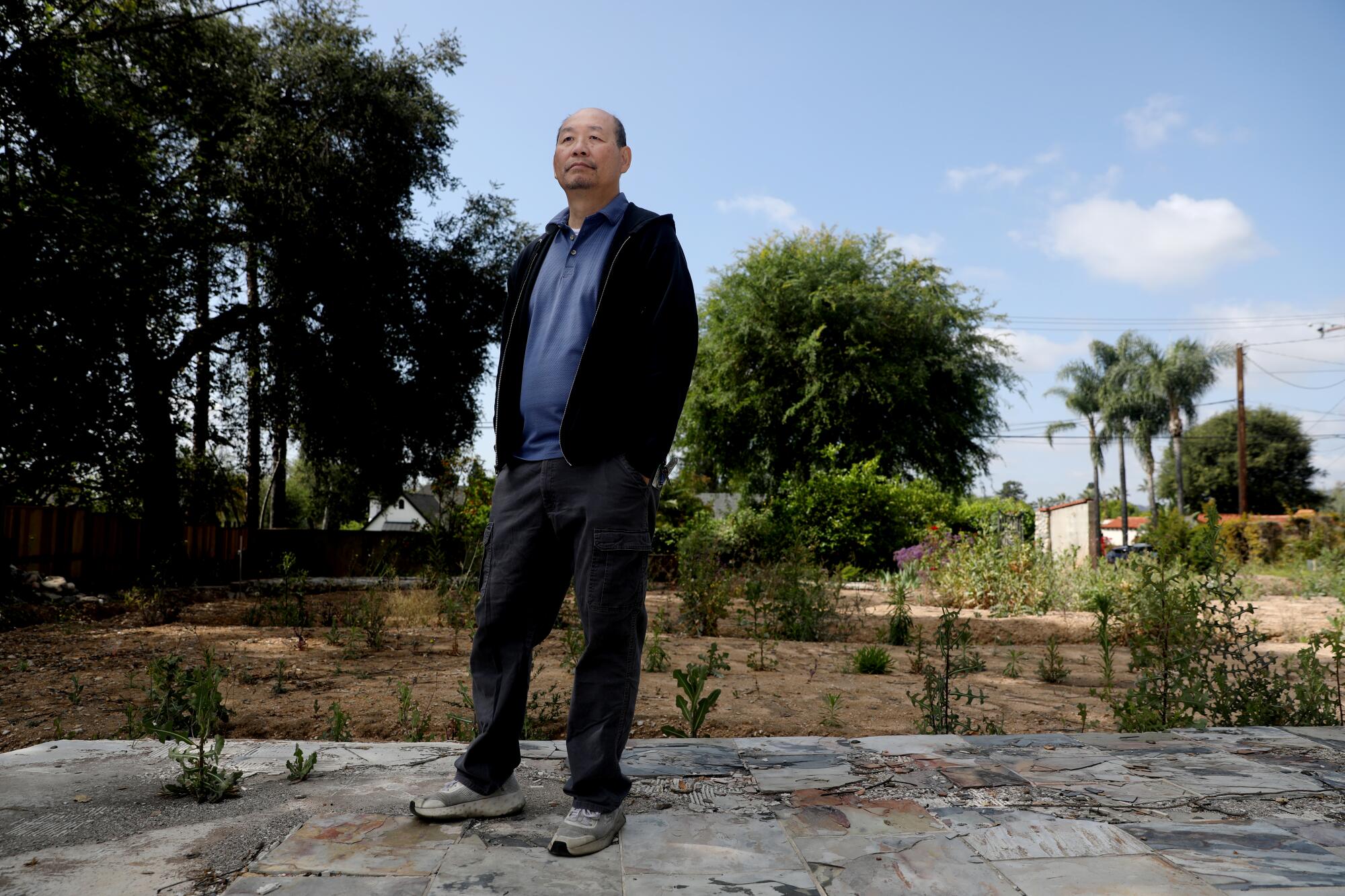
Leo Cheng, 60, on the site where he lived with his wife in a 1960s California ranch home on East Calaveras Street in Altadena.
(Gary Coronado / For The Times)
After going on a passive house tour led by his neighbor Jaime Rodriguez, whom he credits with sparking the passive house movement in Altadena, Cheng became part of a small but growing group that meets once a week to support one another with rebuilding energy-efficient, all-electric homes. A former NASA Jet Propulsion Laboratory engineer, he has decided to become a passive house consultant.
Besides indoor air quality, climate change is a big concern.
“I’m a firm believer that climate change played a big role in how intense and how widespread these fires were,” Cheng said. “Using fossil fuel in this day and age is not a good idea.”
Companies building all-electric catalog homes
Building a custom-designed home can bring an array of hurdles. For those looking for a simpler and more affordable approach, the Foothill Catalog Foundation offers pre-approved, all-electric home designs in styles that honor the architectural legacy of Altadena.
Local architects Cynthia Sigler and Alex Athenson took inspiration from early 20th century Sears catalogs that sold homes as kits when they founded the nonprofit last year.
They’re already working with 11 families with homes under construction, and have 50 more signed on to build their catalog homes.
Athenson said they didn’t set out to design their models all-electric but decided to go that route for health and safety reasons. Another factor was the money and time they could save clients by cutting out the need for two utility hookups.
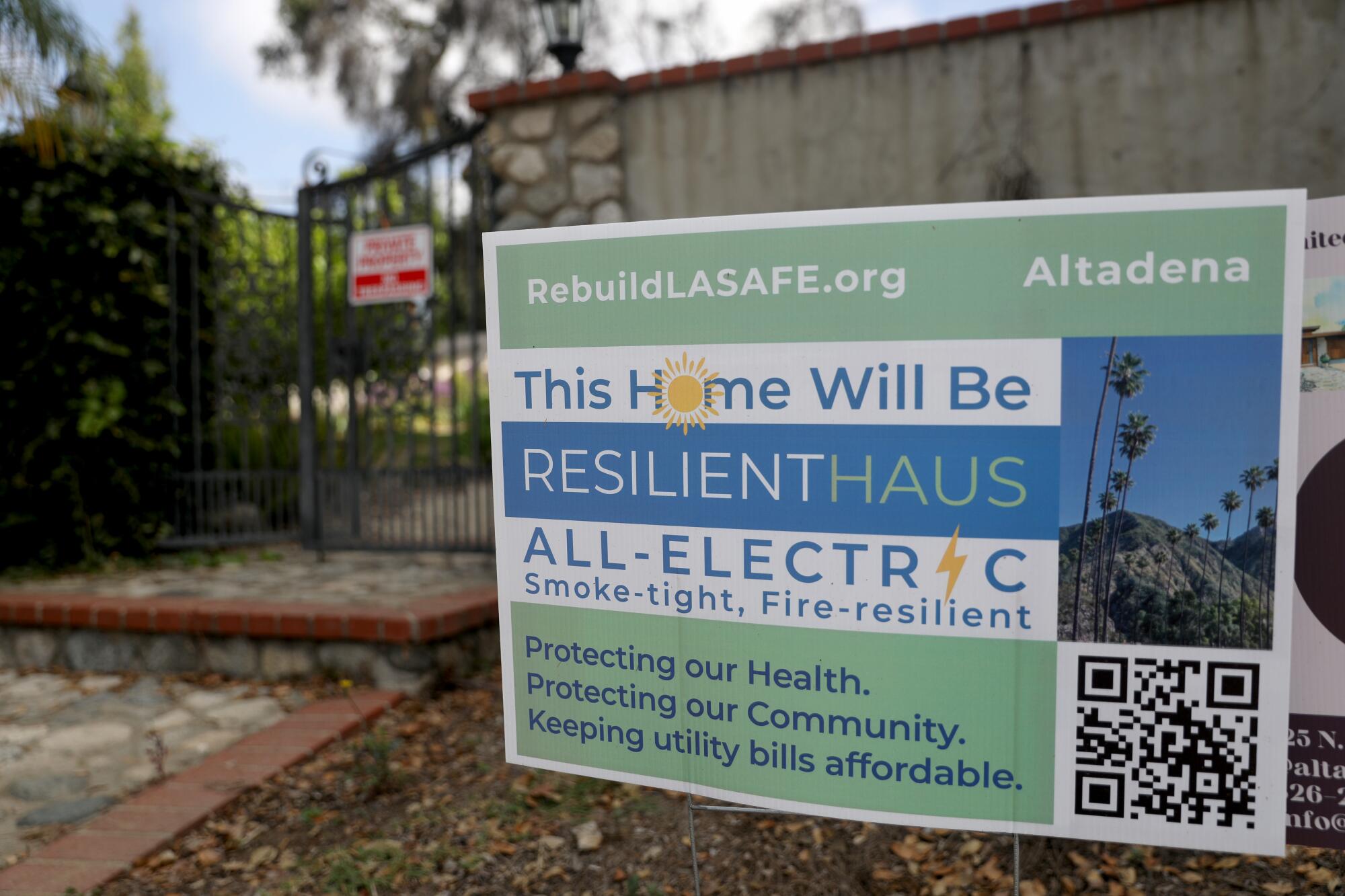
A sign in front of the home of Leo Cheng announcing that an all-electric home will be built where his home burned down during the Eaton fire.
(Gary Coronado / For The Times)
According to the Building Decarbonization Coalition, an electrification advocacy group, all-electric homes cost $3,000 to $10,000 less to build than mixed fuel homes in Los Angeles. That savings helps when it comes to buying appliances like heat pumps, which are the most efficient but tend to be more expensive up front.
The heat pump will yield lower utility bills for summer cooling because they use far less electricity than traditional air conditioners. They create winter heat bill savings in L.A. too.
The biggest question Athenson gets from clients is about electric cooking, especially when they’re used to cooking with gas. But he said concerns usually fall away when they learn more about induction stoves. “If you ask most chefs, that’s the most dialed-in, precise way to cook,” he said.
Genesis Builders LA is also offering fixed-price, pre-approved catalog homes in Altadena, with models that can be all-electric or use gas. Builder Devang Shah said he’s working with about 30 fire survivors, half of whom opted for all-electric.
“Some people have preferences for gas cooking and the look of a gas-lit fireplace,” said Shah. But all his clients will use electric heat pumps for space and water heating. Although the state waived a requirement that all new homes have solar for the burn areas, they still must be solar-ready. Shah’s models all come with solar and that, he said, helps heat pumps pencil out every time.
An incentive program for all-electric rebuilds
After a long delay, a $22-million incentive program launched on April 6 to support residents rebuilding all-electric in California disaster areas served by investor-owned utilities like Southern California Edison. Customers can qualify for $7,000 to $10,000 in subsidies, with more available for low-income fire survivors and bonuses for batteries and passive homes.
In just the first 10 days, 116 people from Altadena applied.

A plan for a new home along East Altadena Drive.
(Gary Coronado / For The Times)
Los Angeles Department of Water and Power, which serves most of the Palisades, also has a rebate program for electric wildfire rebuilds, with subsidies for all-electric homes or individual appliances.
Reza Akef, a builder in the Palisades and chair of the Pacific Palisades Community Council’s Infrastructure Committee, said people do consider these incentives in deciding what appliances to buy. On the other hand, SoCalGas offers wildfire rebates for more energy-efficient gas appliances. More than 1,100 households have enrolled.
About 90% of Akef’s 45 Palisades clients will keep gas. He said the fuel is faster for pool and spa heating, where electric heat pumps are more energy-efficient than gas but heat the water more slowly. Some of his clients feel a gas line will boost the resale value of their home, he said, and others have concerns about relying on one electric utility if the power goes out.
A spokesperson for Newsom said California is “aggressively pursuing widespread electrification” but would not burden survivors with “additional mandates and red tape.” Mayor Karen Bass’ office said she was giving Palisadians “options of how they want to rebuild,” with fire resiliency at the forefront.
Kari Weaver is an interior designer who lost her home in the Palisades fire and a member of Resilient Palisades, a group that’s advocating all-electric rebuilds. She plans to build an all-electric home with a solar and battery system in case of blackouts. But she’ll keep a gas line on the property and is still deciding if she’ll connect it to her pool. She’s looking into options like a cover that insulates the water, hybrid heaters and new electric heating models.
“These types of appliances are getting better all the time,” she said.

Michaela Coel and Ian McKellen star in The Christophers.
Claudette Barius/NEON
hide caption
toggle caption
Claudette Barius/NEON
After Steven Soderbergh’s terrific 2025 double bill of Presence and Black Bag, I almost wish that, purely for the sake of variety, I could say that his new movie, The Christophers, is a dud. But I can’t. It’s terrific, and it’s the latest confirmation that Soderbergh is working with a nimbleness that no other American director at the moment can match. You might have to go back to the workhorse days of the old Hollywood studio system for such a consistent abundance of quantity and quality.
The Christophers, which was written by Ed Solomon, is a spry and witty chamber comedy, most of it set in the ramshackle London townhouse of a famous painter, Julian Sklar, played by a superb Ian McKellen. Not long after the movie begins, Julian takes on a new assistant, Lori Butler, played by Michaela Coel. What he doesn’t know is that Lori is a skilled art restorer, and that she’s been hired to infiltrate his home by his two greedy grown-up children, played by James Corden and Jessica Gunning.

Lori’s mission is to find several of Julian’s unfinished paintings — all portraits of his former lover Christopher — and finish them in Julian’s style. The plan is that when Julian dies, perhaps someday soon, the forged Christophers will be discovered and sold for millions. Lori will get a third of the proceeds.
Soderbergh has a deft way with heist and home-invasion movies, and The Christophers is, as you’d expect, full of twists and reversals. Lori has some moral qualms about taking on a forgery job, but she also has a personal gripe to settle with Julian that leads her to say yes. Also, she needs the money; as ever, Soderbergh is keenly attuned to his characters’ economic straits.
When she starts working at Julian’s townhouse, Lori mostly keeps her head down and pretends to know nothing about her boss or about art. But Julian can sense that his new assistant is more clever than she lets on.

We learn that Julian experienced a close brush with cancellation years ago, owing to some impolitic remarks he made about women artists. It’s one of many reasons his career has floundered in recent years — that, plus a general lack of inspiration and productivity.
McKellen has a sublime ability to combine gravitas with mischief, and he gives his strongest performance in years as this incorrigible old soul. I was reminded of his great Oscar-nominated turn in Gods and Monsters, as the Hollywood director James Whale, another queer artist in the twilight of a legendary career. But McKellen is matched, nuance for nuance, by Coel, an intensely magnetic screen presence whose work here is mesmerizing in its poise and restraint.

It’s no spoiler to note that Julian is too smart to be deceived by Lori for long, and once the truth begins to emerge, their battle of wits doesn’t just deepen; it turns inside out. Despite their differences — in race, gender, class, temperament and worldview — Julian and Lori are more alike than they realize, and what’s thrilling about The Christophers is the way it becomes a tart yet tender portrait of two kindred spirits.
Julian, for all his bloviating, turns out to be a more empathetic listener than he appears, and Lori, for all her initial reserve, turns out to be Julian’s rhetorical and intellectual equal. In the movie’s best scene, Lori dissects the history of Julian’s entire Christophers project, balancing rigorous analysis of his materials and techniques with unsparing insight into what each painting reveals of his emotional state at the time.


McKellen and Coel make such splendid company that I’d have gladly watched them simply trade insults for two hours. But Soderbergh and Solomon have grander ambitions, and every scene of The Christophers is springloaded with ideas. They know that it’s never been harder for artists to make a living doing what they do; it’s no coincidence that both Julian and Lori rely on side hustles just to get by.
The filmmakers also know the absurdities of the fine-art world, where the price of a painting can fluctuate wildly according to the whims of the market. Soderbergh, not for the first time, seems to be commenting at least in part on the struggles of independent filmmaking. Not unlike the New York pro-sports milieu in High Flying Bird or the Florida male strip club in Magic Mike, the studios and galleries of The Christophers can feel analogous to the movie industry itself — a place where, against crushing odds, art somehow manages to find a way.


Atlanta Hawks vs. New York Knicks prediction, pick for Game 1 of 2026 NBA Playoffs first round

Motorcyclist dies after hitting guardrail in Minneapolis

The Zone Extra | April 18, 2026

Flight heading to New York from Chicago diverts to Pittsburgh for a

Lane Bryant to close Augusta Mall store this weekend

Florida High School Football Rankings: Top 25 teams – Oct. 21

How old is Bo Nix? What to know about Oregon quarterback ahead of 2024 NFL Draft

Cleary's 21 help Le Moyne down Central Connecticut State 69-64 in OT

99th annual Pony Swim held in Virginia

Indiana Members Credit Union announced as new anchor tenant at Bottleworks District

BBQ lovers beware: Middle East conflict might disrupt your summer plans this year

White House vs the pope: What is behind the Catholic just war doctrine

What’s it like to negotiate with Iran? We asked people who have done it

Grieving mothers scorch Dem lawmaker after he pivots during hearing to attack ‘MAGA Republicans’

Pressure mounts on Peru’s election authorities amid presidential race delay
-

 Ohio4 days ago
‘Little Rascals’ star Bug Hall arrested in Ohio
-

 Arkansas1 week ago
Arkansas TV meteorologist Melinda Mayo retires after nearly four decades on air
-
 Science4 days ago
‘Dr. Pimple Popper’ Sandra Lee had a stroke last fall. Here’s how the TV doc is bouncing back
-

 Politics4 days ago
Dem fundraising giant in the hot seat as GOP lawmakers demand answers over dodged subpoena
-

 Health1 week ago
Woman discovers missing nose ring traveled to her lungs, causing month-long cough
-

 Politics7 days ago
Trump blasts Spanberger ahead of Virginia meetings, says state faces tax base exodus like New York, California
-

 San Francisco, CA6 days ago
President Trump terminates Presidio Trust
-

 Technology1 week ago
Is the ‘Holy Grail of batteries’ finally ready to bless us with its presence?