Lifestyle
Lead in cinnamon: Where do things stand, 1 year after a scary recall?


The FDA issued three health alerts about lead in cinnamon in 2024, after dangerous amounts of the harmful element were found in children’s applesauce packets last fall.
FDA
hide caption
toggle caption
FDA
Last Halloween, the FDA flagged a worrying discovery: High levels of lead were found in applesauce pouches meant for young kids. Parents were alarmed, because the heavy metal can cause irreversible damage to babies and young children.
Within a month of the Halloween warning, the recall had widened and dozens of illnesses were reported in kids age 4 and younger.

That was just the beginning: This year, the FDA issued three more public health alerts over lead in ground cinnamon, naming more than a dozen brands.
It’s a startling shift, as the FDA’s archives show no product recalls had been linked to lead and cinnamon for several years.
These recent alerts have prompted big questions for consumers: How and why did lead get into the cinnamon? Is it common? What can be done to prevent it from happening again?
Here are some answers.
Reports of more than 500 cases of elevated lead levels
State and local health departments have reported 519 cases of elevated blood lead levels linked to the pouches, the Centers for Disease Control and Prevention says, with 481 of those cases classified as confirmed or probable; lead exposure from other sources is suspected in the rest.
The cases were reported in all but six states (Alaska, Delaware, Hawaii, Maryland, Nevada and Wyoming), along with Washington, D.C., and Puerto Rico, according to the CDC.
The applesauce pouches in last fall’s recall were sold in the U.S. under three brand names: WanaBana (sold on Amazon and other websites, and at Family Dollar and Dollar Tree stores) and two grocery brands: Schnucks and Weis.
An image provided by the Food and Drug Administration shows the three recalled products: WanaBana Apple Cinnamon Fruit Puree pouches, Schnucks cinnamon-flavored applesauce pouches and variety pack and Weis cinnamon applesauce pouches.
Food and Drug Administration
hide caption
toggle caption
Food and Drug Administration
An image provided by the Food and Drug Administration shows the three recalled products: WanaBana Apple Cinnamon Fruit Puree pouches, Schnucks cinnamon-flavored applesauce pouches and variety pack and Weis cinnamon applesauce pouches.
Food and Drug Administration
That high-profile recall came after North Carolina officials investigating cases of children with elevated blood lead levels told the FDA that they identified apple cinnamon fruit puree pouches as the likely source. WanaBana USA initiated a voluntary recall, the FDA said.
Lead chromate is suspected
In last fall’s recall, “lead chromate was detected in the cinnamon collected from the manufacturer in Ecuador of the WanaBana apple fruit puree pouches,” an FDA spokesperson tells NPR. Lead routinely appears in foods due to its ubiquity in the environment. But the levels found in the puree raised both alarm and suspicion.
The recalled pouches “had between 2,270 ppm to 5,110 ppm lead in the cinnamon,” according to the FDA. For perspective: 5,000 parts per million is equal to 0.5%. That is thousands of times higher than U.S. thresholds to recommend a recall.
The agency believes the lead chromate was purposefully used as a color additive and categorizes it as a likely act of economically motivated adulteration, or EMA.
In paints and artists’ materials, lead chromate is known as “chrome yellow.” In the past, it’s been fraudulently added to spices to make their color more vivid so they look more fresh and flavorful.
“We’re aware of this practice in turmeric, where lead chromate has been added to enhance the color,” Laura Shumow, executive director of the American Spice Trade Association, tells NPR. But until last fall, her trade group had never heard of the pigment turning up in cinnamon, she says.

“That was really a very unusual incident,” Shumow says of the cinnamon fruit pouches. “Cinnamon is not typically traded for color. … So everything about that incident was very strange.”
Shumow says that no members of the American Spice Trade Association, which includes the majority of U.S. spice companies, were involved in any of the FDA recalls, and notes that both the cinnamon and the fruit puree pouches came from outside the U.S.
In Ecuador, the FDA says, a supplier named Negasmart sold cinnamon contaminated with lead chromate to the applesauce maker, Austrofood. Officials said the likely source of the contamination was a company named Carlos Aguilera, which processed the raw spice after it was imported from Sri Lanka. Ecuadoran authorities closed the business weeks after the initial recall.
Lead has damaging effects, especially in kids
“There is no level of exposure to lead that is known to be without harmful effects,” the World Health Organization says.
Lead spreads to the brain, liver, kidney and bones — and if a pregnancy occurs, lead is released along with calcium and can potentially harm the fetus.
“Children six years old and younger are most susceptible to the effects of lead,” the EPA says, adding that even at low levels, lead can cause lower IQ and hyperactivity, along with behavior problems and slowed growth.
While children absorb ingested lead more readily than adults, “The human body accumulates lead over a lifetime and normally releases it very slowly,” according to the federal Agency for Toxic Substances and Disease Registry, noting that bodies store lead in bones and teeth.
Lead chromate’s dangers are slightly different than those of lead. It’s a carcinogen that can affect the lungs and gastrointestinal tract, along with the liver, kidneys and immune system, according to the National Institutes of Health.
Families are suing, and coping with lead’s effects
For some families, the applesauce recall ended months of uncertainty over how their children had developed such high lead levels. Dozens of those parents are now suing.
“The good news is that most of the children’s blood lead levels have begun to decline since the recall,” attorney Nicholas Williams of Motley Rice, a law firm representing parents, tells NPR.
“That said, the levels of lead exposure pose significant concerns for the children’s future health and behavioral development, requiring continued monitoring from health professionals,” he adds.
In May, Florida-based WanaBana filed for Chapter 7 liquidation bankruptcy, complicating parents’ hopes for restitution. As of now, Williams says, parents are pursuing claims — both personal injury and class actions — against companies in the manufacturing and distribution chain.
More alerts in 2024, but with lower lead levels
The FDA has issued three public health alerts in 2024 for ground cinnamon, from brands such as Spice Class, Supreme Tradition, Marcum and La Frontera. The agency tells NPR that these products had far less lead than in the earlier recall, and lead chromate wasn’t detected.
Still, the FDA spokesperson says, the agency recommended a recall of products with “elevated lead levels ranging from 2.03 to 20 parts per million.”
Much of the ground cinnamon flagged by the FDA this year was sold by specialty international groceries. Discount stores such as Save-A-Lot and Dollar Tree were also affected.
Alarm over lead in cinnamon spiked again in September, when Consumer Reports said it found that 12 of the 36 cinnamon products it tested had more than “1 part per million of lead — the threshold that triggers a recall in New York,” the only U.S. state that regulates heavy metals in spices.

Cinnamon sticks from Sri Lanka were processed in Ecuador — where officials say lead chromate was added before the adulterated spice was packaged into applesauce pouches bound for the U.S. market. In this file photo, a Sri Lankan worker dries cinnamon quills at a peeling center in the Hikkaduwa region.
LAKRUWAN WANNIARACHCHI/AFP via Getty Images/AFP
hide caption
toggle caption
LAKRUWAN WANNIARACHCHI/AFP via Getty Images/AFP
Recalls highlight efforts to improve regulation
In the months after last fall’s bombshell recall, reports detailed how lead’s presence in applesauce reflects the difficulties of policing a complex supply chain that sends food to U.S. shelves.
The FDA says companies importing foods into the U.S. bear a legal responsibility to ensure the items are safe under U.S. laws and regulations.
“If the FDA determines that the level of lead causes the food to be unsafe, the agency will take regulatory action,” the agency says.
For years, American Spice Trade Association’s members have screened the spices they import for lead, Shumow says.
The small amounts of lead that come into spices naturally through the environment tend to fall below two parts per million, which is the organization’s guidance level of lead in cinnamon, she says.
She adds that while exporters such as India, Vietnam, Sri Lanka and China might have less rigorous regulations than the U.S., “we are a critical customer base for them,” motivating them to work to meet U.S. standards.
“Based on the FDA investigations and the Consumer Reports article, consumers of spices in the United States can be confident that the spices that they’re purchasing from reputable, well-known U.S. brands are safe and do fall below established thresholds of concern for lead,” Shumow says.
Zero tolerance isn’t possible — so what is?
“In reality, we don’t test products to be safe. We test it for the presence of the most-known bad things in it,” food fraud researcher John Spink says. “So for food safety, that’s about 30 or so bad bugs or chemicals.” Spink has seen peanut shells — a potential allergen — used as filler, and the industrial colorant Sudan Red used to make peppers more appealing. But in general, he says, the “vast majority of food fraud does not have a public health threat.”
When it comes to lead, a zero-tolerance policy isn’t practical, experts tell NPR, since it occurs naturally in the soil and water that nourish plants like cinnamon trees. Lead is also present in the environment due to its once-widespread use in paint and plumbing supplies, and gasoline.
The FDA says protecting the U.S. food supply is a main priority.
In 2023, the agency electronically screened 15 million food import lines, or shipments, with products coming from more than 200 countries. But it only physically examines a tiny fraction of that total, increasing its reliance on self-policing by industry.
“Food manufacturers and processors have the responsibility to take steps to ensure that the spices they manufacture are not contaminated with unsafe levels of heavy metals,” the FDA spokesperson says, citing the Federal Food, Drug, and Cosmetic Act and FDA regulations.
In the 2024 fiscal year, “FDA physically examined 50,135 lines and sampled 11,780 lines of human foods coming into the U.S.,” the spokesperson says. “While FDA physically examines less than 2% of shipments, we electronically screen 100% of all shipments and sample from the highest risk shipments.”
The FDA says it has only limited tools for reducing exposure to toxic elements such as lead in the food supply. It’s been asking Congress to give it new authority to establish binding contamination limits in foods, especially those consumed by infants and young children. But those efforts have not succeeded.
In the meantime, the agency has been working to update its guidance for levels of lead in foods meant for young children — a process that began more than two years ago. The FDA hopes to issue its final guidance in December.

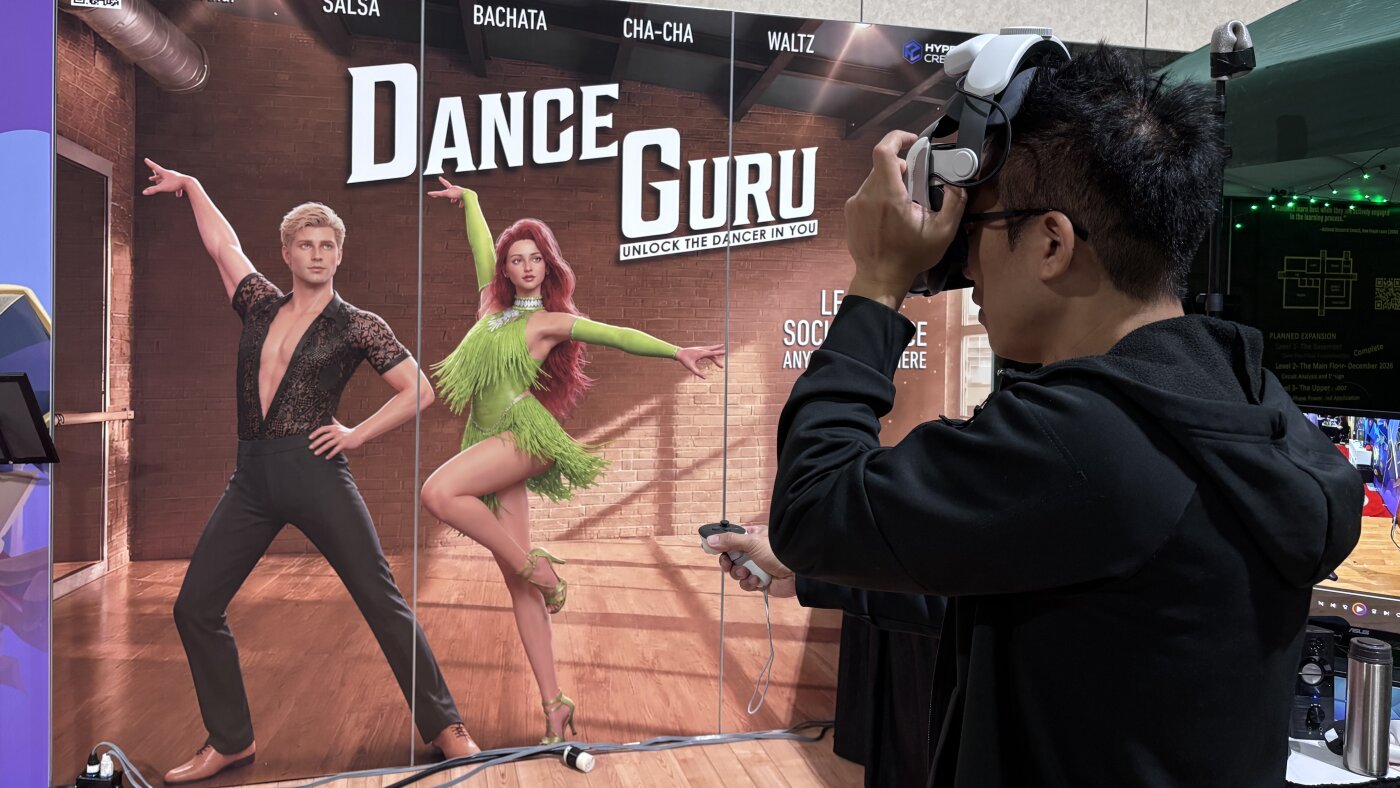
Entrepreneur David Huang tests out a VR headset while conducting demonstrations of the social dance lesson app Dance Guru at the Augmented World Expo in Long Beach, Calif., June 17, 2026.
Chloe Veltman/NPR
hide caption
toggle caption
Chloe Veltman/NPR
Wedding season is in full swing, bringing with it a familiar sense of dread for anyone who fears the dance floor.
But relief may finally be at hand with the help of a new app, Dance Guru, and a virtual reality (VR) headset.
The social dance instruction app transports users to a spacious, digital dance studio. Waiting inside is a computer-generated coach: a handsome, male avatar wearing a shirt open to his navel. He speaks with a slightly gravelly English accent.
“Watch me now,” he instructs at the start of a waltz lesson — which NPR tried out at the Augmented World Expo in Long Beach, Calif., an annual conference showcasing the latest developments in virtual and augmented reality.
The avatar then demonstrates a basic box step.

From there, the lesson becomes interactive. The coach tells the user to hold his hand while an electric pinging sound tracks the student’s foot placement.
“One, two, three, four, five, six,” the virtual teacher counts down.
When the user stumbles, he remains remarkably patient. “Do not worry, foundations take time. Let’s try that again. Work on grounding your steps more intentionally.”
Solving the beginner’s dilemma
Dance Guru creator David Huang said he came up with the idea for the app a couple of years ago out of frustration.
“I always wanted to learn to dance and I was always terrible at it,” Huang said. “And I always ended up stopping midway through the lessons.”
He soon realized that many beginners hit the exact same roadblocks.
“Private lessons are too expensive, and you feel like you’re always forgetting the dance steps,” Huang said. “You cannot find a partner to dance with. So I figured maybe I can create something like this.”
The Dance Guru platform currently offers tutorials in salsa, bachata, waltz, and cha-cha, in both lead and follow modes. To make the digital instruction feel authentic, Huang used motion-capture technology to record the movements of real-life dance teachers — with their permission.
Building on the legacy of online tutorials and video games
Dance Guru belongs to a small but growing wave of apps using VR to demystify social dance. At a nearby booth, conference attendee Victor Chen is testing out a competing app called Trip the Light. It currently offers salsa lessons, as well as freestyle options, where a user can dance with a partner without having to learn specific steps.

Trip the Light’s booth at the Augmented World Expo included posters of the app’s virtual instructors. Real-life performers, who gave Trip the Light permission to motion capture their movements, were used as a basis for these avatars.
Chloe Veltman/NPR
hide caption
toggle caption
Chloe Veltman/NPR
“A lot of times when you’re trying to learn a choreography, it’s watching a YouTube video and you have to pause it, rewind, and play it,” Chen said. “If you were to have a virtual avatar dancing in front of you and correcting for any parts that you missed, it might be a lot easier.”
Interactive video games like Dance Dance Revolution and Just Dance, and YouTube tutorials have been helping people improve their skills in private for years. But those games are mostly aimed at solo players. Unlike the new generation of immersive VR apps, they cannot simulate the mechanics or confidence required for partner dancing on a live dance floor.
The reality check
But this kind of app won’t work for every dancer.
“Everyone learns a little bit differently. And so unless you have a game that has lots of different ways of teaching, you’re going to have things that work for some people and don’t work for others,” said Ariana Katana, a trained contemporary dancer and dance content creator who’s active on YouTube, Twitch and other platforms. “Also, it’s hard to dance with a headset on.”
And then there’s the issue of not being able to physically feel a virtual partner’s hand or shoulder while dancing with them. Patrick Ascolese, the creator of Trip the Light, said the experience could become more tactile in the future. “Haptic suits and wearables will be coming, but I think we’re a little away from that,” he said.
Ascolese said even with their limitations, immersive tools like Trip the Light have immense potential as judgment-free training grounds — giving reluctant dancers the baseline confidence they need to eventually step onto the dance floor with real partners in the real world, including at weddings.
“Just like anything else, practice makes perfect,” said Ascolese. “So the more time you spend in VR with a virtual partner, it works towards helping you get over that social hurdle. We are teaching you the moves that you have to do in order to go out and have fun.”
Jennifer Vanasco edited the broadcast and digital versions of this story. Chloee Weiner mixed the audio.





For half a century, Deidre Hall has taken on every kind of disaster in the drama-packed town of Salem, Ill., as a star of “Days of Our Lives.”
There was the time — actually, it happened twice — when her character, Dr. Marlena Evans, was famously possessed by the devil and even levitated.
In Sunday Funday, L.A. people give us a play-by-play of their ideal Sunday around town. Find ideas and inspiration on where to go, what to eat and how to enjoy life on the weekends.
Or the time a serial killer, who was actually Marlena under hypnosis, seemed to kill several beloved characters. The long-running show’s storylines have become legendary, and in March, while promoting “Hail Mary,” actor Ryan Gosling even gave Hall a shout-out, admitting he was a fan, praising the hard work of soap opera actors and calling her an “OG acting inspiration.”
But Hall’s real life in Santa Monica is much quieter than her character’s, and she likes it that way.
“When I bought my house in Santa Monica, I didn’t realize how great it would be to live near Montana Avenue,” says Hall, 78, about the popular shopping spot. Every day, she walks to the main street with her golden retriever, Riley, and enjoys Pilates, art and good food along the way. “The owners of the Farms Market even keep dog biscuits, so guess where the dog wants to go every time we walk — the Farms, of course,” she says, laughing.
When she isn’t filming the daily soap opera, which airs on Peacock, Hall enjoys raising monarch butterflies, exploring the shops and restaurants on Montana, and hosting movie nights at home with her two sons.
Here’s what a perfect day in L.A. looks like for her.
This interview has been lightly edited and condensed for length and clarity.

7 a.m.: Breakfast and dog walk
I usually kick off my day with a protein shake, feed our golden retriever and take her out for a walk. She’s a phenomenal girl. When we adopted her, her name was Riley, but I did think about naming her after Mrs. Hughes from “Downton Abbey.”

10 a.m.: Church and garden time
After I walk the dog and go to church, I like to spend some time in my yard. I’m not a natural gardener, but I really enjoy it. I started raising monarch butterflies because my identical twin sister, who played my twin on the show, planted a butterfly garden. Monarchs are amazing because they are transitional. Every year, they travel from Mexico to southern New England, but it’s getting harder for them. Their numbers have dropped by about 80%. To help, I plant milkweed, which is what they need to survive. I buy my milkweed from the Staghorn Garden on Wilshire Boulevard in Santa Monica. Julie, who owns the nursery, is delightful and has a wide variety of milkweed. The monarchs always seem to find my garden. Julie was raising some caterpillars too, and she cared a lot about them. We talked about how important it is to help the butterflies. That’s why I do this. Sometimes I get milkweed with eggs already on it, and Julie knows her butterflies are going to a good home.

1 p.m.: Walk to Montana Avenue for some lunch
I live near Montana and love taking long walks, going to Pilates and trying out the great restaurants nearby, like R+D Kitchen and La La Land. I’m a big fan of the waffles at the Courtyard Kitchen. Just a few days ago, I had a chicken salad on raisin bread with an Arnold Palmer, and it was delicious. It is right on Montana and has a nice outdoor seating area. It’s one of my favorite spots. La La Land always has a long line in the morning, which is perfect if you want coffee. They serve coffee, doughnuts, croissants and avocado toast. There’s plenty of outdoor seating, and you can even bring your dog.

2 p.m.: Peek inside a clock shop
There’s a small clock shop on Montana Avenue that’s closed on Sundays, but if you walk by, you’ll see all kinds of clocks — standing, table and wall clocks. The owner is great at fixing them. Once, I bought a wall clock from MacKenzie-Childs, but it didn’t work. And I was really upset because it matched everything else on my countertop. I brought it to the owner and said, “I love this, but I can’t make it work.” He fixed it right away. His name is John, but I call him Geppetto. And we all know why. He really does have a magic touch.

2:30 p.m.: Visit a neighborhood art gallery
Ten Women Gallery is run by 10 artists, all of whom show their work there. I was drawn to some watercolors there, bought a few cards and spoke with one of the artists. She told me, “You seem to love watercolors,” and mentioned that the artist who painted them, Pamela Harnois, lives in Los Angeles and teaches nearby. I got Pamela’s name and found out she taught at the Brentwood Art School. I was so inspired by her gift that I started taking private lessons with her on Saturdays. That gallery is where I discovered my love for watercolor painting.

3 p.m.: Grab some ice cream at Rori’s
The other day, my longtime girlfriend wanted to get ice cream and told me, “We are walking to Rori’s Artisanal Creamery.” It’s a small shop on Montana near Lincoln. They make everything themselves, using local ingredients from grass-fed cows with no added hormones. The place is family-owned and probably has the healthiest ice cream you’ll find. They switch up their flavors often, but my favorite is the salted caramel.

6 p.m.: Family dinner and movie night at home
R+D Kitchen is always packed, so my sons, who are 31 and 33, do the cooking. They come over, and together we make salads and cook dinner. There’s a neighborhood grocery store called the Farms, off Montana, a small family-run place that has everything we need. Everyone knows each other there, and people bring their dogs. We try to have movie night every Sunday. Sometimes the day changes, but we always make sure to have one night a week where we cook a meal and sit down as a family. Keeping that tradition has become really important to us. My sons are great cooks, which is funny because they definitely didn’t get that from me. [Laughs]
9 p.m.: Take Riley for one last walk and visit neighbors
After dinner, I take my dog for a walk. It’s a great way to meet neighbors. We always go around the same block. We’ve met so many people, and since she’s a golden retriever, she loves meeting everyone.

10 p.m.: News, knitting and bedtime
I am a news junkie, so I usually watch whatever is on the news before I go to bed. I have a long-standing passion for knitting. Lately, though, the news would make me drop a stitch.
For Iris van Herpen, couture is a laboratory as much as a runway. Our chief fashion critic, Vanessa Friedman, takes us inside this Dutch designer’s latest Paris show — from sci-fi-inspired gowns to an audacious attempt at a dress made of charged plasma.
-

 Louisiana3 minutes ago
Louisiana judge admits to misconduct; is suspended without pay for rest of term
-

 Maine10 minutes ago
As Democrats pick up the pieces after Graham Platner, many wonder: how did this happen?
-

 Maryland10 minutes ago
Afternoon Summertime Storms Across Maryland Today
-

 Michigan17 minutes ago
117th annual Race to Mackinac takes off from Chicago’s Monroe Harbor
-

 Massachusetts25 minutes ago
Officials ID man and woman killed in Route 6 crash in Dartmouth
-

 Minnesota27 minutes ago
Minnesota weather: Warm Saturday with hotter days ahead
-

 Mississippi32 minutes ago
Tracking Mississippi State baseball players, signees picked in 2026 MLB Draft
-

 Missouri39 minutes ago
Missouri pushes for more nuclear energy to power the future

