Lifestyle
L.A. Affairs: I ran into three of my exes. Was the universe trying to tell me something?

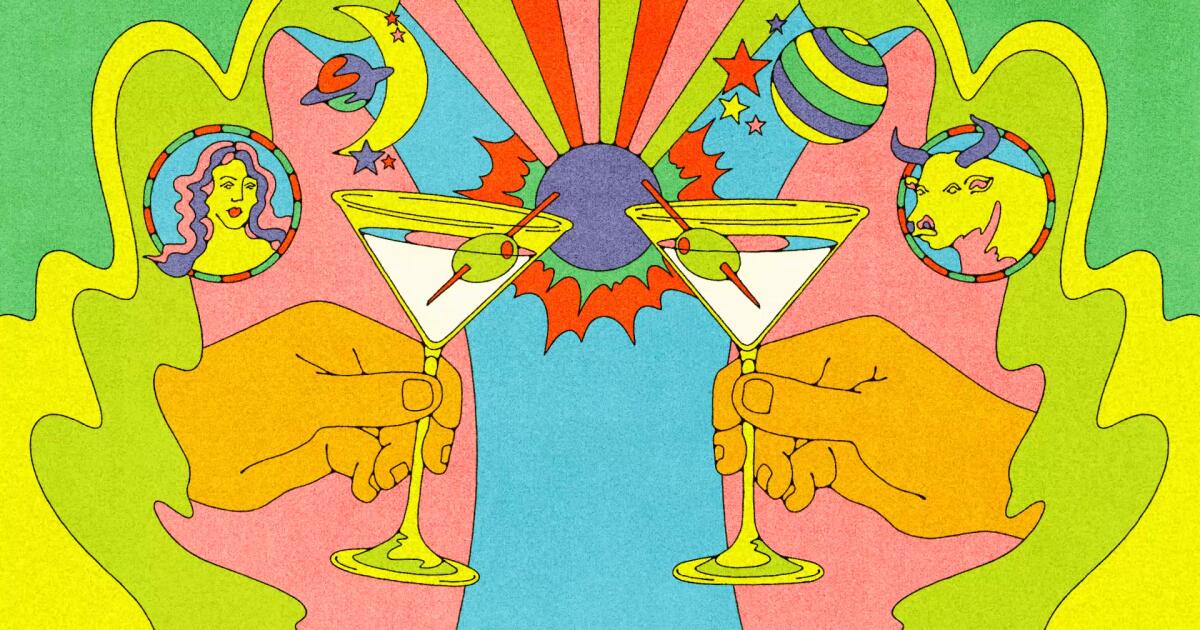
I’d venture to guess that if we were to survey under-40 Angelenos on their religious beliefs, astrology probably would come out on top. I know my chart (Taurus sun, Leo rising), the date of my Saturn return (November 2013), and that I should never date an Aquarius.
So when I met Harrison at a club on the first anniversary of my beloved stepmother Sue’s death, it felt like the stars had aligned. We had a classic is-he-looking-at-me-no-way-yes-he-is moment. We talked and danced, and I bought him a drink. We sidled away in an Uber and dined late night at Kitchen 24 in Hollywood. We became exclusive immediately, and he told me that he loved me by Month 2. I believed he was Sue’s gift to me from the afterlife. Yet within a year, the relationship had imploded, and our last date featured me crying to Bradley Cooper’s suicide in “A Star Is Born” while Harrison shot me pathetic glances, preparing for our scheduled breakup that Sunday.
I did not take it in stride. I clawed, trying to win him back. I upped my therapy sessions and saw my card reader, who revealed a death card and told me lightly: “It’s definitely over.” By July, I was ready to date again, and on to Grindr I went. I saw Nick and sent a message. The conversation came easy, and he proposed drinks instead of sex.
“Let’s go right now!” he said.
An hour later, we were laughing over drinks at Harlowe in West Hollywood about how great a Virgo/Taurus match could be. For two months, we spent time together every weekend, watched hours of “90 Day Fiancé” and shared a handful of overpriced meals. His texting was sporadic, but I was hooked just in time for that oh-so-dreaded message: “You deserve X … I can only give you Y … I wish you the best.”
I crumbled. Heartbroken again. A friend recommended a book: “Calling in ‘The One.’” I worked through three weeks of journaling, “cutting cords,” visualizing. Then one night, dancing at Trunks, Jordan and I locked eyes. I was so fragile, so I avoided his gaze. But he was irresistible. His regular communication and physical presence over the next few weeks reeled me in. Perhaps the third time was the charm, and the universe had been teaching me patience. Naturally, one Saturday morning the next month I sensed the shift, and by Thursday, I was informed he was “seemingly” (his word) still in love with his ex.
::
I’m an extroverted extrovert who always says “Yes!” to social engagements, so going to a party with two people I hardly knew didn’t feel too unorthodox. I had met them at a comedy show, and there I was, pulling up to a house in Mid-City where I knew basically nobody. I entered the party and scanned the room, and somehow there was Jordan. It had been only a month since his feelings for his ex had resurfaced, and our eye-lock shattered me. I faked a smile, waved and avoided him the rest of the night. But then there we were at 2 a.m., among the last 10 or so people who stayed to the end.
Fate, right?! I thought.
I approached. We embraced, talked and kissed. There was no way he wouldn’t text me the next morning. After all, we had such a connection!
Alas, only “seemingly.”
::
I was stuck in bed with methicillin-resistant cellulitis, reeling over the forced cancellation of a trip to Brazil, when a friend reached out with a consolation prize: tickets to Gorgon City at the Shrine Auditorium.
As the sun set and the alcohol kicked in, I stared through my diffraction lenses utterly mesmerized. A tap on my shoulder caused me to spin around. I ripped off the glasses, composed myself and took in Harrison, almost four years since things ended. I plastered a massive smile across my face: “How great to see you!” We caught up while I vainly attempted to control my heartbeat. We talked for a few minutes and then went back to our respective groups.
But then, in the midst of an undulating beat, it came to me: My bout with cellulitis had happened for a reason! I was supposed to be in Brazil, but now I’m here, with him! We were meant to be together again!
I approached Harrison, trying to help him see what I could see so clearly despite my interrupted vision.
Alas, my view was a bit distorted.
::
To celebrate 2024, a friend and I decided to go for dinner. She surprised me with a reservation at Gwen in Hollywood. We were sitting in the dimly lit room when I felt a grip on my shoulder. “I know who this is!”
I’m pretty sure I stopped breathing when I saw Nick would be waiting on us. We engaged in pleasantries; he brought us free wine and dessert, and by the end of the two hours, I had come back to Earth. But was this fate?! I texted him the next morning thanking him for the freebies and proposed we catch up in person. The next Sunday we had brunch, after which he suggested grabbing a coffee. Just as I remembered, our Virgo/Taurus vibes were palpable.
“The third time really is a charm! After four years, we were meant to reconnect!” I concluded.
But then, as Nick sauntered away, making it almost imperceptibly clear that he would never follow up, I finally accepted it. In a city of about 4 million people, it is possible for you to run into the three ex-loves of your life: at a random house party, at a concert you weren’t supposed to be at or at a restaurant you switched to last-minute. As tempting as it can be to give it all deeper meaning, at some point, as you slowly piece your broken heart together, you might just have to say: “Wow! What a wild coincidence!”
The author is a teacher and former principal. He lives in West Hollywood. He’s on Instagram: @sholiday
L.A. Affairs chronicles the search for romantic love in all its glorious expressions in the L.A. area, and we want to hear your true story. We pay $400 for a published essay. Email LAAffairs@latimes.com. You can find submission guidelines here. You can find past columns here.


Students walk on the Stanford University campus on March 14, 2019, in Stanford, Calif.
Ben Margot/AP
hide caption
toggle caption
Ben Margot/AP
When Theo Baker arrived at Stanford University a few years ago, he joined the student newspaper, following the path of his journalist parents, Peter Baker, a White House correspondent for The New York Times, and Susan Glasser, a writer for The New Yorker.
Through his reporting as a student journalist, he eventually broke a story about manipulated data in Stanford President Marc Tessier-Lavigne’s neuroscience research that helped lead to the university president’s resignation.
Theo Baker’s book, How to Rule the World: An Education in Power at Stanford University was released May 19. In it, Baker describes Stanford as a place where proximity to Silicon Valley gives rise to a parallel system of influence, recruitment and money, with investors looking to identify promising students almost as soon as they arrive on campus.
He told Morning Edition host Steve Inskeep there was “a sort of Stanford inside Stanford,” where elite students are drawn into an “alternate reality” of excess and access to cut corners.
In the interview, he discusses how Stanford is not just a university but also a pipeline where status and power can matter as much as ideas.
We reached out to Stanford University for comment and have not heard back.
Listen to the interview by clicking play on the blue box above.


The scoreboard shows the results of the women’s singles final match between Iga Swiatek of Poland and Amanda Anisimova of the U.S. at the Wimbledon Tennis Championships in London, Saturday, July 12, 2025.
Kirsty Wigglesworth/AP
hide caption
toggle caption
Kirsty Wigglesworth/AP
Fifteen points in tennis? Nice. Thirty, 40 — even better. Advantage — that sounds good. “Love” — that also must be great, right? Well, not quite.
As the French Open rolls on and Serena Williams has announced her return to the sport, maybe you’ve been paying a little more attention to tennis. The sport’s scoring system is notably distinct, and can sometimes be hard to grasp for newcomers. But even tennis aficionados might not know why, or how, “love” became the unmistakable callout for zero points. For this installment of NPR’s Word of the Week, we’re exploring how a word that signifies trailing behind got such a sweet name.
“Love” comes from the heart — or an egg?
It’s hard to pinpoint when the first tennis ball went over the net. Tennis is a derivative of lots of other sports, such as “jeu de paume,” a handball game played in France, said JT Buzanga, the collections manager at the International Tennis Hall of Fame museum.

But tennis became a patented, official sport in 1874, said Steve Flink, a journalist whose tennis coverage got him inducted into the International Tennis Hall of Fame. It has retained its unique, mysterious scoring system ever since.
“By and large, the original system has held up almost entirely,” Flink said.
The use of “love” goes back to the late 18th century, said Jesse Sheidlower, a lexicographer. But it was used earlier than that in card games such as whist and bridge. Before the term made its way to tennis, the sport favored plain old “nothing,” or “nil,” he said.
Why love in the first place, though? Historians don’t really know for sure, but there are a few theories.
The French could have something to do with it. Some historians believe “love” derives from “l’oeuf,” which means “the egg” in French. Because eggs are shaped like zeros, terms such as “goose egg” and “duck’s egg” have been used in other contexts to mean zero, Sheidlower said.
It’s also possible English speakers mispronounced l’oeuf as “love.” But Sheidlower isn’t convinced that’s the answer.
“It’s the French equivalent of an English expression. But since that expression doesn’t appear in French, the French word wouldn’t have been used,” he said.
To be sure, France has had a lot of influence on tennis culture, Buzanga said. For example, “deuce” or a game tied at 40 points, comes from the French word for “two”: “deux.” But he prefers another prominent theory: that “love” comes from the idiom “for the love of the game.” Even if a player hasn’t scored, it doesn’t matter, because their heart is in it. It’s the theory Sheidlower said is the most plausible, because the idiom was used by the English before tennis was popularized.

Another variation of the “love of the game” theory is that the word could have come from the Dutch “lof,” or “honor” — or the Latin “amare,” meaning “to love,” Flink said.
But if tennis’ “love” doesn’t come from a French word, the theory at least has a French sensibility.
“I think the ‘for the love of the game’ is kind of romantic,” Buzanga said.
“Love” probably isn’t going anywhere
Tennis used to be a sport of leisure. The style of play has changed a lot over the years; players are more athletic and competitive, for instance, Flink said. But the rules of the sport are more steadfast, he said.
“There’s this incredible, enduring respect for tradition in tennis,” he said. “Changes are not made easily.”
There has been one major change in modern history: the tie-break. Matches can go on and on because players have to score two consecutive points to break a deuce, or by two games to break a tied set. But the onset of television meant matches would have to get shorter if the sport wanted to capture a larger audience, Flink said.

Change even came for “love.” An alternative sprouted up in the 1970s, and is still used today: “bagel,” named for its zero shape, Sheidlower said. Novices may say “zero,” and insiders will understand what they mean, but they “will needle them about it,” Flink said.
But “love” still prevails.
“People kind of like it,” Flink said. “It’s different. Why say zero when you can say love?”
-
Lifestyle23 minutes ago
‘How to Rule the World’ explores education and power at Stanford University
-

 Technology35 minutes ago
Cyberdecks used to look like little laptops, but now they’re getting more personal
-

 World38 minutes ago
Pete Hegseth warns narco-terrorists as U.S. backs Bolivia’s government amid coup warnings
-

 Politics43 minutes ago
Democrats split over Tlaib’s Lebanon measure as Republicans seize on Hezbollah omission
-

 Health50 minutes ago
Popular weight-loss diet shows surprising impact on serious mental health condition
-

 Sports53 minutes ago
NBA bans two fans for life after court invasion during Knicks-Spurs Game 1
-

 Technology58 minutes ago
Charter breach warning: What customers should know
-
 Business1 hour ago
Trump announces new coal export terminal in Oakland

