Lifestyle
In case 2025 wasn’t scary enough, it was a great year for horror, too


Cary Christopher in Weapons.
Warner Bros. Pictures
hide caption
toggle caption
Warner Bros. Pictures
2025 has been a ghoulish year for horror, and you can catch all of it this weekend: Doggie dread, a vampiric Oscar contender, thrillers zombified, supernatural, and nuclear.
No tricks, just treats.
Weapons
Available to stream on HBO Max and rent on demand.
YouTube
Weapons begins with something that seems impossible: One night, in the suburb of Maybrook, every student (save one) from Justine Gandy’s third-grade classroom gets up at 2:17 a.m., goes downstairs, walks out of the house, and silently runs off into the night. They are gone, 17 of them. They are caught on doorbell cameras or security cameras, disappearing into the woods or just into the darkness. Suspicion falls on Justine (Julia Garner), for the simple reason that nobody can figure out how these kids could disappear unless something was happening in that classroom, on her watch. In large part, not unlike HBO’s 2014 series The Leftovers and the novel that inspired it, Weapons is a story about a community recovering from an inexplicable trauma that arrives like a natural disaster, wreaks havoc, and then cannot be reversed, only survived. But there is another thing, another Whole Thing going on in this story, which I would not spoil for anything, because it is simply too wonderfully scary and strange. – Linda Holmes
Read the full review here.
Good Boy
In limited theaters; available to rent on demand.
YouTube
No harm befalls the deeply sympathetic canine protagonist of Good Boy, a low-budget horror film based on those eerie moments when pets seem to have a heightened sense of a presence humans can’t detect. The dog in question, named Indy, is the director’s dog in real life, and we experience the events of the film through his soulful eyes. The film features indie horror auteur Larry Fessenden in a surprise supporting role, and in some ways, it belongs to his lineage of scary movies that explore humanity’s rapacious relationship with nature. While some horror fans have expressed disappointment over Good Boy’s deliberate pace and absence of jump scares, critics have celebrated the film’s emotional, innovative storytelling from the point of view of a very good boy. — Neda Ulaby
Sinners
Available to stream on HBO Max and rent on demand.
This trailer includes an instance of vulgar language.
YouTube
It’s 1932 in Clarksdale, Miss., and enterprising twin brothers Smoke and Stack, both played by Coogler’s longtime muse Michael B. Jordan, have returned to town after some years away in Chicago. What the siblings got into while up North in all likelihood wasn’t on the up-and-up; think robbing, stealing, and doing business with Irish and Italian gangsters. But now back home, they’re flush with cash and booze and eager to set up a new venture: a juke joint. It’s possible you’re aware that Sinners involves vampires, and it does. In a straightforward metaphor for all the ways Black culture has been co-opted by whiteness, the raucous pleasures and sonic beauty of the juke joint attract the interest of a trio of demons led by Remmick (Jack O’Connell); they wish to literally leech off of the talents and energy of Black folks. And — this is not a spoiler — some of those Black people make it pretty easy for Remmick and his ilk to taste blood. – Aisha Harris
Read the full review here.
28 Years Later
Available to stream on Netflix and rent on demand.
YouTube
The apocalyptic horror film 28 Years Later takes place in the same world as the 2002 film 28 Days Later, where a deadly virus transformed the citizens of England into rabid, blood-spewing creatures with really impressive lung capacity. Seriously, those zombies were just as good at wind sprints as they were at cross-country. This year’s film picks up almost three decades later on a small island connected to the mainland by a causeway, where a group of survivors eke out a modest existence. A desperate expedition to the mainland reveals new allies and new horrors — because the infected have evolved. — Glen Weldon
Listen to the Pop Culture Happy Hour panel discuss the movie.
Presence
Available to stream on Hulu and rent on demand.
YouTube
The haunted-house thriller Presence has a formal conceit so clever, I’m surprised it hasn’t ever been done or attempted before. Maybe another movie has done it that I’m not aware of. This is a ghost story told entirely from the ghost’s point of view: We see what the ghost sees.
The ghost cannot leave the house, and so the movie never leaves the house, either. You could say that the ghost is played by the director, Steven Soderbergh, who serves as his own cinematographer, as usual, working under the pseudonym of Peter Andrews. That’s Soderbergh holding the camera as it glides up and down the stairs, following the characters from room to room, and hovering over them as they try to figure out what’s going on.
Soderbergh’s camera movements are so delicate and expressive, he can convey empathy with a mere twitch or shudder, or rage with a sudden, violent lurch. Before long, we realize that the ghost isn’t trying to scare this family; it’s trying to warn them. — Justin Chang
Read the full review here.
Frankenstein
In theaters; on Netflix Nov. 7.
YouTube
Guillermo del Toro has made several monster movies of a particular bent — soulful, swoony, feverish films about grotesque-looking creatures who prove themselves more deeply human than the humans who reject them. Which is why Frankenstein seems like the perfect match between story and muse; certainly del Toro’s been talking about making his own version of the tale for decades, calling it his “lifelong dream.” That dream is now realized, and while the resulting film captures the tone and spirit of the original novel in all its breathless zeal and hie-me-to-yon-fainting-couch deliriousness, the many narrative tweaks del Toro has made — some of which work, some of which don’t — ensure that you’d never mistake his Frankenstein for anyone else’s. – Glen Weldon
Read the full review here.
A House of Dynamite
Available in limited theaters and streaming on Netflix.
This trailer includes instances of vulgar language.
YouTube
An entirely plausible nuclear horror story from the Oscar-winning director of The Hurt Locker, this nerve-jangling thriller begins with a ballistic missile headed toward the continental U.S. Origin unknown, but consequences cataclysmic, the missile plays into doomsday fears so primal, most of us bury them. Nuclear war is unthinkable, we tell ourselves, because mutually assured destruction means no government would ever start one. But suppose, as director Kathryn Bigelow and screenwriter Noah Oppenheim have, that a seemingly rogue threat can’t quickly be traced, that a missile will strike a major American city in just 19 minutes, and that fallible, increasingly frantic civilian and military leaders haven’t a clue how to finesse the possible obliteration of humankind. This explosive scenario, played for farce in Dr. Strangelove, leads here into white knuckle territory. – Bob Mondello





Rob Reiner at the Cannes film festival in 2022.
Andreas Rentz/Getty Images
hide caption
toggle caption
Andreas Rentz/Getty Images
When Rob Reiner spoke with Fresh Air in September to promote Spinal Tap II: The End Continues, Terry Gross asked him about Being Charlie, a 2015 film he collaborated on with his son Nick Reiner. The film was a semiautobiographical story of addiction and homelessness, based on Nick’s own experiences.
Nick Reiner was arrested Sunday evening after Rob and Michele Reiner were found dead inside their California home.


The father character in Being Charlie feels a lot of tension between his own career aspirations and his son’s addiction — but Reiner said that wasn’t how it was for him and Nick.
“I was never, ever too busy,” Reiner told Fresh Air. “I mean, if anything, I was the other way, you know, I was more hands-on and trying to do whatever I thought I could do to help. I’m sure I made mistakes and, you know, I’ve talked about that with him since.”
At the time, Reiner said he believed Nick was doing well. “He’s been great … hasn’t been doing drugs for over six years,” Reiner said. “He’s in a really good place.”

Reiner starred in the 1970s sitcom, All in the Family and directed Stand By Me, The Princess Bride, When Harry Met Sally and A Few Good Men. Spinal Tap II: The End Continues is a sequel to his groundbreaking 1984 mockumentary This Is Spinal Tap.
“After 15 years of not working together, we came back and started looking at this and seeing if we could come up with an idea, and we started schnadling right away,” Reiner recalled. “It was like falling right back in with friends that you hadn’t talked to in a long time. It’s like jazz musicians, you just fall in and do what you do.”
Below are some more highlights from that interview.
Interview Highlights

Carl Reiner (left) and Rob Reiner together in 2017.
Matt Winkelmeyer/Getty Images for TCM
hide caption
toggle caption
Matt Winkelmeyer/Getty Images for TCM
On looking up to his dad, director Carl Reiner, and growing up surrounded by comedy legends
When I was a little boy, my parents said that I came up to them and I said, “I want to change my name.” I was about 8 years old … They were all, “My god, this poor kid. He’s worried about being in the shadow of this famous guy and living up to all this.” And they say, “Well, what do you want to change your name to?” And I said, “Carl.” I loved him so much, I just wanted to be like him and I wanted to do what he did and I just looked up to him so much. …
[When] I was 19 … I was sitting with him in the backyard and he said to me, “I’m not worried about you. You’re gonna be great at whatever you do.” He lives in my head all the time. I had two great guides in my life. I had my dad, and then Norman Lear was like a second father. They’re both gone, but they’re with me always. …

There’s a picture in my office of all the writers who wrote for Sid Caesar and [Your] Show of Shows over the nine years, I guess, that they were on. And, when you look at that picture, you’re basically looking at everything you ever laughed at in the first half of the 20th century. I mean there’s Mel Brooks, there’s my dad, there is Neil Simon, there is Woody Allen, there is Larry Gelbart, Joe Stein who wrote Fiddler on the Roof, Aaron Ruben who created The Andy Griffith Show. Anything you ever laughed at is represented by those people. So these are the people I look up to, and these are people that were around me as a kid growing up.
YouTube
On directing the famous diner scene in When Harry Met Sally
We knew we were gonna do a scene where Meg [Ryan] was gonna fake an orgasm in an incongruous place like a deli, and Billy [Crystal] came up with the line, “I’ll have what she’s having.” … I said, we need to find somebody, an older Jewish woman, who could deliver that line, which would seem incongruous. I thought of my mother because my mother had done a couple of little [movie] things … So I asked her if she wanted to do it and she said sure. I said, “Now listen mom, hopefully that’ll be the topper of the scene. It’ll get the big laugh, and if it doesn’t, I may have to cut it out.” … She said, “That’s fine. I just want to spend the day with you. I’ll go to Katz’s. I’ll get a hot dog.” …
When we did the scene the first couple of times through Meg was kind of tepid about it. She didn’t give it her all. … She was nervous. She’s in front of the crew and there’s extras and people. … And at one point, I get in there and I said, “Meg, let me show you what I meant.” And I sat opposite Billy, and I’m acting it out, and I’m pounding the table and I’m going, “Yes, yes, yes!” … I turned to Billy and I say, “This is embarrassing … I just had an orgasm in front of my mother.” But then Meg came in and she did it obviously way better than I could do it.
On differentiating himself from his father with Stand By Me (1986)
I never said specifically I want to be a film director. I never said that. And I never really thought that way. I just knew I wanted to act, direct, and do things, be in the world that he was in. And it wasn’t until I did Stand By Me that I really started to feel very separate and apart from my father. Because the first film I did was, This Is Spinal Tap, which is a satire. And my father had trafficked in satire with Sid Caesar for many years. And then the second film I did was a film called The Sure Thing, which was a romantic comedy for young people, and my father had done romantic comedy. The [Dick] Van Dyke Show is a romantic comedy, a series.
But when I did Stand By Me, it was the one that was closest to me because … I felt that my father didn’t love me or understand me, and it was the character of Gordie that expressed those things. And the film was a combination of nostalgia, emotion and a lot of humor. And it was a real reflection of my personality. It was an extension, really, of my sensibility. And when it became successful, I said, oh, OK. I can go in the direction that I want to go in and not feel like I have to mirror everything my father’s done up till then.
On starting his own production company (Castle Rock) and how the business has changed
We started it so I could have some kind of autonomy because I knew that the kinds of films I wanted to make people didn’t wanna make. I mean, I very famously went and talked to Dawn Steel, who was the head of Paramount at the time. … And she says to me, “What do you wanna make? What’s your next film?” And I said, “Well, you know, I got a film, but I don’t think you’re going to want to do it.” … I’m going to make a movie out of The Princess Bride. And she said, “Anything but that.” So I knew that I needed to have some way of financing my own films, which I did for the longest time. …
It’s tough now. And it’s beyond corporate. I mean, it used to be there was “show” and “business.” They were equal — the size of the word “show” and “business.” Now, you can barely see the word “show,” and it’s all “business.” And the only things that they look at [are] how many followers, how many likes, what the algorithms are. They’re not thinking about telling a story. … I still wanna tell stories. And I’m sure there’s a lot of young filmmakers — even Scorsese is still doing it, older ones too — that wanna tell a story. And I think people still wanna hear stories and they wanna see stories.


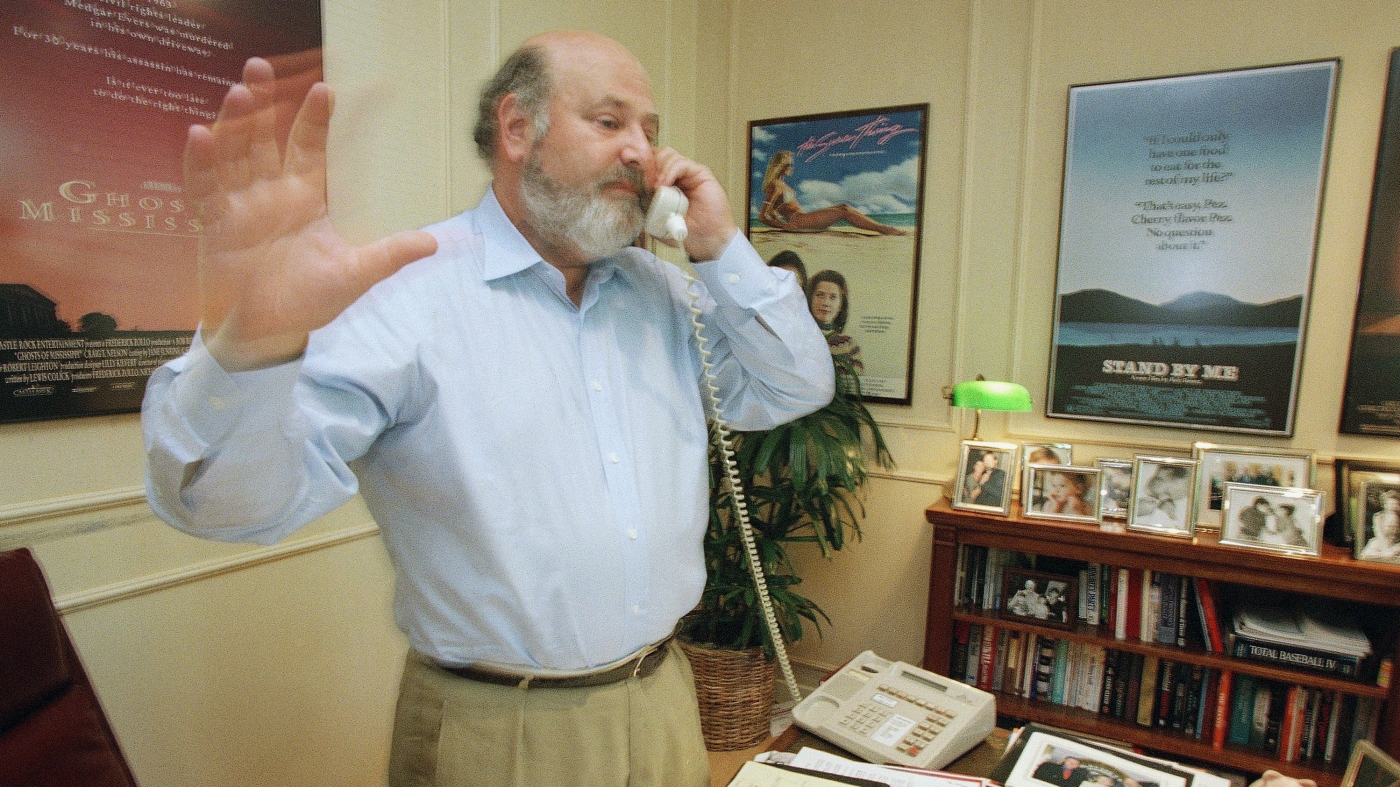
Rob Reiner at his office in Beverly Hills, Calif., in July 1998.
Reed Saxon/AP
hide caption
toggle caption
Reed Saxon/AP
Maybe an appreciation of Rob Reiner as a director should start with When Harry Met Sally…, which helped lay the foundation for a romantic comedy boom that lasted for at least 15 years. Wait — no, it should start with Stand By Me, a coming-of-age story that captured a painfully brief moment in the lives of kids. It could start with This Is Spinal Tap, one of the first popular mockumentaries, which has influenced film and television ever since. Or, since awards are important, maybe it should start with Misery, which made Kathy Bates famous and won her an Oscar. How about The American President, which was the proto-West Wing, very much the source material for a TV show that later won 26 Emmys?

On the other hand, maybe in the end, it’s all about catchphrases, so maybe it should be A Few Good Men because of “You can’t handle the truth!” or The Princess Bride because of “My name is Inigo Montoya, you killed my father, prepare to die.” Maybe it’s as simple as that: What, of the words you helped bring them, will people pass back and forth to each other like they’re showing off trading cards when they hear you’re gone?
There is plenty to praise about Reiner’s work within the four corners of the screen. He had a tremendous touch with comic timing, so that every punchline got maximum punch. He had a splendid sense of atmosphere, as with the cozy, autumnal New York of When Harry Met Sally…, and the fairytale castles of The Princess Bride. He could direct what was absurdist and silly, like Spinal Tap. He could direct what was grand and thundering, like A Few Good Men. He could direct what was chatty and genial, like Michael Douglas’ staff in The American President discussing whether or not he could get out of the presidential limo to spontaneously buy a woman flowers.
But to fully appreciate what Rob Reiner made in his career, you have to look outside the films themselves and respect the attachments so many people have to them. These were not just popular movies and they weren’t just good movies; these were an awful lot of people’s favorite movies. They were movies people attached to their personalities like patches on a jacket, giving them something to talk about with strangers and something to obsess over with friends. And he didn’t just do this once; he did it repeatedly.
Quotability is often treated as separate from artfulness, but creating an indelible scene people attach themselves to instantly is just another way the filmmakers’ humanity resonates with the audience’s. Mike Schur said something once about running Parks and Recreation that I think about a lot. Talking about one particularly silly scene, he said it didn’t really justify its place in the final version, except that everybody loved it: And if everybody loves it, you leave it in. I would suspect that Rob Reiner was also a fan of leaving something in if everybody loved it. That kind of respect for what people like and what they laugh at is how you get to be that kind of director.
The relationships people have with scenes from Rob Reiner movies are not easy to create. You can market the heck out of a movie, you can pull all the levers you have, and you can capitalize on every advantage you can come up with. But you can’t make anybody absorb “baby fishmouth” or “as you wish”; you can’t make anybody say “these go to 11” every time they see the number 11 anywhere. You can’t buy that for any amount of money. It’s magical how much you can’t; it’s kind of beautiful how much you can’t. Box office and streaming numbers might be phony or manipulated or fleeting, but when the thing hits, people attach to it or they don’t.
My own example is The Sure Thing, Reiner’s goodhearted 1985 road trip romantic comedy, essentially an updated It Happened One Night starring John Cusack and Daphne Zuniga. It follows a mismatched pair of college students headed for California: She wants to reunite with her dullard boyfriend, while he wants to hook up with a blonde he has been assured by his dirtbag friend (played by a young, very much hair-having Anthony Edwards!) is a “sure thing.” But of course, the two of them are forced to spend all this time together, and … well, you can imagine.
This movie knocked me over when I was 14, because I hadn’t spent much time with romantic comedies yet, and it was like finding precisely the kind of song you will want to listen to forever, and so it became special to me. I studied it, really, I got to know what I liked about it, and I looked for that particular hit of sharp sweetness again and again. In fact, if forced to identify a single legacy for Rob Reiner, I might argue that he’s one of the great American directors of romance, and his films call to the genre’s long history in so many ways, often outside the story and the dialogue. (One of the best subtle jokes in all of romantic comedy is in The American President, when President Andrew Shepherd, played by Michael Douglas, dances with Sydney Wade, played by Annette Bening, to “I Have Dreamed,” a very pretty song from the musical … The King and I. That’s what you get for knowing your famous love stories.)
Rob Reiner’s work as a director, especially in those early films, wasn’t just good to watch. It was good to love, and to talk about and remember. Good to quote from and good to put on your lists of desert island movies and comfort watches. And it will continue to be those things.

4 dead, Detroit firefighter injured in slew of fires. What to know

What have San Francisco police been doing at 16th and Mission?

DA: Nick Reiner will be charged with first-degree murder in deaths of Rob & Michele Reiner

Packers star Micah Parsons heads to Dallas while awaiting ACL surgery

An immersive ‘Survivor’ experience and fan café will open in Miami in January

Florida High School Football Rankings: Top 25 teams – Oct. 21

Cleary's 21 help Le Moyne down Central Connecticut State 69-64 in OT

How old is Bo Nix? What to know about Oregon quarterback ahead of 2024 NFL Draft

99th annual Pony Swim held in Virginia

Video: ‘It Didn’t Have to Happen This Way:’ U.Va. Faculty Call for Review of Police Response to Protests
DA: Nick Reiner will be charged with first-degree murder in deaths of Rob & Michele Reiner

Video: Nick Reiner Talked Openly About His Addiction Struggles

Trump admin defends White House ballroom as national security matter

Venezuelan opposition leader Machado injured on covert Nobel Prize trip

Peace plans ready to be presented to Russia in days, says Zelenskyy
-

 Washington1 week ago
LIVE UPDATES: Mudslide, road closures across Western Washington
-

 Iowa2 days ago
Addy Brown motivated to step up in Audi Crooks’ absence vs. UNI
-

 Iowa1 week ago
Matt Campbell reportedly bringing longtime Iowa State staffer to Penn State as 1st hire
-

 Iowa3 days ago
How much snow did Iowa get? See Iowa’s latest snowfall totals
-

 Miami, FL1 week ago
Urban Meyer, Brady Quinn get in heated exchange during Alabama, Notre Dame, Miami CFP discussion
-

 Cleveland, OH1 week ago
Man shot, killed at downtown Cleveland nightclub: EMS
-
World1 week ago
Chiefs’ offensive line woes deepen as Wanya Morris exits with knee injury against Texans
-

 Minnesota1 week ago
Two Minnesota carriers shut down, idling 200 drivers

