Lifestyle
How one Afro-Colombian community honors their ancestry


Camilo Garcia peeks through a curtain of his house on the morning of March 29, 2024, in the town of Juntas, Buenaventura, Colombia. The community gathers during Holy Week to celebrate the Manacillos festival, an ancestral ritual originating in the upper part of the Yurumangui River.
Nathalia Angarita for NPR
hide caption
toggle caption
Nathalia Angarita for NPR
It’s Spy Wednesday, almost 6 a.m. At the shipyard port in Buenaventura, the major port city in Colombia’s Pacific region, the last wooden boats are about to depart for the Afro-Colombian communities along the Yurumanguí River.
Dozens of people embark on a journey that can last up to eight hours, crossing the Pacific Ocean, skirting cliffs and navigating through mangroves. Most passengers now live far from their native territory, displaced to the city due to economic instability, lack of health care access, education or the region’s armed conflict.
Upon reaching the clear waters of the Yurumanguí River, wooden houses begin to appear along its banks. There are 13 settlements in the river basin, home to approximately 4,000 residents, mostly descendants of enslaved Africans and maroons brought to work in the mines between the 17th and 19th centuries.
In a context of geographic isolation and state neglect, where illegal armed groups have a substantial presence, the Afro community of Yurumanguí comes together despite intimidations to celebrate the Manacillos festival every Holy Week.
Far from tourists, this ancestral and unique ritual originated in Juntas, the uppermost village on the river, as an act of cultural resilience. During the festival, no one is allowed to work in the artisanal gold mines or the agricultural fields in the jungle.
In Juntas, the memory of slavery is alive. The Manacillos hold profound spiritual significance, reaffirming their African roots and resisting colonialism and imposed Catholicism through syncretism, creating a new collective cultural identity.

A silhouette of an Afro-Colombian woman in her home, on the night of March 28, 2024, in the town of Juntas, Buenaventura, Colombia.
Nathalia Angarita for NPR
hide caption
toggle caption
Nathalia Angarita for NPR

People arrive in boats to the village located on the banks of the Yurumangui River on March 28, 2024, in Juntas, Buenaventura, Colombia.
Nathalia Angarita for NPR
hide caption
toggle caption
Nathalia Angarita for NPR
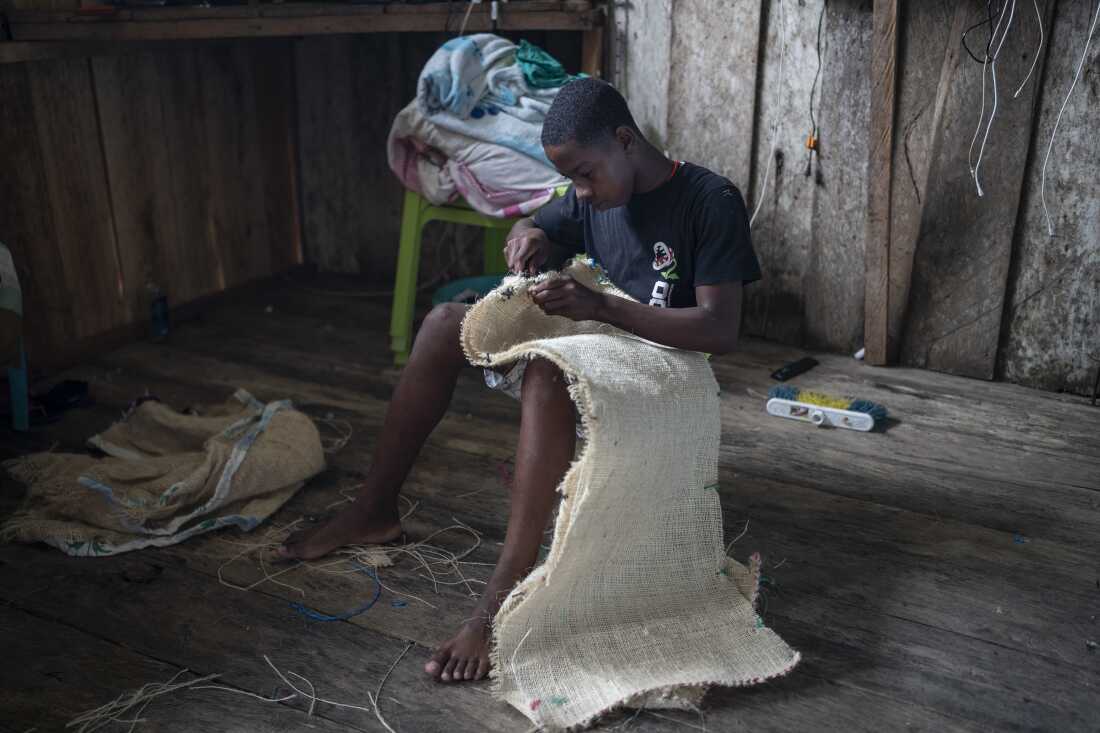
A boy designated to be one of the Manacillos sews his costume for Holy Week on March 29, 2024, in Juntas, Buenaventura, Colombia.
Nathalia Angarita for NPR
hide caption
toggle caption
Nathalia Angarita for NPR

Camilo Garcia on the morning of March 30, 2024, in the town of Juntas, Buenaventura, Colombia.
Nathalia Angarita for NPR
hide caption
toggle caption
Nathalia Angarita for NPR
Manacillos: Spiritual beings
It’s Maundy Thursday. The community has adorned the cobblestone streets and balconies with corozo palm leaves. Ayerson Valencia and Henry García finish sewing their Manacillos costumes with the help of female family members. Meanwhile, in the same room, some women braid their hair, paint their nails, and try on elegant dresses.
The typical Manacillo’s costume is made of burlap sacks and banana leaves and is often adorned with colorful fabric patches. Additionally, every Manacillo wears a slender leather whip fastened to their waist, which they use to “punish” the other participants during the Manacillos’ games.
Along with this, the rest of the costume consists of a distinctive and colorful mask carved from balsa wood sourced within their own jungle. In the backyard of his house, 15-year-old Henry applies the final touches to his mask, painting a red smile reminiscent of the Joker’s.
The masks of the Manacillos transform the wearer into spiritual beings. “Every year, we decide what type of mask to paint, reflecting how we want to be perceived. Some evoke fear, others are humorous,” he says.
Meanwhile, some men are completing the construction of the Manacillos’ house, a small wooden structure located in the center of the village that faces the church. Here, the group gathers to play traditional Manacillo songs, recharge with viche — a traditional alcoholic beverage of the Afro-Pacific communities — and plan their next activities. During the Manacillos’ game, they attempt to steal Jesus’ coffin, play pranks, tease passersby, steal objects and even “kidnap” locals, including babies, for ransom.
There is no age limit to become a Manacillo, as membership is inherited from parents by their sons or other close male relatives after they pass away. This year, the youngest member is 7-year-old Leandro Valencia, who inherited the role after his father, a leader in the community, died in exile. Over the next few days and nights, he plays his role tirelessly, just like a child.
Adolescents such as Henry, who has been playing the role for five years, feel a strong sense of pride: “I became a Manacillo to honor our ancestors and preserve our cultural heritage. My goal is to pass down this knowledge to the younger generation so that our traditions are not forgotten.”

People walk through the town in a procession while singing traditional songs at midnight on March 29, 2024, in Juntas, Buenaventura, Colombia.
Nathalia Angarita for NPR
hide caption
toggle caption
Nathalia Angarita for NPR

Women sing religious and ancestral songs during a Holy Week procession on March 29, 2024, in Juntas, Buenaventura, Colombia.
Nathalia Angarita for NPR
hide caption
toggle caption
Nathalia Angarita for NPR
Resistance through the traditional music
Holy Week is celebrated differently here. In their tradition, Jesus’ death occurs at midnight on Thursday, not on Good Friday. The ritual begins with a procession of Jesus the Nazarene and is repeated nightly until Easter Sunday. During this religious syncretism, the village is shrouded in darkness, illuminated only by candlelight.
The village catechist, Delio Valencia, and the altar boys chant prayers while carrying leaf-adorned statues of Jesus and his mother, Mary. Leading the procession, a group of women sing soulful and loud salves and alabaos — traditional Afro community songs for religious rituals and funerals to bid farewell to the deceased. Their bodies sway with the rhythm.
At the front of the crowd, Luz Damaris García, a 49-year-old vocalist, sings with a deep, raspy voice. Tears glisten in her eyes as she holds her friend’s arm. Both sway gently, harmonizing the lyrics and melody. “The salve is like a feeling. It reminds us of those who have departed,” she says.
That night, the ceremonial procession visits the local cemetery, where three solitary souls, portrayed by trembling men in white sheets, descend from the sacred heights. Children hold their mothers’ hands tightly, some crying, others laughing. They will sing their unique religious songs in the church until 4 a.m. The Manacillos will not appear until the next day.
The main outer wall of the church is adorned with a large painting of the last two social leaders who disappeared at the hands of armed groups. The painting includes the phrase, “We will die on the day we remain silent in the face of injustices.”
One of the leaders was 79-year-old Delio’s son. “During prayers, we always entrust ourselves to them, who lost their lives to free the Yurumanguí River and liberate their people,” he says.

People dress up as souls in purgatory coming down from the cemetery at midnight on March 29, 2024, in the town of Juntas, Buenaventura, Colombia.
Nathalia Angarita for NPR
hide caption
toggle caption
Nathalia Angarita for NPR

The Manacillos make a representation of the Pharisee soldiers who collaborated with the death of Jesus Christ, dressed in local tree leaves and colorful wooden masks, on March 29, 2024, in the town of Juntas, Buenaventura, Colombia.
Nathalia Angarita for NPR
hide caption
toggle caption
Nathalia Angarita for NPR

A person dressed as a Manacillo rests during a celebration on March 29, 2024, in the town of Juntas, Buenaventura, Colombia.
Nathalia Angarita for NPR
hide caption
toggle caption
Nathalia Angarita for NPR

The Manacillos make a representation of the Pharisee soldiers who collaborated with the death of Jesus Christ, dressed in local tree leaves and colorful wooden masks, at midnight on March 29, 2024, in the town of Juntas, Buenaventura, Colombia.
Nathalia Angarita for NPR
hide caption
toggle caption
Nathalia Angarita for NPR
The rules of the Manacillos’ game
Originally, the Manacillos’ ritual commemorated the passion, death and resurrection of Christ in their unique way. The group started with 12 men led by a Manacillo named Barrabás, after the Biblical figure, and has now grown to nearly 40. According to oral tradition, the Manacillos are the spirits of the Jews who betrayed and executed Jesus.
The Manacillos’ play begins on Good Friday evening, and they are not allowed to sleep for the next 48 hours. Before singing, the masked men shout, “Death to God and long live Barrabás!” The rest of the community responds, “Long live God and death to Barrabás!”
The celebration begins with the drumbeat. A woman initiates a melodic chant: “On Holy Thursday, God died; on Friday, they buried him; on Saturday, they sang his glory; on Sunday, he ascended to heaven.” Other musicians join in with traditional instruments — bass drum, cununo and guasá, which sounds like water. The song is repeated several times.
Everyone is covered in sweat, the musicians seeming to merge with their instruments. The female singers and other participants repeat the song without showing signs of fatigue, their voices full of emotion. The music creates a mystical trance and euphoria among the participants. No other music is allowed until Easter Sunday; otherwise, the Manacillos will punish the offenders with whips.
Over the next few days, the entire community gathers in Juntas, captivated by the nocturnal warmth and viche spirits. Amid this fervor, the game’s characters dance, leaping from side to side, holding their attires. The youngest members of the community move from house to house, singing in honor of the Manacillos.
“Music helps us preserve our identity amid the armed conflict. Today, many children prefer picking up an instrument over a weapon,” explains Franklin Valencia, an instrumental musician from the popular group Matachindé.

A person holds a gold necklace with the image of Jesus Christ on March 29, 2024, in the town of Juntas, Buenaventura, Colombia.
Nathalia Angarita for NPR
hide caption
toggle caption
Nathalia Angarita for NPR

A child dresses up as a Manacillo on March 30, 2024, in the town of Juntas, Buenaventura, Colombia.
Nathalia Angarita for NPR
hide caption
toggle caption
Nathalia Angarita for NPR
More than daily violence
During the Manacillos’ dramatization, violent scenes occur as they are allowed to punish locals and vice versa. Many suggest that beneath the Manacillos’ masks are community members affiliated with armed groups. These individuals get permission from their superiors during Holy Week to play the role before returning to the wilderness.
The festival enables improbable encounters in daily life. Civilians and soldiers from different armed groups come together in the same space without violence. Solange Bonilla Valencia, a Ph.D. student in social anthropology and a specialist in peace, culture and international humanitarian law, explains that in the tense conflict of Yurumanguí’s river communities, violence takes on a spiritual dimension — a collective release.
“It’s a moment of catharsis, a chance to encounter the other. The fear of being struck with a whip is different from the fear of being killed with a firearm,” she says.
Amid the exuberant nature along the banks of the Yurumanguí River, prominent signs bearing the insignias and messages of the Jaime Martínez Group, an illegal armed faction of the demobilized guerrilla Revolutionary Armed Forces of Colombia (FARC), appear every few kilometers upstream. The dissident group displays its presence and activity in the territory. The ever-present, yet hidden, eyes that intimidate the inhabitants.
The conflict among armed groups for control over this territory has intensified due to its strategic location for drug trafficking. The celebration has changed, and there is fear of losing ancestral traditions. “Many former Manacillos can no longer participate,” Angulo explains. “Some were killed, others relocated due to insecurity.”
Angulo, a 60-year-old human rights defender and active Manacillos leader who is identified only by his last name for his safety, as he plans on returning for future celebrations, spent several years away from his homeland due to the threats posed by the armed groups. Now, he is enthusiastic about the significant number of community members who have returned for the four-day celebration.
The Manacillos’ festival is not only a moment of joy and a break from routine but also a time to remember deceased relatives, return to the territory and reinforce social ties. “I was raised in this jungle and then forced to leave, abandoning my children and traditions,” he says. “That had a profound impact on me. Here, I feel good. I’m not a city man.”
In late November 2021, two prominent social leaders, Abencio Caicedo and Edinson Valencia, were kidnapped by armed groups, plunging the community into distress and fear. Even the popular Manacillos festival was temporarily silenced by the residents’ grief.
“The loss of a leader is a huge pain. Many have been killed, the most important leaders are lost, and we are left unprotected,” says Luz Damary.

People carry religious representations while walking on the Manacillos on March 31, 2024, in the town of Juntas, Buenaventura, Colombia.
Nathalia Angarita for NPR
hide caption
toggle caption
Nathalia Angarita for NPR

People carry religious representations while walking on the Manacillos on March 31, 2024, in the town of Juntas, Buenaventura, Colombia.
Nathalia Angarita for NPR
hide caption
toggle caption
Nathalia Angarita for NPR

Children disguised as Manacillos in the Yurumangui River on March 31, 2024, in Juntas, Buenaventura, Colombia.
Nathalia Angarita for NPR
hide caption
toggle caption
Nathalia Angarita for NPR

A person wears a Manacillo costume representing the Pharisee soldiers who collaborated with the death of Jesus Christ, on March 31, 2024, in the town of Juntas, Buenaventura, Colombia.
Nathalia Angarita for NPR
hide caption
toggle caption
Nathalia Angarita for NPR
The Yurumanguí River as a living entity
For the Yurumanguireños, the river is a living entity and an essential part of their community. Daily life revolves around its waters. Children learn to swim before they can speak. Women wash clothes and kitchen utensils in the river, which also serves as a natural shower and the main route for transporting wood, fish and fruits. The crystalline waters are surrounded by a lush, dense jungle that conceals sugarcane, plantain and corn fields, their primary sources of sustenance.
“Their primary concern is to safeguard the territory for future generations,” Bonilla explains. “They emphasize the vital role of a thriving, preserved river in sustaining life. They warn that neglecting the river, especially through heavy machinery in gold mining, would deprive future generations of the essence of life itself.”
“The river is life,” the inhabitants of Juntas reiterate when asked about its significance. The sentiment is evident in their efforts to protect the river from external threats, a struggle that has claimed the lives of several social leaders.
It’s Easter Sunday. After three sleepless nights, few seem tired. Once the rain stops, the Manacillos and the rest of the community — this time without the elderly or the children — march toward one of the river’s beaches. Despite the previous night’s alcohol, they skillfully cross the river. Some dive into the water while others fall asleep on the shore.
During the parade, the sound of the Manacillos’ songs resonates continuously, and everyone dances in ecstasy. This time, a few women, known as Manacillas, join them. Dressed in banana leaves and wearing straw hats adorned with colorful strips of plastic, they play their role while smoking prominent tobacco leaf cigars.
“Wearing the Manacilla attire brings me joy and fulfillment, connecting me deeply with memories of my grandmother,” says 18-year-old Manacilla Camila García Valencia. “I am honored to uphold her legacy.”
The procession returns to the village, where children and the elderly gather around the church, dressed in their best clothes. As Jesus rises from the dead, the Manacillos throw themselves to the ground, acknowledging his resurrection. Now, they are believers.
Once inside the church, everyone dances to the rhythm of drums and bells. After several minutes, the instruments fall silent and the Manacillos retreat into the mystic world. Those behind the masks return to being ordinary people. The game between life and death ends in the ritual, but not in real life. “We are free here,” Angulo says. “Look at the river! We just want more security in our territory.”

The community gathers at the river on the last on the last day of Holy Week on March 31, 2024, in the town of Juntas, Buenaventura, Colombia.
Nathalia Angarita for NPR
hide caption
toggle caption
Nathalia Angarita for NPR
Nathalia Angarita is a documentary photographer and Marina Sardiña is a reporter, both are based in Bogotá, Colombia. You can see more of their work on instagram at @nathalianph and @marina_sardina


Lifestyle
L.A. Affairs: It’s hot when a man drives to me. But would this new guy make the trek from the Valley?

I met Dan on Hinge.
He lives in Woodland Hills, and I live in Venice. In Los Angeles, this is considered a long-distance relationship. In another city it might be nothing. Here, it’s a factor.
But I believe that with the right person, you can make anything work, so I stay open. I’m a native New Yorker, and if I were living in Brooklyn and a guy lived on the Upper West Side, that would be a 45-minute subway ride, which is truly nothing in New York. So with that same logic, I try to have flexibility with men in L.A.
When we started planning our first date, Dan suggested three options: a hike on mushrooms, a wine tasting or a walk on the beach.
A hike on mushrooms is something I’d only do with someone I already trust, not someone I just met online. I don’t do first-date hikes because I don’t like feeling trapped if the guy’s a dud. So I chose the wine tasting.
Then I learned the wine tasting was in West Hills.
On a Friday night, driving there from Venice would be insane. So I said I didn’t want to meet there because of the traffic. He suggested Malibu. That was also not ideal on a Friday.
I was getting annoyed — this was a pink flag because in my dating world, the guy is supposed to come to the woman’s neighborhood in the early days. I’ve gone out with plenty of men from the Valley who effortlessly suggested they come to me. It’s not rare or impossible.
I suggested he come to the Westside. I didn’t specifically say Venice, and in hindsight, I probably should have. He landed on Brentwood, which was manageable for both of us. On our first date, we met at an Irish pub on Wilshire Boulevard. He was cuter and more interesting than I had expected, and with the Guinness flowing, we had fun.
When I got home, he texted me: “Well, I like you 🙂 Less the tik tok and the lack of rock music in your life, but it’s not a deal breaker — there are other qualities 🙂 What are your thoughts?”
I noticed the slight negativity but was mostly dazzled that a man texted immediately after the date to say he liked me. In the modern dating economy, this felt rare.
The next day, both of our evening plans fell through, so we made a last-minute date. The wine tasting he originally suggested still sounded like fun, and although it meant me driving to the Valley, I was up for it now that we’d met.
We sipped flights at Malibu Wines & Beer Garden in its airy, romantic courtyard and played a flirty version of Truth or Dare. Halfway through, he dared me to kiss him.
We ended with sushi on Ventura Boulevard and a short make-out session in his car. He invited me to Thanksgiving at his uncle’s, which felt too soon, but also sweet.
After the second date, he texted and said he had his kids that week and was also hosting an event on Thursday, so his only day to meet was Wednesday. I said great.
On Tuesday night, he checked if we were still on, and I said yes.
Then he texted: “I’m flexible on time but not on location. I have a big event on Thursday, hopefully you can come to me again.”
My stomach tightened. This again?
So I texted back: “I drove to you last time, which was a bit of an exception for me especially in the early days, but the wine tasting location sounded special. Usually guys come to my area. How about we switch it up this time?”
He replied: “I appreciate the effort! Because of my event, I’d rather be close to a computer just if needed … Here is what i offer:
— I’ll come to your area anytime next week/end
— Lunch/dinner on me
I want to continue where we stopped last time 😉 No pressure of course, but let’s snuggle”
I responded: “Ok let’s meet next week. Snuggles sound nice … let’s see what happens …”
Then he wrote: “So I won’t see you tomorrow?”
I replied: “Unless you wanna come to me and bring your laptop along, let’s rain check until you have more flexibility.”
He said: “Dang, you are hard. I’ll let you know tomorrow around midday if it’s ok.”
And then — surprise — he decided to come.
He drove to Venice for a 5 p.m. date. He said his ETA was 5 p.m., and it ended up being 5:25 p.m., typical 405 Freeway.
When he showed up, he was in a cranky mood. On our way to KazuNori in Marina del Rey, I thanked him for picking me up and told him I think it’s hot when the guy comes to the girl.
“You’re just saying that because you want me to come to you more,” he said, not playfully, but aggressively.
That was basically the end for me. But there I was, in his car, heading to dinner. So I stayed pleasant and tried to make the best of it.
I shared that in the early stages of dating, I find it’s good etiquette for the guy to come to the woman’s neighborhood. He immediately disagreed and started ranting about how dating rules are ridiculous and how they swing in women’s favor. He resented paying for dates and declared he wasn’t looking to “sponsor a woman’s life.”
“If women want equality and equal rights,” he said, “then it should apply all across the board, including dating, and the man shouldn’t have to pay.”
I said women don’t actually have equal rights because we get paid less than men and often receive lower salaries than men in the same position.
I tried to change the subject and reset the mood, but he insisted we keep hashing it out.
I tried to explain masculine/feminine dynamics: providing and protecting, giving and receiving.
“What does the man get out of this arrangement?” he asked.
It was like watching someone’s personality warp into Mr. Hyde. Then he brought up another point: He’s a single dad of two kids, so he gets tired; and because I don’t have kids, that should factor into who drives where.
At this point, I was barely engaging and focused on eating my hand rolls, and I couldn’t wait to get home.
The check came, and I happily split it, wanting nothing further from him.
In the car back to my place, he remarked: “It’s obvious we’re never gonna see each other again.”
Obvious, but did it need to be stated?
Then he showed me a Spotify playlist he’d made for me of his favorite electronic music, because he knows I like EDM.
“Oh, that’s sweet,” I said.
“Yeah, that’s how I show interest. Through things like this, not who drives to who,” he replied.
When I got out of the car, we wished each other luck, and I headed inside and shut the door.
Two hours later, he sent me the playlist. I’ve yet to listen to it.
It wasn’t the distance that ruined it. It was the resentment. I’m not looking for a man who feels burdened by the effort. I’m looking for a man who sees the value of courting a woman in the first place.
The author is a writer, comedian and former psychologist who lives in Venice. She is the creator of the new vertical series “Manfari.” She’s on Instagram: @solange_neue and @manfari.show.
L.A. Affairs chronicles the search for romantic love in all its glorious expressions in the L.A. area, and we want to hear your true story. We pay $400 for a published essay. Email LAAffairs@latimes.com. You can find submission guidelines here. You can find past columns here.

Lonnie Bunch III is the 14th Secretary of the Smithsonian. He’s pictured above in September 2017.
J. Scott Applewhite/AP
hide caption
toggle caption
J. Scott Applewhite/AP
In a memo addressed to staffers sent Tuesday, the secretary of the Smithsonian, Lonnie G. Bunch III, defended the institution after the White House issued a 162-page report that characterizes the National Museum of American History as a place which has become “subject to institutional capture by a radical, activist ideology that is fundamentally opposed to telling the noble, honest story of the great country we know and love.”
In his email, which NPR has obtained, Bunch wrote in part: “While there will always be room for improvement, this report is not a fair characterization of the work and totality of the National Museum of American History. At the Smithsonian, our work is driven by scholarship, accuracy and an uncompromising commitment to tell the fullness of America’s story. As public servants and the keepers of this institution, we are charged with helping a nation find understanding, hope and clarity and as part of that duty, we are dedicated to excellence, reflection and growth.”

He continued: “We remain focused on what grounds us: a steadfast commitment to scholarship, nonpartisanship, independence, accuracy and integrity. For nearly 180 years, the Smithsonian has worked alongside partners across government — from the White House to Congress to our governing Board of Regents — guided by our enduring mission to increase and diffuse knowledge. That purpose remains: to pursue knowledge with rigor and to serve the American public with clarity and care.”
The White House report was issued on July 4 by the Domestic Policy Council under the title “Saving America’s Story: How Ideological Capture at the Smithsonian Institution’s National Museum of American History Erases Our Heritage.”

The council faults the National Museum of American History on a multitude of fronts, saying it underemphasized the Founding Fathers and early colonial and Revolutionary history; was not sufficiently celebratory of the country’s 250th anniversary; and that it engaged in “anti-white,” “illegal alien” and transgender activism.
It also accuses the museum of trying to “indoctrinate” teachers and students through its exhibitions, programming and teaching resources.
In the report, the council also specifically criticizes museum director Anthea Hartig, who has led the National Museum of American History since 2019 and is concurrently the president of the Organization of American Historians, calling her “an activist advancing an ideological agenda contradictory to the museum’s founding purpose of fostering patriotism.”

The Trump administration has made the Smithsonian museums one of its primary targets in its efforts to reshape cultural narratives to align with its viewpoints. In August 2025, the White House requested a “comprehensive internal review” of eight Smithsonian museums, including the National Museum of American History, following an executive order issued by President Trump in March 2025 in which he called for the removal of “improper ideology” from the Smithsonian’s offerings.
According to the Smithsonian’s charter, all of its 21 museums, 14 education and research centers, and the National Zoo are meant to be run independently of the federal government. The Smithsonian is overseen by Bunch and a board of regents, which includes Vice President Vance, Supreme Court Chief Justice John Roberts and other members appointed by Congress.
In an interview with NBC’s Meet the Press on Sunday, Bunch spoke about the Smithsonian’s 250th anniversary special exhibition at the Smithsonian Castle, which is called “American Aspirations.”
He told NBC: “It’s really important for people to understand that America is much an ideal as it is a place, that it’s a series of aspirations that have really shaped who this country is. And so for me, what is so powerful is to say, ‘Let us honor the words of Thomas Jefferson and the founders, but let us use those to challenge us to be better.’”
Jennifer Vanasco edited this story.

-

 World3 minutes ago
Belgium to introduce new road tax in 2027, even for transiting drivers
-
 News28 minutes ago
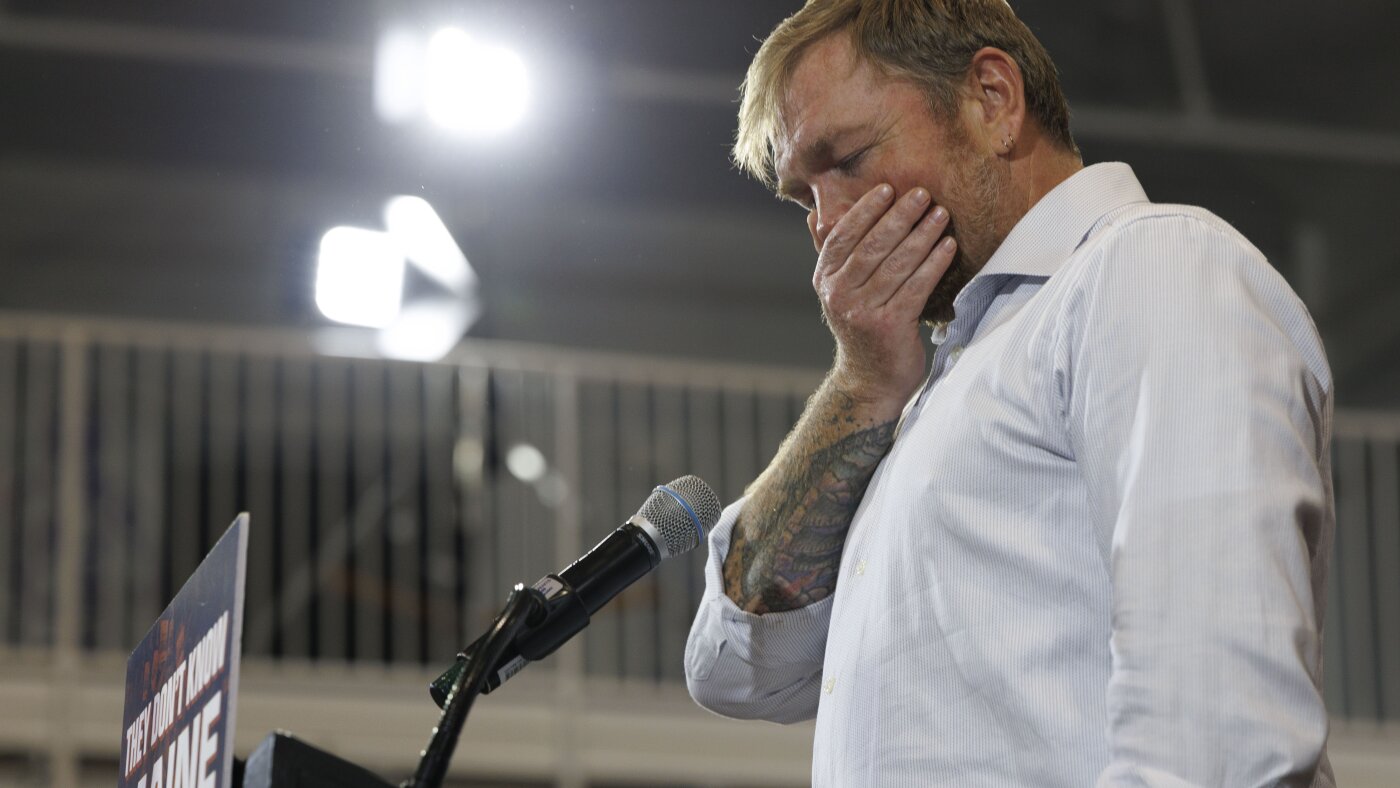
Graham Platner makes it official in Maine, submitting paperwork to leave Senate race
-

 Los Angeles, Ca2 hours ago
Knee irritation forces Shohei Ohtani out of Friday start, All‑Star game
-

 Detroit, MI2 hours ago
Detroit Evening Report: Waymo cars blocking first responders – WDET 101.9 FM
-

 San Francisco, CA2 hours ago
San Francisco Mayor Daniel Lurie Blocks Vacant Grocery Store Tax Proposal | KQED
-

 Miami, FL2 hours ago
Oregon Battling Miami, Mario Cristobal for Four-Star EDGE Recruit
-

 Dallas, TX2 hours ago
FC Dallas Forward Logan Farrington Inks Contract Extension
-

 Boston, MA3 hours ago
Red Sox face lengthy travel issues ahead of series vs. Mets

